
The Great Extinction Lie: How Genetics and Environmental Fraud are Destroying Rural Populations
With Elizabeth Nickson – 40 Q&As

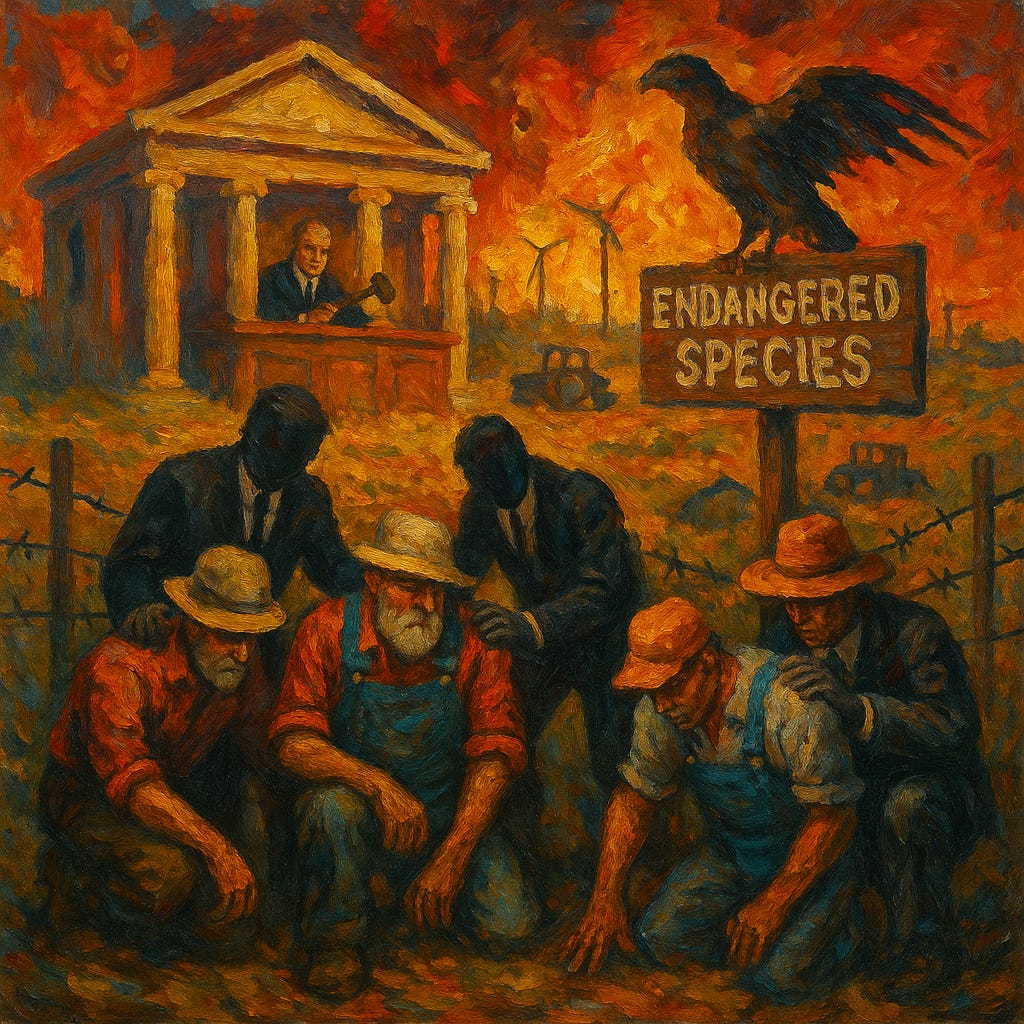
In the late 20th century, a narrative of ecological catastrophe emerged, claiming humanity was driving a "Sixth Great Extinction" with thousands of species vanishing annually due to habitat loss. This claim, rooted in Edward O. Wilson’s species-area relationship theory, relied on computer modeling that predicted extinction rates 200 times higher than observed reality, asserting 27,000 species perished yearly without evidence of widespread corpses. As detailed by Elizabeth Nickson here, this fabricated crisis, birthed from the weaponized genetics of conservation biology, mirrors other scientific deceptions, such as attributing autism to genetics to obscure vaccine-induced brain inflammation. The Endangered Species Act (ESA), enacted in 1973, became the oligarchy’s patient and persistent tool to restrict land use, suppress sovereign citizens, and impoverish rural populations. Environmental groups, exploiting the Act’s deadlines, amassed billions in legal fees—$4.7 billion from the Judgment Fund between 2003 and 2007 alone—while designating 250 million acres as critical habitat, often for species thriving elsewhere, like Massachusetts black bears, whose population surged from 100 to 5,000. This manufactured crisis, driven by the same modeling fraud seen in virology and climate change science, enriched a litigation industry while devastating rural economies, revealing a pattern of empire-driven control masquerading as conservation. Yet, as Willis Eschenbach’s research exposed, only three mammals and six birds have gone extinct on continents in 500 years, prompting skepticism: where are the bodies?
This environmental fraud parallels the broader regulatory capture described in Capture, where elite interests co-opt public institutions to entrench power. The ESA’s implementation exemplifies this, with groups like the Center for Biological Diversity filing 409 lawsuits in a decade, using “psychological warfare” to demoralize agency staff into compliance, as admitted by leader Kiernan Suckling. Conservation biology abandoned field observation for desktop extinctions—virtual losses existing only in models—while ignoring natural population fluctuations, like German moths multiplying 10,000-fold in two years, which contradict the myth of ecosystem balance. Historically, species depletion peaked during the 1890-1920 industrialization surge, but the Environmental Kuznets curve shows prosperity naturally restores biodiversity without regulatory coercion, as seen in thriving black bear populations. The oligarchic strategy, however, persists: by splitting healthy species into “distinct population segments,” like Florida’s black bears, regulators justify restrictions despite abundant populations elsewhere, transforming genetics into a tool of empire. This introduction sets the stage for Nickson’s exposé, questioning the scientific and moral foundations of policies that sacrifice rural livelihoods for a crisis that exists more in computer simulations than in reality.
With thanks to Elizabeth Nickson1.
The Sixth Great Extinction Lie Is Destroying Economy and Culture
If This is the Sixth Great Extinction, Where are All the Corpses? (substack.com)
Analogy
The Great Hospital Fraud Analogy
Imagine if hospitals started claiming there was a "Sixth Great Health Crisis" with millions dying daily from a mysterious plague. They demand billions in funding and the power to shut down entire neighborhoods to "protect public health." But when investigators actually check hospital records, they find almost no one is dying from this supposed plague—maybe 3 people total over 500 years.
The "medical experts" respond by saying "Well, our computer models show millions should be dying based on our 'patient-area relationship' theory." They split healthy people into artificial categories—declaring blue-eyed people in Florida "critically ill" even though blue-eyed people everywhere else are thriving, justifying quarantining entire cities.
Meanwhile, a massive legal industry emerges where "patient advocacy groups" sue hospitals for missing paperwork deadlines, collecting billions in legal fees while actual healthcare deteriorates. These groups openly admit they use "psychological warfare" to exhaust hospital staff until they comply with demands to declare more healthy people sick.
The hospitals abandon actual medical examination in favor of desktop diagnosis using computer models, while real patients suffer because resources flow to fictional emergencies. Rural communities lose their doctors and hospitals as regulations make healthcare impossible, creating actual health crises while claiming to prevent imaginary ones.
The fraud becomes so entrenched that suggesting people aren't actually dying from the plague gets you labeled anti-science, even though morgues remain empty and populations keep growing healthier.
This is exactly what's happening with environmental policy—a manufactured crisis driving real destruction while enriching the very people claiming to solve the problem they invented.
The One-Minute Elevator Explanation
You know how we're told we're in the middle of a "Sixth Mass Extinction" with thousands of species dying daily? Well, here's the shocking truth: Only 3 mammals and 6 birds have actually gone extinct on all continents in 500 years. Edward O. Wilson's math predicts extinction rates 200 times higher than reality, yet drives every environmental policy.
Think about that: Massachusetts black bears went from 100 to 5,000—yet remain "endangered" because bureaucrats split healthy species into fake fragments. Meanwhile, environmental groups filed 409 lawsuits in a decade, extracting $4.7 billion in taxpayer legal fees through deliberately missed deadlines.
So what happened when scientists couldn't find the predicted corpses? They created "desktop extinctions"—computer-generated deaths while real populations thrived. The red-legged frog got 5.4 million acres of California while Wyoming officials admitted sage grouse are "thriving everywhere" but 40,000 residents still face economic destruction.
The brutal reality: 60% of "recovered" species were never actually endangered. It's the conservation equivalent of banning farming to protect unicorns, and the entire environmental establishment is too invested in their billion-dollar lawsuit industry to admit the obvious truth.
[Elevator dings]
Want proof? Look up 'Willis Eschenbach extinction corpses' and 'ESA legal fees scandal.' The evidence is hiding in plain sight.
12-point summary
1. The Extinction Crisis is Fabricated: Despite claims that we're experiencing a "Sixth Mass Extinction" with 27,000 species dying annually, actual data shows only 3 mammal extinctions and 6 bird extinctions on all continents in the past 500 years. Edward O. Wilson's species-area relationship theory, which drives all conservation policy, predicts extinction rates 200 times higher than reality shows. The crisis exists only in computer models, not in nature, yet drives policies costing hundreds of billions while destroying rural economies based on desktop science rather than field observation.
2. The Endangered Species Act is Economic Warfare Against Rural America: The ESA has become the most powerful law outside cities, routinely overturning constitutional protections and serving as the primary weapon to destroy rural livelihoods. After 50 years and hundreds of billions spent, only 61 species have been "recovered," with 60% of those recoveries being fraudulent—species that were never actually endangered. The Act has removed cattle from millions of acres, demolished over 1,000 dams, placed 90% of Western forests off-limits, and created cascading poverty, addiction, and cultural destruction across rural communities.
3. Environmental Groups Operate a Massive Legal Racket: Organizations like the Center for Biological Diversity have turned species protection into a billion-dollar litigation industry, filing 409 lawsuits in a decade while collecting over $4.7 billion in legal fees from taxpayers between 2003-2007. They deliberately flood agencies with petitions knowing missed deadlines guarantee profitable lawsuits, with some groups filing new suits every 32 days. This money should fund actual conservation but instead finances more lawsuits, creating endemic collusion between activist litigators and agency bureaucrats who profit from manufactured conflicts.
4. Conservation Biology Abandoned Scientific Method: Unlike traditional biology that increased agricultural bounty and human health, conservation biology starts with predetermined assumptions that humans destroy nature and resources are finite. This field replaced hypothesis testing with advocacy, using computer models instead of field research to generate theoretical extinctions that don't exist in reality. The Environmental Kuznets curve proves the opposite—that prosperity naturally leads to environmental improvement without regulatory intervention, as shown by Massachusetts black bears increasing from 100 to 5,000 as the region became wealthier.
5. Species Population Management is Systematically Fraudulent: Agencies manipulate species listings through "distinct population segments"—artificial divisions that split healthy species into supposedly threatened fragments. Black bears exemplify this fraud: despite 5,000% population growth in Massachusetts, they remain listed because one subspecies in Florida struggles, while western populations are so robust that young males migrate eastward. Most ESA litigation involves arguing whether identical species in different locations are threatened, creating artificial scarcity where abundance exists.
6. Critical Habitat Designations Eliminate Property Rights: The U.S. has designated 250 million acres of critical habitat based on theoretical species needs rather than actual presence, with Biden administration changes allowing "potential habitat" designations anywhere species might theoretically exist. Red-legged frogs received 5.4 million acres—one-twentieth of California—while property owners face total activity bans based on speculation about wildlife that may never have lived there. Private land, gardens, and leased ranges become regulatory hostages to desktop biology conducted by bureaucrats who never visit the areas they control.
7. Psychological Warfare Tactics Target Government Employees: Environmental groups openly use systematic harassment to break down agency morale until staff surrender to activist demands. The Center for Biological Diversity's leader admits that repeated lawsuits, injunctions, and bad press make employees "feel like their careers are being mocked and destroyed—and they are," forcing compliance through psychological warfare rather than scientific merit. This creates a revolving door between agencies and NGOs where both sides profit from manufactured conflicts while taxpayers fund fabricated battles with predetermined outcomes.
8. Habitat Science Deliberately Ignores Species Needs: Conservation groups focus protection on wrong habitat types to manufacture endangerment while ignoring areas where species actually thrive. Pocket gophers do better in Christmas tree farms and clear-cuts than protected prairie, but counts focus only on prairie to justify listings, creating incentives for farmers to eliminate thousands of gophers on their productive land. This "shoot, shovel, and shut up" response transforms theoretical endangerment into actual population decline through policies that protect habitats species don't prefer while threatening their real homes.
9. Rural Communities Face Systematic Cultural Destruction: Environmental policies have created an "error cascade" removing tens of millions from their lands while making natural resources off-limits to desperate populations worldwide. Rural America experiences psychological paralysis where communities cannot go forward or stay still but must accept increasingly limited lives in smaller enclosures. Traditional cultures face extinction as ranching, farming, and forest management become impossible under regulatory restrictions designed to eliminate rural livelihoods rather than protect genuinely threatened species.
10. Financial Corruption Flows Through Multiple Government Channels: Beyond the $4.7 billion Judgment Fund payments, environmental groups extract money through the Equal Access to Justice Act, missed deadline penalties, and procedural violations, with no accounting required since 1995. The Forest Service alone paid $1.6 million for minor paperwork errors, while groups receive payment simply for filing complaints regardless of merit. This represents a massive wealth transfer from taxpayers to elite activist organizations using regulatory complexity to hide enormous financial flows behind species protection claims.
11. Natural Systems Contradict Ecosystem Balance Theory: Real biological data shows extreme population fluctuations as normal—German moths multiplying 10,000-fold in two years, lynx populations oscillating between 800 and 80,000 over 240 years, demonstrating that dramatic change rather than balance represents nature's constant. Conservation biology's demand for perfect ecosystem balance with each species present in correct proportions contradicts observable reality, where removing species often helps systems thrive. This fundamental misunderstanding of natural processes drives policies that prevent beneficial management while pursuing impossible stability that never existed.
12. Complete Systemic Reform is Required: The ESA must be thrown out entirely and science started over, since the current system is so corrupted that incremental reform cannot address systemic problems. Environmental NGOs profiting from regulatory contradictions must be reformed or eliminated, while conservation biology must return to evidence-based management focused on creating abundance rather than restricting human activity. The damage from 50 years of regulatory paralysis will take decades to reverse, requiring restoration of actual scientific debate to environmental policy and rebuilding economic foundations destroyed by ideological warfare disguised as species protection.
The Role of Genetics in this Fraud
Genetics plays a crucial role in the extinction modeling fraud, particularly through the manipulation of "distinct population segments" (DPS) that artificially fragment healthy species populations.
The Genetic Manipulation:
Nickson reveals that environmental groups exploit minor genetic differences to create artificial endangerment. As Norman MacLeod explains, there are "considerable numbers of biologists who don't agree that you should manage anything by subspecies or even that there is validity to subspecies, much less distinct population segments." The "very slight genetic differences in fish from one creek to another" are used to justify treating each population as if it were "absolutely critical" for species survival, when these minor variations are likely "unnecessary for the survival of the species as a whole."
The Black Bear Example:
This genetic fraud is perfectly illustrated by black bears: Massachusetts populations exploded from 100 to 5,000 (a 5,000% increase), yet bears remain "endangered" because the Florida black bear—a "distinct population segment"—struggles in its specific region. Genetically, these are the same species, but bureaucrats split them into separate conservation units to manufacture endangerment where abundance exists.
Salmon and Trout Manipulation:
The salmon-saving world exemplifies this genetic scam, where "each salmon stream has its DPS" and "bull trout streams" get their own designations. Minor genetic adaptations to local creek conditions become justification for treating thriving species as critically endangered, with each waterway managed as if containing unique, irreplaceable genetics when the species as a whole faces no threat.
The Scientific Reality:
This genetic manipulation represents pseudo-science because minor population differences typically represent normal evolutionary adaptation rather than distinct conservation units requiring separate protection. The fraud lies in treating natural genetic variation—which strengthens species resilience—as evidence of fragmentation requiring massive regulatory intervention.
The genetics angle is absolutely central to exposing how healthy, thriving species get artificially divided into "threatened" fragments to justify billions in spending and regulatory control.
40 Questions and Answers
1. What is the Endangered Species Act and why is it considered the most powerful law outside cities?
The Endangered Species Act is federal legislation signed by Nixon that has become the most powerful law of the land outside urban areas, with authority that routinely overturns the Constitution of the United States. This act serves as the primary weapon used by the environmental movement to control rural America, giving it unprecedented power to halt economic activity across vast territories. The ESA's power stems from its ability to designate critical habitat and impose restrictions that can shut down entire industries and communities based on the presence or potential presence of listed species.
The law's extraordinary reach becomes evident when you consider that the U.S. has designated 250 million acres of critical habitat and 60,000 miles of river habitat, not counting other set-asides that probably account for another quarter-million acres. With 1,186 species listed and the ability to create "distinct population segments" through congressional definition, the Act has triggered a tsunami of lawsuits that lock up courts at every level in every state, creating stasis, poverty and addiction, all funded by taxpayers.
2. What are the main criticisms of conservation biology compared to traditional scientific methods?
Conservation biology represents a sharp departure from the scientific method taught in middle school, where hypotheses are tested, revised, and subjected to rigorous falsification before being deemed useful. Instead of investigation, conservation biology starts with the assumptions that humans are wreaking havoc on the natural world and that resources are finite and decreasing, then positions itself not as investigators but as educators meant to inform the public about biodiversity loss. This field hijacked the reputation of traditional biologists who had contributed most to human well-being through increasing agricultural bounty and advancing health understanding.
Traditional biology recognized nature as a complex system we're only beginning to understand, while conservation science claimed definitive knowledge about ecosystems that must be in perfect balance with each member present in correct proportions. Old-school biologists knew this was observably wrong—you can remove buttercups and deer from a meadow and it will not only survive but thrive. The circular reasoning that follows from assuming man destroys nature means conservation biologists look for destruction in human footprints rather than evidence of health, leading to the desktop work of computer modeling rather than expensive field research to verify assumptions.
3. How much has the ESA cost taxpayers and what are the opportunity costs?
The cost of the Endangered Species Act to the general public ranges into the hundreds of billions of dollars, not counting the certain trillion lost in opportunity cost. A comprehensive report on just one threatened species costs at least $9 billion, while the Fish and Wildlife Service estimates that listing a species costs $85,000 and designating critical habitat averages $515,000. Overall, listing and habitat designation have cost about a billion dollars, though this would sound reasonable if the listings weren't based on corrupt and agenda-driven science.
The financial hemorrhaging extends far beyond direct costs through an elaborate legal racket where environmental groups profit from procedural missteps. Since 1995, there has been no accounting of money paid to groups like the Sierra Club, Center for Biological Diversity, Western Watersheds, Wilderness Society, and Defenders of Wildlife, with estimates reaching hundreds of millions of dollars in legal fees alone. Between 2003 and 2007, the Judgment Fund paid over $4.7 billion in attorney's fees to environmental groups, while the six regions of the Forest Service alone paid out $1.6 million in legal fees between 2003 and 2005 for cases where groups were paid simply for filing complaints about missed deadlines or minor omissions.
4. What is Edward O. Wilson's species-area relationship theory and how is it used?
Edward O. Wilson's species-area relationship theory, developed with MacArthur in "The Theory of Island Biogeography," mathematically relates the number of species found to the area surveyed as a power law: S = C * a ^ z, where "S" is species count, "C" is a constant, "a" is habitat area, and "z" is the power variable typically ranging from .15 to .3 for forests. Wilson extrapolated this relationship in reverse, claiming that if forest area decreases, species numbers decrease proportionally, with those reductions representing actual extinctions. This theory now dominates every conservation data center worldwide and serves as the primary equation for all land-use decisions outside cities.
In 1992, Wilson used this relationship to claim that 1% annual forest habitat loss worldwide would doom 27,000 species to extinction each year—74 per day, 3 per hour—using what he called "maximally optimistic" calculations. This species-area relationship has become the foundation for environmental policy despite the fact that it claims extinction rates two hundred times higher than actual data shows. The theory's influence extends so thoroughly through the conservation establishment that someone with a serious doctorate from a serious university will insist over dinner that ten thousand species annually are going extinct, demonstrating how deeply this corrupt thinking has penetrated educated society.
5. What does Willis Eschenbach's research reveal about actual extinction rates versus predicted rates?
Willis Eschenbach's fact-checking research, published in "Where Are All the Corpses?" revealed a staggering disconnect between predicted and actual extinction rates that burned through the Internet like Agent Orange. If Wilson's predictions were accurate and 27,000 species had been lost annually since 1992, over 300,000 species should have gone extinct, with well over half a million species lost forever in 24 years since 1980 when Wilson claimed this rate began. Eschenbach's investigation found virtually no evidence supporting these massive extinction claims.
Examining actual data, Eschenbach discovered that of 4,428 mammal species living in Asia, Europe, Africa, North America, South America, and Antarctica, only three have gone extinct in the last five hundred years: the bluebuck antelope in South Africa, the Algerian gazelle in Algeria, and the Omilteme cottontail rabbit in Mexico. For birds, the pattern proved similar—of 8,971 known continental bird species, only 6 have gone extinct worldwide, with two of those being the passenger pigeon and Carolina parakeet in the U.S. The most recent total bird and mammal extinction rate stands at 0.2 extinctions per year, down from a peak of about 1.6 extinctions per year a century ago, while no forest extinctions from habitat loss have been documented.
6. How many species have actually gone extinct on continents versus Wilson's predictions?
The stark contrast between Wilson's predictions and reality becomes clear when examining continental extinction data versus his species-area calculations. Since the white man arrived in the Americas, there have been no forest bird or mammal extinctions from any cause—not even one. The Pacific Research Foundation, sourcing from the IUCN Red List, finds that only 2.7 percent of species have gone extinct since the last ice age, while new species continue being discovered by the thousands annually with global species estimates ranging wildly from 1.5 million to 40 million.
Wilson's mathematical projections suggested catastrophic losses that simply haven't materialized in the real world. Of the 128 extinct bird species documented, 122 were island extinctions, demonstrating that island ecology cannot be projected onto continents without producing grievous error. Continental ecosystems prove far more resilient than Wilson's species-area relationship suggests, yet this discredited theory continues driving policy decisions that lock up millions of acres and cost billions of dollars while the predicted extinction crisis remains purely theoretical, existing only in computer models rather than observable reality.
7. What is the difference between real extinctions and "desktop extinctions"?
Desktop extinctions represent theoretical species losses generated through computer modeling and mathematical projections, while real extinctions involve actual documented disappearance of species from the physical world. Conservation biology has become so focused on virtual science that researchers spend time creating theoretical extinction scenarios on computers rather than conducting expensive field research to verify whether species are actually disappearing. The Nature Conservancy's NatureServe.org, the U.S. Geological Survey's ten-dimensional nature mapping, and hybrids used by the International Union for Conservation of Nature have turned saving the biosphere into desktop work, making it convenient to avoid deploying expensive armies to fact-check assumptions.
What we're frightened of are these desktop extinctions rather than real extinctions, created by plugging climate change findings into computer models to produce predetermined results showing that 33 percent of species are definitely about to go extinct. Meanwhile, so much time has been spent on virtual science that we don't even know how many species exist in the world, with estimates ranging from 1.5 million to 40 million, while new species are discovered annually by the thousands. The fundamental problem is that conservation policy is based on the logic that despite having no idea how many species exist by at least one order of magnitude, and despite only 2.7 percent of known species having gone extinct since the last Ice Age, we nonetheless believe one third of all species are about to disappear.
8. How do environmental groups profit from ESA litigation?
Environmental groups have created an enormously profitable litigation machine around the Endangered Species Act's built-in deadlines and procedural requirements. When lawmakers passed the ESA in 1973, they filled it with deadlines to force bureaucratic decisions, but these same deadlines became the foundation for a legal cash cow worth hundreds of millions of dollars. Any group can petition to list a species, and Fish and Wildlife must reply within ninety days—when they miss this deadline, environmental groups sue and win, with taxpayers paying their legal fees through various mechanisms including the Equal Access to Justice Act and the Judgment Fund.
The Center for Biological Diversity exemplifies this profitable strategy, having filed 409 lawsuits and 165 appeals between 2000 and 2009, at one point filing a new lawsuit every thirty-two days. These groups deliberately flood the service with listing demands to tie up the system, knowing that missed deadlines guarantee profitable lawsuits. Since 1995, there has been no accounting of money flowing to environmental groups, but forensic accounting by Karen Budd-Falen revealed that the Judgment Fund alone paid over $4.7 billion in attorney's fees to environmental groups between 2003 and 2007, with many cases resulting in payment simply for filing complaints about procedural missteps rather than actual conservation work.
9. What is the Center for Biological Diversity and what tactics does it use?
The Center for Biological Diversity stands as one of the most egregious litigators in the environmental movement, funded by the most extreme elements in both government and private sectors, operating as a plague on the rural economy where success is measured through lawsuits, forced listings, and court-imposed timetables. The organization claims to have caused the listing of hundreds of species and has developed plans to list another seven hundred, using science that is almost always exaggerated and delivered with hysterical tone. Between 2000 and 2009, the CBD filed 409 lawsuits and 165 appeals in federal courts, receiving tens of millions in legal fees from the government.
The Center's tactics extend beyond mere litigation to what its leader Kiernan Suckling openly describes as psychological warfare designed to demoralize agency staff. Suckling explained in 2009 that repeated injunctions, species listings, and bad press "take a terrible toll on agency morale" and when they "stop the same timber sale three or four times running, the timber planners want to tear their hair out" because "they feel like their careers are being mocked and destroyed—and they are." This deliberate campaign of harassment makes agency personnel "much more willing to play by our rules and at least get something done," demonstrating how the Center uses systematic intimidation rather than genuine conservation science to achieve its goals.
10. What role does Karen Budd-Falen's research play in exposing ESA costs?
Karen Budd-Falen, a lawyer and fifth-generation Wyoming rancher, conducted groundbreaking forensic accounting to expose the massive financial flows from taxpayers to environmental groups through ESA litigation. Her investigation revealed endemic collusion between activist litigators and agency bureaucrats, where "friends sue me and I can force new regulation," creating a system where environmental groups profit from the very conflicts they create. Budd-Falen physically visited court files and examined dockets using WESTLAW and PACER DATA SERVICES to track every environmental case in federal court, discovering that initial estimates of corruption costs were off by one standard deviation—the actual numbers reached into the billions.
Her research documented that since 1995, there has been no accounting of money paid to groups like the Sierra Club, Center for Biological Diversity, Western Watersheds, Wilderness Society, and Defenders of Wildlife, with amounts by conservative estimates reaching hundreds of millions of dollars. The Judgment Fund alone paid over $4.7 billion in attorney's fees to environmental groups between 2003 and 2007, while the Forest Service's six regions paid $1.6 million between 2003 and 2005 for cases where groups were paid simply for filing complaints. Budd-Falen's work exposed how billions received by tax-exempt environmental groups fund more lawsuits rather than actual wildlife protection, coming from budgets that should fund maintenance and protection of public lands, national forests, and parks.
11. How do "distinct population segments" expand the scope of endangered listings?
Distinct population segments represent a congressional definition that allowed functionaries to add hundreds more creatures to endangered species lists, creating a tsunami of lawsuits that forms the core of most ESA court cases. Most litigation concerns whether a frog from one river valley is threatened while its brother, 100 miles away in another ravine, is thriving, demonstrating how this classification splits healthy species populations into artificially threatened segments. The Fish and Wildlife Service manages everything by subspecies and distinct population segments, though considerable numbers of biologists disagree that subspecies management has validity, much less distinct population segments.
The slight genetic differences in fish from one creek to another—what constitutes "distinct population segments"—are likely unnecessary for species survival as a whole, yet Fish and Wildlife manages those creeks as if each were absolutely critical. In the salmon-saving world, each salmon stream gets its DPS, as do bull trout streams, creating a nice argument that probably doesn't hold water scientifically. Black bears exemplify this manipulation: where there were once 100 black bears in Massachusetts, there are now 5,000, yet black bears remain on the endangered list because a so-called "distinct population" segment, the Florida black bear, is not thriving, even though western black bear populations are so robust that young males are migrating eastward to prop up other populations.
12. What happened with black bear populations in Massachusetts?
Massachusetts black bear populations demonstrate how the Environmental Kuznets curve works in practice, showing that as economic prosperity rises, so does environmental health without regulatory intervention. Where there were once 100 black bears in Massachusetts, there are now 5,000, representing a fifty-fold increase that occurred naturally as the region became more prosperous. This dramatic population recovery happened during the same period when environmental activists claimed species were disappearing due to human activity, yet the bears thrived alongside human development and economic growth.
Despite this remarkable success story, black bears remain on the endangered species list, not because the species faces any genuine threat, but because bureaucrats focus on a so-called "distinct population segment"—the Florida black bear—that isn't thriving in its specific region. This manipulation allows regulators to maintain endangered status for a species that has increased by 5,000 percent in its primary habitat, while so many black bears exist out west that young males are being driven eastward to supplement populations elsewhere. The Massachusetts black bear recovery illustrates how prosperity and human activity can actually benefit wildlife populations, contradicting the fundamental assumptions underlying conservation biology.
13. What problems have wolf reintroductions caused for ranchers?
Wolf reintroductions have created devastating problems for ranchers who must now leave their bedroom windows open at night to listen for predations, transforming their homes into vigilant outposts against constant threat. The introduced wolves, primarily from northern Canada, lost their ancestral behavioral patterns and abandoned the wildlife biologists' predictions that they would only feed on wild animals. Instead, these wolves happily feed on pets, chickens, lambs, and cattle, eviscerating profits for marginal ranchers every year in what ranchers believe represents yet another deliberate attack on their livelihoods.
The Trump administration attempted to delist wolves due to their successful breeding and expanding populations, but environmental groups blocked these efforts despite the obvious recovery. Ranchers face a particularly cruel irony: wolves are now everywhere due to false hysteria about their endangerment, yet the economic damage continues mounting as these predators destroy livestock operations. The breeding success of the introduced wolves has created populations that behave differently than predicted, demonstrating how conservation biology's theoretical models fail to account for real-world animal behavior, leaving rural communities to bear the economic and psychological costs of policies based on flawed assumptions about wildlife management.
14. What is the sage grouse controversy in Wyoming?
The sage grouse controversy in Wyoming exemplifies how environmental groups use species listings to control entire regions despite abundant populations of the targeted bird. Wyoming is "nothing but sagebrush and sage grouse," with the bird once being so common it could be considered the robin of the range, yet the Wilderness Society has bent on listing the fowl through convolutions of the species-area equation. If listed, all activity around sage grouse habitat—essentially all of Wyoming—would be curtailed, demonstrating how species protection becomes a tool for halting human economic activity across vast territories.
The bureaucratic solution involves sacrificing Fremont County, which contains 85 percent of the sage grouse's core habitat and 40,000 residents, to prevent statewide restrictions. County commissioners learned they would face prohibitions on water development, drilling, wind energy, gold mining, uranium extraction, and oil and gas development in core areas, while their grazing base had already been pitched into decline. The cruel irony became apparent when Fish and Game admitted by meeting's end that "the more we study the sage grouse, the more we realize that they are thriving, and everywhere, even around tailings ponds," yet the regulatory machinery continued grinding forward, forcing commissioners to ask whether they should "commit suicide now or just let them kill us."
15. How do critical habitat designations affect private property rights?
Critical habitat designations represent one of the most powerful tools for controlling private property, with the ability to freeze land use whether on private property, back gardens, or leased cattle range. The U.S. has designated 250 million acres of critical habitat and 60,000 miles of river habitat, creating a massive regulatory overlay that can halt all commercial activity regardless of property ownership. Under the Biden administration's changes, anything can be considered "potential habitat," meaning economic activity must stop based on theoretical rather than actual species presence.
The red-legged frog case demonstrates the scope of this power, where frogs got one-twentieth of California—5.4 million acres—in the late 1990s, and today every rural area faces either existing regulatory mazes or imminent critical habitat designation threats. Even when the creature hasn't been found in an area, if the movement thinks it should be there, habitat will be designated based on the theory that the species could have been in residence once, could possibly recolonize, or might merely pass through on its way somewhere else. Around Tucson, seventy thousand acres of critical habitat for the cactus ferruginous pygmy owl forced smart growth policies, freezing exurban land forever, while investor Robert F. Kennedy Jr's BrightSource Energy spends $1 million of taxpayer money per tortoise to move desert tortoises from solar farm sites.
16. What is the "shoot, shovel, and shut up" phenomenon?
The "shoot, shovel, and shut up" phenomenon represents the desperate response of property owners who discover endangered species on their land and realize that reporting the finding will trigger devastating regulatory consequences. When landowners understand that enforcement focuses on specific habitat types while their income depends on commercial forestry or farming operations not recognized as critical habitat, they face perverse incentives to eliminate species rather than protect them. Conservation biologist Kathy Reimer captured this reality when told about species prevalence, responding: "No, You didn't. And don't tell me—or anyone like me—again."
This behavior emerges from the practical implications of flawed conservation science that misidentifies actual species habitat. When pocket gophers thrive better in early successional habitat like Christmas tree farms and clear-cuts than in the prairie habitat targeted for protection, landowners face economic ruin if discovered harboring thousands of gophers on their productive land. The likely response becomes obvious: "Oh, I'm sorry, I thought I was dealing with a mole problem." This creates the potential for species to become genuinely threatened as official conservation efforts focus on wrong habitat types while thousands receive "mole treatment" to prevent damage to commercial tree seedlings, transforming theoretical endangerment into actual population decline.
17. How do missed deadlines and procedural requirements create lawsuit opportunities?
The Endangered Species Act's built-in deadlines have created a legal gold mine for environmental groups who deliberately flood agencies with petitions knowing that missed deadlines guarantee profitable lawsuits. When lawmakers passed the ESA in 1973, they filled it with deadlines to force bureaucratic action, but environmental litigators turned these requirements into weapons for extracting millions in legal fees from taxpayers. Any group can petition to list a species, Fish and Wildlife must reply within ninety days, and when they inevitably miss deadlines due to the volume of requests, petitioners sue and collect attorney fees through the Equal Access to Justice Act and Judgment Fund.
The Southwest Center for Biological Diversity perfected this strategy in the late 1990s, suing Fish and Wildlife for missing deadlines on forty-four rare California plants and winning on all forty-four counts, with taxpayers paying the legal fees in every case. Environmental groups flood services with listing demands specifically to tie up the system, knowing that procedural missteps generate automatic victories and payment. Between 2003 and 2005, the Forest Service's six regions alone paid $1.6 million in legal fees to environmental groups under the Equal Access to Justice Act for cases involving nothing more than missed deadlines or minor brief omissions, with many groups receiving payment simply for filing complaints rather than proving any conservation benefit.
18. What is the Environmental Kuznets curve and what does it show?
The Environmental Kuznets curve demonstrates that as economic prosperity rises, so does environmental health, with the critical transition point occurring when median income reaches approximately $15,000. This relationship shows that people naturally begin taking care of their land, towns, water, rivers, forests, and wildlife as they become more prosperous, without requiring regulatory hectoring from government agencies. The curve proves that wherever humans land, they almost inevitably increase biodiversity, with more biological activity occurring in the interstices between humans and wilderness than in wilderness areas alone.
This economic principle directly contradicts the foundational assumptions of conservation biology, which starts with the premise that humans wreak havoc on the natural world and that resources are finite and decreasing. The Environmental Kuznets curve shows the opposite: that bounty, life expectancy, health, wealth, clean water, and air are all increasing for those living under democratic capitalism. Between 1890 and the 1920s, species were depleted due to mass industrialization and immigration, but as prosperity increased, environmental conditions improved naturally. The curve demonstrates that industrialization can be lethal when it occurs, but humans develop mitigation technology that could be implemented if not blocked by environmental hysteria that wastes billions annually on unnecessary regulatory conflicts.
19. How do prairie/pocket gopher listings demonstrate flawed habitat science?
The prairie/pocket gopher case in Washington state reveals how conservation groups manipulate habitat science to achieve predetermined regulatory outcomes while ignoring actual species needs. The Center for Natural Lands Management and Cascadia Prairie Oak Partnership claim prairie habitat is diminishing and use the threatened prairie/pocket gopher to stop farming, ranching, and building on open space described as "pre-Columbian prairie." However, the prairie is diminishing because Indians used to burn forests to create it, and since the environmental movement stopped logging—which created prairie habitat similar to Indian burning—prairie has been vanishing in the Northwest through their own policies.
The scientific fraud becomes obvious when examining where gophers actually thrive versus where conservation groups focus protection efforts. Pocket gophers do better in early successional habitat like Christmas tree farms and clear-cuts than in the mature prairie habitat targeted for preservation, but population counts are based only on gophers found in prairie settings, producing artificially low numbers that justify listing. Meanwhile, thousands of gophers in neighboring clear-cuts and commercial tree farms face "mole treatment" from landowners who recognize that harboring gophers could trigger devastating regulatory consequences. This creates the potential for gophers to become genuinely threatened through conservation policies that focus protection on wrong habitat types while driving elimination of species from their actual preferred environments.
20. What was the spotted owl controversy and its economic impact?
The spotted owl controversy represents the foundational case that demonstrated how flawed endangered species listings could trigger massive economic devastation across entire regions. The ill-founded listing of the spotted owl curtailed 90 percent of the economy in forested communities throughout the West, serving as the trigger for a negative cascade of poverty, drug addiction, family breakup, and forest destruction. This single species listing effectively shut down the timber industry across vast areas, destroying communities that had sustained themselves through forest management for generations.
The spotted owl case established the template for using endangered species listings as weapons to halt rural economic activity, regardless of actual conservation benefit or scientific validity. The listing's economic impact extended far beyond immediate job losses in timber, creating a domino effect that devastated entire communities and their supporting economies. Most tragically, the restrictions intended to protect forest habitat actually contributed to forest destruction by preventing active management that had maintained healthy forest conditions. The spotted owl controversy proved that environmental groups could use the Endangered Species Act to achieve broad social and economic transformation under the guise of species protection, setting the precedent for similar campaigns across rural America.
21. How many species has the ESA actually recovered in 50 years?
After fifty years of implementation, the EPA has managed to recover only 61 species despite spending hundreds of billions of dollars and listing 1,667 threatened or endangered species. However, this already dismal success rate becomes even worse when examined closely: of the 62 officially "recovered" species, 36—nearing 60 percent—are not real conservation success stories at all. These "recoveries" are hollow, representing inaccurate proclamations attributable to erroneous original determinations that the species was endangered or threatened in the first place, meaning the government was essentially taking credit for fixing mistakes they created.
The ESA's poor performance becomes even more damning when considering that for some species that have genuinely recovered, the improvement is not primarily or substantially attributable to the Act itself. Of species currently proposed for delisting based on recovery, at least 5 of 12 appear more likely to owe their improvement to original data error rather than conservation efforts. About 20 of 40 downlisted species—those lowered from endangered to threatened status—that the Fish and Wildlife Service points to as recovering also appear to primarily owe their improved status to data error rather than actual conservation work, revealing the fundamental corruption underlying the entire enterprise.
22. What percentage of "recovered" species were never actually endangered?
A comprehensive analysis found that approximately 60 percent of species claimed as ESA success stories were never actually endangered or threatened in the first place, representing fraudulent recoveries based on erroneous original listings. Of the 62 officially "recovered" species, 36 fall into this category of hollow proclamations where government agencies essentially took credit for correcting their own mistaken determinations. This means that the majority of supposed conservation victories represent bureaucratic face-saving rather than genuine species protection achievements.
The pattern extends beyond outright fraud to cases where recovery owes more to data correction than conservation action. Of species currently proposed for delisting based on recovery, at least 5 of 12 appear more likely to owe their improvement to original data error, while about 20 of 40 downlisted species pointed to by Fish and Wildlife as recovering primarily owe their improved status to corrected information rather than protective measures. This systematic pattern of false recoveries demonstrates how the ESA has become a mechanism for generating the appearance of success while wasting enormous resources on species that were never threatened, creating an elaborate charade that diverts attention and funding from addressing genuine conservation needs.
23. How do environmental groups use psychological warfare tactics?
Environmental groups openly employ psychological warfare tactics designed to demoralize and break down agency personnel until they surrender to activist demands. Kiernan Suckling of the Center for Biological Diversity explicitly described this strategy in 2009, explaining how "new injunctions, new species listings and new bad press take a terrible toll on agency morale" and when they "stop the same timber sale three or four times running, the timber planners want to tear their hair out." The goal is making government employees "feel like their careers are being mocked and destroyed—and they are," creating psychological pressure that forces compliance.
This systematic campaign of harassment produces the desired result: demoralized agency staff "become much more willing to play by our rules and at least get something done," as Suckling acknowledged. The Center for Biological Diversity perfected this approach by filing a new lawsuit every thirty-two days during peak activity, creating relentless pressure that wears down resistance through sheer volume and persistence. Suckling openly admitted that "psychological warfare is a very underappreciated aspect of environmental campaigning," revealing how these groups use deliberate intimidation tactics rather than scientific merit to achieve their goals, transforming conservation policy into a battle of psychological endurance rather than evidence-based decision making.
24. What is the revolving door between agencies and environmental NGOs?
A revolving door exists between environmental agencies, NGOs, and the Department of Justice, with rules written specifically to profit environmental organizations through systematic conflicts of interest. Karen Budd-Falen documented endemic collusion between activist litigators and agency bureaucrats, where the relationship operates on the principle of "my friends sue me and I can force new regulation." This cozy arrangement allows agency personnel to create regulatory outcomes they couldn't achieve through normal processes by facilitating lawsuits that force their hand.
The financial incentives driving this corruption are enormous, with environmental groups receiving hundreds of millions in legal fees from agencies they sue, creating a system where both sides profit from manufactured conflicts. Agency bureaucrats can point to court orders as justification for unpopular regulations while environmental groups collect massive legal fees for filing predictable lawsuits about missed deadlines and procedural requirements. This revolving door ensures that personnel move seamlessly between supposedly adversarial organizations, maintaining relationships that blur the lines between regulators and activists, while taxpayers fund both sides of fabricated legal battles that produce predetermined outcomes favoring environmental restrictions over economic activity.
25. How do current species population estimates vary and why?
Current species population estimates vary wildly, ranging from 1.5 million to 40 million globally, representing uncertainty by at least one order of magnitude that makes extinction predictions scientifically meaningless. This enormous variation exists because so much time has been spent on virtual science and computer modeling that basic biological inventory work has been neglected in favor of desktop theorizing. New species continue being discovered annually by the thousands, suggesting that the actual number may be far higher than even optimistic estimates, yet conservation policy proceeds as if definitive species counts exist.
The absurdity of extinction predictions becomes clear when considering that we live in a world where environmental policy is based on believing that one third of all species are about to go extinct despite having no idea how many species exist by at least one order of magnitude. Meanwhile, only 2.7 percent of known species have gone extinct since the last Ice Age, according to the Pacific Research Foundation sourcing from the IUCN Red List. This fundamental ignorance about basic species inventory undermines the entire foundation of conservation biology's catastrophic predictions, yet billions continue being spent on policies based on computer models rather than actual biological knowledge, creating a system where theoretical extinctions drive real economic destruction.
26. What role do computer models play versus field observation in conservation biology?
Computer models have completely replaced field observation in conservation biology, transforming species protection into desktop work that avoids the expense and difficulty of actual biological research. The Nature Conservancy's NatureServe.org, the U.S. Geological Survey's ten-dimensional nature mapping, and hybrids used by the International Union for Conservation of Nature have made saving the biosphere a matter of plugging climate change findings into computers to produce predetermined extinction scenarios. This desktop approach proves conveniently inexpensive compared to deploying expensive armies of researchers to fact-check assumptions in the field.
The dominance of virtual science over observational data creates a system where theoretical models become more important than actual evidence, as demonstrated when a 2004 Nature paper warned of massive species loss from warming while ignoring that similar warming in the previous century had not produced anything like the predicted devastation. Michael Duffy pointed out that this observational data was considered irrelevant compared to the virtual world of models, revealing how conservation biology has abandoned the scientific method in favor of computer-generated scenarios that support predetermined conclusions. The result is policy based on mathematical projections rather than biological reality, where desktop extinctions drive real economic restrictions while actual species populations remain unstudied and misunderstood.
27. How has the Biden administration changed "potential habitat" rules?
The Biden administration reversed Trump administration restrictions and now allows agencies to consider "potential habitat" as well as "critical habitat" for endangered species designations, dramatically expanding regulatory reach into any area where species theoretically could exist. The Trump administration had forbidden agencies from setting aside "potential habitat" in addition to critical habitat, recognizing that this distinction provided some limit to regulatory overreach. However, the Biden changes mean that anything can now be considered potential habitat, requiring that economic activity be stopped based on theoretical rather than actual species presence.
This expansion of potential habitat designations allows regulators to freeze private land, back gardens, and cattle range based purely on speculation about where species might possibly live, could have lived historically, or could theoretically be introduced in the future. The change eliminates meaningful boundaries around habitat protection, creating a system where any property anywhere could face restrictions if bureaucrats decide it represents potential habitat for any listed species. This regulatory expansion gives environmental groups unlimited ammunition for lawsuits and habitat designations, as they no longer need to prove actual species presence but merely argue theoretical suitability, transforming the entire landscape into potential conservation battleground where property rights disappear based on government speculation about wildlife possibilities.
28. What was the historical context of species depletion from 1890-1920?
Between 1890 and the 1920s, species were genuinely depleted across the board as the direct result of mass industrialization and immigration, representing a real period of environmental stress that provides the historical foundation for legitimate conservation concerns. This era of actual species decline occurred during rapid industrial development when environmental protection technologies and understanding were primitive, creating genuine threats to wildlife populations that required intervention. However, this historical period of depletion has been used to justify modern conservation policies despite fundamentally changed circumstances.
The Environmental Kuznets curve demonstrates that this depletion period represented a temporary phase in economic development rather than an inevitable consequence of human activity. As prosperity increased beyond this industrial transition, environmental conditions began improving naturally without regulatory intervention, showing that economic growth and environmental health ultimately align rather than conflict. The conservation movement has exploited this historical period of genuine species stress to justify current policies, even though modern conditions bear no resemblance to the unregulated industrial expansion of the early 1900s, creating a false historical narrative that ignores how prosperity and environmental stewardship naturally develop together once societies move beyond subsistence-level economic conditions.
29. How do natural population fluctuations contradict ecosystem balance theory?
Natural population fluctuations demonstrate that dramatic change rather than balance represents the only constant in nature, completely contradicting conservation biology's ecosystem theory that demands perfect balance with each member present in correct proportions. Records of German coniferous forests show lasiocampid moth numbers sometimes multiplying by over ten thousand in just two years, while chinch bug populations along the Mississippi rose and fell erratically and dramatically between 1823 and 1940. Canadian lynx populations oscillated between eight hundred and eighty thousand over a 240-year period ending in the 1940s, and moose and wolf populations also varied wildly over time.
These extreme fluctuations prove that old-school biology was correct in recognizing nature as a complex system we're only beginning to understand, where change is rapid and often catastrophic rather than gradual and balanced. Chase's research in "In a Dark Wood" revealed that creatures of every kind, from insects to elephants, undergo extreme and often destructive fluctuations as normal biological processes. This reality means that caretaking becomes possible through understanding these patterns—if you want wildlife, specific actions can be taken; if you want stunning landscapes, cattle ranges, or working forests, different management approaches can achieve those goals through working with natural change rather than attempting to freeze ecosystems in theoretical balance states that never existed.
30. What is Western Watersheds Project and Jon Marvel's goals?
Western Watersheds Project is an environmental NGO started and run by Jon Marvel, a society architect and proud Vietnam draft dodger living in Hailey, Idaho, who has made removing cattle and sheep from American rangeland his primary mission. Marvel filed ninety-one lawsuits and thirty-one appeals between 2000 and 2009, running a close second to the Center for Biological Diversity in litigation frequency and representing one of the two worst offenders in using ESA lawsuits to attack rural economies. Marvel openly claims to have "saved" millions of acres of ranch land from what he characterizes as the predations of cattle, revealing his fundamental opposition to traditional ranching operations.
Marvel's anti-ranching agenda represents a broader environmental movement goal of eliminating traditional rural livelihoods under the guise of species protection, using endangered species listings to achieve social transformation that couldn't be accomplished through democratic processes. His organization exemplifies how environmental groups use the Endangered Species Act as a weapon against specific economic activities they oppose ideologically, rather than pursuing genuine conservation goals. The pattern of his lawsuits and stated objectives demonstrates that Western Watersheds Project functions as an attack mechanism against ranching culture rather than a legitimate conservation organization, using procedural lawsuits and species protection claims to eliminate an entire way of life from the American West.
31. How much money flows to environmental groups through the Judgment Fund?
The Judgment Fund represents a massive financial pipeline flowing from taxpayers to environmental groups, with over $4.7 billion paid in attorney's fees alone between 2003 and 2007 to various environmental organizations. This line-item appropriation is used specifically for Endangered Species and Clean Water Act cases, creating a system where environmental groups profit enormously from suing the government over procedural requirements and missed deadlines. Karen Budd-Falen's forensic accounting revealed that since 1995, there has been no accounting of this money flowing to groups like the Sierra Club, Center for Biological Diversity, Western Watersheds, Wilderness Society, and Defenders of Wildlife.
The scale of this financial corruption extends far beyond the Judgment Fund, with the Forest Service's six regions alone paying out $1.6 million in legal fees between 2003 and 2005 under the Equal Access to Justice Act for cases involving nothing more than missed deadlines or minor brief omissions. Many environmental organizations receive payment simply for filing complaints, creating a system where procedural lawsuits generate automatic revenue streams. Budd-Falen discovered that her initial estimates were off by one standard deviation—the actual numbers reach way up into the billions, representing money that should fund maintenance and protection of public lands, national forests, and parks but instead finances more lawsuits rather than actual conservation work.
32. What are the social and cultural impacts on rural communities?
The Endangered Species Act has inflicted profound social and cultural destruction on rural America, creating what observers now call an error cascade that has devastated entire ways of life across the heartland. The corruption of this well-meant act has created a psychological paralysis where rural communities cannot go forward, cannot stay where they are, and must be driven inch by inch into smaller enclosures with increasingly limited lives. Tens of millions have been removed from their beloved lands, while immensely valuable natural resources have been declared off-limits to the most desperate people in developing regions worldwide.
Rural America faces systematic cultural destruction as cattle are removed from millions of acres of range, over 1000 dams have been demolished from once-magnificent waterworks, 90 percent of Western forests are placed off-limits, and the countryside becomes emptier than it has been since the early twentieth century. Range, forest, and farm are dying while water systems face destruction, creating cascading effects of poverty, drug addiction, and family breakup in communities that once sustained themselves through natural resource management. The Act serves as the primary weapon used to destroy rural America, with environmental groups openly acknowledging their goal of eliminating traditional livelihoods, forcing entire cultures into extinction while claiming to protect wildlife that often isn't actually threatened.
33. How do Christmas tree farms relate to gopher habitat science?
Christmas tree farms provide the perfect example of how conservation science deliberately ignores actual species habitat preferences to achieve predetermined regulatory outcomes. Pocket gophers actually thrive better in early successional habitat like Christmas tree farms and clear-cuts than in the mature prairie habitat that conservation groups target for protection, yet population counts focus exclusively on prairie settings to produce artificially low numbers justifying endangered listings. This manipulation allows environmental groups to claim gophers are threatened while ignoring the thousands that flourish in commercial forest operations.
The scientific fraud creates perverse incentives where landowners whose income depends on Christmas tree farms face economic ruin if discovered harboring gophers, since enforcement focuses on prairie habitat while commercial forestry isn't recognized as critical habitat. Recognizing that gopher presence could trigger devastating regulatory consequences, tree farmers have strong motivation to eliminate what they perceive as pest populations threatening their seedlings. This creates the potential for gophers to become genuinely threatened through conservation policies that protect wrong habitat types while driving elimination from areas where species actually thrive, transforming theoretical endangerment into real population decline through misguided regulatory focus.
34. What is the Chevron deference case and its potential impact?
The Chevron deference case before the U.S. Supreme Court represents a potential watershed moment that could fundamentally shift how environmental science is evaluated in legal proceedings. Currently, only scientists approved by the Department of the Interior can give evidence in land and resource-based cases, effectively shutting out contrary opinions and creating a system where predetermined conclusions face no scientific challenge. If the case succeeds in overturning Chevron deference, it would break this monopoly and allow independent scientists to present evidence that contradicts agency positions.
However, the damage caused over the last fifty years since Nixon signed the Endangered Species Act into existence is so profound that reversing it will require decades of work to restore reasoned care and enable critically necessary economic progress in rural America. The case offers hope for ending the scientific censorship that has allowed flawed conservation biology to dominate policy making, but the entrenched interests, massive financial flows to environmental groups, and psychological paralysis inflicted on rural communities will persist long after any legal victory. Breaking Chevron deference could represent the first step toward restoring actual scientific debate to environmental policy, but rebuilding the economic and cultural foundation destroyed by fifty years of regulatory overreach will require sustained effort across multiple generations.
35. How do island extinctions differ from continental extinctions?
Island extinctions occur at rates several orders of magnitude higher than continental extinctions, making it scientifically invalid to project island ecology patterns onto continental landmasses without producing grievous errors. Of the 128 extinct bird species documented globally, 122 were island extinctions, while only 6 continental bird species have gone extinct worldwide over the same period. This dramatic difference demonstrates that continental ecosystems possess resilience mechanisms that island environments lack, yet conservation biology routinely uses island extinction data to justify continental habitat restrictions.
Writers like Jared Diamond and Ronald Wright made this fundamental error in their collapse predictions, using Australia as an example of Western agricultural science destroying biological systems, inspiring detailed refutations pointing out that not only was Australia thriving, but that island extinction patterns cannot be applied to continents. The critical point these catastrophists missed is that island extinctions represent unique ecological situations where species have limited escape routes and genetic diversity, while continental species can adapt, migrate, and maintain viable populations across vast territories. Edward O. Wilson's species-area relationship theory makes this same mistake by treating continental forests like islands, ignoring the fundamental ecological differences that make continental species far more resilient than his mathematical models suggest.
36. What role does Tom Knudson's reporting play in exposing movement financing?
Tom Knudson became the first mainstream reporter to penetrate the environmental movement's carefully constructed image of grassroots poverty and expose it as a monolith of money and power working with sophisticated financial instruments, major marketing firms, and funding from the largest private fortunes in world history. His groundbreaking investigation demolished the movement's "of the people" posturing by revealing the massive financial machinery behind environmental activism, showing how groups claiming to represent ordinary citizens actually operate as well-funded corporate entities with budgets rivaling major corporations.
Knudson's most valuable contribution involved documenting the systematic legal looting of the U.S. Treasury by environmental groups through missed deadlines and procedural lawsuits, but he went deeper into the corruption by detailing the critical-habitat racket that has locked up tens of millions of acres. His work exposed how the movement uses sophisticated financial manipulation to extract billions from taxpayers while maintaining a facade of grassroots activism, revealing the fundamental dishonesty underlying environmental claims of representing popular will. Knudson's reporting provided the first comprehensive look at how environmental protection has become a massive wealth transfer mechanism from taxpayers to elite activist organizations, using regulatory complexity to hide enormous financial flows behind claims of species protection.
37. How do prairie dog and black-footed ferret interactions affect farming?
Prairie dogs and black-footed ferrets create a regulatory nightmare for farmers because environmental groups have spent years trying to list the extremely common prairie dog while simultaneously introducing the endangered black-footed ferret onto farms. Prairie dogs breed prolifically and can eat and dig a field or range into desert within two months unless controlled, making them massively destructive pests that farmers must poison annually to protect crops. However, the movement persuades vulnerable landowners to release black-footed ferrets on their properties, creating impossible regulatory complications.
Every time farmers or ranchers need to poison prairie dogs to save their crops, they must first round up every black-footed ferret in the area or face breathtaking fines for harming an endangered species. Since ferrets hunt at night and are extremely difficult to find, farm families spend weeks thrashing through scrub trying to capture them alive before they can control prairie dog infestations. This system forces farmers to choose between protecting their livelihoods and complying with impossible regulatory requirements, creating deliberate obstacles to agricultural production while providing no genuine conservation benefit, since prairie dogs are so common they represent the rabbit equivalent of the plains yet face potential listing through bureaucratic manipulation.
38. What are Pleistocene introductions and how do they expand habitat requirements?
Pleistocene introductions represent an emerging trend where environmental groups introduce species into areas where they never historically lived, then demand habitat protection for these artificially placed animals. The Bolson tortoise, naturally found only in a small part of Mexico, is being introduced into the Sonoran desert with habitat designation following automatically, creating regulatory control over vast new territories through biological manipulation. The Center for Biological Diversity advocates introducing jaguars into New Mexico's boot heel, where they have never lived, demonstrating how species introduction becomes a tool for expanding regulatory reach rather than protecting natural ecosystems.
These introductions create regulatory facts on the ground that justify habitat restrictions across enormous areas, transforming landscape management from protecting existing species to accommodating artificially introduced populations. The strategy allows environmental groups to manufacture endangered species presence in areas where they want to halt human activity, using biological introductions to create legal justification for land use restrictions. Once introduced species establish any presence, habitat protection requirements can extend across entire regions regardless of historical species distribution, creating a system where environmental groups can essentially designate any area for regulatory control by introducing appropriate species and claiming habitat protection needs.
39. How does the red-legged frog case demonstrate habitat designation scope?
The red-legged frog case exemplifies the massive scope of critical habitat designations, with frogs receiving one-twentieth of California—5.4 million acres—in the late 1990s, demonstrating how single species listings can control enormous territories. This designation shows how habitat protection extends far beyond areas where species actually live to encompass vast regions where they theoretically could exist, have historically lived, or might pass through during migration. Today, every rural area worldwide faces either existing regulatory restrictions from such designations or imminent threats of critical habitat designation.
The frog case established the template for using theoretical habitat needs to justify regulatory control over private property, with restrictions applying whether species are actually found in designated areas or not. Environmental groups argue that species could have been in residence once, could possibly recolonize areas, or might merely transit through regions, making any land subject to critical habitat designation regardless of actual biological evidence. This approach transforms habitat protection from preserving areas where species live into controlling areas where bureaucrats think species should live, creating a system where theoretical biology drives real economic restrictions across millions of acres while property owners lose fundamental rights based on speculative species distribution models.
40. What fundamental reforms does Nickson propose for environmental policy?
Nickson demands throwing out the Endangered Species Act entirely and starting the science over again from scratch, recognizing that the current system is so fundamentally corrupted that reform efforts cannot address its systemic problems. The Act must be reformed root and branch, with environmental NGOs that profit from its contradictions either reformed or buried under public contempt for their destructive impact on rural communities. Since the science underlying the Act is so flawed it becomes destructive beyond measure, and since we've killed the tax base needed to fund proper research, complete reconstruction becomes necessary rather than incremental change.
The fundamental corruption extends beyond legislative problems to encompass the entire field of conservation biology, which abandoned scientific method in favor of predetermined conclusions and virtual science conducted on computers rather than in the field. Environmental policy must return to evidence-based management focused on creating bounty rather than restricting human activity, using the tools of ecology—which depends on higher mathematics rather than professed virtue—to work with natural systems productively. Nickson envisions restoring old-school biological approaches that could create "increase of Edenic proportions" if the "cold dead hand of the conservation biologist" can be pried from natural resource management, allowing reasoned care and economic progress to resume in rural America after decades of regulatory paralysis.
I appreciate you being here.
If you've found the content interesting, useful and maybe even helpful, please consider supporting it through a small paid subscription. While 99% of everything here is free, your paid subscription is important as it helps in covering some of the operational costs and supports the continuation of this independent research and journalism work. It also helps keep it free for those that cannot afford to pay.
Please make full use of the Free Libraries.
Unbekoming Interview Library: Great interviews across a spectrum of important topics.
Unbekoming Book Summary Library: Concise summaries of important books.
Stories
I'm always in search of good stories, people with valuable expertise and helpful books. Please don't hesitate to get in touch at unbekoming@outlook.com
Baseline Human Health
Watch and share this profound 21-minute video to understand and appreciate what health looks like without vaccination.
Elizabeth Nickson was trained as a reporter at the London bureau of Time Magazine. She became European Bureau Chief of LIFE magazine in its last years of monthly publication, and during that time, acquired the rights to Nelson Mandela’s memoir before he was released from Robben Island. She went on to write for Harper’s Magazine, the Guardian, the Observer, the Independent, the Sunday Telegraph, the Sunday Times Magazine, the Telegraph, the Globe and Mail and the National Post. Her first book The Monkey Puzzle Tree was an investigation of the CIA MKULTRA mind control program and was published by Bloomsbury and Knopf Canada. Her next book, Eco-Fascists, How Radical Environmentalists Are Destroying Our Natural Heritage, was a look at how environmentalism, badly practiced, is destroying the rural economy and rural culture in the U.S. and all over the world. It was published by Adam Bellow at Harper Collins US. Elizabeth is a Senior Fellow at the Frontier Centre for Public Policy. fcpp.org