
Genetics Was Built on Bad Chemistry
An Essay on Why the Foundation of DNA Science Has Never Been Validated, and What That Means for Your Doctor’s Diagnosis

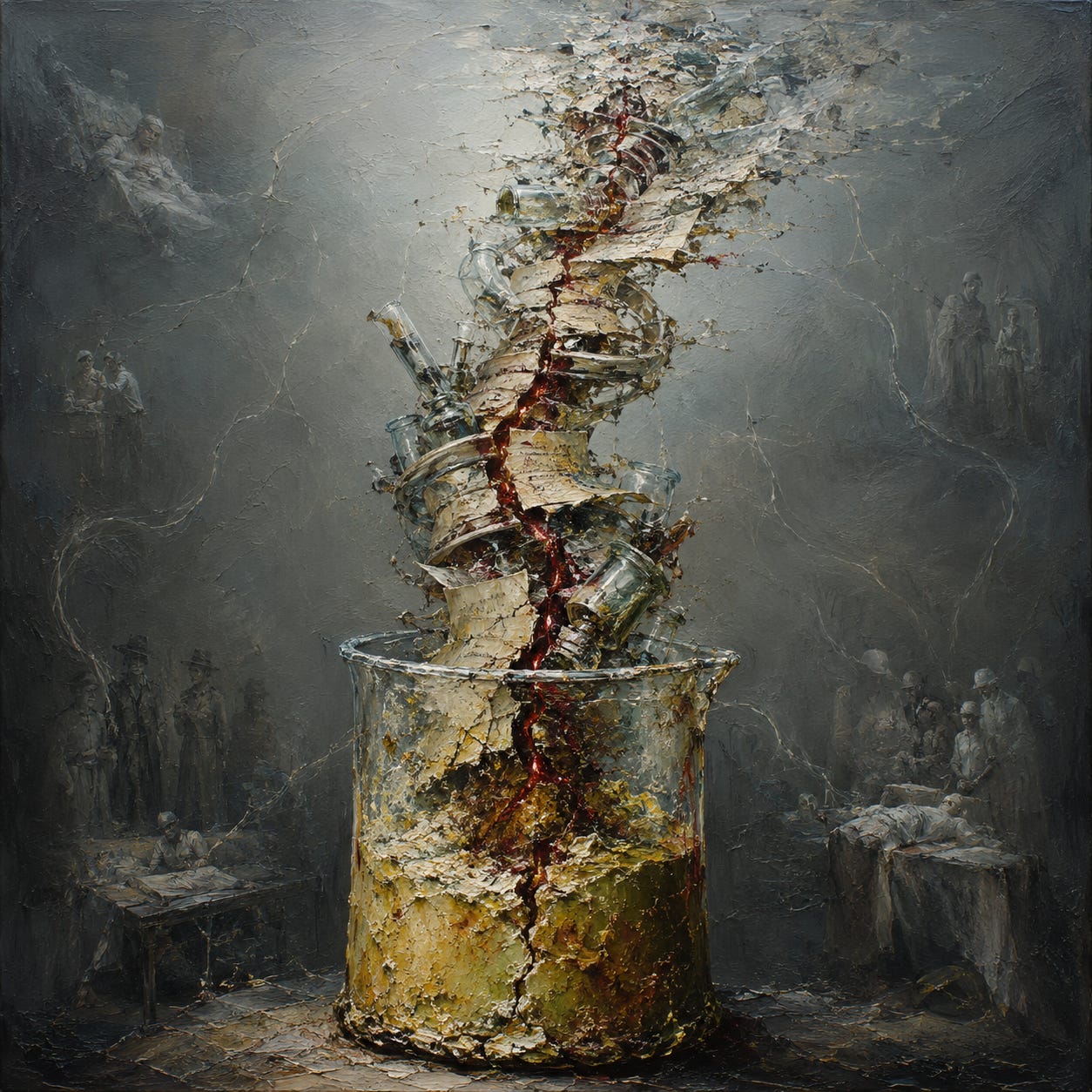
In 1869, a young Swiss physician named Friedrich Miescher walked to a hospital and collected used surgical bandages. The pus on the bandages was his starting material. He soaked them in sodium sulfate, washed the recovered cells in hydrochloric acid, treated them with ether, then ran them through alternating acid and alkali washes. At the end he had a phosphorus-rich white precipitate. He called it “nuclein.”
The chemistry he used to produce it included acids. The conclusion that distinguished his precipitate from a protein was that it contained more phosphorus than nitrogen.
He had no control experiment. He had no parallel run of his procedure without the biological starting material to demonstrate that the elemental composition at the end was not a product of the chemistry itself. He concluded the phosphorus came from the cells. That conclusion is the foundation of the entire science of genetics.
Every claim downstream from Miescher — the bases identified by Kossel, the ratios proposed by Chargaff, the double helix proposed by Watson and Crick, the genome project, the BRCA test that took Angelina Jolie’s breasts, the spit-tube your cousin sent to 23andMe — inherits the unfixed problem in his methodology. The chain has held for 156 years not because the foundation was repaired but because the people building on top of it stopped looking down.
This essay walks the chain. The argument draws on a recent conversation between Dr. Andrew Kaufman and Lev Dalton — both of whom set out to prove the framework and found themselves dismantling it after reading the original papers. Their work converges on a structural pattern: at every step where the framework should have been validated, an assumption was made instead, and the assumption was treated as evidence.
The argument is not that you don’t pass things to your children. You do. Eye colour, stature, dental development, constitution — heredity is observable and real. The argument is that DNA, as the framework presents it, is not the mechanism doing the work. Nobody has demonstrated that it is. They have assumed it, and the assumption has consequences that reach into operating theatres and into families told their child’s condition is innate so they stop looking for what actually caused it.
Support This Work
This work remains free because paid subscribers make it possible. If you find value here, consider joining them.
Paid subscribers get access to all books — including The DMSO Book, The Kitchen Remedies Guide, Chlorine Dioxide, The PSA Trap, Breast Cancer, and more — with 1-2 new books added each month. Plus the Deep Dive Audio Library: 180+ in-depth audio book summaries and discussions.
I do this work independently, outside the institutions these books so often describe. No foundation grants, no academic approval, no editorial gatekeepers deciding what’s acceptable to publish. Your subscription makes that independence possible.
Explain It Like I’m Six
Imagine you want to find out whether there is a special kind of sand on a beach. You go to the beach. You scoop up some sand. Then you take it home and add five different kinds of glitter, some glue, and a little bit of paint. You stir it all up. At the end you have a sparkly, sticky, painted ball of stuff.
You hold up the ball and say: look, I have proven there is sparkly, sticky, painted sand on the beach.
A grown-up walks by and asks: how do you know the sparkles came from the beach? You added glitter. How do you know the stickiness came from the beach? You added glue. How do you know the colour came from the beach? You added paint.
You cannot answer. You did not check what was in the sand before you added all those things.
That is what happened in 1869. A scientist took some pus from a hospital bandage. He added chemicals to it — acids, washes, more acids. At the end he had a white powder that contained a lot of phosphorus. He said: look, I have found a special phosphorus substance in the cells. He called it “nuclein.” Today we call it DNA.
But he had added chemicals that contained phosphorus during the experiment. He never did the test where you skip the pus and just add the chemicals to see what happens on their own. He just decided the phosphorus must have come from the cells.
Everyone after him believed him. Then they built bigger and bigger ideas on top of his idea. They said the phosphorus stuff was a special ladder shape. They said the ladder could tell you what diseases you would get. They said tiny pieces of the ladder could prove who your dad was, or who you were related to, or whether you were going to get sick.
But the very first step — the step where the man on the beach said the sparkles came from the beach — was never checked. And every step after that was built on top of the unchecked step.
So when a doctor today looks at a special test and says “your genes will give you this disease,” that doctor is standing at the top of a very tall tower. The tower was built on top of a man who held up a sparkly ball and said “look what I found in the sand.”
Maybe the tower is right. Maybe the sand really did have sparkles in it. But nobody ever went back to the beach to check.
This essay is about why nobody went back to the beach.
A Confounded Experiment Treated as a Discovery
The scientific method has one non-negotiable requirement when you are trying to demonstrate that a substance exists in biological tissue. You need a control. You need to run the same procedure without the biological starting material — only the chemicals, the reagents, the heat — to demonstrate that the procedure does not generate the substance you claim to have isolated. This is what separates a finding from an artefact.
Miescher had no control. He used a sequence of acid and alkali washes — chemistries that interact with phosphorus-containing molecules — and his central evidentiary claim was the elevated phosphorus content of the resulting powder. The thing his interpretation rested on was the same kind of chemistry he had introduced.
His reasoning was theory-laden in the sense Thomas Kuhn used the term: he expected to find a phosphorus-rich substance distinct from protein, and when he found one he took it as confirmation of the expectation.¹ A nitrogen-rich precipitate would have been classified as a protein. A phosphorus-rich precipitate became something new — nuclein, the substance of the nucleus, eventually DNA.
Hoppe-Seyler reproduced Miescher’s procedure on dog leukocytes shortly after and obtained a similar precipitate. In the literature, this is treated as confirmation. Repeating the same flawed procedure and obtaining the same flawed result does not validate either. It demonstrates only that the procedure is reproducible. The confounding is reproducible too.
The deeper question, which Kaufman raises directly: how did they know the white powder was what they said it was? Nineteenth-century chemistry could observe that the powder dissolved in alkali and reformed in acid. It could measure rough elemental ratios. It could not characterise the molecular structure of what it had produced. The interpretation that the powder was a previously unknown nuclear substance was downstream of the same expectation that drove the experiment in the first place.
What was actually demonstrated in 1869 was that if you take pus, run it through a sequence of acid and alkali washes, and process the result through filtration and precipitation, you get a phosphorus-rich solid. That is a real chemical observation. Everything beyond that — the claim that the solid existed in the cells before the chemistry touched them, the claim that it was a single molecular species, the claim that it had any biological function — was assumption.
The assumption became the foundation. The foundation has never been independently verified.
The Same Trick, Repeated Across the Catalogue of “Discovered” Biomolecules
Once you see the move Miescher made, you start seeing it across the whole catalogue of substances biology claims to have isolated from living tissue: vitamins, hormones, neurotransmitters, peptides, enzymes. All of them were produced using variants of the same procedure. Take biological starting material. Add aggressive chemical reagents. Apply heat, centrifugation, solvent extraction. Obtain a precipitate. Declare the precipitate identical to a substance present in the original tissue.
Vitamins are the cleanest example. Dalton lays out the original isolation procedures for what is now sold as vitamin C: lead acetate, lead citrate, silver nitrate, mercury, petroleum derivatives. Silver nitrate is what hospitals use to chemically cauterise tissue — to burn it. Adding it to biological material burns the material. You cannot run that procedure and then claim, without independent demonstration, that what precipitated at the end was present at the start.
The methodology was iterative in a way that makes it explicitly a manufacturing procedure rather than an isolation. Researchers generated twenty or thirty candidate precipitates from related procedures, tested each on subjects with the relevant deficiency symptoms, and selected the one that produced the strongest symptomatic response. The selected compound was then declared “the vitamin.” A different combination of reagents in a slightly different sequence would have selected a different compound, which would have been declared the vitamin instead. The procedure does not isolate something. It creates a population of synthetic candidates and chooses among them.
The same applies to thyroid hormone, to insulin, to testosterone, to the catalogue of neurotransmitters. The insulin and testosterone preparations sold as pharmaceuticals are not even structurally identical to what biology claims insulin and testosterone are in the body. They are structural analogues — modified amino acid sequences, modified side chains. The pharmaceutical is a synthetic compound that approximates a hypothesised endogenous compound, and the approximation is treated as evidence that the endogenous compound exists in the form claimed.
Peptides are the current craze. Kaufman, who synthesised peptides in a college summer job, points out that the manufacturing process requires gaseous hydrofluoric acid — among the most dangerous substances in any laboratory — to cleave the finished peptide off the resin it was assembled on. Hydrofluoric acid does not exist in living tissue. If it did, the tissue would dissolve. The peptide that emerges from this procedure is not what is in the body. It is what synthetic chemistry can build that the manufacturer hopes will resemble what is in the body.
Biological material plus aggressive chemistry plus assumed interpretation produces a synthetic compound that is then declared to have been there all along. DNA is one entry in this catalogue. The methodology is not unique to it. The framework’s confidence that DNA exists in cells in the form described — phosphate-sugar backbone, paired nitrogenous bases, double-stranded helix — rests on the same kind of evidence that supports the existence of vitamin C in the form sold in tablets.
Kossel, Chargaff, and the Bases Nobody Could See
The next link in the chain is the identification of the four bases — adenine, thymine, guanine, cytosine — that are said to make up DNA. Albrecht Kossel won the 1910 Nobel Prize for this work. He produced the bases between 1885 and 1901 using procedures harsher than Miescher’s. The starting materials varied: guanine from bird droppings (which is where the name comes from), adenine from ox pancreas, thymine and cytosine from calf thymus. The procedures used phosphotungstic acid, mercury chloride, silver nitrate, and prolonged heating.²
The same methodological problem applies. The bases Kossel obtained at the end of his procedures may have been present in the starting tissue. They may have been generated by the procedures themselves. There is no way to distinguish, because Kossel did not run controls. The bases were never directly observed in tissue. They have never been directly observed in tissue since. They cannot be imaged by X-ray crystallography because they are described as transparent to X-rays at the relevant scales. They cannot be imaged by electron microscopy because they are below the resolution limit. Their existence in DNA is inferred from chemical reactions that occur after the molecule has been disassembled.
This sets up the problem Erwin Chargaff was meant to resolve. By the 1940s, the four bases had been accepted as the building blocks of DNA on the strength of Kossel’s procedures, but the question of how they were arranged remained open. Chargaff hypothesised that bases pair: adenine with thymine, guanine with cytosine, in equal ratios. The ratios were the load-bearing claim. If A always pairs with T and G always pairs with C, then in any sample of DNA the amount of A should equal the amount of T, and the amount of G should equal the amount of C.
When Chargaff measured the ratios in his samples, the data did not show the equal ratios his rule predicted.
The numbers were close enough to the predicted values that he was able to argue the rule held within experimental error. They were also far enough off that, in any other field, the rule would have been considered unsupported pending further data. The rule survived because the framework needed it to. The man whose ratios are now invoked as foundational evidence for base pairing did not find the ratios he claimed to find.
When Watson and Crick built the double helix model a few years later, Chargaff’s rule was treated as established. The disconfirmatory aspects of the original data were not. This is the second layer of assumption built on top of Miescher’s: the bases are real because Kossel said so, and the bases pair because Chargaff said so, and neither claim was independently validated against the standards any honest replication would require.
The Helix That Was Assumed Before the Image Was Taken
By 1952, Rosalind Franklin and Raymond Gosling had produced Photo 51 — the X-ray diffraction pattern that became the iconic evidence for the double helix.³ Franklin and Gosling themselves stated their X-ray data alone could not prove DNA was helical. Watson and Crick used the image anyway. Their original 1953 paper used the words “suggested,” “assumed,” and “believed” repeatedly. They acknowledged that their structure needed to be “checked against more exact results” and that previously published X-ray data was “insufficient for a rigorous test.” The paper proposed a model. It did not demonstrate one.
Watson and Crick built the model from a stack of assumptions. They assumed Chargaff’s rule held strictly, despite the data. They assumed the molecule was double-stranded — one of multiple possible interpretations of the same diffraction pattern. They assumed complementarity between the strands. And, in a detail Dalton flags that rarely appears in textbook accounts, they did not calculate the angle of the helix from the diffraction pattern. They assumed an angle and looked at the image through that assumption.
Each assumption was defensible only if the assumptions beneath it were sound. Chargaff’s rule was assumed despite contradicting data. The bases were assumed despite never being directly observed. The cellular existence of nuclein was assumed despite the confounded extraction. The helical interpretation was assumed despite Franklin’s own statement that the data did not require it. The angle of the helix was assumed because there was no way to derive it from what Photo 51 actually showed. Each layer was patched into the next without independent verification at any level.
The replication experiment Cowan has cited makes the problem visible. Undergraduate researchers, decades after Photo 51, ran the same X-ray diffraction procedure on metal springs from ballpoint pens.⁴ They obtained a diffraction pattern indistinguishable from Photo 51. The procedure does not detect double-helical DNA. It detects helical structure of any kind, in any material. The image Watson and Crick used as evidence for the structure of DNA is consistent with the image you get from a piece of office stationery. It is not specific to DNA, to biology, or to anything biological at all.
There is a deeper problem with the X-ray crystallography interpretation that Kaufman raises and that rarely gets discussed. X-ray crystallography requires a crystal. The procedure works by passing X-rays through a substance with a regular, repeating molecular arrangement, capturing the diffraction pattern, and back-calculating a structure. The technique is genuine and has produced real structural information for substances that genuinely form crystals. But there are no crystals inside cells. Look at any cell under any microscope and you will not see a crystalline phase. DNA, if it exists in living tissue at all, does not exist there as a crystal.
The substance Franklin and Gosling crystallised had been through Miescher’s confounded extraction, then dehydrated, then forced into a regular structure that does not occur in nature. Even granting every assumption above — even granting that the bases exist, pair, and form a helix in the way claimed — the X-ray pattern would tell you what shape the substance takes when you crystallise it. It would not tell you what shape it takes inside a cell. Carbon as graphite and carbon as diamond are the same element in two different crystal structures with completely different properties. Whatever was in Franklin’s sample, the form she imaged is not the form that exists in tissue, because the form that exists in tissue is not crystalline.
The double helix is what the substance becomes when you put it through the procedure. Whether the procedure reveals the helix or creates it has never been answered.
The Growing List of Mutations: A Theory That Cannot Be Wrong
Once the foundational structure is in place, the framework needs to do something with it. The work it does is causal: certain DNA sequences cause certain diseases. This is the claim that justifies the testing infrastructure, the predisposition diagnoses, the targeted drugs, the prophylactic surgeries. It is also the claim that fails, repeatedly, in ways the framework absorbs rather than corrects.
The mechanism Dalton describes is straightforward. Every time a person presents with the symptoms of a “genetic” disease but does not carry any of the variants on the established list, the framework adds another to the list. The disease is still genetic. The list is just incomplete.
Cystic fibrosis is the standard case. The condition is attributed to mutations in the CFTR gene. Over 2,000 catalogued “CFTR mutations” are now associated with cystic fibrosis. Some patients with cystic fibrosis symptoms have none of them. The response of the framework is not to ask whether the gene is the cause. The response is to find the variant those patients do have and add it to the list. The list grows. The theory is preserved. No result can falsify it, because any result that fails to find a known mutation is treated as evidence for an unknown one.
Sickle cell disease shows the same mechanism in a less commonly remarked form. The variability in clinical expression is enormous — some patients require constant hospitalisation, others go their lives essentially unaffected. Within the genetic framework, this variability requires modifying genes or modifying environmental factors that are largely unstudied. Within a framework that does not assume a genetic cause, the variability requires only that the actual cause varies between patients.
The BRCA case shows the same pattern in its most consequential form. Between 35 and 55 percent of those who carry a BRCA1 or BRCA2 variant never develop breast cancer.⁵ This is the majority outcome for BRCA2 carriers and a substantial minority for BRCA1 carriers. In a genetic causation model, this gap requires explanation. Something protects the carriers who do not develop disease. The 1994 Miki paper that established BRCA1 explicitly called for research into modifying factors. That research has been minimal. The clinical infrastructure moved forward on the assumption that the variant is sufficient to justify intervention. Tens of thousands of women have removed healthy breasts on this assumption. The science does not support it.
Dwarfism provides what Dalton offers as the cleanest data point. Roughly 80 percent of dwarves are born to non-dwarf parents.⁶ If the condition were genetically inherited in the way the framework claims, this number would be impossible. The framework absorbs it the same way it absorbs everything else: the cases are described as “de novo mutations” — said to be random new mutations occurring in the germ line. There is no independent evidence for these mutations beyond the necessity of explaining the data. Their existence is required by the theory. What should have been a falsification became a category that confirms the theory.
Schizophrenia shows the pattern at its most cynical. The condition has been attributed to genetics for decades. No reliable gene has been identified. Twin concordance rates fall well short of what genetic causation would predict. The clinical literature on what actually drives psychotic states — fragmented family communication patterns, severe early trauma, prolonged sleep deprivation, certain pharmaceutical interactions — was developed decades ago by Theodore Lidz and others and has been largely buried.⁷ The genetic framework persists not because evidence supports it but because environmental and pharmaceutical causation are inconvenient.
Karl Popper’s diagnostic test is unforgiving. A theory that cannot be falsified — that absorbs every contradicting result by adding new categories — is no longer a scientific theory. It is a framework arranged to survive. Latham and Wilson, after reviewing more than 700 genome-wide association studies covering 80 different diseases, concluded that genetic contributions to common diseases account for at most 5 to 10 percent of disease risk.⁸ The expected genes have not been found. The framework’s response was to invent “missing heritability” — a category for the genetic causation that must exist somewhere even though every search for it has failed.⁹ Each proposed hiding place has come up empty. The framework continues.
This is what Wayne Bennett’s family encountered when their son Justin’s catastrophic reaction to a 1977 whooping cough vaccination was reframed, decades later, as Dravet syndrome — a “rare genetic epilepsy.”¹⁰ Justin was a healthy four-month-old before the injection. He has spent forty-five years with severe disability. Bennett, in a 2023 biography, used the words “he was allergic to the whooping cough vaccination.” The medical establishment overlaid the genetic diagnosis on top of his account. The vaccine, in the new framing, did not cause the injury — it revealed an underlying genetic condition. The neurotoxic substances injected into the developing brain — the whole-cell pertussis endotoxins, the aluminium salts, the thimerosal — became inert bystanders. The genes, in the establishment’s account, became the cause.
Industrial poisoning occurred. The poisoning was attributed to the genes. The pharmaceutical company carried no responsibility. The parents carried both the burden of care and the implicit blame of having passed on defective genes. The genetic framework supplied the alibi.
Pattern-Matching Mistaken for Blueprint-Reading
The applied side of the genetics industry — paternity testing, ancestry testing, forensic identification — is widely treated as the solid ground beneath the contested disease claims. This is where most people encounter the framework personally, and the encounter typically convinces them. Your cousin sent a spit-tube to 23andMe and learned she has a long-lost half-sister. Your friend’s paternity test settled a custody dispute. The applications appear to work.
They appear to work because they detect something. The question is what.
Different ancestry-testing companies, sent samples from the same individual, return different ancestry breakdowns. A person identified as fifty percent Scottish by one company is identified as fifty percent French by another. Fake samples — DNA submitted from animals, samples deliberately corrupted — have come back with detailed ancestry reports indistinguishable from the reports returned for genuine submissions.¹¹ When a news investigation submitted human DNA labelled as dog DNA to pet ancestry companies, none of the companies identified the sample as human. More than half returned specific dog breed breakdowns.¹²
A test that produces detailed, confident output for samples that contain nothing the test purports to identify is not measuring what it claims to measure. It is measuring something else and reporting on that something through the categories the company has built.
What the test detects is patterns. Any sufficiently complex biological sample will produce a pattern when you run it through PCR amplification, gel electrophoresis, or sequencing. The patterns differ between individuals. They differ less between related individuals. This relatedness signal is real — it derives from whatever biological samples share between family members — but it does not require the genetic framework to explain. Fingerprints work the same way. Fingerprints show family resemblance. Fingerprints can identify individuals. Fingerprints can be used in criminal investigation. Nobody claims fingerprints are the blueprint of life.
HLA typing — used to match organ donors — produces relatedness patterns similar to those produced by DNA testing, and has been used in research on ancient migration patterns.¹³ Nobody claims HLA proteins are the blueprint of life. Facial geometry — the relative positions of features, the proportions between distances — produces relatedness patterns. Nobody claims facial geometry is the blueprint of life.
The genetic framework conflates two distinct claims. The first is that biological samples carry signals that allow you to detect relatedness between individuals. This is true and uncontroversial. The second is that those signals are encoded in DNA sequences that function as a blueprint for the organism. This is the framework. The first claim does not require the second. Pattern-matching works regardless of what the patterns are made of. The leap from “this test detects something correlated with family relationships” to “this test reads the genetic code that built you” is not an inference. It is the framework being assumed.
The paternity-testing failures matter more because the consequences are more severe. A 2006 study at Ernst-Moritz-Arndt University in Germany took 336 children and 348 men known to be unrelated to those children. Standard paternity testing methodology — STR analysis, the same technology used worldwide — was applied with the mother’s profile excluded from the comparison. The expected result was that almost all unrelated men would be excluded as fathers. The actual result was that 322 of the 336 children — 95.8 percent — could match with at least one unrelated man. One child matched with thirty-two different unrelated men.¹⁴
When NIST was forced to test forensic DNA accuracy under blinded conditions, accuracy on a three-person mixture dropped from the claimed 99.8 percent to approximately 6 percent.¹⁵ Forensic and paternity laboratories not only fail to blind their procedures — they actively resist blinding and demand contextual information before conducting tests. Dr. Dan Krane, who has provided expert testimony in over 100 court cases, compared the practice to a student asking for the answer key before taking an exam.
The Lydia Fairchild case shows what happens when the framework collides with reality.¹⁶ In 2002, Fairchild was told by DNA testing that she was not the biological mother of her own children. She had photographs of her pregnancies. Her mother, the children’s father, and her obstetrician all testified to the births. A judge ordered DNA testing on her third child immediately after delivery — the baby that emerged from her body in front of witnesses. The test said the baby was not hers.
The scientific response should have been to re-examine the test. What actually happened was the invention of a new category — chimerism — to explain why the falsification was not really a falsification. The test, in the new framing, was not wrong. Fairchild was unusual. Her body, the framework now claims, contained two distinct DNA populations, and the eggs that produced her children carried DNA different from the DNA in her cheek swab. There is no independent evidence for chimerism in Fairchild’s case beyond the necessity of explaining the test result. The category exists because the test result needed an explanation that did not implicate the test.
This is the same mechanism that absorbed the dwarfism statistic, the BRCA non-penetrance, the missing heritability. The framework cannot be falsified, because every falsifying result generates a new category that absorbs the falsification.
The Harm
The methodology problems would be an academic curiosity if they did not have consequences. They have consequences.
Angelina Jolie’s announcement in 2013 that she had undergone preventive double mastectomy after testing positive for a BRCA1 variant was framed as empowerment. She had been told her lifetime risk of breast cancer was 87 percent. The figure was derived from family studies in which families had been selected because they had extreme cancer clustering — six, eight, ten cases across generations. The cancer rate in those highly selected families became the “risk” assigned to anyone carrying the variant, regardless of whether their family resembled the original study families. A 2002 BMJ study of women who had undergone prophylactic bilateral mastectomy found that most overestimated their risk of breast cancer by more than 90 percent compared to computer-generated risk estimates.⁵ Eighteen women in the study, those with the lowest computed risk, believed they were at the highest risk. Their average estimated risk was 80 percent. Their computed risk was approximately 12 percent.
These women removed healthy breasts. They were told their genes caused cancer. The papers do not show this. The papers show association in pre-selected families. The distance between association in pre-selected families and a causal claim that justifies prophylactic surgery is the distance the framework crossed without supporting evidence, and women paid for the crossing with their bodies.
Wayne Bennett’s son Justin received a vaccination at four months. Within hours, he had a catastrophic neurological reaction. He has spent the subsequent forty-five years with severe disability requiring round-the-clock care. In 2019, the family received the diagnosis that closed the case in the medical establishment’s terms: Dravet syndrome, a “rare genetic epilepsy” said to be caused by mutations in the SCN1A gene.¹⁰ The mutations are described as “often triggered by vaccination.” This is the genetic alibi at its purest. The vaccination triggered the seizures, the establishment says — the genes caused them. The injection of neurotoxic substances into a developing infant brain becomes a discovery procedure for a genetic condition that was always going to manifest.
Bennett still says, in the 2023 biography, “He was allergic to the whooping cough vaccination.” He maintains the truth of what he saw. The medical establishment overlaid the genetic frame on top of his account. The pharmaceutical company carried no liability. The Bennetts carried the burden of care and the implication that their genes had caused the catastrophe.
The same mechanism operates in millions of cases that never make a biography. Children who develop seizure disorders, autism spectrum conditions, autoimmune diseases, or developmental delays after vaccination, environmental exposure, or pharmaceutical injury are routinely told the cause is genetic. The investigation of what actually triggered the condition stops at the diagnosis. The parents are referred to genetic counsellors. The family members are encouraged to be tested. Attention turns inward, toward heredity, and away from the agent that did the damage.
The genetic framework, whatever its founders intended, has the effect of routing causal attribution away from environmental and pharmaceutical agents and toward the patient’s own body. It was built on a confounded experiment in 1869, layered with assumptions throughout the twentieth century, and is now used to tell parents that the chemicals that injured their children had nothing to do with it.
The 700 genome-wide association studies have not found the genes the framework predicted. The 5-to-10-percent contribution they found to common diseases is dwarfed by what environmental interventions can achieve. Modest lifestyle changes reduce type 2 diabetes risk by 89 percent. Populations that migrate acquire the disease patterns of their adopted country within a generation — far faster than the framework’s own mechanism would allow. Seventh Day Adventists live an average of eight years longer than other Americans through dietary practice alone.⁸ The evidence about what causes disease is not ambiguous. The framework is arranged to ignore it.
What Is in Front of You
The chain that runs from Miescher’s bandages to the spit-tube on your counter is not unbroken. It was never solid. Each link was patched together with assumptions that were never verified, and the assumptions accumulated until the framework became a structure that no result could falsify and no observation could dislodge.
Here is what is in front of you, that the framework is not needed to explain.
You go outside in summer and your skin tans. Your body has adapted, visibly, in days. There is no random mutation. There is no “genetic predisposition” that activated. Your tissue responded to its environment, intelligently, on a timescale the framework cannot accommodate.
You drink alcohol regularly for a few weeks and your tolerance increases. Your body has adapted again, on a timescale of weeks. The framework’s own concept of inherited change runs over generations, not weeks — yet here is change happening in front of you. What actually happened was that your liver upregulated the enzymes that metabolise ethanol because ethanol was present and needed processing. This is not a mutation. It is the body doing what it does.
You eat fast food daily for years and develop chronic illness. You stop eating it for a few months and you feel different. If you eat it again after the break, the response is acute and immediate — your body has lost the tolerance it built. Adaptation runs in both directions. None of this requires DNA as a blueprint. It requires only that tissue responds to its environment.
Weston Price documented populations that returned to traditional diets after a generation of industrial food. The dental deformations and developmental problems that had appeared in the children of the industrial diet did not appear in the next generation. The children born to parents who had returned to traditional foods developed normally. One generation. No mutation. The terrain changed, and the bodies that grew in the new terrain grew differently.¹⁷
The framework would have to call this a mutation, then a counter-mutation, occurring in lockstep with dietary change, in directions that Price’s observations consistently showed were beneficial. The framework’s own concept of random mutation cannot accommodate this. It cannot accommodate the data without invoking categories — directed mutation, environmental induction of specific genetic changes — that contradict its own foundational claims.
What is in front of you is a body that adapts. The framework asks you to look past the body, into a substrate of computer-generated sequences whose existence rests on a confounded extraction performed on pus-soaked bandages in 1869. It asks you to interpret your tanning, your tolerance, your child’s response to environmental change, through a model that has never been independently validated and that fails its own predictions whenever those predictions are tested.
You are not required to interpret your life through that model. The model is not the data. The model is an interpretation laid over the data, an interpretation built on assumptions that someone made and that nobody has ever bothered to check.
When the doctor tells you the condition is genetic, ask which gene. Ask whether the mutation has been independently demonstrated to cause the condition rather than merely correlated with it. Ask what the penetrance is — what percentage of carriers develop the disease. Ask what environmental factors have been ruled out, and how. The answers will not be satisfying, because the framework is not built to give satisfying answers. It is built to give the appearance of explanation while keeping the actual cause out of view.
The actual cause is usually visible if you know to look for it. It is in the diet, the toxic exposures, the electromagnetic environment, the chronic stress, the pharmaceutical interventions. These are not abstract categories. They are the things that have changed in the lifetimes of the people who are now sick in ways their parents and grandparents were not. Disease patterns are changing on the timescale of decades. Even on the framework’s own assumptions, what it calls “genes” could not change fast enough to explain this. The framework cannot account for the data. The framework was built so you would not notice.
Miescher took pus from a surgical bandage, ran it through acid and alkali, and concluded the phosphorus came from the cells. That is the experiment. That is the foundation. Everything else is what was built on top of it without checking whether the ground would hold.
The ground does not hold.
References
Kuhn, T. (1962). The Structure of Scientific Revolutions. University of Chicago Press. The concept of “theory-ladenness” — the tendency for prior theoretical commitments to shape observation and interpretation — is central to Kuhn’s account of how scientific paradigms persist.
Kossel, A. (1885–1901). Foundational papers on nucleic acid components, including the isolation of adenine, guanine, thymine, and cytosine from animal tissues. Many of these papers remain untranslated from German and are not freely available. As discussed in Unbekoming (2025), “Fool’s Gold Standard: The Unvalidated Science of DNA,” and Cowan, T. (2024), livestream on the Human Genome Project.
Watson, J. D., & Crick, F. H. C. (1953). “A Structure for Deoxyribose Nucleic Acid.” Nature, 171(4356), 737–738. Franklin, R., & Gosling, R. (1953). “Molecular Configuration in Sodium Thymonucleate.” Nature, 171, 740–741. Photo 51 reproduced therein.
Cowan, T. (2024). Discussion of undergraduate replication of the Photo 51 X-ray diffraction pattern using metal springs from ballpoint pens. Livestream on the Human Genome Project, October 9, 2024.
Metcalfe, K., et al. (2002). “Women who undergo prophylactic bilateral mastectomy overstate risk of cancer.” BMJ, 325(7369), 921. BRCA penetrance figures from Kuchenbaecker, K. B., et al. (2017), “Risks of breast, ovarian, and contralateral breast cancer for BRCA1 and BRCA2 mutation carriers,” JAMA, 317(23), 2402–2416. As discussed in Unbekoming (2026), “The BRCA Gene and the Women Who Lost Their Breasts to a Hypothesis.”
Kaufman, A., & Dalton, L. (2025). Conversation on the True Health Report. Statistic on de novo dwarfism cited by Dalton from the medical genetics literature on achondroplasia. The clinical figure is widely cited as approximately 80 percent of achondroplasia cases occurring as de novo mutations in children of average-stature parents.
Lidz, T. (1973). The Origin and Treatment of Schizophrenic Disorders. Basic Books. Modrow, J. (2003). How to Become a Schizophrenic: The Case Against Biological Psychiatry. Writers Club Press.
Latham, J., & Wilson, A. “The Great DNA Data Deficit: Are Genes for Disease a Mirage?” Independent Science News. As discussed in Unbekoming (2025), “The Great DNA Data Deficit.”
Manolio, T., et al. (2009). “Finding the Missing Heritability of Complex Diseases.” Nature, 461, 747–753.
Webster, A. (2023). The Wolf You Feed. Biography of Wayne Bennett. As discussed in Unbekoming (2025), “The Genetic Alibi: How Wayne Bennett’s Family Tragedy Exposes the Dravet Syndrome Cover Story.”
Multiple consumer journalism investigations have documented the inconsistency of ancestry-testing results across providers and the acceptance of fraudulent samples. See discussions in Andrews, J. (2025), “The DNA Hoax” series, The Virology Controls Studies Project.
Inside Edition (2019). Investigation submitting human DNA samples labelled as dog samples to pet ancestry companies. As discussed in Unbekoming (2025), “The DNA Myth.”
Human Leukocyte Antigen (HLA) typing has been used extensively in research on population genetics and ancient migration patterns. See Cavalli-Sforza, L. L., et al. (1994), The History and Geography of Human Genes, Princeton University Press.
Poetsch, M., et al. (2006). “The problem of single parent/child paternity analysis—Practical results involving 336 children and 348 unrelated men.” Forensic Science International, 159(2–3), 98–103.
Butler, J. M., & Coble, M. D. (2015). NIST Scientific Foundation Reviews: DNA Mixture Interpretation. National Institute of Standards and Technology. Dror, I. E., & Hampikian, G. (2011). “Subjectivity and bias in forensic DNA mixture interpretation.” Science & Justice, 51(4), 204–208.
Lydia Fairchild case. Documented in multiple media sources from 2002–2006 and analysed in Unbekoming (2025), “Unfalsifiable” and “The DNA Myth.”
Price, W. A. (1939). Nutrition and Physical Degeneration. Foundational study of dental development and offspring health across populations transitioning between traditional and industrial diets.
Source Conversation
Kaufman, A., & Dalton, L. (2025). True Health Report podcast episode on the foundations of genetics. Available via Beyond Terrain (Lev Dalton) and the True Health Report (Dr. Andrew Kaufman). The conversation provides the spine of this essay’s argument — particularly the framing of the confounded chemistry in Miescher’s original procedure, the methodological parallel between vitamin and DNA isolation, the assumed angle in the Watson–Crick model, the growing list of mutations as an unfalsifiability mechanism, the dwarfism statistic, and the closing observations on adaptation as visible biological reality.