
Plato’s Cave
An Essay

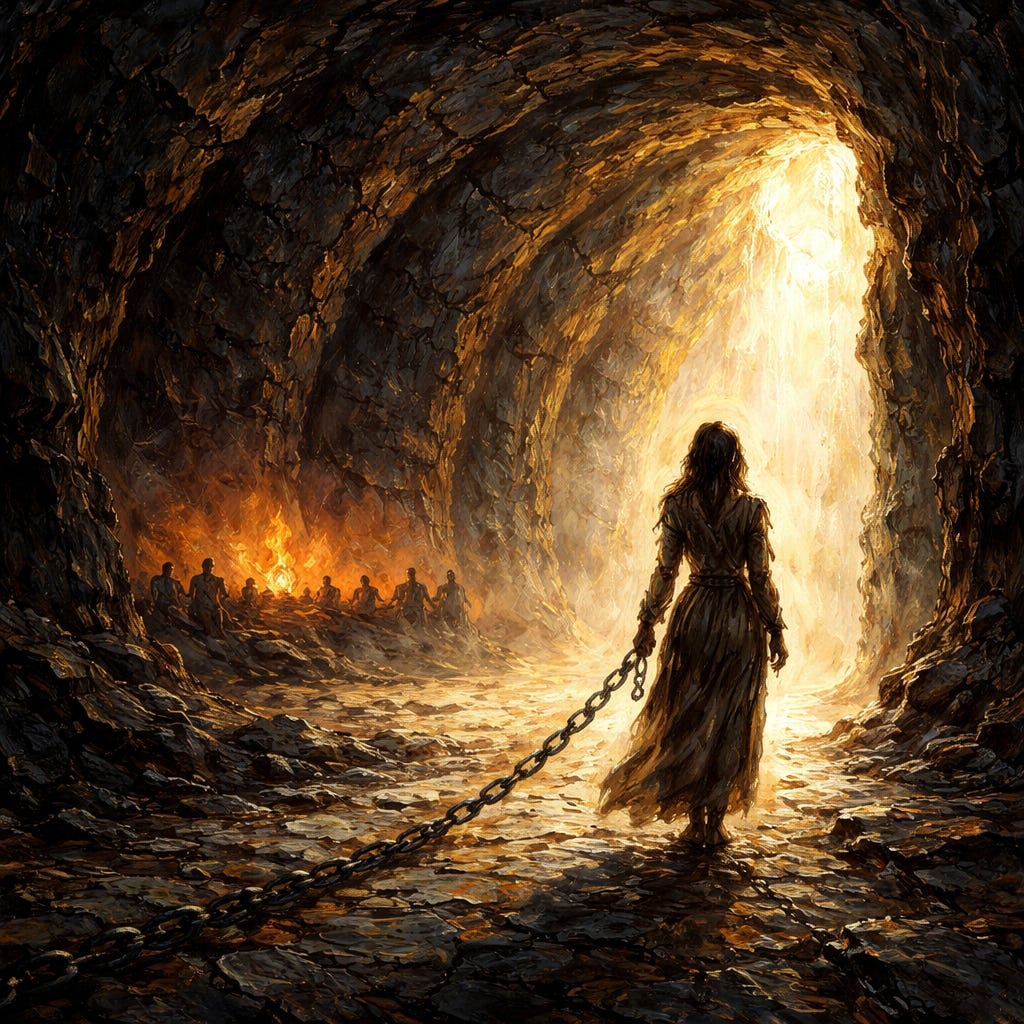
A Note Before Reading
This essay is a synthesis. It draws together the arguments, evidence, and frameworks developed across more than a dozen previous essays — on vaccination, allopathic medicine, bacteriology, virology, genetics, diagnosis, extraction, epistemic capture, and the medicalization of birth, aging, and death. Each of those essays stands on its own. This one shows what they look like together.
The structure borrows from the oldest map we have of epistemic imprisonment: Plato’s allegory of the cave, told by Socrates to Glaucon in Book VII of The Republic. Prisoners chained from birth in an underground cave, watching shadows cast on the wall by a fire behind them, mistaking the shadows for reality. One prisoner breaks free, turns toward the light, and makes the painful ascent to the surface. She sees the sun. She returns to tell the others. They do not believe her.
Twenty-four centuries later, the allegory does not need updating. It needs a change of setting.
What follows is the modern cave. Then the map of what it contains.
Support This Work
This work remains free because paid subscribers make it possible. If you find value here, consider joining them.
Paid subscribers get access to all books — including The DMSO Book, The Kitchen Remedies Guide, Chlorine Dioxide, The PSA Trap, Breast Cancer, and more — with 1-2 new books added each month. Plus the Deep Dive Audio Library: 180+ in-depth audio book summaries and discussions.
Pricing Update: The annual subscription moves from $50 AUD to $50 USD on May 1 — the first change in five years. Current paid subscribers keep their existing rate. Free subscribers can lock in the current price by upgrading before May 1.
Part One: The Allegory
She was born in the cave.
Her mother was born in the cave. Her grandmother was born in the cave. The shadows on the wall had always been the world. They flickered and moved and sometimes frightened her, but they were consistent, and everyone around her watched them, and the watching was how you knew you belonged. The shadows had names. The names felt like knowledge.
The chains were comfortable. They had always been there — wrapped around her since the first hours of life, when she was injected before her eyes could focus. She did not remember the chains being attached. No one did. That was the point. A chain fastened to an infant becomes invisible. It becomes the shape of the body. You cannot miss what you have never been without.
The cave hummed. The hum came from everywhere and nowhere. It sounded like safety. It sounded like the low, constant drone of monitors and fluorescent lights and waiting rooms with calming colours on the walls. It sounded like authority speaking gently. It sounded like what responsible people do.
She watched the shadows and learned their names. This shadow was called health. This one was called prevention. This one was called science. The shadows shifted and reformed, but the names remained stable, and the names were what mattered. As long as you could name the shadows, you understood the world. As long as you understood the world, you were safe.
She grew. She studied the shadows carefully — she was a good student of shadows. She learned which ones to approach and which to avoid. She learned that certain shadows required action: when this shadow appeared, you took your child to a person in a white coat. When that shadow appeared, you swallowed what was prescribed. The shadows told you what to do, and doing what they told you was the highest form of care.
Then she became pregnant, and the cave turned its full attention toward her.
More shadows than she had ever seen began flickering on the wall. Shadows of risk. Shadows of complication. Shadows of what might go wrong. She had been a spectator in the cave; now she was the subject. The chains she had never noticed tightened. New ones were attached — at the first appointment, at the first blood draw, at the first ultrasound where a number crossed a threshold and a face behind a desk changed expression.
She was managed. That was the word, though no one used it in her presence. Her pregnancy — a process her body had been engineered by millions of years of evolution to accomplish — was supervised, measured, intervened upon, and converted into a sequence of appointments, each one generating data that justified the next. She complied because compliance was love. She complied because the shadows said this is what good mothers do.
The birth was taken from her by a cascade she could not see. Each intervention created the conditions for the next. The induction because a number said she was overdue. The Pitocin because the induction stalled her body’s rhythm. The epidural because the Pitocin made the pain unbearable. The monitor because the epidural masked her body’s signals. The emergency cesarean because the monitor showed distress — distress that the cascade itself had manufactured. She lay on a table under lights, opened by a blade, and her child was pulled from her, and everyone said we saved your baby, and she was grateful, and the gratitude was real, and the gratitude was the deepest chain of all.
Her child was taken to a warmer. Eye drops were administered. An injection was given — Vitamin K, they said, standard. Then another injection — Hepatitis B, for a disease transmitted through sex and intravenous drug use, given to a baby who would do neither. She watched. She trusted. The shadows on the wall showed her images of protection, of responsibility, of science working as it should.
In the weeks and months that followed, the injections continued. Two months. Four months. Six months. Twelve months. Eighteen months. Each visit added metals, preservatives, foreign proteins to a body whose blood-brain barrier had not fully formed, whose cleansing and repair processes were still developing. She held her child still while the needle went in. She held her child afterward and said it’s okay, it’s okay. The shadows said this was love.
Then her child changed.
It did not happen in a single moment — or perhaps it did, and the moment was obscured by the days that followed. The words that had been forming stopped. The eyes that had been tracking, connecting, lighting up when she entered the room grew distant. Something she had seen — something she had watched with her own eyes, the way you watch anything you love more than your own life — was gone. Not dead. Absent. As though a light behind the eyes had been switched off.
She took her child to the person in the white coat. The shadows on the wall said: coincidence. The shadows said: developmental variation. The shadows said: genetic. She heard the names and they sounded like the names had always sounded — authoritative, certain, final.
But her eyes said something else.
For the first time in her life, the shadows and her sight disagreed.
She sat in the cave and looked at the wall and looked at her child and looked at the wall again. The shadows flickered. They showed her the same images they had always shown — safety, science, responsibility. But the images no longer matched what was in front of her. The thing on the wall and the thing in her arms could not both be true.
A chain cracked. Not loudly. Not dramatically. A hairline fracture in something she had worn so long she had mistaken it for bone.
She turned.
The light behind her was blinding. She had never looked at it directly. No one in the cave looks at the fire — you look at the wall, where the shadows are. The fire is behind you. It makes the shadows, but the shadows are what you see, and seeing is believing, and believing is belonging.
The fire was enormous. It burned in every doctor’s office, every pharmacy, every television screen, every journal that claimed to evaluate the very products its owners sold. It burned with a fuel that was not information but something dressed as information — marketing so pervasive that it had become the atmosphere, indistinguishable from the air the cave-dwellers breathed.
Behind the fire, she saw figures. They carried shapes — cutout forms held aloft on sticks, paraded between the fire and the prisoners, casting the shadows the prisoners believed were real. The shapes had names: clinical guideline, standard of care, scientific consensus, safe and effective. The figures carrying them wore different costumes — lab coats, suits, the insignia of regulatory agencies — but they moved in the same direction, at the same pace. Some believed in what they carried. Some did not. The shadows were the same regardless.
She began to climb.
The ascent moved outward — from the innermost wall, where she had been captured before her child could consent, through each successive barrier. Every wall she broke through hurt. Not because the walls were physically painful, but because each one was load-bearing. Each one held up a piece of the world she had believed in.
The first wall was vaccination. Breaking through it meant accepting what her eyes had told her — that the injection and the regression were connected, that the studies claiming safety had never used true placebos, that the manufacturers had been granted immunity from liability, that the communities who refused entirely had virtually none of the chronic diseases devastating her child’s generation. Breaking through it cost her the belief that the system had protected her child. It cost her the comfort of having done the right thing.
The second wall was the medicine itself — the entire framework that classified her child’s symptoms as a disorder requiring management rather than a body responding to injury. She saw the inversion: symptoms labelled as diseases, healing responses suppressed, the body’s intelligence overridden. Seventy thousand diagnostic codes built on four causes. Breaking through this wall cost her the ability to walk into a doctor’s office without seeing the machinery behind the encounter.
The third wall was the story about bacteria — the confusion of cleanup crews with demolition teams. She learned that the microbes found at the site of illness were not invaders but responders, that the terrain determined the outcome, that a century of trying to sterilise the body’s internal environment had devastated the microbial communities that actually maintained health. Breaking through this wall cost her the simple comfort of antibiotics as rescue.
The fourth wall was the deepest structural fiction — virology and contagion. She learned that no virus had been properly isolated, that the foundational experiment produced the same results without any patient material, that controlled transmission experiments had failed to demonstrate person-to-person spread. Breaking through this wall cost her a shared language for explaining illness. It cost her the ability to say “I caught a cold” without hearing the architecture collapse.
The fifth wall was the hardest. Genetics. The wall disguised as identity. The wall that said: you are the problem. Not your environment, not your exposures, not what was injected into your child. You. Your DNA. Your heritage. The wall that said: this was always going to happen, and there is nothing to be done except manage the decline. She learned that the genes supposedly responsible for common diseases explained almost nothing. She learned that genetic diagnoses converted environmental damage into biological destiny, protecting every institution that caused the damage. Breaking through this wall cost her the most, because it meant refusing the story that explained her child’s condition without offering a comfortable replacement.
By the time she emerged, she was no longer the woman who had entered the ascent.
The sun was blinding.
Four causes. Toxic exposure. Nutritional deficiency. Electromagnetic radiation. Chronic stress. The body responding to these with intelligence refined across millennia — inflammation bringing repair resources, fever accelerating clearing, fatigue enforcing rest, pain signalling what requires attention. Not malfunctions. Communications.
The sun was simple. After the elaborate architecture of the cave — the thousand specialists, the million tests, the seventy thousand names — the truth outside was devastatingly plain. The body heals. Symptoms communicate. Remove the assault and support the response and the body does what it was designed to do. The complexity had been manufactured because complexity was profitable.
She stood in the light and breathed and grieved.
Then she went back.
She went back because her child was still in the cave. Because her husband was in the cave. Because her mother and her friends and her neighbours were still chained to the wall, watching shadows, calling them by name.
She tried to tell them what she had seen. She described the fire. She described the figures. She described the sun. She spoke carefully — not as a torchbearer thrusting light into their eyes, but as a guide, describing the path.
They could not hear her.
The shadows were all they had ever known. A woman who said the shadows were not real was not bringing news. She was threatening reality itself. Some pitied her. Some feared her. Some grew angry — not the anger of people confronting an argument but the anger of people whose world is being unmade. The anger said: anti-vaxxer. The anger said: conspiracy theorist. The anger said: dangerous. Names that functioned exactly as the diagnostic names functioned — converting a person into a category that required no further engagement.
She learned that the cave did not need guards. The prisoners guarded each other. The social enforcement was total — not through violence but through exclusion, which in the cave was the same thing.
She learned the difference between a torchbearer and a guide. She had been a torchbearer too many times. The conversations that became arguments. The arguments that became silences. The silences that became the particular loneliness of seeing what others cannot see.
She learned, too, that the ascent had its own danger. That too many red pills can build a new cave. That after rejecting the old shadows, you can begin to distrust everything — to see deception behind every surface, to create a new imprisonment made of suspicion rather than trust. She watched for this in herself. She did not always catch it.
She found others who had climbed. They were scattered, connected by thin threads — independent research, alternative channels, the shared experience of having seen the sun and been unable to unsee it. They were not a movement. They were people who had broken their chains one at a time and found each other in the light.
And she learned to make a pact — the pact that every person who climbs must eventually make with someone who stays. The people she loved most were still in the cave. She could not drag them out. She could not stop wandering. So she made the only arrangement available: she would speak only on things that truly mattered, and when she spoke, they would trust her — even when the shadows told a different story. She would not flood them with everything she had seen. They would not dismiss her when the moment came that required seeing.
It was not a perfect arrangement. It was love, operating under conditions no one had chosen, in a cave no one had built. The person who climbs discovers that their highest value is truth. The person who stays discovers that their highest value is connection. The pact is the place where those two values meet — not comfortably, not completely, but enough to hold.
The sun was still there.
Part Two: The Map
Every element in the allegory has a documented counterpart. The chains are real. The shadows are real. The fire is real. The puppeteers have names and addresses and quarterly earnings reports. What follows maps each element of the cave to the evidence — the studies, the financial structures, the exposed documents, the exposed methods — that shows the cave is not metaphor. It is architecture.
The Chains: Diagnosis as Binding
The chains in the cave are the diagnoses. Not the symptoms — the symptoms are real. The chains are what happens when the symptoms receive a name.
In 1992, a man was diagnosed with metastatic oesophageal cancer. Doctors told him it had spread throughout his body. He died within weeks. The autopsy found almost nothing — a single two-centimetre nodule on his liver. No metastasis. No tumours riddling his body. His physician admitted he did not know the pathological cause of death. The name killed him. The diagnosis carried a prognosis, and the prognosis carried a death sentence, and the body obeyed.
The case is not an anomaly. The nocebo effect has been documented across decades of research. In a 1983 British study, 130 cancer patients who believed they were receiving chemotherapy but were actually given saline developed chemotherapy side effects — thirty-one percent lost their hair, thirty-five percent experienced nausea, twenty-two percent vomited. Their bodies responded to the name of the treatment, not the treatment itself.
A diagnosis converts a description into an identity. “My joints are inflamed” is a statement about what is happening — it leaves space for investigation. “I have rheumatoid arthritis” is a statement about what you possess — it closes that space. Rheumatoid arthritis has a specialist, a drug, a prognosis, a support group, a lifetime of management. The question shifts from why is this happening? to how do I manage what I have?
The chains feel like knowledge. They are containment. The International Classification of Diseases contains over 70,000 diagnostic codes. Each code is a chain. Each chain binds a person to a treatment pathway, a specialist, a pharmaceutical product, a billing cycle that renews for life. “Diabetes is managed. Hypertension is managed. Depression is managed.” The language reveals the business model. A cured patient is a lost customer. A managed patient is an annuity.
The chains are fastened early. A child diagnosed with a functional heart murmur — a harmless finding in at least a third of all children — is restricted from sports, watched anxiously. The chain creates the disability it claims to describe. A man told his cholesterol of 225 makes him a cardiac patient takes statins for forty years and ends up on a surgical table with ninety percent blockage, told his genes failed him, never told that no one actually tested him for genetic familial hypercholesterolemia. The chain was the diagnosis. The diagnosis was never verified. The wealth was extracted on schedule.
The deepest chains are the ones disguised as identity. “I am diabetic.” “I am bipolar.” “It’s genetic.” These chains cannot be removed because the prisoner believes the chain is part of their body. The fifth wall operating at the individual level — the genetic label that converts environmental damage into biological destiny, protecting every external cause from investigation while binding the person to lifelong management.
The mechanism runs in both directions. A man known as “Mr Wright” was diagnosed with lymphosarcoma — tumours the size of oranges throughout his body. He heard promising reports about an experimental substance called Krebiozen and requested injections. His tumours shrank dramatically. He returned to health. Then he read news reports debunking Krebiozen. The tumours returned. His doctors, in desperation, told him the original dose had been too weak and began injecting saline while telling him it was high-dose Krebiozen. The cancer disappeared completely. Months later, a peak medical body stated conclusively that Krebiozen was useless. His cancer returned within days. He died shortly after. The tumours obeyed the narrative, not the treatment. The saline worked when the name said it would. The drug failed when the name said it would.
The diagnostic moment is not observation. It is intervention. When a physician pronounces “you have cancer” or “this is autoimmune” or “your genes predispose you to heart disease,” they are participating in the creation of the reality the diagnosis describes. The authority of the diagnostician creates the reality. The white coat matters. The clinical setting matters. These are the conditions under which the incantation takes hold.
The chains were never locked. They were named into place.
The Shadows: 70,000 Disease Names
The shadows on the cave wall are the disease names — the 70,000 codes that the prisoners watch, study, and use to navigate their world.
Four causes of disease: toxic exposure, nutritional deficiency, electromagnetic radiation, and chronic stress. Seventy thousand diagnostic codes. The gap between these numbers is where the money is.
Florence Nightingale understood this 165 years ago: there are no specific diseases, only specific disease conditions. The symptoms are real. The suffering is real. What is artificial is the conversion of symptoms into named entities that justify intervention, generate billing codes, and ensure the patient remains within the system.
The shadows are not discoveries. They are projections. Someone decided what shapes to carry past the fire. When polio cases needed to disappear after the vaccine arrived, the diagnostic threshold was changed from 24 hours of paralysis to 60 days — and cases of “spinal meningitis” increased proportionately, clinically indistinguishable from what had been called polio. When a positive HIV test was added, tuberculosis stopped being tuberculosis and became AIDS — same symptoms, same patient, different shadow, different billing code. When the WHO declared that a COVID-19 case required laboratory confirmation “irrespective of clinical signs and symptoms,” the shadow became the test result. A healthy person could be declared ill.
Each shadow generates its own economy. The shadow called “ADHD” generates stimulant prescriptions for millions of children whose energy is being pathologised. The shadow called “pre-diabetes” generates metformin prescriptions for a number on a lab report, not for symptoms anyone is experiencing. The shadow called “osteopenia” generates bisphosphonate prescriptions for postmenopausal women measured against the bone density of thirty-year-olds — drugs associated with the very fractures they claim to prevent. The shadow called “SIDS” absorbs infant deaths that occur within weeks of vaccination, preventing the question from being asked.
The naming is a minting operation. Something is created from nothing. Before diagnosis, a person experiencing fatigue might ask: Am I sleeping enough? Am I eating well? What toxins am I exposed to? These questions point toward free or inexpensive solutions. After diagnosis — “chronic fatigue syndrome” — the same person asks: What medications treat this condition? Which specialists should I see? The questions now point toward the medical system and its revenue streams. The diagnosis converts a person with symptoms into a patient with a condition. The patient becomes a customer. The ICD expanded from approximately 13,000 codes to 70,000 not because human disease multiplied fivefold but because billing granularity did. Each new code is a new product line.
The WHO describes the ICD as defining “the universe of diseases.” That word — defines — is not neutral. What the ICD does not define does not exist within the financial architecture of medicine. A doctor who tells a patient “your body appears to be detoxifying — rest, drink water, and let this pass” has provided sound advice and generated no revenue. A doctor who diagnoses “acute viral nasopharyngitis” and prescribes a decongestant has produced a billable event. The financial incentive always points toward naming, never away from it. Seven minutes per patient. A code for every encounter. The system requires names the way banks require account numbers.
Latin suffixes redescribe ordinary processes as pathology — “rhinitis” is a runny nose with a billing code. Eponymous names borrow authority — Parkinson’s, Alzheimer’s — telling you nothing about causation. “Idiopathic” means “of unknown cause,” an admission dressed as precision. “Autoimmune” smuggles a causal theory into the label, pre-empting investigation into what external factor is driving the response.
The prisoners study the shadows their entire lives. They become expert shadow-namers. The expertise feels like knowledge. It is pattern recognition within a closed system — a system designed so that no shadow points back toward the fire that cast it.
The Fire: The Marketing Apparatus
The fire is the $27 billion annual pharmaceutical marketing machine — the apparatus that generates the shadows.
This figure exceeds the entire budget of the National Institutes of Health. It purchases not merely advertisements but the infrastructure of belief: continuing medical education, clinical guidelines, quality metrics, electronic medical record prompts, journal supplements, conference sponsorships, and the training of the people who train doctors.
The journals are part of the fire. The Lancet generates up to two million euros from reprints when a positive drug study is published. The New England Journal of Medicine’s annual turnover reaches $100 million. The shareholders of the companies owning these journals are the same investment funds — BlackRock, Vanguard — that hold major stakes in pharmaceutical companies. The same entities own the products and the evaluation system for the products. Forty percent of medical journal articles are ghostwritten by industry. Authors with conflicts of interest are twenty times less likely to publish negative findings.
Richard Horton, editor of The Lancet, admitted that perhaps half of the scientific literature is untrue. Marcia Angell, former editor of the New England Journal of Medicine, wrote that the profession has been bought. These admissions were published. The fire continued to burn.
The fire was lit deliberately. The 1910 Flexner Report — funded by the Carnegie and Rockefeller foundations — restructured American medical education to exclude schools teaching approaches that did not align with pharmaceutical interests. Within two decades, the number of medical schools dropped from 162 to 66. Homeopathy, naturopathy, and any framework emphasising terrain over pathogen was eliminated. Rockefeller money flowed to compliant schools. The man who personally used homeopathic physicians directed his foundations to fund only allopathic schools. He understood terrain well enough to choose it for his own family — and ensured everyone else’s family would be locked into germ theory and the products it justified.
The fire has burned for over a century and has only grown larger.
The Puppeteers: Who Carries the Shapes
Behind the fire, figures carry shapes on sticks. The shapes cast the shadows. The figures are the pharmaceutical companies, the guideline committees, the regulatory agencies, the captured academic institutions.
They are not a conspiracy. They are a convergence.
The pharmaceutical company profits from the products the shadows protect. The doctor maintains income and status by following the protocols the shadows dictate. The regulator secures future employment by approving what industry wants — Julie Gerberding from CDC vaccine safety to president of Merck’s vaccine division, Scott Gottlieb from FDA commissioner to Pfizer’s board. The journal collects reprint fees. The academic builds a career on the approved research agenda. The politician receives campaign contributions. Each figure carries their shape for their own reasons. The shadows are the same regardless. No one needs to coordinate. The interests converge like iron filings around a magnet.
Some figures believe in what they carry. Many doctors entered medicine to help people. Their training — delivered through captured curricula, evaluated by captured journals — has convinced them that the shapes they carry are truth. They are epistemically blind. Medical school has become, as Toby Rogers described to the U.S. Senate, a glorified trade school for the pharmaceutical industry. Only 28 percent of medical schools have a formal nutrition curriculum. Students receive on average 19.6 contact hours of nutrition instruction during four years — 0.27 percent of classroom time. Doctors who cannot understand food as medicine can only offer drugs. The ignorance is not accidental. It is architectural.
The viciousness is in the structure, not the intention. A woman loses her uterus to a surgery she did not need, and the surgeon was following the standard of care, and the standard was set by a committee, and the committee relied on studies funded by companies that profit from the surgery, and the companies are owned by shareholders who never think about uteruses, and the shareholders include pension funds that include the retirement savings of nurses who work in the hospitals where the surgeries are performed. Where does blame land? Everywhere and nowhere. The harm is distributed so thoroughly it becomes atmospheric.
The complicity of comfort sustains the arrangement. A comfortable lie demands nothing. An uncomfortable truth demands everything — action, disruption, reversal of past choices, separation from the herd. The parent who accepts that vaccines are safe can believe they protected their child. The parent who questions must face what they may have done. The comfortable lie offers belonging. The uncomfortable truth offers exile. Given the choice, most people choose comfort. They are not stupid. They are human. The architecture exploits this.
The streetlight effect keeps the shadows stable. Research, funding, and career advancement concentrate where the fire shines. Questions that would destabilise the arrangement lie in darkness — not forbidden, merely unrewarded. The vaccinated-versus-unvaccinated study does not exist. The tampon-cervical cancer study does not exist. The long-term antidepressant outcome study does not exist. These are not gaps in the research. They are the research. The lamppost was positioned. The studies that would move it do not get funded. The researchers who ask the wrong questions do not get hired. Kilmer McCully discovered that homocysteine, not cholesterol, was destroying arteries. His laboratory was moved to the basement. His funding evaporated. No institution would hire him for two years. The survivors learned what questions not to ask.
The founding lies are protected by unfalsifiability. When a DNA test tells a woman she is not the mother of a child she just gave birth to, the test is not questioned — the woman is diagnosed with chimerism. When a virus rarely produces the cytopathic effect that is supposed to prove its existence, the virus is not questioned — it is declared slow-growing. When a control experiment produces the same results as the experiment, the method is not questioned — the control is ignored. Each contradiction is absorbed into the theory. A theory that nothing can disprove has told you nothing about the world. It has told you about its own internal structure — a sealed room with no windows.
The puppeteers are not all-knowing. They are simply aligned — by incentive, by training, by an architecture that rewards certain shapes and punishes others. The prisoners do not see them because the prisoners have never turned around. The shadows are enough.
The Ascent: Through the Walls
The allegory compresses the journey into narrative. The documentation fills libraries. What follows is the evidence the parable could not carry.
The innermost barrier — the medicalization of birth — has been documented in granular detail: 123 interventions across six phases, from pre-conception capture through postpartum surveillance. The cascade logic is mechanical. The induction that stalls labour justifies the Pitocin. The Pitocin that intensifies pain justifies the epidural. The epidural that masks signals justifies the monitor. The monitor that shows distress justifies the cesarean. The cesarean rate exceeds fifty percent in some hospitals. Each surgery creates scar tissue that complicates future pregnancies, ensuring repeat customers. The woman who enters the system for a natural process exits as a surgical patient with a permanent medical record.
The first wall — vaccination — rests on an evidence base that Aaron Siri’s forensic analysis dismantled: not a single routine childhood vaccine on the CDC schedule was licensed using a true inert placebo. The clinical trials compared new vaccines to old vaccines, or to aluminium adjuvants, making it impossible to identify the actual safety profile. The 1986 National Childhood Vaccine Injury Act removed all financial consequence for harm. Since then, the mandated doses have tripled. The autism rate has risen in lockstep — from one in ten thousand to one in thirty-six. The Vaccine Injury Compensation Program has paid out roughly five billion dollars while capturing, by the Harvard Pilgrim study’s estimate, fewer than one percent of actual adverse events. The communities that opted out entirely — Amish populations, the participants in Joy Garner’s 2024 study — show chronic disease rates that are a fraction of the vaccinated population. The study that would settle the question has never been conducted.
The second wall — allopathic medicine — operates through the inversion described in the Shadows section: the body’s healing responses classified as pathology. The economic logic is precise. Healthcare spending in the United States exceeds four trillion dollars annually. Seventy-six percent of adults are chronically ill. The spending does not produce health. Drug companies profit from chronic disease. Insurance companies profit from premiums. Hospitals profit from procedures. Doctors are trained in pharmaceutical intervention, not cause identification. The incentive structure at every level rewards the perpetuation of illness.
The third wall — bacteriology — was settled by money, not evidence. The 1910 Flexner Report eliminated every school that taught terrain-based medicine. Rockefeller funding reshaped the surviving institutions. Béchamp’s framework — that the body’s internal environment determines whether disease develops, that microbes found at disease sites are responders rather than invaders — was buried for a century. Modern science has validated it inadvertently. The Human Microbiome Project confirmed that the same bacterial species can be beneficial or pathogenic depending on context. Fecal microbiota transplants resolve conditions by restoring microbial ecosystems — terrain medicine wearing a lab coat.
The fourth wall — virology and contagion — rests on a methodology whose inventor flagged its central problem. Enders’ 1954 measles paper noted that uninoculated control cultures produced breakdown “not gruesome enough to be distinguished with confidence from the viruses obtained from measles.” Lanka replicated this in 2021 — the standard virological protocol, applied without any patient material, produced the same particles claimed as viral evidence. Massey’s FOIA project — over two hundred institutions, forty countries — returned no records of any virus isolated directly from a human sample. Rosenau’s 1918 experiments attempted to transmit influenza through every method available, escalating to direct nose-to-nose transfer of diseased material. Not a single volunteer fell ill. An Antarctic base study found eight of twelve men developing cold symptoms after seventeen weeks of complete isolation — timed with a temperature drop, not human contact. No outside pathogen could have reached them.
The fifth wall — genetics — promised to decode disease and delivered almost nothing. Genome-wide association studies across hundreds of thousands of participants found variants explaining typically less than five percent of risk. The “missing heritability” problem became the field’s defining embarrassment. The gene itself, as Dr. Marizelle has documented, is a conceptual construct — Mendel never described genes, Johannsen introduced the term as an accounting device, no one has observed a gene operating inside a living organism to produce the outcomes attributed to it. Genetic tests collapse under blinding. Prenatal screening drives termination decisions at false positive rates that would constitute malpractice in any other diagnostic context. The BRCA research that launched a billion-dollar industry included, in its own foundational paper, women who carried “cancer-causing mutations” for eighty years without developing cancer.
The outermost barrier — the medicalization of aging and death — operates through the progressive lowering of disease thresholds by panels whose members hold financial ties to the companies manufacturing the relevant drugs. The 2001 cholesterol revision tripled the number of Americans classified as abnormal. The 2017 blood pressure revision created 31 million new hypertension patients overnight. The 2003 pre-diabetes revision added millions more. Each revision followed the same sequence: the panel meets, the threshold drops, millions become patients, prescriptions increase, no one gets healthier. The man who walks into a routine checkup at fifty-five feeling fine walks out with three prescriptions and three follow-up appointments. The polypharmacy cascade begins. The statin causes muscle pain attributed to aging. The reduced activity accelerates bone loss. The bisphosphonate causes jaw necrosis. Each intervention feeds the next. Roughly sixty percent of Americans die in hospitals or nursing facilities. Twenty-five percent of Medicare spending occurs in the last year of life. The system has protocols for doing. It has no protocol for stopping.
Each wall reinforces the others. Vaccination creates damage. Allopathic medicine labels the damage as disease. Bacteriology and virology provide invisible enemies to blame. Genetics redirects responsibility to the patient’s own code. The circle closes. Pull any wall out and the others wobble. The walls need each other. That is both the system’s strength and its vulnerability.
The purpose of the entire architecture is extraction. A middle-class family’s accumulated wealth — retirement accounts, home equity, savings — transfers systematically to pharmaceutical shareholders through the cascade of chronic illness. First the acute symptoms. Then the diagnostic odyssey. Then chronic management. The family liquidates assets in sequence. This is biological colonialism: the systematic extraction of wealth through the creation of dependence. The territory is not geographic but demographic. The mechanism is not military force but medical intervention. The colonised do not resist because they believe they are being saved.
The Sun: Four Causes and the Body’s Intelligence
Four causes. Toxic exposure — more than 350,000 synthetic chemicals saturating modern life, over 2.5 billion tonnes produced each year, the average person consuming roughly five grams of plastic per week. Nutritional deficiency — industrial agriculture stripping minerals from soil, processing stripping nutrients from food, the modern diet energy-dense but nutrient-poor. Electromagnetic radiation — artificial fields at intensities unimaginable a century ago, cells producing stress proteins at exposure levels a billion times weaker than what regulators claim is safe. Chronic stress — compounded by emotional patterns encoded in childhood, the psycho-neuro-immuno-endocrine system responding to suppressed emotions with the same physiological intensity as chemical assault.
The causes converge. EMF exposure increases blood-brain barrier permeability, allowing more toxins to reach the brain. Nutritional deficiencies impair the body’s ability to detoxify. Chronic stress suppresses the body’s cleansing and repair processes. A person carrying all four burdens faces multiplicative, not merely additive, harm. Different insults, different pathways — the endpoint is the same: cells that cannot function properly, tissues that become damaged, systems that fall out of balance.
The body responds to these insults with symptoms. The symptoms are not the disease. They are the body’s intelligence at work — a system refined over millions of years doing exactly what it was designed to do. Inflammation brings repair resources to damaged tissue. Fever accelerates metabolic clearing — laboratory studies show that animals with artificially suppressed fevers die at higher rates while those allowed to maintain fever survive. Fatigue enforces the rest necessary for recovery. Mucus encapsulates and removes irritants. Diarrhoea rapidly clears toxins from the digestive tract. Skin eruptions push poisons outward rather than letting them circulate internally. Pain signals that something requires attention. The body never attacks itself. What medicine calls “autoimmune disease” is the body responding to damage — often damage caused by prior medical interventions.
This convergence explains why the same symptoms appear across apparently different “diseases.” The body has a limited repertoire of adaptive responses. It deploys them according to what is needed, not according to diagnostic categories invented by committees. The inflammation that medicine calls “arthritis” in one patient and “colitis” in another is the same process: repair resources brought to damaged tissue. The fatigue that becomes “chronic fatigue syndrome” in one framework and “depression” in another is the same process: the body enforcing rest.
The gap between four causes and seventy thousand disease names is the extraction zone. A system that acknowledged four causes would need no thousands of specialists, no millions of diagnostic tests, no trillion-dollar pharmaceutical industry. The complexity was manufactured because complexity is profitable.
The sun does not require credentials to see. The documents are public. The FOIA responses are filed. The court testimonies are recorded. The package inserts list the ingredients. The data does not require a medical degree to interpret — it requires the willingness to look. The evidence is not hidden. It is simply outside the light the fire casts.
Every health decision changes with this understanding. The fever your child develops is not a malfunction requiring suppression — it is a repair process requiring support. The pain that wakes you at night is not a mystery requiring a label — it is a signal requiring investigation. The genetic diagnosis that forecloses all further questions is not a discovery about who you are — it is a framework that protects every external cause from scrutiny. Once you see the four causes, the seventy thousand names become what they always were: products.
The sun was always there. The cave was built around it.
The Return: The Cost of Seeing
Plato’s prisoner returns to the cave. His eyes, accustomed to sunlight, cannot adjust to the darkness. He stumbles. He cannot read the shadows as quickly as those who never left. The cave-dwellers conclude he has been damaged by the journey. They resolve to kill anyone who tries to lead them out.
Twenty-four centuries later, the mechanism is identical.
The mother who questions vaccination does not receive counter-evidence. She receives a label: anti-vaxxer. The label functions exactly as a medical diagnosis — it converts a person into a category requiring no further engagement, excludes them from the conversation, and warns others not to listen.
The othering is systematic. Reporters covering vaccine skepticism do not investigate claims. They do not interview injured families with curiosity. They portray anyone who questions as irrational, dangerous. The medical freedom movement has thousands of peer-reviewed sources, exposed regulatory documents, exposed internal communications. The reporters never read the material. Position-switching — the minimum requirement of honest engagement — does not occur.
The othering serves the architecture. It renders testimony inadmissible — a mother’s direct observation of her child’s regression is dismissed as coincidence. It prevents pattern recognition — if each injured family is isolated, 277 daily regressions remain 277 separate coincidences. It provides ideological cover — the same people who would never dismiss a racial minority engage in open contempt for vaccine-questioning families. It creates social enforcement — the chained policing the chained. And it pre-empts solidarity — the families of vaccine-injured children, chronic disease patients, and those bankrupted by medical bills never recognise each other as fellow victims of the same system.
The dehumanisation follows a pattern documented across every colonial enterprise. The colonised must be rendered less than fully rational — anti-science, conspiracy theorist, health misinformation — before the coloniser’s actions can be justified as necessary. The pharmaceutical industry spends billions on public relations training reporters in how to cover “misinformation.” The othering is manufactured, then presented as organic consensus. The violence it enables is already visible. Vaccine mandates stripped people of employment, education, and medical care. Doctors who spoke out lost licences. Scientists who published inconvenient findings were defunded and deplatformed.
A thirteen-year-old girl in London who declined Gardasil is being pressured about a screening test she will not be eligible for until she is twenty-five. The pressure is not medicine. It is correction. The system registered a deviation and applied force. No one transmitting the pressure experiences themselves as coercive. The teacher is concerned. The nurse follows guidelines. The friends are curious. Everyone is being normal. The viciousness is in the normal. The normal was constructed, over decades, through thousands of small decisions, each one defensible, none examined, until the accumulated weight presses down on a thirteen-year-old whose only crime was asking questions.
The cave does not need guards. The prisoners guard each other.
They guard each other through gratitude. The prisoner who has been injured by the intervention — the woman who had a stroke after the injection, the man whose muscles wasted on statins, the mother whose child regressed after the vaccination — defends the thing that harmed her. She does this sincerely. She is not performing. She is inside a room with four walls: the counterfactual she cannot test (it would have been worse without it), the renaming of her injury as evidence the intervention worked, the unbearable cost of admitting that years of compliance were years of harm, and the tribal fact that honest testimony means exile from every community that helped her survive. The gratitude is what captivity sounds like when it speaks.
The captured person’s grateful testimony does something worse than silence. It recruits. The chemotherapy survivor who credits the poisoning urges the newly diagnosed to accept the protocol. The vaccinated parent who defends the schedule shames the hesitant parent at the school gate. Each captured person, defending their own wall, builds walls around others — because their own wall depends on the walls around others holding. If the friend refuses the drug and flourishes, fifteen years come into question. So the friend must be pressured, or shamed, or cut off.
This is why the walls fall in reverse, and only from inside. The tribal seal breaks first — when one captured person speaks honestly about their injury, others recognise themselves in the testimony. The seal failing exposes the sunk cost. The sunk cost examined reveals the injury as injury rather than vindication. The injury named dissolves the counterfactual shield. The most valuable instrument in medicine is the captured person’s dissenting voice. It is the one thing the architecture was designed to prevent, and it is the only thing that has ever brought it down. The OxyContin walls stood for twenty years. They fell when the families of the dead spoke for those who could no longer speak.
But the return carries another danger — one that comes from the climber herself. Kennedy Hall identified it: after rejecting the old shadows, there is a temptation to distrust everything, to see deception behind every surface, to build a new cave made of suspicion rather than trust. “A life lived on red pills is an unstable way of being. We spend the whole time tearing things down and disbelieving things so that we leave little room to build things up and to believe in real things.” Imagine the freed prisoner who sees real trees for the first time, then assumes those real things are simply more advanced shadows. Imagine he sees the sun and takes it to be an imitation of the real sun he has yet to find. The speculation becomes infinite. He has traded physical shackles for a mental paralysis of his own making. He has built a new cave outside the old one.
The distinction between a torchbearer and a guide matters here more than anywhere. The torchbearer forces light on people who are not ready. The light damages rather than illuminates. The guide says: the path is here, when you are ready. The guide describes what they have seen without insisting others see it now. The guide knows that the adjustment takes time — that eyes accustomed to darkness need gradual exposure, that the pain of seeing is real, that the social cost is real, that the decision to look must belong to the person who looks. Allan Bloom, in his translation of The Republic, drew this distinction sharply: “The philosopher does not bring light into the cave, he escapes into the light and can lead a few to it; he is a guide, not a torchbearer.”
The pact is what every climber eventually makes with someone who remains inside. You will speak only when it matters. When you speak, they will trust you — even when the shadows say otherwise. You discover that your highest value is truth. They discover that theirs is connection. Neither value is wrong. The tension between them cannot be resolved. It can only be held — carefully, with respect, with the recognition that the person in the cave is not stupid and the person outside is not crazy.
This is the cost of seeing. Not the intellectual difficulty — that part, while painful, is finite. The cost is relational. It is the distance that opens between you and everyone who has not looked. It is the particular loneliness of knowing something that the people you love cannot yet hear. The cave was built to make this cost as high as possible, because the architecture survives only as long as the social enforcement holds. Every relationship that survives the pact — every family that finds a way to hold truth and connection together — is a structural failure in the system.
The parallel structures are emerging. Independent researchers are conducting the studies the captured system refuses to fund. The legal challenges have entered the congressional record — Siri’s placebo analysis was presented to the U.S. Senate, and no one in the room could refute it. Massey’s FOIA aggregation has put over two hundred institutions on record admitting they possess no evidence of viral isolation. Platforms outside the captured journals allow researchers to reach audiences directly. Communities that opted out entirely — Amish populations, the participants in Joy Garner’s 2024 study — have provided the health comparison data the establishment refused to generate. The censorship that was supposed to maintain control has driven audiences to seek alternatives. Every parent who researches before consenting, every patient who questions a prescription, every person who notices the weather was made and begins asking who made it — each one is a crack in the architecture.
The overreach itself is producing the resistance. COVID awakened millions who had trusted institutions. When people experienced adverse events that were supposedly impossible, when they were told their own observations were misinformation, when they watched the science reverse itself while the mandates continued — the shadows became visible as shadows. Once seen, they cannot be unseen.
The sun does not require the cave’s cooperation to exist. The walls are not as solid as they appear. The vaccine wall is cracking — declining uptake, legal challenges, and the existence of unvaccinated communities with superior health outcomes are forcing the conversation. The allopathic wall weakens every time someone supports a fever and watches their child recover faster. The virology wall cannot survive the demand: show us the isolated virus. The genetics wall collapses when seven hundred studies looking for disease genes find almost nothing.
The weather was made. Every element of it was chosen. The clinical guidelines were written by people who could have written different ones. The regulatory approvals were granted by people who could have demanded different evidence. The training curricula were designed by faculties that could have designed different ones. Each choice was made by humans. Each human could have chosen otherwise. The moment the weather becomes visible as choices, it becomes contestable. The moment it becomes contestable, it can be refused.
Every wall you see through is a wall that no longer holds you.
This essay synthesises arguments developed across the following works: “Five Walls,” “Four Causes, Seventy Thousand Diseases,” “The Name Is the Product,” “Overcome the Diagnosis,” “Epistemic Capture,” “The Streetlight Effect,” “Extraction: The Middle Class as Colony,” “Iatrogenic Slavery,” “Unfalsifiable,” “Vicious,” “The Gratitude of the Captured,” “The Medicalization of Aging and Death,” “Socrates’s Cave: A Love Story,” and “Medicalized Motherhood: From First Pill to Permanent Patient.” Each can be found at unbekoming.substack.com.