
Pleomorphism
An Essay on Microzymas, Homotoxicology, and the Organisms That Change Form

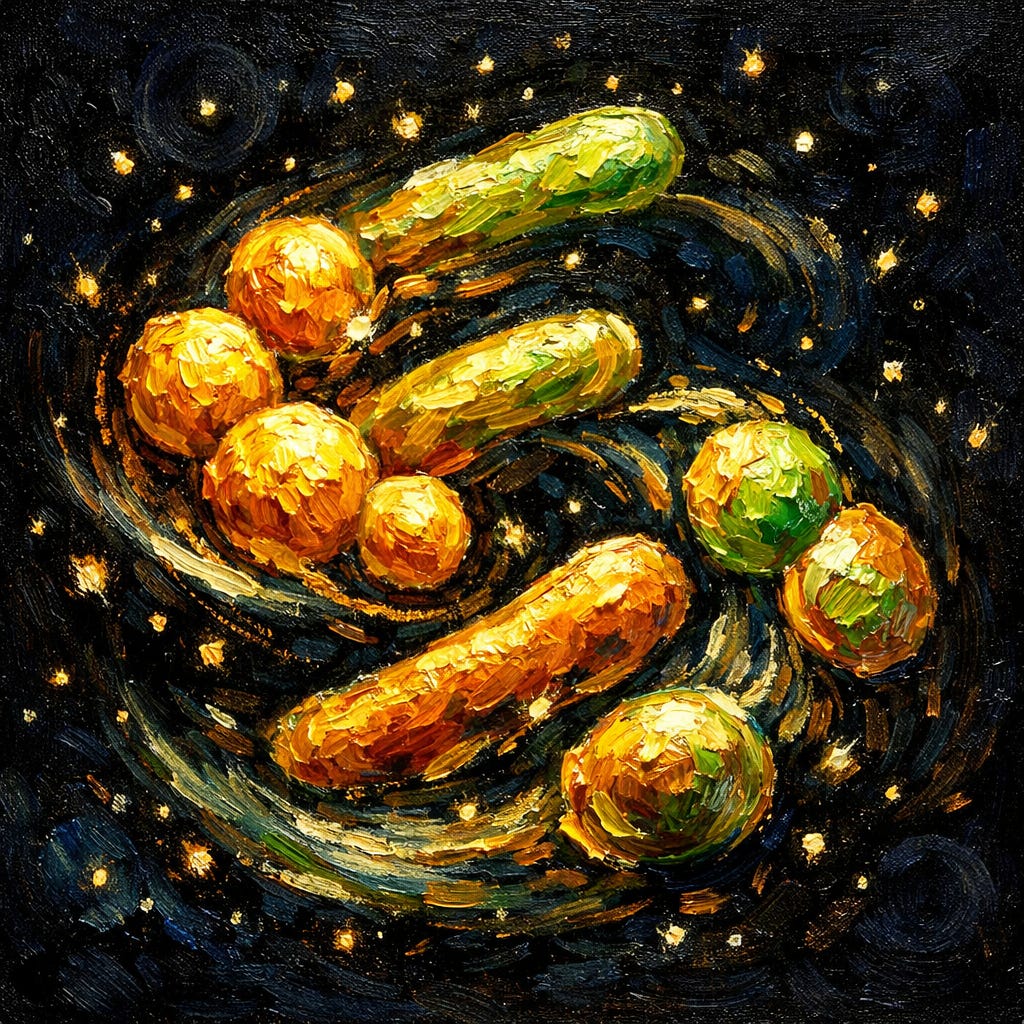
In naturopathic medical school, Dr. Marizelle | Undiagnosed swabbed her cell phone and placed the sample in a petri dish. Standard microbiology coursework. She incubated it at body temperature, then examined what grew under the microscope.
The bacteria were wrong.
Not cocci (round) and not bacilli (rod-shaped) - the two forms students are taught to identify - but something in between. Oval. And as she watched, they shifted. Round forms elongating into rods. Rods contracting into spheres. The organisms were dancing between states.
She reported this to her professor. He told her she’d done the sterile method incorrectly. She repeated the experiment. Same results. The professor repeated it himself, supervised her technique, ran his own parallel culture. Same results.
“Well, you know,” he said, “there’s something going on here. You’re going to have to just write that up in your report. I’ve never seen this before.”
Dr. Arce shared this story recently on Dr. Andrew Kaufman's True Health Report - a conversation between two practitioners I hold in high regard, both doing essential work in terrain medicine. I've had the privilege of interviewing Dr. Arce myself, and her work continues to shape my understanding of these concepts. A year after her lab discovery, Arce was hired as a sales representative for a German company called Sanum (then operating in the US as Pleosanum). On her living room floor, reading their materials, she found the explanation for what she'd witnessed: pleomorphism. The understanding that microorganisms are not fixed species but forms that shift and transform according to their environment.
The professor had never seen it because he’d never been taught to look for it. The mainstream abandoned this understanding over a century ago.

Support Independent Investigative Journalism and Research
This work remains free because paid subscribers make it possible. If you find value here, consider joining them.
What paid subscribers get: 1-2 free books per month. e.g. The PSA Trap, Breast Cancer.
Plus: Access to the Deep Dive Audio Library — 180+ in-depth discussions (30-50 min each) exploring the books behind these essays. New discussions added weekly. That’s 100+ hours of content for less than the price of a single audiobook.
[Upgrade to Paid – $5/month or $50/year]
Get in touch Essay ideas, stories, or expertise to share: unbekoming@outlook.com
The Precursor of All Forms
Antoine Béchamp, a contemporary and rival of Louis Pasteur, spent decades documenting what he called microzymas - submicroscopic entities present in all living tissue. He observed them in blood, in organs, in plants, even in natural chalk from ancient geological formations. His 1,800-page treatise and hundreds of published experiments described their behavior in exhaustive detail.

One experiment became foundational. Béchamp obtained chalk from ancient geological deposits - mineral material that had been sealed from the outside environment for millions of years. No bacteria could have contaminated it. Yet when he created the right conditions, microzymas from within the chalk gave rise to bacterial forms. Life emerging not from external contamination but from within inert natural material.
The microzymas were not bacteria. They were smaller, more fundamental - what Arce calls “precursors” in her book Germs Are Not Our Enemy, a term that captures their function. Given the right environmental conditions, these precursors aggregate and differentiate into bacterial forms. Change the environment again, and the bacteria transform - into mycobacteria, into fungal forms, into yeast.
Kaufman points out that nothing about this should seem exotic. We already accept that bacterial spores can survive conditions that kill active bacteria, then revive when the environment becomes hospitable. We accept that a seed smaller than a fingernail contains everything needed to produce a hundred-foot tree. And as he observes, the pleomorphic cycle “so closely resembles all of the cycles of stem cells from human physiology” - hematopoietic stem cells differentiating into red cells, white cells, platelets, dramatically different forms arising from common precursors based on the body’s needs.
Pleomorphism is this same principle applied to microorganisms. The resistance to it isn’t scientific; it’s paradigmatic.

Multiple scientists across different eras and countries independently observed the same phenomenon. Günther Enderlein in Germany called them protits, from the Greek for “first” - believing they were the base unit from which cells themselves were constructed. Gaston Naessens in Quebec, working with a specialized microscope of his own design, named them somatids and documented a sixteen-stage pleomorphic cycle. Royal Rife, also using proprietary microscopy, observed that minute changes in pH, salinity, temperature, and even sunlight produced “billions if not more forms” from the same fundamental starting material.

Each worked in relative isolation. Naessens was a decade into his research before discovering that others had documented the same phenomenon. The information age had not yet connected them. They developed different terminology for the same observations - microzymas, protits, somatids, bions - creating the appearance of competing theories when they were actually convergent discoveries.

What Enderlein proposed - and what Arce witnessed under her microscope - goes further than Béchamp’s original observations. These precursors don’t merely become bacteria. They may be the building blocks from which our own cells are constructed. Enderlein documented what he described as microzymas coming together to form cellular structures, leading him to argue that Rudolf Virchow was wrong: the cell is not the smallest unit of life. The protit is.
This claim remains unverified by mainstream science, which has shown no interest in investigating it. But Arce has seen the precursors herself - “little micro diamonds” visible in the background of dark field microscopy, sparkling against the black field. She’s observed them in biochar (biological charcoal), present even after organic material has been burned at high temperatures. Surviving conditions that would destroy any recognized life form.

Why Dark Field Matters
The mainstream doesn’t see microzymas because it doesn’t use the right tools.
Standard light microscopy illuminates the background and views specimens against a bright field. This works for larger structures - cells, formed bacteria - but the precursors are too small and too translucent to register. Phase contrast microscopy improves things slightly but still misses them.
Dark field microscopy reverses the lighting principle. The background stays black; objects in the sample are illuminated by refracted light. Against this dark screen, the microzymas become visible - sparkling, moving, transforming.
There’s a second problem. Conventional microbiology stains and fixes specimens before examination. This kills them. What you’re observing is a corpse, frozen in whatever state it occupied at the moment of death.
Arce ran an experiment with methylene blue, commonly used as a microscopy stain. She added a microdot of diluted solution to a blood sample and watched under both light and dark field conditions. As the stain spread across the slide, it lysed the red blood cells - ruptured them - and fixed everything in place. Activity ceased. The sample became a static artifact.
“A lot of people who take methylene blue experience euphoria or experience some sort of relief,” Arce observes, “but it’s basically just suppressing the activity of the symptom that you’re feeling and it’s not really healing you in any way.”
To witness pleomorphism, you need living specimens and dark field conditions. The mainstream uses neither routinely. The dancing between forms happens in a space they’ve chosen not to observe.

The Pleomorphic Cycle
The sequence matters. Microzymas don’t transform randomly; they follow a progression that corresponds to the deteriorating state of their environment.
In healthy terrain - properly oxygenated, mineralized, pH-balanced - the precursors remain small and maintenance-oriented. As conditions degrade, they aggregate into bacterial forms. The specific bacterial species that appears reflects the specific nature of the imbalance.
Dr. Arce uses streptococcus as an example. Strep requires blood to grow; laboratory cultures use blood agar specifically for this reason. When strep appears in tissue, it indicates that tissue is breaking down, possibly experiencing microbleeds. The presence of the organism is diagnostic information, not evidence of invasion. It tells you the mucosa needs support - bone broth, marshmallow root, rest - not that a pathogen has attacked.
“Strep was there because it was doing a job,” Arce explains. “So what do I need to do to help the body so that the strep can pleomorph back into its more, you know, smaller maintenance form?”
If the terrain continues to degrade - more acidity, less oxygen, more accumulated toxicity - the bacterial forms progress to mycobacteria, then to fungal forms, then to yeast. Each stage represents a more advanced state of tissue compromise.
Yeast is a powerful saprophyte, meaning it breaks down dead and dying tissue. Its presence indicates severe lack of oxygen, blood flow, and nourishment - tissues approaching decomposition. This is why yeast flourishes in body areas with poor circulation, minimal sunlight, reduced airflow: between toes, in skin folds, in body cavities. Runners develop fungal toenails not because they’ve encountered a pathogen but because repeated trauma to compressed, oxygen-deprived tissue creates conditions where yeast becomes necessary.
The organisms are not the disease. They’re the response to the disease. They’re telling you what’s wrong if you know how to read them.
What Antibiotics Actually Do
If bacteria are adaptive responses rather than invading enemies, what happens when you kill them with antibiotics?
Arce’s answer: you don’t kill them. You force them to adapt.
Antibiotics are toxic compounds. When introduced to the body, they become the most urgent threat requiring attention. The body diverts resources to eliminating this new toxin. Meanwhile, the bacteria already present - responding to whatever tissue condition called them forth - don’t die. They pleomorph. They shift form to survive the changed environment.
This explains the consistent pattern of fungal infections following antibiotic treatment. The bacteria didn’t leave and get replaced by opportunistic fungi. They transformed. The strep or staph you started with pleomorphed into fungal forms that can survive the new, more toxic terrain.
It also explains antibiotic resistance, which the mainstream treats as a mysterious evolutionary arms race. From a pleomorphic perspective, resistance is simply form-shifting. The “resistant strain” is the same organism in a different configuration, adapted to conditions that now include chronic antibiotic exposure.
The short-term relief people experience from antibiotics is real. But the mechanism isn’t pathogen elimination - it’s the body’s attention being forced elsewhere, the diversion of resources creating temporary symptomatic improvement while driving the underlying problem deeper into the system.
Homotoxicology: The Suppression Gradient
This suppression dynamic operates beyond antibiotics. Hans-Heinrich Reckeweg developed homotoxicology as a framework for understanding how symptoms progress when the body’s eliminatory processes are blocked.
The principle is straightforward. The body eliminates what it doesn’t need through various channels: sneezing, coughing, mucus production, diarrhea, sweating, skin eruptions, fever, inflammation. These are not malfunctions. They’re sanitation systems. When they activate, something is being expelled.

Suppressing these channels doesn’t make the underlying problem disappear. It forces the body to find another route - or, failing that, to store the toxin somewhere.
Arce walks through a typical progression. You sneeze repeatedly after eating pizza - your body attempting to expel something it finds problematic. Rather than investigating, you take an antihistamine. The sneezing stops. Victory.
Except the body still needs to eliminate whatever triggered the response. So it escalates: inflamed sinuses, increased mucus production, expanded surface area for elimination. You now have “sinusitis.” A swab reveals bacteria - because bacteria have been called in to help process what the simple sneeze was trying to accomplish.
You take antibiotics. Or decongestants. Or steroid nasal sprays. The sinusitis resolves. The underlying issue moves deeper.
Now perhaps bronchitis - the lungs recruited for elimination duty. Or gut symptoms as the digestive system takes over. Or skin eruptions as the body’s largest organ attempts to push toxins out.
At each stage, the appropriate symptom looks like illness. At each stage, the standard response is suppression: antihistamines, decongestants, antidiarrheals, topical steroids, anti-inflammatories.
Reckeweg’s chart of homotoxicology maps this progression systematically across six phases: excretion, inflammation, deposition, impregnation, degeneration, and dedifferentiation. The early phases represent the body successfully eliminating toxins through normal channels. The later phases represent toxins that couldn’t be eliminated being stored in tissues, eventually causing cellular damage and dysfunction.
Kaufman observes that the cascade often begins not with prescription drugs but with over-the-counter medications - the first line of suppression that most people reach for without a second thought. Antihistamines to stop sneezing and runny nose. Decongestants to reverse the vasodilation that brings extra blood for healing. Loperamide to paralyze gut elimination. Antipyretics to lower fever. Each one blocks a channel the body opened for a reason.
The phase transitions happen when elimination is blocked. Each suppressed symptom forces the body to either find another exit or move to the next phase. This is the mechanism behind what mainstream medicine calls disease progression - the patient who develops condition after condition, each seemingly unrelated, each treated independently with its own pharmaceutical protocol.
The conditions aren’t unrelated. They’re the same underlying toxic burden being driven deeper by repeated suppression.
“You go further and further towards deeper, stronger eliminatory patterns,” Arce explains, “because either the simple symptoms or the simple patterns are suppressed.”
At the end of this road lies what Reckeweg called the deposition phase: the body, unable to eliminate toxins, surrounds them with protective tissue - biofilm, extracellular matrix, neoplastic growth. The sneeze you suppressed a decade ago has contributed to a cellular environment adapted to containing what it couldn’t expel.
This perspective reframes cancer not as a random cellular mutation but as an endpoint on a suppression continuum - the body’s final adaptive response when all other options have been blocked. The tumor isn’t the disease; it’s the body’s attempt to contain the disease, to isolate what it couldn’t eliminate through the channels that were systematically shut down over years or decades of symptomatic treatment.

The Inflammation Reversal
This framework inverts the mainstream understanding of inflammation.
Conventional medicine treats inflammation as inherently pathological. Anti-inflammatory drugs are among the most commonly prescribed and purchased medications. The natural health world has adopted this framing - “anti-inflammatory diets,” “anti-inflammatory supplements,” turmeric marketed as an inflammation fighter.
But inflammation is a process, not a pathogen. Heat, swelling, increased blood flow - these are logistics. Construction crews arriving at a damaged site. Equipment being mobilized. Roads being closed so work can proceed.
“That swelling, that heat that you get on your ankle when you sprained it is important,” Arce notes. “It creates blood flow, it creates lymph flow, it’s moving the junk out.”
The analogy to construction works precisely because inflammation is construction - or rather, demolition followed by reconstruction. Damaged tissue must be broken down and removed before new tissue can replace it. Osteoclasts break down bone so osteoblasts can build it. As Kaufman puts it, the body cannot repair a water-damaged roof by building over the rot; it must remove the compromised material first, then replace it with new material.
Microorganisms participate in this demolition. That’s what saprophytes do. The bacteria and fungi appearing at sites of inflammation are workers processing damaged tissue, not invaders causing damage.
When inflammation becomes chronic - the actual clinical concern behind anti-inflammatory medicine - the issue isn’t that inflammation itself has become a disease. The issue is blockage. The demolition crew arrived but can’t finish the job. Debris keeps accumulating because drainage routes are compromised. Toxins keep arriving because exposures haven’t stopped. The body maintains inflammation because the work isn’t complete.
Kaufman extends the metaphor: imagine the repair crew on a bridge laid down structural elements, then went on strike because the city refused to pay. That’s what anti-inflammatory drugs do - they send the workers home with the job incomplete. And then traffic continues across the unfinished bridge.
Suppressing chronic inflammation with steroids or NSAIDs doesn’t complete the work. It sends the crew home with the job half-done.
The Natural Medicine Trap
Arce makes a point that implicates the natural health world as much as conventional medicine: herbs and homeopathic remedies can be suppressive too.
“Even certain herbs can be suppressive,” she notes, “because again it’s all about understanding what you need, what your body needs to do, and support that - not go against it.”
Someone walks into a health food store with a sinus infection. They find a homeopathic remedy labeled for sinusitis. They take it. The symptoms resolve. They assume they’ve done something fundamentally different from taking a pharmaceutical.
But if the mechanism is still suppression - stopping the eliminatory process rather than supporting it - the consequence is the same. The problem moves deeper. The terrain approach requires understanding why the body is doing what it’s doing, not merely substituting one suppressant for another.
This is why protocol-based natural medicine often fails. The practitioner (or the self-treating patient) identifies symptoms and matches them to remedies without asking what the body is trying to accomplish. The remedy may be plant-based rather than synthetic, but if it’s blocking elimination rather than supporting it, the homotoxicology gradient continues.
The question isn’t whether to use natural or pharmaceutical interventions. The question is whether the intervention supports or suppresses what the body is already doing.
An herb that stimulates diarrhea when the body is trying to eliminate through diarrhea is supportive. An herb that stops diarrhea is suppressive - even if it’s “natural.” A homeopathic remedy that assists the inflammatory process is supportive. A homeopathic remedy that calms inflammation before the job is done is suppressive - even if it’s diluted beyond molecular presence.
This distinction requires actual understanding of physiology and terrain, not just product categories. It’s why Arce emphasizes becoming “health literate” rather than merely switching from pharmaceutical to natural protocols.
Reading the Terrain
The practical application of this framework is diagnostic. Different organisms indicate different tissue states.
Staphylococcus versus candida on the skin tells different stories even though both indicate that the skin needs support. Staph suggests one type of imbalance; yeast suggests more advanced oxygen and circulation deficits. Reading the organism tells you where the tissue is on the degradation spectrum and thus what kind of support it needs.
Arce describes this as learning a Rosetta Stone. The organism is a symbol that decodes the message the body is sending.
This requires abandoning the germ theory premise that the organism is the problem. Once you understand bacteria and fungi as workers called to specific job sites under specific conditions, their presence becomes information rather than threat.
Consider recurrent vaginal yeast infections - a condition mainstream medicine treats with antifungals, often repeatedly, because “the infection keeps coming back.” From a pleomorphic perspective, the yeast isn’t coming back; it never left. The tissue conditions that call forth yeast forms persist: poor circulation in a body cavity with limited air and light exposure, possibly combined with the metabolic effects of hormonal contraception or antibiotic use depleting bacterial forms that would otherwise be present.
Antifungal treatment suppresses the yeast temporarily. The tissue conditions remain unchanged. The yeast forms return because the terrain still requires them. The solution isn’t more aggressive antifungal protocols but addressing the conditions themselves: improving circulation, reducing toxic exposures, supporting the tissue so it can sustain bacterial forms rather than fungal ones.
“Anytime you see an organism on your body,” Arce says, “it’s not to fight them. It’s to understand that they’re telling you something. They are the Rosetta Stone of some sort of degradation, some sort of decomposition, some sort of trauma, toxin - something that needs help.”
Supporting rather than suppressing means asking what the body is trying to accomplish and providing the conditions for that accomplishment to succeed.
For diarrhea: increased hydration (because fluid is being lost), minerals (because electrolytes are being depleted), and something like charcoal to help absorb and eliminate whatever triggered the response. Not loperamide to paralyze the gut. Arce recommends a simple mixture: clean sea salt, raw honey, and lemon juice in water - essentially the functional equivalent of what Gatorade was supposed to be before it became sugar water with food coloring. Kaufman offers his variation: water with molasses and Shilajit. Same principle, different ingredients - replenishing what’s being lost so the body can continue doing what it needs to do.
For strep throat: support for tissue repair - bone broth for collagen and minerals, marshmallow root for mucosal soothing, rest to conserve energy for healing. Perhaps even a day without speaking to reduce mechanical stress on damaged tissue. Not antibiotics to kill workers who were called to process damaged tissue.
For fever: hydration and rest, allowing the body to create conditions inhospitable to forms that thrive at normal temperature. Not antipyretics to restore the environment those forms prefer.
For skin eruptions: recognizing that the skin is attempting to eliminate something the internal organs couldn’t handle. Supporting that elimination with sweating, dry brushing, and investigation of what’s being expelled rather than topical steroids to suppress the eruption and drive it back inward.
The pattern is consistent: identify what the body is doing, assess whether it needs resources to do it better, and avoid blocking the process unless genuinely life-threatening.
The Decomposition Observation
Arce regularly observes blood samples under dark field conditions as they degrade on the slide. Outside the body, deprived of nourishment and oxygen, blood begins to decompose. The pleomorphic cycle runs in accelerated time.
She can watch microzymas respond to the changing environment - shifting into bacterial forms, then into more advanced forms as conditions worsen. The end state is fixed, dried tissue and the organisms that processed it into that state.
One finding stands out: every person’s blood decomposes differently. The specific forms that appear, the rate of progression, the patterns of transformation vary between individuals. There’s no single decomposition pathway. Each terrain has its own character.
This variability is another form of diagnostic information. How your blood dies tells a story about how it lived - what accumulated, what was deficient, what adaptive patterns your microzymas developed.
The mainstream, fixing and staining specimens, observing corpses rather than processes, has no access to this information.
What Was Lost
Louis Pasteur won and Antoine Béchamp lost. Germ theory became medicine’s foundation. The organism became the enemy. The terrain became irrelevant.
This wasn’t a scientific conclusion reached through rigorous comparison of the two frameworks. It was a choice - arguably a political and commercial choice - that closed off entire avenues of inquiry. Dark field microscopy of living specimens became a niche practice. Pleomorphism became a curiosity mentioned in passing, if at all. The millions of forms that emerge from the same precursor under varying conditions became fixed species to be catalogued and destroyed.
The consequences extend beyond theory. Germ theory produces a medical system oriented around killing - antibiotics, antivirals, antifungals, disinfectants, sterilization. It produces patients who view their own bodies as battlegrounds under constant siege. It produces a pharmaceutical industry built on identifying enemies and selling weapons.
Terrain theory produces something different: a framework for understanding the body as intelligent, its symptoms as communications, its microorganisms as partners in maintenance and repair. It produces patients who investigate their internal and external environments rather than demanding prescriptions. It produces practitioners who read organisms rather than fight them.
Arce’s professor had genuinely never seen bacteria change form. His training ensured he never would. When his student showed him evidence that contradicted what he’d been taught, he had no framework to interpret it. Something is going on here. I’ve never seen this before.
That reaction - honest confusion from a credentialed expert confronting evidence outside his paradigm - captures why pleomorphism remains marginal despite over a century of documented observation. The experts genuinely don’t know. They can’t know, because knowing would require using tools and methods their training excludes.
Arce made it her mission to teach every student in her school about pleomorphism and isopathic remedies. She went on to write Germs Are Not Our Enemy, to build a practice around terrain medicine, to carry forward what Béchamp and Enderlein and Naessens documented.
The cost of the other path is measured in chronic disease: conditions that emerge from decades of symptom suppression, from misreading the body’s communications, from treating adaptive responses as pathology. The sneeze that became sinusitis that became bronchitis that became something with a name and a pharmaceutical protocol and a lifetime of management.
The organisms were trying to help. They were dancing between forms, adapting to conditions, processing what needed processing. We declared war on them instead.
References
Interview Source
Dr. Marizelle Arce in conversation with Dr. Andrew Kaufman, The True Health Report - YouTube
Books
Marizelle Arce, Germs Are Not Our Enemy: Why the New Terrain Medicine Is Best for Optimal Health - Amazon
Historical Researchers
Antoine Béchamp - French scientist who documented microzymas and their transformation into bacterial forms; author of The Blood and Its Third Element
Günther Enderlein - German microbiologist who developed the protit theory and pleomorphic cycle; founder of Sanum remedies
Gaston Naessens - Quebec-based researcher who documented the sixteen-stage somatid cycle using his proprietary Somatoscope
Royal Rife - American inventor whose microscopy work documented form variability in microorganisms
Hans-Heinrich Reckeweg - German physician who developed homotoxicology as a framework for understanding disease progression
Contemporary Practitioners
Dr. Andrew Kaufman - Physician and researcher whose work challenges mainstream virology and germ theory; host of The True Health Report - Website
Dr. Marizelle Arce - Naturopathic doctor specialising in terrain medicine, pleomorphism, and dark field microscopy; author of Germs Are Not Our Enemy
Substack: Dr. Marizelle
Website: terraindoctor.com
Book website: germsarenotourenemy.com
Previous Coverage
Interview with Dr. Marizelle Arce: The Terrain Doctor - Lies are Unbekoming
New Biology Clinic
For those of you looking for practitioners who actually understand terrain medicine and the principles we explore here, I want to share something valuable. Dr. Tom Cowan—whose books and podcasts have shaped much of my own thinking about health—has created the New Biology Clinic, a virtual practice staffed by wellness specialists who operate from the same foundational understanding. This isn’t about symptom suppression or the conventional model. It’s about personalized guidance rooted in how living systems actually work. The clinic offers individual and family memberships that include not just private consults, but group sessions covering movement, nutrition, breathwork, biofield tuning, and more. Everything is virtual, making it accessible wherever you are. If you’ve been searching for practitioners who won’t look at you blankly when you mention structured water or the importance of the extracellular matrix, this is worth exploring. Use discount code “Unbekoming” to get $100 off the member activation fee. You can learn more and sign up at newbiologyclinic.com
Dear Unbecoming, You had better check your brakes. Many a person was made to suffer in the early 20th century for daring to discuss pleomorphism.
In 1917, someone at the NY Times published that Edward Rosenow had cured polio (it has to do with the morphing of bacilli and virus). Oops not supposed to reveal that. So back we went to the belief that polio is just a virus.
This is discussed in my 2013 book, "Consider the Lilies". Here is the PDF: https://gumshoenews.com/wp-content/uploads/2024/11/lillies_book_20Jan2014_highres368.pdf
PS Are the illustrations on your Substack painted by you? Wow.
Health care is so desperate to be relevant that they weaponized the clean up crew and the rubbish collector that picks up your weekly trash. The harder they try the less relevant they become. How about if we all said "I will not comply" and ate food that are close to the soil. Not necessarily being a vegan, but if we choose to eat animals, then eat animals raised according to their nature: free roaming and eating what grows naturally if left unfallowed. (Plants we call 'weeds'). By disconnecting we avoid the fear porn, vax pushers or paid off government bureaucrats telling us how to think. It's wealth transfer pure and simple.