
Five Bottles, No Vitamins
An Essay on What the Body Needs, What the Industry Sells, and the Five Substances That Sit Between Them

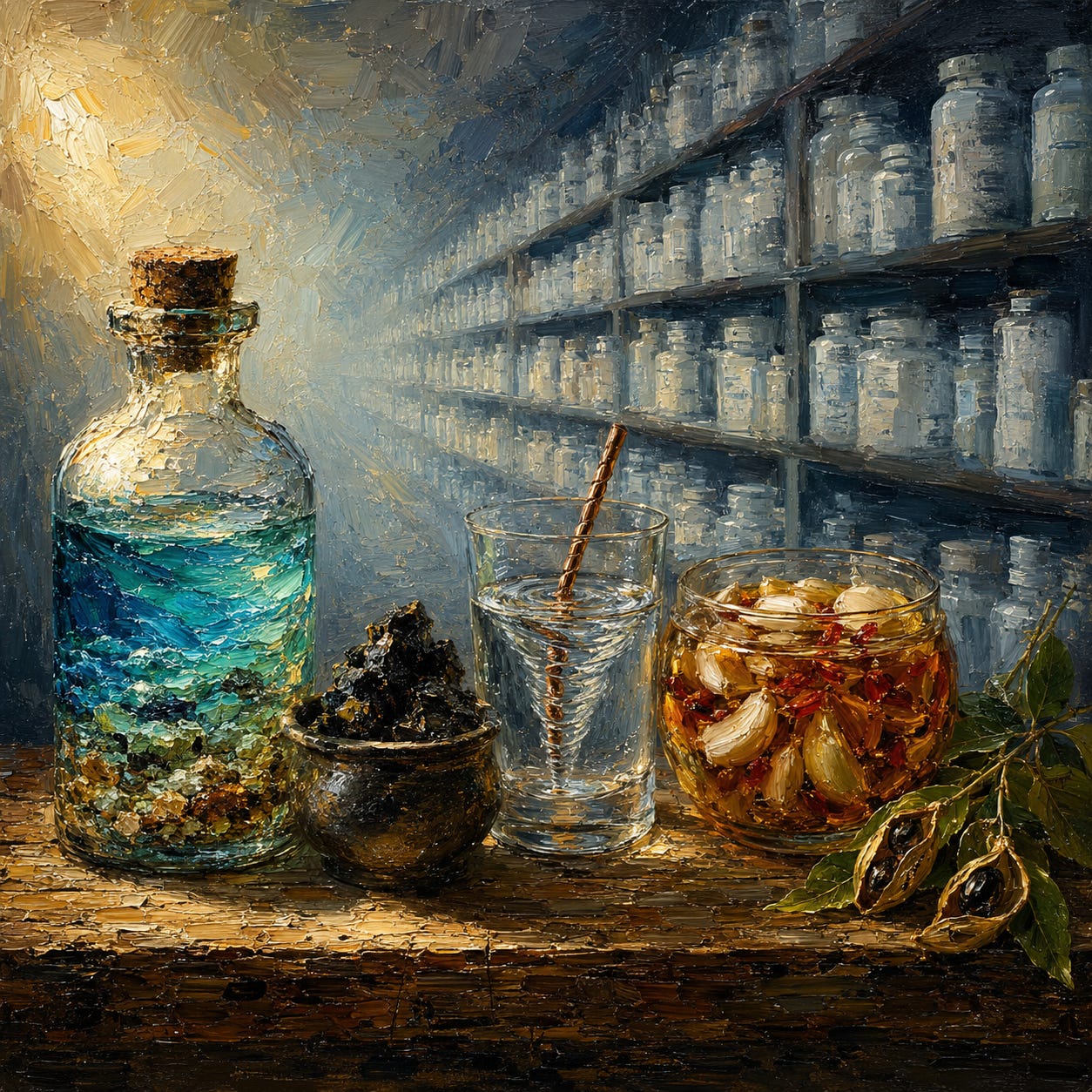
The Absence
Walk into any health-food shop and look at what’s on offer. Vitamin C in capsules and powders, dosed in grams. Vitamin D, the dominant supplement of the last fifteen years, in soft-gels and drops. Omega-3 fish oils, increasingly krill oils. Magnesium glycinate, magnesium citrate, magnesium threonate. B-complex tablets, methylated and unmethylated. Probiotics with strain counts running into the tens of billions. Zinc lozenges, selenium, iodine drops, NAC, CoQ10, alpha-lipoic acid, quercetin, resveratrol. A wall of bottles, each promising the body something the body is presumed to lack.
Thomas Cowan, asked in April 2025 what he would take if limited to five supplements, named none of them.¹
Not one of the staples of the alternative-health supplement aisle appears in his daily routine. No vitamin C. No vitamin D. No omega-3. No B-complex. No magnesium tablets. No probiotic capsules. No CoQ10 or NAC. The five things Cowan does take share almost nothing in common with the products that dominate the supplement industry — including the products marketed to readers of alternative health Substacks, podcasts, and books. His list is shorter than most. The absences in it carry the methodological argument that, once granted, dissolves the supplement industry as currently constituted. Cowan’s protocol is what coherent supplementation looks like after that argument has been taken seriously.
This work stays free because paid subscribers make it possible. They get the full book library, the Deep Dive Audio Library, and the Questions for Your Doctor, Before You Consent, and Package Insert series. No grants, no gatekeepers — your subscription is what keeps it that way.
The Methodological Problem
No chemical, Cowan says, has ever been found in the living tissues of any organism without other substances being added in the process of finding it. To “isolate” what the industry calls vitamin C from blood, the blood must be mixed with reagents — acids, solvents, indicators. To detect dopamine in brain tissue, the tissue must be processed with extraction chemicals. To measure interleukin-2 in serum, the serum must be combined with antibodies, buffers, and detection compounds. The detection procedure is never separable from the substance detected.
The question this raises cannot be answered within biochemistry. How do we know the chemicals we added did not produce the thing we claim to have found?
“I’m not claiming it does,” Cowan said in the April 2025 podcast. “What I’m saying is we don’t know whether it does or not. And so if we don’t know whether it does or not, then you can’t say that that thing — whatever that chemical was — is actually found in you while you were alive.”¹
The named compounds exist as chemicals in a laboratory. Ascorbic acid exists. Cholecalciferol exists. These molecules can be synthesised and characterised. What is unproven is that they exist as discrete entities in living tissue before the isolation procedure begins. The procedure may create what it claims to detect. Biochemistry cannot rule this out, because the only way to look is by way of a procedure that admits the possibility.
The history bears the methodological problem out. McCollum and Davis’s 1913 vitamin A studies, the founding work of the field, used heated casein as a “deficiency diet” — not knowing that casein binds retinol tightly and that heating converts some of it to retinoic acid, the most toxic form. Wolbach and Howe’s 1925 study, which became the foundational reference for vitamin A deficiency pathology, repeated the same methodology with the same blind spot. A foundational pillar of the vitamin A story proved the opposite of what its authors believed, and the inversion was never corrected. Lind’s concentrated citrus juice (”rob”) failed to prevent scurvy where fresh citrus succeeded — and the standard explanation that the heat destroyed the ascorbic acid concedes the central point. If removing the compound from its living matrix destroys its function, the matrix is the active agent.
Robert Thiel, cited extensively by Lester and Parker, puts the practical consequence in plain terms: most supplement vitamins are made or processed with petroleum derivatives or hydrogenated sugars, and mineral supplements are “industrial chemicals made from processing rocks with one or more acids.” Plants can metabolise rock minerals into a form the body can absorb. The body, fed rock minerals directly, cannot. The supplement is not what it is presented as.
A multivitamin, on this account, contains industrial chemicals named for substances that may or may not exist in the form claimed in the food they are supposedly extracted from. A vitamin D capsule contains cholecalciferol — derived from lanolin processed with benzene and chloroform, sharing its molecular identity with the active ingredient in commercial rat poison — and the proposition that this compound replaces something the body needs rests on a measurement of “vitamin D status” that itself measures what the liver does with supplemental cholecalciferol. The reasoning is circular at every point.
Cowan does not perform this critique in the April 2025 podcast. He states the conclusion and moves on. The five things on his counter are what supplementation looks like for someone who has accepted that the entire vitamin-and-extracted-nutrient model rests on a foundation it cannot defend.
What He Takes
The five items belong to a single logic, with one acknowledged exception. The logic is the mineral spectrum. The internal environment of the body — the fluid in which every cell lives — requires the full range of minerals to hold its electrical character. Modern food, modern water, and modern soil do not provide that range. The substances Cowan takes are whole materials that do.
Plasma seawater, taken first thing every morning. A capful, before the cats are fed. Marine plasma is seawater drawn from naturally occurring ocean vortices where phytoplankton concentrate, cold-filtered without heat or chemical sterilisation, and diluted in some preparations to match plasma osmolarity. It carries the full mineral spectrum of the sea, in the proportions life developed within. The clinical history of marine plasma is its own story, told elsewhere.² The relevant point here is that this is a whole substance from a whole environment, not an extracted compound, and it delivers minerals in a charged matrix no isolated tablet can replicate. Cowan calls it “pretty much the number one supplement” he would recommend to anyone.

Strophanthus, taken next. Twenty drops of liquid extract, or the contents of one capsule, placed under the tongue. Cowan has taken strophanthus daily for twenty years. He has no heart disease and makes no personal therapeutic claim. He keeps taking it for two reasons. One biographical — he started because critics told him it would kill him, and it hasn’t. One clinical — the cardiac glycoside literature for the over-fifty-five cohort.¹ The full case is told elsewhere.³
The strophanthus item should be named for what it is: the exception in the protocol. It does not fit the mineral-spectrum logic that unifies the other four. It is a plant glycoside with a specific mechanism — Cowan, following Gilbert Ling, locates that mechanism in the support of structured cellular water, which sits closer to the broader framework than a pharmaceutical action does but is still a different category of intervention than mineral repletion. The framework holds for four items; the fifth is included for reasons internal to Cowan’s own clinical history and his judgment about cardiac glycosides past the mid-fifties. Including it anyway is what a real practitioner’s protocol looks like — coherent at the level of overall logic, with one acknowledged item that survives on its own merits.

Charged water, made each morning with the Analemma wand. Primary spring water, collected weekly in glass jars, stirred for one minute with the wand before drinking. The wand is the supplement; the water is the medium. The principle is structure and coherence — that healthy water can be improved further by vortex-induced restructuring, that the resulting water carries different properties than the water that went in. Mayu Water vortex devices produce a similar effect by different means. The argument here is closer to physics than nutrition. Water has structure. Structured water behaves differently in the body than bulk water. The terrain runs on water; the quality of the water shapes the terrain.
Shilajit, three or four squirts of liquid or one tablet, taken in the morning. The substance has been used in Ayurvedic medicine for millennia and was tested extensively in Soviet clinical research, with documented effects on bone repair, hormonal health, and cellular energy production. The full case is told elsewhere.⁴ For Cowan’s purposes, shilajit functions as the earth-element complement to marine plasma. Marine plasma carries the minerals of the sea. Shilajit carries the minerals of the mountains — compressed plant matter, organic acids, fulvic and humic compounds, the full periodic-table spectrum minus the rare earths. The terrain is restored from two directions.

Fire cider, a tablespoon added to the morning glass of water. A traditional preparation — apple cider vinegar, garlic, cayenne, sometimes horseradish, ginger, turmeric, onion. Cowan speaks to the apple cider vinegar component specifically: digestion support, acidity introduction. The longer folk history of fire cider includes circulatory stimulation and respiratory benefit. This is a whole substance, a fermented matrix of plant materials and vinegar. The body recognises what it is. The category is food, not medicine.
The morning sequence, as Cowan describes it: wake up. Capful of plasma seawater. Open the strophanthus capsule and place the contents under the tongue. Begin drinking the glass of charged water. Add a tablespoon of fire cider to the water. Squirt the shilajit into the mouth while drinking. The whole protocol takes a few minutes. He does it once a day. If he were treating a specific condition he might dose more often; without a complaint to address, once is enough.
The Logic Behind the Choices
The unifying principle is mineral charge. The body holds electrical character because it holds the mineral spectrum that maintains that character. Minerals carry charge. Charge animates the terrain. Mineral depletion produces charge loss, charge loss produces dysfunction, and dysfunction is what medicine calls disease.
The electrical character of living tissue is what EKGs, EEGs, and EMGs measure. Bone is piezoelectric. Connective tissue conducts. Albert Szent-Györgyi spent the latter half of his career arguing that life at the cellular level is fundamentally a matter of electron flow, and that the substances we call vitamins act — when they act at all — as electron donors rather than as molecular cogs in a metabolic machine. The body, at the deepest level we can currently measure, is an electrical organism, and its electrical character depends on the minerals that carry the charge.
Modern life depletes exactly this. Industrial agriculture strips soils. Refined foods strip what remains. Tap water provides a narrow band of dissolved solids, mostly altered by treatment. The minerals that traditional diets delivered — through bone broth, organ meats, fermented foods, unrefined sea salt, mineral-rich spring water — are largely absent from the modern table. The terrain that twentieth-century medicine inherited from nineteenth-century industrial food had already been depleted for fifty years before that century began.
The five items address this directly. Marine plasma carries the minerals of the sea. Shilajit carries the minerals of the mountains. Charged water restores the structure of the medium that delivers them. Fire cider supports the digestive acidity required to absorb them. Strophanthus, as noted, sits adjacent to this logic rather than within it.
The implicit cosmology underneath the protocol is older than supplementation. Cowan names four elements — water, air, warmth, and earth — and frames the substances as practical instantiations of restoring what modern life depletes from each. Water is restored by structure (the wand) and by mineral repletion (marine plasma, shilajit). Earth is restored by the mineral-rich materials drawn from sea and mountain. Air and warmth he addresses through practices rather than substances.
What Sits Around the Five
Cowan does not stop at the substances. Asked the question, he answered it, and then kept going. The five bottles are part of a larger picture that includes four daily practices he treats as continuous with the morning protocol.
Cold water on the face each morning — five splashes from a bowl of refrigerator-cold water, a ritual he has maintained for years, framed as parasympathetic activation and morning alertness. Earthing, at least thirty minutes daily, bare feet on bare ground — grass, sand, garden, mud. Sun exposure, also at least thirty minutes, without glasses, face oriented toward the sun, as much skin exposed as the temperature permits. Daily physical stress until the body can do no more — push-ups, bar hangs, primal movement work — five to ten minutes a day.
The substances are not the whole answer, and Cowan does not present them that way. The bottles on the counter restore minerals and charge. The earth contact, the sun exposure, the cold immersion, and the physical stress restore what no substance can supply. The protocol is the five items plus the four practices.
A reader who takes only the five substances and changes nothing else has done about half of what Cowan is suggesting. The four practices are free, require nothing to be purchased, and may matter more than any of the substances. The structure of what he says is that the substances complete the practices, not the other way around.
Explain It To A Six-Year-Old
Your body is full of tiny little machines called cells. The cells are alive because they have a kind of invisible electricity running through them. That electricity is what makes your heart beat and your brain think and your muscles move.
The electricity comes from minerals — tiny pieces of the earth and the sea that are dissolved in your body. The minerals are like the batteries that run the cells.
A long time ago, people ate food that had lots of these minerals in it. They drank water from springs and rivers that had lots of minerals. They walked on the ground with bare feet and stood in the sun and ate vegetables from soil that had everything in it. Their cells had plenty of batteries.
Now, most food does not have very many minerals in it. Most water doesn’t either. Most people stay inside and wear shoes and never touch the ground. The cells run out of battery.
The shop has rows and rows of bottles that say they put minerals back in. Most of those bottles have just one thing in them — like a battery with only one corner. Your body needs the whole battery.
A man called Tom Cowan figured out which things give your body the whole battery instead of just one corner. Water from the sea, because the sea has every mineral in it. A black goo from the mountains, because the mountains have every mineral in it too. Water that has been stirred properly. A spicy vinegar drink. And one plant from Africa that helps the heart.
He also walks on the ground every day. He looks at the sun every day. He puts cold water on his face every morning. He moves his body until he can’t move any more.
You don’t really need bottles. You mostly need the things people used to have all the time and don’t anymore.
What This Means
The point is not that Cowan’s five items are the correct answer. The point is that the question “which supplements should I take?” is downstream of a paradigm question the supplement industry depends on not being asked. The paradigm holds that nutrients exist as discrete chemicals in food, that those chemicals can be measured, that deficiency is what falls below a threshold, and that the answer is to take the measured chemical in a tablet. Every step of this rests on a methodology of isolation that cannot establish that the named chemicals exist as discrete entities in living tissue before the isolation begins.
A protocol built on that paradigm looks like a multivitamin and a stack of single-compound capsules. A protocol built on the rejection of that paradigm looks like Cowan’s — whole substances from whole environments, chosen for the breadth of what they deliver rather than the narrowness of what they isolate, accompanied by direct contact with the earth, the sun, the cold, and physical stress.
The five items do not constitute medical advice. They are an example of what coherent supplementation looks like once the isolation premise has stopped governing the choices. The case for any individual item is in the dedicated essays. The underlying argument is here.
The body needs minerals in their natural matrices, water in good structure, sun on skin, earth under feet, food that was alive, and the physical stress that animates living tissue. The man who has been doing this every morning for twenty years takes five things to fill the gaps modern life leaves in that picture. None of the five appear at the supplement aisle of an average pharmacy. The mismatch between what the body needs and what the industry sells is the picture, and the picture is the argument.
References
Cowan, Thomas. “If I Had Only 5 Supplements to Take, What Would They Be?” Podcast, 30 April 2025.
Unbekoming. “What Is Marine Plasma? An Essay on René Quinton, the Inner Ocean, and the Medicine the Pharmaceutical Industry Let Die.” 25 April 2026.
Unbekoming. “The Gift from Paradise: Strophanthus and the Heart Medicine That Disappeared.” 4 February 2026.
Unbekoming. “Shilajit: The Mountain’s Medicine That Modern Science Can’t Patent.” 10 March 2026.
Unbekoming. “Do Vitamins Exist?” 11 January 2026.
Unbekoming. “The Supplement Question: An Essay on Vitamins, Minerals, and the Business of Deficiency.” 29 December 2025.
Genereux, Grant. Poisoning for Profits. Self-published, available at ggenereux.blog.
Lester, Dawn, and David Parker. What Really Makes You Ill? Why Everything You Thought You Knew About Disease Is Wrong. 2019.
Thiel, Robert. “The Truth About Vitamins in Supplements.” Cited in Lester & Parker (2019).
Thiel, Robert. “The Truth About Minerals in Nutritional Supplements.” Cited in Lester & Parker (2019).
Price, Weston A. Nutrition and Physical Degeneration. Price-Pottenger Nutrition Foundation, 1939.
Szent-Györgyi, Albert. Bioenergetics. Academic Press, 1957.
Unbeknownst to many and well hidden behind the scenes, is the fact that big pharma owns much of the supplement industry. Yes, it is true. Since their biggest profit makers are vaccines and drugs, why would they bother with marketing much cheaper-to-manufacture supplements?
Their extremely profitable marketing model requires a plethora of unhealthy and ill patients feeding endlessly in their putrid and toxic drug trough. Thus, there is NO FRICKING WAY that the slime known as big pharma is going to market supplements to keep you healthy. Many of these supplements are toxic too. Many come with ingredients from China and India. Spooky.
Connect the dots and ditch the vaccines, drugs and SUPPLEMENTS. Eat as much real food as you can and less sody-pop, energy drinks and fast foods.
I agree that chemicals, referred to as vitamins or supplements, are bogus. I was taking thousands of milligrams of liposomal vitamin C (ascorbic acid), and my vitamin C was low. My functional chiropractor told me to try Camu Camu, a tropical fruit that I had never heard of. I did, and all my bruises disappeared in days, and I no longer bruise. I now stick, when possible, to naturally sourced supplements. Substances our bodies recognize, and can actually use