
What Is Depression?
An Essay on the Disease That Was Invented to Treat Sorrow

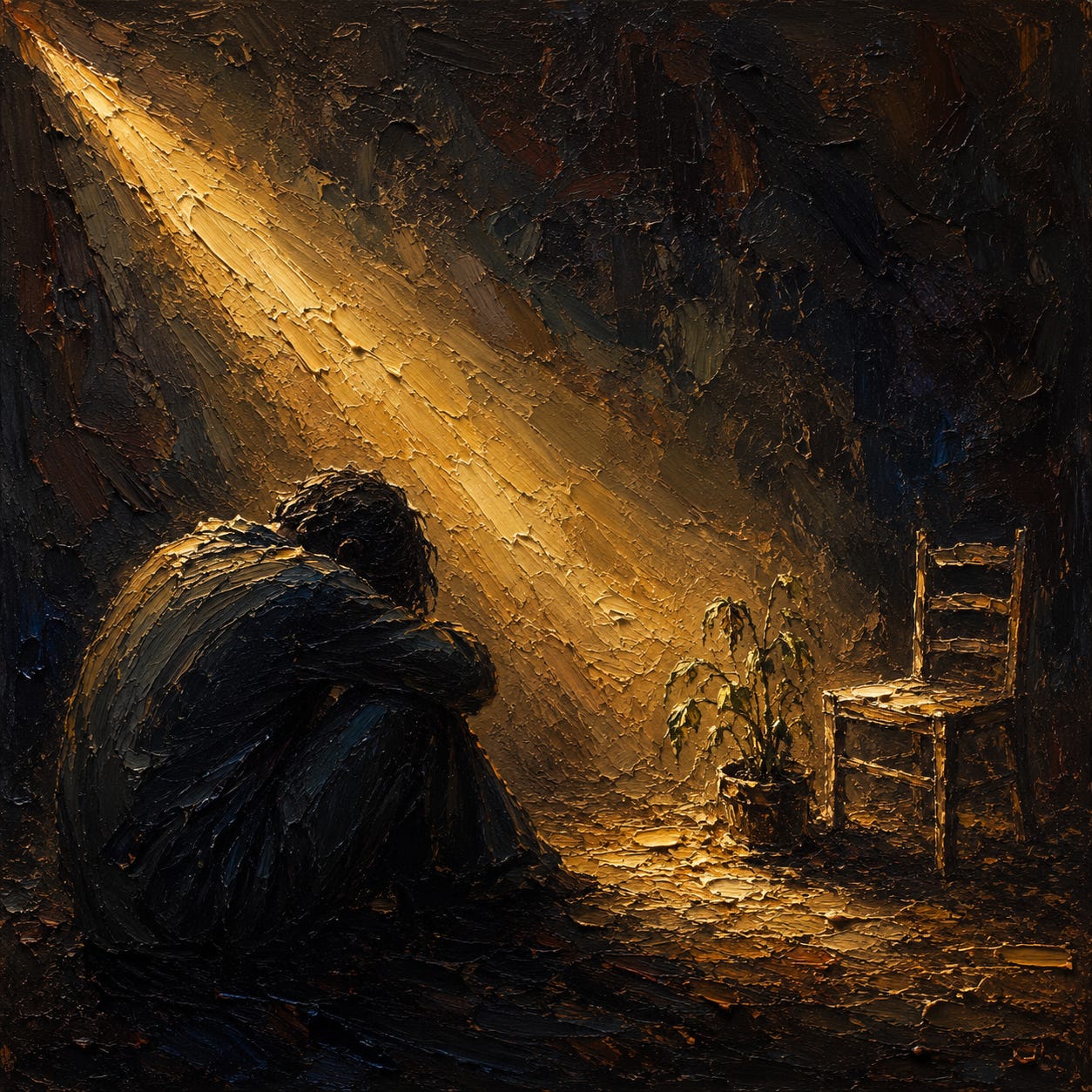
This essay examines the medical concept of depression and the framework that replaced sorrow with diagnosis. It is not medical advice. Nothing here is an instruction to start, stop, or alter any medication. Stopping a psychiatric drug abruptly can be dangerous, and safe withdrawal is its own subject, addressed in separate essays.
The Admission
In 2005, the director of the National Institute of Mental Health stood before the assembled membership of the American Psychiatric Association and told them that the manual they diagnosed from had “100 percent reliability and zero percent validity.”¹
Thomas Insel was not a critic. He ran the largest mental health research agency on earth. Reliability means that two clinicians applying the same checklist to the same patient will reach the same label. Validity means the label corresponds to something real — an actual disease, with a cause, a course, and a biological signature that separates the sick from the well. Insel was conceding, to the people who make their living from the diagnosis, that the second quality was entirely absent. The checklist was consistent. It was consistent about nothing.
He framed this as good news. The age of “trial-and-error diagnosis” was ending; brain imaging would soon reveal “the underlying biology of mental disorders,” and validity would arrive at last.¹ Two decades later it has not arrived. No scan, no blood test, and no biological marker distinguishes a person diagnosed with major depression from a person who is not. The diagnosis remains exactly what Insel described: a reliable label for something that has never been shown to exist as a discrete disease.
The question “what is depression?” has two answers that point in opposite directions. The medical answer is a disease of the brain, a chemical malfunction, a lifelong condition requiring lifelong management. The other answer is older, simpler, and supported by the establishment’s own data once you stop looking where the streetlight shines. Depression is what a body and a mind do when something is wrong — wrong in a life, wrong in a diet, wrong in the conditions a person is forced to live inside. It is a response, not a defect. Medicine took the response, called it the disease, and built an industry on suppressing the signal.
The case for that second answer is built from the establishment’s own admissions, its own studies, and its own diagnostic manual. It begins with the seam where the disease comes apart.
This work stays free because paid subscribers make it possible. They get the full book library, the Deep Dive Audio Library, and the Questions for Your Doctor, Before You Consent, and Package Insert series. No grants, no gatekeepers — your subscription is what keeps it that way.
The Disease That Was Invented, Not Discovered
In the years leading up to DSM-III, a psychiatrist named Paula Clayton made a discovery that should have ended the project before it began. Clayton was not an outsider. She sat on the DSM-III Task Force on Affective Disorders and had helped perfect the diagnostic criteria that the manual would soon enshrine. Studying the recently widowed, she found that people in ordinary grief routinely met five or more of the nine symptoms of depression. By the book, the bereaved were mentally ill.²
The committee could not ignore this. A diagnostic manual that turned every mourner into a psychiatric patient was, in Gary Greenberg’s phrase, “a scientific nightmare and a potential public relations disaster.”³ But the committee could not solve it either, because solving it would have required admitting that the symptoms of depression are also the symptoms of being human after a loss — that the checklist could not tell sickness from sorrow. So they did neither. Robert Spitzer, the architect of DSM-III, carved out an exception and slipped it into the back of the manual, in a section titled “Conditions Not Attributable to a Mental Disorder.” A grieving person with all the symptoms of depression did not have depression. He had Uncomplicated Bereavement.²
The exclusion acquired a clock. In DSM-III-R, the loophole was given a time limit: after two months of meeting the criteria, the bereaved person crossed the line into major depressive disorder.⁴ The same tears, the same sleeplessness, the same loss of appetite and pleasure — a normal reaction on day fifty-nine, a brain disease on day sixty-one. No biological event marks the transition. Greenberg compared the bereavement exclusion to the epicycles that Ptolemaic astronomers bolted onto their models to explain why the planets refused to move where the theory said they should. The epicycles kept the astronomers respectable and the models intact. They described nothing real.⁵
The exclusion exposes the whole construct, and it does so using the manual’s own logic. The stated principle of DSM-III was that mental disorders are known by their symptoms alone, without reference to cause or circumstance. Depression was its symptoms — no more, no less. Yet here was a single circumstance, recent death, that suspended the diagnosis. If the diagnosis can be suspended by knowing that a person’s husband just died, then cause and circumstance were never irrelevant. They were decisive. The manual smuggled back in, through one narrow door, exactly the thing it claimed to have eliminated.
The exemption raised a question the profession could not afford to answer. If grief after a death is a normal reaction rather than a disease, then death cannot be the only loss that produces one. Greenberg listed the obvious candidates: betrayal by a lover, financial ruin, political upheaval, serious illness, the slow accretion of life’s defeats, the despair that comes from looking honestly at one’s own mortality.⁵ Each of these produces the same picture. Each leaves a person sleepless, joyless, withdrawn. By the manual’s logic, each should also spare the sufferer from diagnosis. None of them did.
The reason becomes clear in what happened when someone finally pressed the point. Jerome Wakefield, a professor at New York University, argued that if grief after death is exempt, grief after other losses should be too — that the manual was pathologizing normal sadness on a vast scale. To test it, he and his colleagues mined the National Comorbidity Survey, an NIMH dataset that had asked depressed subjects what set their symptoms off. Of 1,308 people diagnosed with major depression, 157 traced their symptoms to a death and 710 to some other loss — a divorce, a job, a financial collapse. Wakefield compared the two groups across every dimension: number of symptoms, duration, which of the nine symptoms appeared. The groups were, for practical purposes, identical.⁶ A death and a divorce produced the same depression. The exemption for one and not the other was arbitrary on its face.
This finding could have led the profession to a humane and obvious conclusion: that depression is, in a great many cases, what loss feels like, and that the line between sorrow and sickness depends on the meaning of the loss to the person living through it. It led to the opposite. When the DSM-5 committee took up the bereavement exclusion, the psychiatrists Sidney Zisook and Kenneth Kendler used Wakefield’s own data to argue not that the exemption should be extended to other losses, but that it should be abolished altogether. If grief and depression are indistinguishable, they reasoned, then the grieving should be diagnosed and treated too. “They used my evidence against me,” Wakefield said.⁷
Kendler made the stakes explicit in a statement the APA posted during the controversy. “The DSM-IV position is not logically defensible,” he wrote — meaning that singling out bereavement contradicted the manual’s founding premise. The exclusion had to be either eliminated or extended “so that no depression that arises in the setting of adversity would be diagnosable.” And since, as he acknowledged, “the majority of individuals” who get the diagnosis develop it “in the setting of psychosocial adversity,” extending the exemption would gut the diagnosis entirely.⁸ There was the choice, stated plainly by one of the field’s own nosologists: recognize that most depression is a response to adversity and watch the disease category collapse, or erase the concept of adversity from the diagnosis and keep the category intact.
The man who had chaired the previous edition saw exactly what was at stake and said so in public. Allen Frances, who ran the DSM-IV task force, attacked the proposal in a New York Times op-ed, warning that removing the exclusion would turn ordinary grief into major depression and deliver more patients to the drugs.²⁷ A public furor followed, and the APA posted Kendler’s defense in response. The argument was now in the open: the discipline’s own former chief diagnostician on one side, calling the removal a medicalization of mourning, and the current committee on the other, insisting that consistency demanded it. The committee won. In 2013, the DSM-5 chose the second path. The bereavement exclusion was removed.⁹ A person could now be diagnosed with a mental disorder for grieving a death two weeks after the funeral.
The detail worth holding onto is that this was not a discovery. Nothing was learned about the brain between DSM-IV and DSM-5 that justified the change. The same symptoms that had been a normal reaction to loss became a treatable disorder because a committee decided that admitting otherwise would shrink the diagnosis below a defensible size. The boundary of the disease moved, and it moved for reasons that had nothing to do with biology and everything to do with keeping the category whole.
The serotonin story — the chemical imbalance that supposedly underlay all of this — had already failed by the time these arguments took place, and it failed in the same way: the establishment’s own researchers could not find it. (That collapse is the subject of a separate essay and need not be relitigated here.) What matters for the question at hand is that the diagnosis never rested on biology. It rested on a checklist, and the checklist could not survive contact with a single grieving widow without an emergency patch. “Even the highest priests of psychiatric orthodoxy,” Greenberg wrote, “will, at least in private company, admit that they haven’t resolved this conundrum so much as legislated it out of existence.”¹⁰ That is the literal history. The conundrum — that depression is nothing more or less than its symptoms, and those symptoms are also the symptoms of an unhappy life — was not solved. It was voted on.
A condition defined by committee vote, patched with an arbitrary calendar, and stripped of that patch the moment it threatened the size of the market, is not a disease that was discovered. It is a category that was built. The question is what got built on top of it.
The Manufacture of Chronicity
Before the drugs, depression was understood as something people recovered from.
This is not nostalgia. It is the documented natural history. Studies of hospitalized patients in the pre-drug era found that depression was episodic, and that around half of those who suffered a first episode were never hospitalized for it again.¹¹ Emil Kraepelin, cataloguing depression at the turn of the twentieth century, observed that untreated episodes usually cleared within six to eight months.¹² The expectation a doctor could offer a patient and a family was that the darkness, however severe, would lift. It took time, and it passed.
The most rigorous modern confirmation of this came from a psychiatrist who set out to measure it. In 2006, Michael Posternak of Brown University tracked eighty-four patients who had recovered from one episode of depression, relapsed, and then declined further medication. He could therefore watch an untreated episode run its course in the modern era. Twenty-three percent recovered within one month. Sixty-seven percent within six months. Eighty-five percent within a year.¹³ Posternak noted that this matched Kraepelin almost exactly, and drew the conclusion that ought to govern every discussion of antidepressant efficacy: “If as many as 85% of depressed individuals who go without somatic treatment spontaneously recover within one year, it would be extremely difficult for any intervention to demonstrate a superior result.”¹³
The present looks nothing like that. Major depression is now the leading cause of disability in the United States for people aged fifteen to forty-four.¹⁴ A condition from which five in six people recovered within a year, unaided, has become the foremost reason working-age Americans are too disabled to work. Something transformed it, and the transformation tracks the arrival of the drugs.
The disability data move in lockstep with prescriptions. In Britain, the number of days of incapacity attributed to depression and neurotic disorders rose from 38 million in 1984 to 117 million in 1999 — a threefold increase across the years the SSRIs arrived and saturated the market.¹⁵ Iceland’s depression disability rate nearly doubled between 1976 and 2000.¹⁶ In the United States, the share of working-age adults reporting disability from depression tripled during the 1990s.¹⁷ Every country that adopted widespread SSRI use saw its mood-disorder disability rolls climb in time with the prescriptions.¹⁴
Correlation is not the whole case, and the careful reader should withhold judgment until the rest arrives. It arrives in the naturalistic studies — the ones that follow medicated and unmedicated patients over years rather than weeks. A WHO study of 640 depressed patients found that those treated with medication had worse general health, and were more likely to still be mentally ill, at the end of one year than those who went untreated.¹⁸ A six-year NIMH study of 547 patients found that those treated for depression were three times more likely to suffer a cessation of their principal social role, and nearly seven times more likely to become incapacitated, than those who were not.¹⁹ In that same study, 59 percent of the untreated patients saw their incomes rise over the six years, while many of the treated saw theirs fall.¹⁹ A Canadian study of 1,281 workers who took short-term disability for depression found that 19 percent of those who filled an antidepressant prescription went on to long-term disability, against 9 percent of those who did not.²⁰ A five-year study of 9,508 depressed Canadians found the medicated symptomatic for nineteen weeks a year, the unmedicated for eleven.²¹
The pattern is consistent across decades, countries, and research groups: the treated do worse over time. The flagship trial meant to showcase the drugs confirmed it from the inside. The STAR*D study enrolled more than four thousand real-world patients and was announced to doctors and the public with the claim that roughly 70 percent recovered. When Ed Pigott and colleagues reconstructed the data against the study’s own protocol, the real figure for patients who remitted, stayed well, and remained in the trial through one year of follow-up was 3 percent. Confronted with that number, one of the principal investigators acknowledged it was accurate, and that the investigators had known.²² Three percent staying well on treatment, against 85 percent recovering without it.
The researchers who have looked hardest at this have stopped calling it a coincidence. Giovanni Fava, an Italian psychiatrist, has argued for years that the drugs themselves “may propel the illness to a more malignant and treatment unresponsive course.”²³ Rif El-Mallakh, an American psychiatrist, found that roughly 40 percent of patients on long-term antidepressants end up in a chronically depressed, “treatment resistant” state, and proposed a mechanism: the drug induces changes that “cause a worsening of the illness, continue for a period of time after discontinuation of the medication, and may not be reversible.”²⁴ A toxin introduced to suppress a symptom forces the body to adapt around it. When that adaptation outlasts the dose, the person is worse than before, and the worsening is read as the disease declaring its true, chronic nature. The profession rewrote its textbooks to match. The 1999 APA Textbook of Psychiatry informed students that earlier studies showing recovery had been wrong, and that depression was now known to be “a highly recurrent and pernicious disorder.”²⁵ Rather than re-examine the natural history, the field overwrote it to fit the drug-damaged outcomes.
One caution belongs here, and it does not soften the argument. Everything above concerns the long-term course of medicated depression across whole populations — what the drugs do over years and across thousands of people. It is not an instruction to any individual to stop taking anything. Antidepressants and related drugs produce physical dependence, and stopping them abruptly can be dangerous, sometimes severely so; the withdrawal can be mistaken for the return of the disease and can itself be disabling. Safe withdrawal is a real and difficult subject with its own evidence and its own essays. The claim here is narrower and harder to evade: a self-limiting condition was converted, on a population scale, into a chronic one, and the conversion followed the treatment.
That brings the argument back to where it started. If the disease was invented, and the treatment manufactures the chronicity attributed to the disease, then the thing itself — the sleeplessness, the heaviness, the withdrawal from the world that sends people to the doctor in the first place — remains unexplained. It is real, and it is not a malfunction. The question is what it is.
What Depression Actually Is
Start with what the body does that no one calls a disease.
A fever raises the temperature to make the internal environment hostile to what is harming it. Inflammation floods damaged tissue with the materials of repair. Vomiting and diarrhea expel a poison at speed. Fatigue, the most ordinary of them, removes the option of activity so that the body’s resources can go to recovery instead. None of these is the organism breaking down. Each is the organism doing precisely what the situation requires. The symptom is the response, and the response is intelligent — not in the sense that it is pleasant, but in the sense that it is fitted to a purpose.
Depression belongs on this list. The state consists of withdrawal from activity, loss of interest in the things that normally pull a person outward, a slowing of movement and thought, a turning inward, an exhaustion that makes the ordinary machinery of a life feel impossible to operate. Described without the diagnostic frame, this is the body and mind enforcing a near-total withdrawal from circumstances that are not working — fatigue extended from the muscles to the whole project of being a person. When a situation cannot be fought and cannot be fled, when a grief cannot be reversed or a trap cannot be escaped, the organism does the remaining thing: it conserves, pulling back from a world that is, for the moment, returning nothing.
Read this way, the data that baffles the medical model becomes coherent. Of course a death, a divorce, and a financial ruin produce the same picture, as Wakefield found — they are different losses, and the response to loss is general. Of course “the majority” of cases arise “in the setting of psychosocial adversity,” as Kendler conceded — the response is to adversity, and adversity is what triggers it. Of course five in six people recover within a year, as Posternak measured — the response is self-limiting, like a fever, because it is doing a job and the job ends. The terrain framework does not need to explain these findings away. It predicts them. Gøtzsche, working entirely within the establishment, arrived at the same verdict from the other side: depression “is not the result of a faulty brain but a normal brain responding to stress or adversity.”²⁶ The brain is not making a mistake. It is responding correctly to conditions that are wrong.
The medical model performs a specific reversal on this sequence, and naming it precisely is what exposes it. The real order of events is: a loss or an injury occurs, the organism responds with withdrawal and slowing, and the response is what the person and the doctor eventually call depression. Medicine reverses the arrow. It starts with the response — the low mood, the fatigue, the loss of interest — treats that as the primary event, and locates its cause inside the brain, in a chemistry gone wrong for no reason anyone can specify. The loss that came first disappears from the account entirely. This is why the diagnosis can be made from a checklist with no questions about a person’s circumstances: the circumstances have been defined as irrelevant in advance. A framework that begins by deleting the cause will never find it, and will mistake the body’s answer to a problem for the problem itself. The bereavement exclusion was the single place where the original order of events — loss first, response second — briefly survived in the manual. Its removal completed the inversion.
The conditions that are wrong fall into a small number of categories, and they are not all emotional. The heaviest, by the weight of the evidence, is the one the establishment’s own data keeps pointing at: psychological and emotional strain — grief, isolation, meaningless or degrading work, poverty, the chronic stress of a life lived under pressure with no exit. This is the terrain factor that Wakefield, Kendler, Greenberg, and Gøtzsche all circle, because it is the one that survives contact with the numbers. When a person’s circumstances are unlivable, the withdrawal response is not a disorder layered on top of the circumstances. It is the circumstances, registered by a nervous system doing its job.
But the same state can be produced by insults that have nothing to do with meaning, and this is where the medical model’s refusal to look at cause does the most damage. The body’s energy systems can be poisoned. Alcohol, a depressant in the precise pharmacological sense, reliably produces the state in heavy users. A great many prescribed drugs list depression among their effects. Chronic exposure to industrial and household toxins burdens the systems the body uses to produce energy and clear waste, and a body spending its capacity on detoxification has less left for everything else — including the maintenance of mood. Nutritional depletion does the same from the other direction: a body starved of the raw materials for cellular energy production, whether through poor diet, depleted soil, or impaired digestion, cannot manufacture the vigor that its absence is later diagnosed as depression. Sunlight deprivation — well documented in the seasonal pattern that even the establishment recognizes — is a straightforward environmental insult with a straightforward environmental remedy. These are not metaphors for sadness. They are physical conditions that drag the organism’s energy down, and the organism responds to a depleted state the way it responds to any depleted state: by conserving.
There is a fourth category, electromagnetic exposure, and honesty requires marking it as the thinnest thread of the four. The mechanisms by which chronic exposure to artificial fields might burden a nervous system are plausible and partly documented, but the direct evidence linking such exposure to depressed states specifically is far weaker than the evidence for stress, toxicity, and depletion. It belongs in the list as a hypothesis to investigate, not a conclusion to assert, and the careful reader should weight it accordingly. The discipline that the medical model abandons — matching the strength of a claim to the strength of its evidence — is the discipline that makes the terrain framework worth taking seriously in the first place.
What unites the four is that they are causes, and the medical model is built to avoid causes. This is the deepest reason the diagnosis was constructed the way it was. A disease defined purely by its symptoms, with the question of cause ruled out of order, is a disease that never has to ask why the person in the chair is suffering. The bereavement exclusion was the one place that question briefly intruded, and it was sealed shut in 2013. Once cause is forbidden, every depression becomes a brain that has gone wrong for no reason, and the only available response is to act on the brain. The signal gets suppressed, and the thing the signal was pointing at — the grief, the poison, the depletion, the unlivable life — goes unexamined and uncorrected.
Herbert Shelton, working a century ago in the hygienic tradition, described what follows from suppressing a healing response. The body produces an acute symptom to deal with an insult. The symptom is suppressed by intervention, which adds a new burden of its own. The body, still carrying the original insult plus the new one, produces further symptoms. These are suppressed in turn. Step by step, an acute response that would have resolved is driven into a chronic condition that does not. What medicine calls a “progressive” or “recurrent” disease is, in a great many cases, this cycle — not an inherent trajectory written into the body, but the predictable result of continuous insult met with continuous suppression.
The depression data fit the pattern exactly. The acute response — self-limiting, resolving in five of six people within a year — is met with a drug that suppresses it while adding a chemical burden the brain must adapt to. The adaptation outlasts the dose. The condition that was going to lift becomes the chronic, recurrent, treatment-resistant illness the textbooks now describe. The drug is one of the toxic insults the terrain framework names, and in the case of depression it is an insult applied directly on top of the original one, deepening the very state it was given to relieve. The disability curves that climbed in lockstep with the prescriptions are Shelton’s cycle drawn at the scale of nations.
Depression is not a disease of the brain. It is the response of a whole organism — a mind and a body that are not separate — to conditions that are wrong: a loss that has not been grieved, a life that cannot be lived as it is, a body poisoned or starved or deprived of light. The response is real, sometimes crushing, and worth taking with complete seriousness. But it is a signal, and the signal has content. It is pointing at something. The medical model took the signal, named it the disease, and spent half a century learning to suppress it more efficiently, which is why the people it treats most do worst. The terrain framework reads the signal as a message and asks what it is pointing at — which is the only question with any hope of an answer, because it is the only question aimed at a cause.
Explaining This to a Six-Year-Old
When your body has a job to do, it makes you feel a certain way so that you’ll let it do the job.
When you eat something bad, your tummy makes you throw up, because that’s how it gets the bad thing out. When you’re sick, you get tired and sleepy, because your body wants you to lie still and rest so it can fix you. The yucky feeling isn’t the problem. The yucky feeling is your body being smart.
Sometimes a person feels very sad and very tired for a long time, and doesn’t want to do anything or see anyone. Grown-ups have a name for this. They call it depression. And for a long time, doctors said it was like a broken part inside the brain — a part that just broke for no reason, the way a toy breaks.
But that isn’t really what’s happening. Usually the sad, tired feeling is the person’s body and mind doing the same smart thing your body does when you’re sick. Something has gone wrong — maybe someone they loved went away, maybe they’re stuck somewhere they don’t want to be, maybe they aren’t eating good food or getting enough sunshine — and the sad, tired feeling is telling them to stop and rest and pay attention, because something needs to be fixed.
The mistake the doctors made was thinking the feeling was the broken part. So they made medicines to switch the feeling off. But if you switch off the light that’s telling you something’s wrong, the wrong thing is still there in the dark. And it turned out that the people who took the medicine for a long time often stayed sad longer than the people who didn’t.
The feeling is not the broken thing. The feeling is the smart part pointing at the thing that needs to change.
(If you or someone you care about is taking medicine for this, none of that means you should stop on your own. Some of these medicines are very hard to stop safely and have to be stopped slowly, with help. The point isn’t “throw away the pills.” The point is that the sad feeling was never the enemy — it was a messenger.)
References
Greenberg, Gary. The Book of Woe: The Making of the DSM and the Unmaking of Psychiatry. Plume, 2013. (Insel’s 2005 address to the APA: “The DSM-IV… has 100 percent reliability and zero percent validity,” and his account of brain imaging as the route to validity.)
Greenberg, Gary. The Book of Woe. (Paula Clayton’s finding that the bereaved met the depression criteria; Spitzer’s insertion of “Uncomplicated Bereavement” into the “Conditions Not Attributable to a Mental Disorder” section of DSM-III.)
Greenberg, Gary. Manufacturing Depression: The Secret History of a Modern Disease. Simon & Schuster, 2010. (The bereavement problem as a “scientific nightmare and a potential public relations disaster.”)
Greenberg, Gary. The Book of Woe. (DSM-III-R adds the two-month time limit to the bereavement exclusion.)
Greenberg, Gary. Manufacturing Depression. (The epicycle analogy; the list of other losses — betrayal, financial ruin, political upheaval, illness, existential despair — that are not exempted.)
Greenberg, Gary. The Book of Woe. (Wakefield’s National Comorbidity Survey reanalysis: 157 bereavement-triggered vs. 710 other-loss-triggered cases, with no meaningful difference between the groups.)
Greenberg, Gary. The Book of Woe. (Zisook and Kendler’s use of Wakefield’s data to argue for removing the exclusion; Wakefield’s “they used my evidence against me.”)
Greenberg, Gary. The Book of Woe. (Kendler’s posted statement: “The DSM-IV position is not logically defensible”; the exclusion to be eliminated or extended; “the majority of individuals” develop depression “in the setting of psychosocial adversity.”)
American Psychiatric Association. Diagnostic and Statistical Manual of Mental Disorders, Fifth Edition (DSM-5). 2013. (Removal of the bereavement exclusion from the criteria for major depressive disorder.)
Greenberg, Gary. Manufacturing Depression. (Psychiatry “haven’t resolved this conundrum so much as legislated it out of existence”; depression “is nothing more or less than its symptoms.”)
Gøtzsche, Peter C. Is Psychiatry a Crime Against Humanity? 2024. (Pre-drug depression as episodic; roughly half of first-episode patients never rehospitalized.)
Whitaker, Robert. Anatomy of an Epidemic. Crown, 2010. (Kraepelin’s observation that untreated episodes cleared in six to eight months; Posternak’s confirmation.)
Whitaker, Robert. Anatomy of an Epidemic. (Posternak’s 2006 study of 84 patients: 23% recovered in one month, 67% in six months, 85% within a year; “extremely difficult for any intervention to demonstrate a superior result.”)
Gøtzsche, Peter C. Is Psychiatry a Crime Against Humanity? (Depression as the leading cause of disability in the U.S. for ages 15–44; disability rising “in lockstep” with SSRI use across countries.)
Whitaker, Robert. Anatomy of an Epidemic. (UK days of incapacity from depression and neurotic disorders: 38 million in 1984 to 117 million in 1999.)
Whitaker, Robert. Anatomy of an Epidemic. (Iceland’s depression disability rate nearly doubling, 1976–2000.)
Whitaker, Robert. Anatomy of an Epidemic. (U.S. working-age disability from depression tripling during the 1990s.)
Gøtzsche, Peter C. Is Psychiatry a Crime Against Humanity?; Whitaker, Robert. Anatomy of an Epidemic. (WHO study of 640 patients: medicated patients with worse general health and more likely still mentally ill at one year. Goldberg, D., British Journal of General Practice 48, 1998.)
Whitaker, Robert. Anatomy of an Epidemic. (Coryell’s six-year NIMH study of 547 patients: treated three times more likely to cease their principal social role, nearly seven times more likely to become incapacitated; income outcomes. Coryell, W., American Journal of Psychiatry 152, 1995.)
Whitaker, Robert. Anatomy of an Epidemic. (Dewa’s Canadian study of 1,281 workers: 19% of medicated vs. 9% of unmedicated went to long-term disability. Dewa, C., British Journal of Psychiatry 183, 2003.)
Gøtzsche, Peter C. Is Psychiatry a Crime Against Humanity? (Five-year Canadian study of 9,508 patients: medicated symptomatic 19 weeks/year vs. 11 weeks unmedicated.)
Gøtzsche, Peter C. Is Psychiatry a Crime Against Humanity? (STAR*D: announced ~70% recovery; Pigott et al.’s protocol-faithful reanalysis showing 3% remitted, stayed well, and stayed in the trial over one-year follow-up; Maurizio Fava’s acknowledgment. Pigott et al., BMJ Open 13, 2023.)
Gøtzsche, Peter C. Is Psychiatry a Crime Against Humanity? (Giovanni Fava on antidepressants propelling the illness to “a more malignant and treatment unresponsive course.”)
Gøtzsche, Peter C. Is Psychiatry a Crime Against Humanity? (Rif El-Mallakh: ~40% of long-term medicated patients in a chronic “treatment resistant” state; drug-induced worsening that may persist after discontinuation and may not be reversible.)
Whitaker, Robert. Anatomy of an Epidemic. (1999 APA Textbook of Psychiatry recharacterizing depression as “highly recurrent and pernicious,” overwriting earlier recovery findings.)
Gøtzsche, Peter C. Is Psychiatry a Crime Against Humanity? (Depression “is not the result of a faulty brain but a normal brain responding to stress or adversity.”)
Frances, Allen. “Good Grief.” The New York Times, August 14, 2010. (The DSM-IV task force chair’s public opposition to removing the bereavement exclusion, and the ensuing public controversy, as recounted in Greenberg, The Book of Woe.)
Herbert Shelton’s acute-to-chronic mechanism and the four-category model of insult (toxic, nutritional, electromagnetic, psychological/emotional) are drawn from the terrain framework within which this essay operates.
I am forever saying that "depression" is sadness, unhappiness, grief, sorrow... whatever you want to call it, but it's NOT a disease and pharmaceutical drugs won't "fix it", but high chances that it will make you feel worse. Talking from experience, anti depressant numb you and dumb you without a shadow of a doubt. I absolutely believe in the long term they will make your "symptoms"/feelings 100 times worse.
This is spot on. But the entire DSM is full of “diseases” defined by committees. Homosexuality was once considered highly abnormal and a “disease.” Then, presto changeo, it’s not. 😳
How can rational people take it seriously?