
The Pharmacist
A Short Story

The first box of the morning is always the same. Six refrigerated vials, packed in a foam sleeve, with the cold pack still firm against her palm when she lifts them out. The courier comes at seven. She is here at six-forty-five because she likes the quiet before the lights come on at the front of the store. The pharmacy is at the back. From here she can see the long aisle of cereals, the seasonal display they have not changed since Halloween, the automatic doors that will not open until seven-thirty.
She checks the manifest, counts, initials the bottom corner. She uses the same pen she has used for nine years, a heavy black rollerball her daughter gave her one Christmas, kept in the front pocket of her coat. The vials go into the locked refrigerator, on the second shelf from the top, behind the door she does not need to open with a key but does anyway, because that is how it is done.
The insert is in the box. A folded rectangle, smaller than a playing card. She has held a hundred of these. A thousand. Twenty years of them. The folds are sharp because the paper has been folded by a machine and has never been opened. She knows this because she has opened them — not all of them, but enough — and she knows what the fold feels like when nobody has been there before.
She does not open this one. She puts the box in the recycling bin under the counter. The insert goes with it.
This is the first thing she does every morning. It is also the last thing she will think about today, though she does not know that yet.
The technician, Maria, comes in at seven-thirty. Maria is twenty-six. She has been here for three years. She is good at her job, which is to say she is fast and accurate and does not ask questions about anything that is not on the label. Maria’s son is four. Maria brings him into the pharmacy sometimes, after preschool, and he stands at the counter with his chin just above it and waits for the lollipop that Maria’s boss gives him from the jar.
Maria’s son had a fever last September and Maria called in to say she could not come and Maria’s boss said of course, take the day. Maria’s boss is a man named Vernon who has run this pharmacy for thirty-one years and who is talking about retiring next year. Vernon is not in yet. Vernon comes in at nine.
Maria is at the bench measuring out a compound for Mrs. Reilly, who has a dog with a thyroid condition and gets it filled here because the human strength is what the vet wants and the vet does not stock it. Maria works quickly. She does not look up when the bell rings at the front of the store, because that is not her job.
The bell ringing is her job. She walks to the counter.
It is a woman she knows. Mrs. Hall. Mrs. Hall is in her early thirties and has a baby in a sling against her chest. The baby is six weeks old. Mrs. Hall was in last month picking up prenatal vitamins and she made a small joke about being almost done with them and now here she is, on the other side of it, with the baby asleep and her hair a little flat and a card in her hand from the hospital that she places on the counter.
“They said to bring this in. For his records.”
She takes the card. She looks at it. The hospital doses are listed with their dates. The next one is two months, which is two weeks from now.
“I’ll put this in his file.”
“Thank you.”
“How is he sleeping?”
“He’s wonderful. He’s so good.”
She types Mrs. Hall’s son’s name into the system. The screen shows the schedule that her software auto-generates based on the date of birth — coloured bars, ages, the next ten appointments laid out in a grid that fills the page. She prints a copy. She slides it across the counter.
“This is what’s coming up. You’ll get reminders from the clinic too.”
Mrs. Hall takes the sheet and folds it without looking at it and puts it in her bag. She is looking at the baby. She has been looking at the baby the whole time.
“He’s beautiful.”
“Thank you.”
Mrs. Hall leaves. The bell rings again as the door closes. The aisle is empty. She stands at the counter for a moment with her hand on the printer.
The fold of the manifest in the recycling bin is sharp. She knows this without looking.
Vernon comes in at five past nine. He is carrying his coffee and a bag from the bakery next door. He says good morning to her and good morning to Maria and disappears into the back room where he will spend the morning on paperwork and the afternoon at the bench. Vernon still likes the bench. Vernon is the reason she came to this pharmacy fifteen years ago, when she left the chain on the other side of town. Vernon reads the inserts.
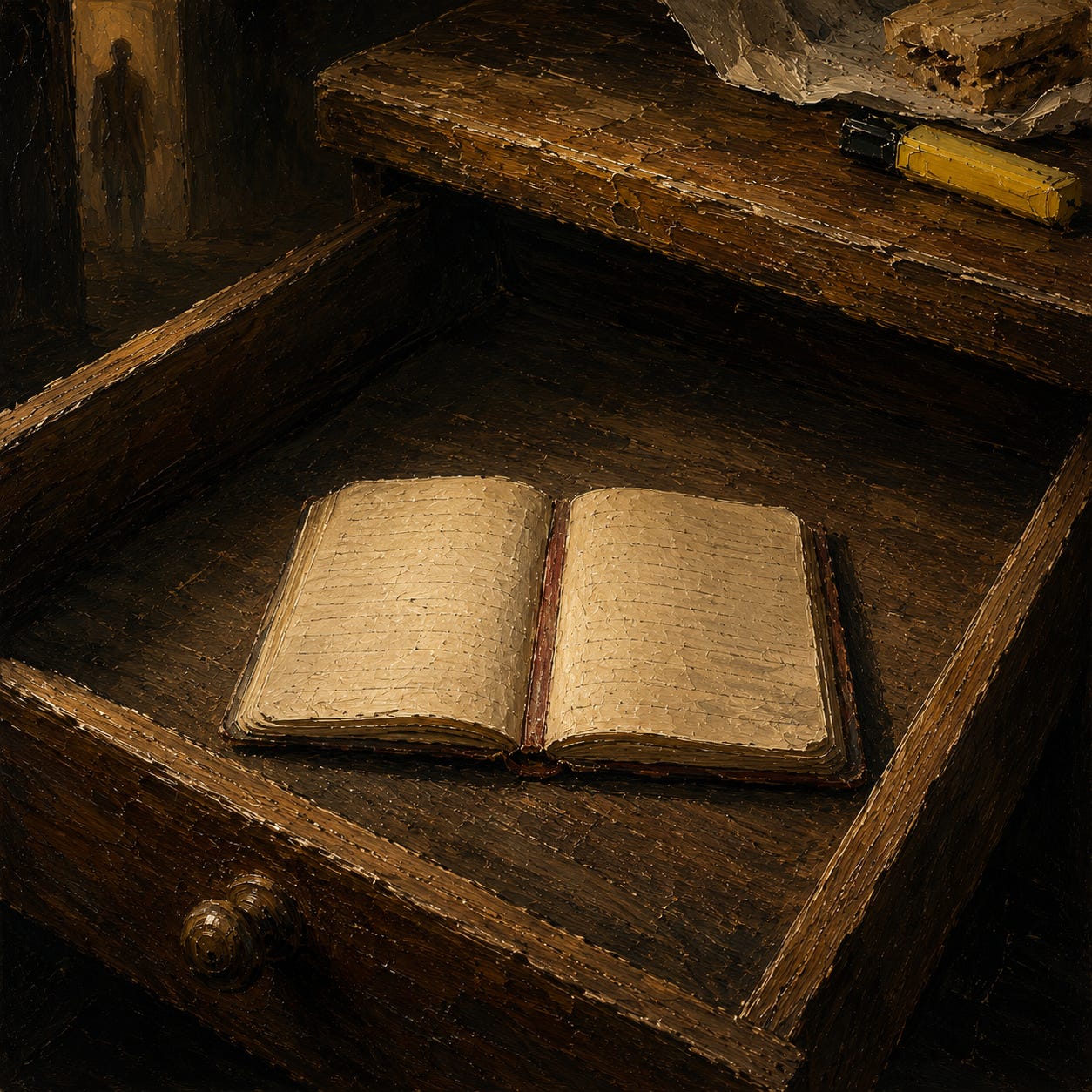
She knows this because she has seen him do it. Years ago, when she first started here, she walked into the back room one afternoon and Vernon was at his desk with an insert open in front of him, smoothed out on the blotter, and a yellow highlighter in his hand. She did not say anything. He looked up and saw her and folded the insert and put it in a drawer.
He has never mentioned that drawer. She has never asked. She does not know what is in it. She has thought about it, over the years, and she has decided that the thing in the drawer is the thing that is keeping Vernon in this pharmacy at sixty-eight years old when he could have sold the business and retired five years ago. The thing in the drawer is the reason he stands at the bench in the afternoons and counts out tablets by hand from the bulk bottles, the way pharmacists did before the machines.
She has not asked because she is afraid that asking would require her to do something with the answer.
At eleven, the boxes for the school programme arrive. A larger delivery. This is a quarterly thing. The school district contracts with the pharmacy to handle the doses for the immunisation clinic they run at the middle school three times a year. It is good business. It pays for the new computer system they got two years ago.
She signs for the boxes. There are forty-eight of them. She counts twice. Maria helps her carry them to the refrigerator at the back, the larger one, the one with the temperature monitor that sends an alert to Vernon’s phone if it drifts more than half a degree.
The inserts in these boxes are bulk-packed. One per carton, not one per vial. She knows where they are. She has never read one of these particular ones. She has read older versions, from previous years. She has read the one from 2021 and the one from 2023. She has not read this one.
She tells herself it is the same. The active ingredient has not changed. The excipients are listed. The cold chain documentation is intact. There is no reason to open the insert. The insert is a regulatory document. The insert is for the manufacturer to satisfy a requirement. The insert is not for her.
She closes the refrigerator. She does not open it again until the afternoon, when a school nurse comes by to pick up the first carton, and she signs the chain-of-custody form, and the nurse signs the chain-of-custody form, and the carton leaves the building.
She watches the nurse walk out to her car. The nurse has the carton in a small insulated bag with the gel pack on top. The nurse is a woman in her fifties. She has been the school nurse for sixteen years. She has been picking up these cartons from this pharmacy for sixteen years.
The bell rings as the door closes.
Mrs. Hall comes back. This is not on the schedule. It is two-twenty in the afternoon. Mrs. Hall is alone — no sling, no baby. Her eyes are pink. She does not have her bag. She is holding her keys in her hand the way you hold something you do not want to lose.
She comes to the counter. She does not say hello.
“I need to talk to someone.”
“Of course. Is everything all right?”
“He had a —” Mrs. Hall stops. She puts the hand with the keys against her mouth, fingers spread, and holds it there. “He had something this morning. After I fed him. He went stiff. His eyes. The doctor said it was probably just — she said it was probably a startle. She said babies do this.”
She comes around the counter. She does not know that she is going to do this until she is doing it. She puts a hand on Mrs. Hall’s elbow and walks her to the small chair by the consultation window, the chair where elderly customers sit while she explains their new medications. Mrs. Hall sits down.
“Tell me what you saw.”
Mrs. Hall tells her. The stiffening. The eyes rolling. The arms out from the body. The duration — maybe ten seconds, maybe twenty, she does not know. The baby afterwards was sleepy, very sleepy, and would not feed for an hour, and then fed and slept again and is sleeping now, at home, with Mr. Hall watching him.
She listens. She does not interrupt. She does not say what she is thinking.
What she is thinking is that the schedule sheet she printed at ten this morning had the two-month doses listed for two weeks from now, and she is also thinking about a box that came in last September with a particular lot number that she does not need to look up because she has, against her own rules, looked it up before, and what she found when she looked it up.
What she says is, “Have you called the clinic again?”
“They said to watch him. They said if it happens again to bring him in.”
“And it hasn’t happened again?”
“No. He’s sleeping. He’s just sleeping.”
“Did they take any notes? Did they tell you what to write down if it happens again?”
Mrs. Hall shakes her head.
She is quiet for a moment.
“Write down what you saw,” she says. “Today. Now. In as much detail as you can remember. Time, duration, what he had eaten, what his temperature was, what he did afterwards. Write it down before you forget any of it. And keep it somewhere safe. If something else happens, you’ll want it. And if nothing else happens, you’ll still want it.”
Mrs. Hall is nodding slowly.
“The hospital doses.”
“Yes.”
“They didn’t tell me what those were.”
“They wouldn’t have.”
“They didn’t show me anything to sign.”
“No.”
Mrs. Hall looks at her. There is a long moment. Behind them, Maria is at the bench, counting tablets, and the radio is playing something soft, and the automatic doors at the front have just opened and closed for a customer who has gone toward the cold and flu aisle.
“Is something wrong with my son?”
She does not answer that question. She cannot answer that question. The honest answer is that she does not know, and that the system that would tell them is the same system that gave him the dose, and that system is not asking.
What she says is, “Watch him. Write everything down. If anything changes, write that down too. And before the next appointment — before any next appointment — ask them for the manufacturer’s insert. The whole thing. Not the summary. Read it before you decide anything.”
Mrs. Hall is looking at her.
“You’re telling me to read the insert.”
“Yes.”
“You’re a pharmacist.”
“Yes.”
“And you’re telling me to read the insert.”
There is a silence. In the silence she understands that Mrs. Hall has heard what she said and heard what she did not say and is doing the arithmetic on both at the same time.
“Take care of him, Mrs. Hall.”
Mrs. Hall stands up. She walks to the door. The bell rings as she leaves.
She goes back behind the counter. Maria looks up from the bench.
“Everything okay?”
“She had a question about her son.”
“Cute baby.”
“Yes.”
She stands at the counter. The schedule sheet she printed for Mrs. Hall that morning is on the screen, on a recent-documents list, and she clicks it closed. She opens the inventory log. She closes the inventory log. She opens her email.
The fold of the insert in the recycling bin under the counter is still sharp. She has known this since seven.
She walks to the back room. Vernon is at his desk with a stack of paperwork and a half-eaten sandwich and his reading glasses pushed up on his forehead. He looks up.
She stands in the doorway. She does not come in.
She says, “Vernon. The drawer.”
He looks at her over the glasses. He does not say which drawer. He knows which drawer.
He looks at her for a long time. Long enough that the radio in the front of the store gets through one whole song and starts another.
He says, “Sit down.”
She sits down.
He opens the drawer.
There is a notebook. It is the kind with a stiff black cover and a red cloth spine, the kind that used to be sold at every stationer and is now hard to find. The cover is worn pale along the edges where his hand has rested on it.
He places it on the desk between them. He does not open it.
“I started it the year I bought the pharmacy.”
She does not say anything.
“I don’t know what else to do with it.”
He turns it so it faces her. He opens it.
The first page is a name. A date. A few lines in his handwriting — neat, the handwriting of a man who counts tablets — describing what the family came back to tell him. The next page is another name. The next page is another. The dates go forward through the years. She turns through. The handwriting changes a little as he ages. The pen changes. The names continue.
She does not count them. She can see without counting that there are a lot of them.
Some entries are a single line. Took him to the ER, never the same. Some are a paragraph. Some have a second date written underneath the first in a different ink, written later.
She stops on a page. She does not know why she has stopped on this page. The name is a name she does not know. The date is from before she worked here. The entry says the child was eighteen months old and that the mother had brought him in for a cough syrup six weeks before and had asked Vernon a question and that Vernon had answered the question in the way he was supposed to answer it.
She closes the notebook.
She looks at him.
He says, “I never gave it to anybody. There’s nobody to give it to.”
She nods.
He says, “Some of them are your customers.”
She nods again.
He puts the notebook back in the drawer. He closes the drawer. He does not lock it because the drawer does not lock.
She stands up. She walks out of the back room. She does not look at Maria as she passes the bench. She goes to the counter and stands behind it with her hands flat on it for a moment. Then she goes back to work.
At five-fifty in the afternoon, she walks out to her car. The sky is the colour of the inside of a shell. The parking lot is mostly empty. Her car is at the far end, where she always parks, because she likes the walk in and the walk out. She gets in. She closes the door. She puts the keys in the ignition. She does not turn them.
She sits.
She thinks about Mrs. Hall, who is at home now with her husband and her son, who is probably sleeping still, who may or may not have another event tonight, who may or may not be different next week, next month, next year. She thinks about the school nurse who picked up the carton this morning and is driving home now with the empty insulated bag on her passenger seat. She thinks about Maria’s son, who is four, and who comes into the pharmacy after preschool with his chin above the counter, waiting for the lollipop. She thinks about Vernon, who is going to sell the pharmacy next year, and about the notebook in the drawer that does not lock, and about the names she did not recognise and the one or two she did.
She thinks about September. About the lot number she looked up. About the week Maria’s son had the fever.
She thinks about the manifest in the recycling bin. The sharp fold. The unread page.
She thinks about the moment when Mrs. Hall said they didn’t tell me what those were and she said they wouldn’t have.
She had said they as if she were not one of them.
She is one of them. She has been one of them for twenty years. Every box she has put on the second shelf from the top. Every manifest she has signed. Every insert she has dropped into the recycling bin without opening. Every printed schedule she has slid across the counter to a mother who folded it without looking.
She thinks about her own daughter, who is twenty-nine now, who lives in another state, who has been talking about wanting a child. Her daughter has not called this week. Her daughter will call on Sunday.
The pen is in the pocket of her coat. She can feel its weight against her hip.
She turns the key. The engine starts. The dashboard lights come on.
She drives home.
Tomorrow she will be here at six-forty-five. The courier will come at seven. She will check the manifest, count, initial the bottom corner. The vials will go on the second shelf from the top. The insert will go in the recycling bin.
The fold will be sharp.
This work stays free because paid subscribers make it possible. They get the full book library, the Deep Dive Audio Library, and the Questions for Your Doctor, Before You Consent, and Package Insert series. No grants, no gatekeepers — your subscription is what keeps it that way.
I am a pharmacist. I woke up. I chose not to do vaccines. I gave out antivax literature. I was sent the inspector from hell. I was able to retire. I am heart sick about my profession.
I am a nurse who woke up in 2020. I tried warning patients where to go for Covid treatment ie not the hospital or clinic but where I knew there would be doctors/nurses using protocols with hydroxychloroquine, supplements and antibiotics. But I had to do this under the radar, as this was not the acceptable “protocol”. When the shots rolled out, I had suspicions and they came after me to comply. I didn’t. A few months later I saw on an Internet podcast that many in Israel were being injured by them. I knew I would never inject a patient. It would be unethical so I quit. Somewhere in that time I saw the documentary Vaxxed and realized THEY (the public health agencies, the hospitals and pharma) would kill babies to achieve their goal. Precious babies. And if they are willing to kill babies I knew adults were also victims. I realized then I had become a nurse to help people but I had been used by the system to carry out their dirty work. I can never go back.