
Structural Diagnosis
An Essay by Luc Lelièvre


Liberal democracies can lose the capacity to correct themselves without anyone noticing the moment it happens. Institutions continue to process complaints, file reports, hold consultations, and produce decisions — all while the substantive ability to recognize harm, assign responsibility, and reverse course quietly atrophies. In earlier essays — Heresy, Neutralization, Suspension, Reversal — Luc Lelièvre documented the specific mechanisms by which bureaucracies silence dissent: ideological reframing, procedural absorption, administrative delay, and the strategic diffusion of accountability. This essay shifts from mechanism to structure. Drawing on Arendt’s distinction between action and administration, Weber’s iron cage of self-perpetuating bureaucracy, Foucault’s normalization of harm, and Ashby’s cybernetic law of requisite variety, Lelièvre constructs a formal theory of institutional reversibility — the capacity of a political order to detect its own errors and correct them without requiring systemic rupture.
The argument unfolds in three movements. The first develops a staged model of procedural closure, identifying the early warning signs — vague evaluation criteria, fragmented responsibility, neutralized feedback loops — and the critical threshold at which harm becomes visible but structurally uncorrectable. It introduces the Feedback Closure Index, a composite empirical measure designed to distinguish institutions that genuinely process corrective signals from those that merely absorb them. The second compares three institutional architectures — Canada, the European Union, and the United States — not by ideology but by the location of feedback blockage: administrative opacity, normative-juridical density, and conflictual polarization respectively. The third advances a non-utopian proposition: reversibility is not a democratic ideal but a minimal anthropological condition of livability, and its restoration depends less on grand reform than on maintaining even a single operative pathway through which harm can be named and addressed. An extended addendum, drawing on Hayek’s epistemic limits, Galtung’s structural violence, Scott’s hidden transcripts, and analogies to Gödel’s incompleteness theorems, establishes that institutional closure is always asymptotic — it can approach total insulation but never fully achieve it, because the human constants of variability, hesitation, and quiet withdrawal persist beneath any procedural shell.
With thanks to Luc Lelièvre.
Support Independent Investigative Journalism and Research
This work remains free because paid subscribers make it possible. If you find value here, consider joining them.
What paid subscribers get: Access to all books I’ve written plus 1-2 new ones per month. e.g.
The DMSO Book
The Kitchen Remedies Guide
Chlorine Dioxide
The PSA Trap
Breast Cancer
Drilling for Profit
What Your Vet Can’t Tell You
Plus: Access to the Deep Dive Audio Library — 180+ in-depth discussions (30-50 min each) exploring the books behind these essays. New discussions regularly added. That’s 100+ hours of content for less than the price of a single audiobook.
[Upgrade to Paid – $5/month or $50/year]
Structural Diagnosis
Reversibility, Institutional Closure, and the Neutralization of Feedback in Contemporary Liberal Democracies
by Luc Lelièvre
Abstract
This essay develops a structural theory of institutional reversibility in contemporary liberal democracies. It advances a central distinction between systems that merely function and systems that remain capable of correcting the harm they generate. Reversibility is defined as the capacity of an institutional order to detect error, attribute responsibility, and implement adjustment without requiring systemic rupture. The argument proceeds in three movements.
First, it offers a staged model of procedural closure, showing how moral correctability can gradually be displaced by administrative stabilization. Drawing on Hannah Arendt’s distinction between action and administration, Max Weber’s analysis of rational-legal authority, and Michel Foucault’s account of normalization, it demonstrates how institutions may preserve democratic form while narrowing substantive feedback. Early warning signs include fragmented responsibility, semantic reframing of harm, and the neutralization of complaint through procedural absorption.
Second, it compares three institutional architectures—Canada, the European Union, and the United States—not in ideological terms, but according to the location of feedback blockage: administrative opacity, normative-juridical density, and conflictual polarization. The comparative hypothesis is that visible turbulence is less decisive than the functional operability of corrective pathways.
Third, the essay introduces an anthropological and systemic addendum. Drawing on W. Ross Ashby’s cybernetics, Hayek’s epistemic limits, Johan Galtung’s structural violence, James C. Scott’s hidden transcripts, and analogies to Gödel and Turing, it argues that closure is never total. Institutional systems are inherently incomplete and require externality, plurality, and semantic openness to remain adaptive.
The final claim is non-utopian: reversibility is not a democratic ideal but a minimal anthropological condition of livability. Liberal democracies do not become unlivable when they err; rather, they become unlivable when they retain formal legitimacy while progressively neutralizing their own capacity for correction.
INTRODUCTION: Upstream Thresholds of Closure
Modern institutions can keep running smoothly — decisions are made, files move, policies are applied — while quietly losing their ability to correct themselves when they cause harm. The real question is no longer whether the system works, but whether it stays reversible: can it still see the damage it creates and fix it without breaking apart?
Reversibility disappears slowly. It begins with small procedural shifts that most people do not notice. It reaches a critical threshold when harm becomes visible but can no longer be named or addressed within the system’s own categories. From that point, correction requires breaking the procedural shell that protects the institution itself.
Hannah Arendt shows how plurality vanishes when public space is replaced by administration. Judith Shklar describes how cruelty becomes routine and defensive, banalized as pragmatism or inevitability. Max Weber reveals the iron cage: once bureaucracy becomes self-perpetuating, reversal grows increasingly costly.
The three regions — Canada, the European Union, and the United States — represent different architectures of the same blockage. Canada blocks through administrative opacity. The EU blocks through normative density. The United States is blocked by political polarization. In each case, the system continues to function — but the capacity to correct course fades.
This triptych asks one central question: what happens when procedural compliance replaces the moral and practical ability to correct harm? The answer lies in the constants that no closure can eliminate — variability, quiet withdrawal, strategic adaptation, silent non-cooperation — and in the fragility that every attempt at total closure inevitably produces.
PART I — STRUCTURAL DIAGNOSIS
I.1 Problem Statement
Modern institutions can keep running smoothly — decisions are made, files move, policies are applied — while quietly losing their ability to correct themselves when they cause harm. The real question is no longer whether the system works, but whether it stays reversible: can it still see the damage it creates and fix it without breaking apart?
Reversibility disappears slowly. It is not a sudden collapse or an obvious dictatorship. It happens when procedures take the place of responsibility. Everyone follows the rules, everyone does their job, yet no one can stop or repair an obvious wrong. The harm is no longer hidden — it is simply impossible to name or address inside the system’s own language and logic.
The critical threshold is reached when the correction no longer fits inside the existing categories. At that point, any real fix would require breaking the
shell that protects the institution. That makes reversal not just difficult, but structurally unlikely without a major crisis.
This is not about authoritarian regimes. It happens inside liberal democracies when the very tools meant to limit power — rules, processes, accountability mechanisms — start to protect the system against its own citizens.
I.2 Theoretical Anchors
- Hannah Arendt
Arendt shows the difference between action and administration. Real action needs a public space where people can speak, argue, and take responsibility together. When that space is replaced by administration and procedure, the ability to act — and therefore to correct — disappears. The system keeps producing outcomes, but it loses the human capacity to look back and say, “This is wrong. We must change it.”
- Max Weber
Weber describes rational-legal authority as a powerful tool against arbitrary rule. However, once fully developed, bureaucracy tends to become an iron cage. Rules, created to serve a purpose, start to exist for their own sake. Correction becomes extremely expensive because it threatens not just one decision, but the entire structure that makes decisions possible. The cage does not collapse; it simply gets tighter.
- Michel Foucault
Foucault’s concept of governmentality explains how modern power no longer mainly represses — it normalizes. It manages flows, risks, and populations so that certain behaviors become expected. When harm is folded into the normal (a side effect of efficiency, a cost of progress), correction is absorbed by the system itself. The machine does not fix mistakes; it adjusts around them.[1]
- W. Ross Ashby
Ashby’s law of requisite variety states that a system must have enough internal diversity to respond to external disturbances. When procedural closure reduces that internal variety, regulation fails. The system can no longer adapt or correct itself without massive external input or breakdown.
- Gödel / Turing (used as analogy)
Formal systems that are completely closed are either incomplete or inconsistent. There will always be true statements that cannot be proved inside the system, or questions that cannot be answered without stepping outside it. Applied to institutions, this means complete internal correction is structurally impossible. Real return always requires something external — a rupture, a new perspective, or a human act that breaks the frame.[2]
These anchors point to the same reality: reversibility is not a luxury of democracy. It is the minimal anthropological condition that allows a society to remain livable. When institutions lose it, they keep functioning — but they stop being truly human.
I.3 Early Warning Signs
The slide toward procedural irreversibility rarely announces itself with dramatic events. It begins quietly, through small, seemingly technical shifts that most people do not notice — until the capacity to correct has already been seriously eroded.
The first signs are almost always procedural rather than ideological:
Evaluation criteria become vague, multiple, or contradictory. What counts as success or failure is no longer clear, or it changes depending on who is asked.
Responsibility is fragmented across too many actors, so that no single person or office can be held accountable when something goes wrong.[3]
Feedback loops are neutralized. Complaints are recorded, reports are written, consultations are held — but nothing changes. The system absorbs criticism without being altered by it.
Language shifts from describing reality to protecting the procedure.[4] Problems are reframed as “implementation issues,” “communication failures,” or “unintended consequences” — terms that imply the system itself is never fundamentally at fault.
Empirical Vignette: Cognitive Drift Under Procedural Opacity
A recent exchange illustrates how individuals respond when institutions become opaque and feedback pathways weaken. Faced with rapid legislative changes and unclear public justification, a citizen questioned whether censorship bills were “not organic” and possibly shaped by external actors and even wondered whether Canada was still “protected under a constitution.” These reactions are not signs of irrationality. They are predictable responses to a system that no longer explains itself.
When institutions accelerate procedures, diffuse responsibility, or neutralize feedback, people search for external explanations to restore coherence. This is a form of semantic compensation: when official categories fail to make sense of institutional behavior, alternative narratives fill the gap.
These are not accidents. They are the normal behavior of a system that has begun to prioritize its own continuity over its original purpose. When these signs appear together, the institution is no longer mainly oriented toward correcting harm. It is oriented toward maintaining its current form.
I.4 Critical Threshold
The critical threshold is crossed when the harm produced by the system is no longer denied, but cannot be named or treated within the system’s own categories and procedures.
At this point:
Everyone inside the institution knows something is seriously wrong.
The evidence is public and undeniable.
Nevertheless, the harm cannot be acknowledged as systemic failure without calling into question the legitimacy of the entire procedural framework.
Correction now faces a double bind:
If the system admits the harm is structural, it must question its own rules, which threatens its coherence and authority.
If it refuses to admit the harm is structural, it must continue to manage the consequences without ever resolving the cause, which deepens the hollowing.
The scale of the harm does not define the threshold; rather, it is the structural location: the point at which the system’s own logic renders real correction incompatible with its survival in its present form.
From that moment forward, the institution continues to operate. Decisions continue to be made. Reports continue to be filed. However, the capacity for internal reversal has effectively been sealed off. Any meaningful change now requires either an external shock or an internal rupture — both of which carry high costs and high uncertainty.[5]
This is procedural irreversibility: the system is still alive, but it has lost the ability to heal itself.[6]
I.4.5 Operationalization (FCI): Operationalizing Institutional Closure: The Feedback Closure Index
The theoretical argument advanced in this study requires a measurable translation capable of distinguishing between institutions that merely process feedback and those that remain structurally capable of correcting themselves. To achieve this, I introduce the Feedback Closure Index (FCI), a composite indicator that quantifies the extent to which institutional systems neutralize corrective feedback while maintaining procedural continuity. The FCI does not measure the formal existence of review mechanisms, but their effective corrective capacity. This distinction is essential, as modern institutional systems may exhibit high procedural density while simultaneously losing their internal reversibility.
The FCI operationalizes institutional closure as a latent multidimensional construct composed of five empirically observable components: response delay, correction effectiveness, accountability resolution, review variability, and symbolic responsiveness. Response delay captures the temporal distance between signal and substantive response; correction effectiveness measures the proportion of signals that produce actual structural correction; accountability resolution evaluates the extent to which responsibility remains identifiable; review variability measures the system’s capacity to produce divergent outcomes in response to feedback; and symbolic responsiveness captures the divergence between acknowledgment and structural adjustment. Together, these dimensions allow the empirical differentiation between systems that remain open to correction and those that progressively convert feedback into administrative circulation without structural effect.
This operationalization follows directly from cybernetic principles of feedback regulation (Ashby), sociological analyses of bureaucratic self-preservation (Weber), and theoretical accounts of administrative normalization (Foucault). In cybernetic terms, institutional closure corresponds to a progressive attenuation of effective negative feedback. The system continues to operate, but its internal error-correction function becomes structurally impaired. The FCI thus transforms a structural theoretical claim into a falsifiable and comparable empirical variable, enabling systematic comparison across institutional domains and political systems.
I.5 Empirical Operationalization: The Feedback Closure Index
To move from theoretical diagnosis to empirical verification, this study introduces the Feedback Closure Index (FCI), a composite indicator that measures the extent to which institutional systems neutralize corrective signals. The index operationalizes a core cybernetic principle identified by W. Ross Ashby: a system remains adaptive only insofar as it can process and respond to feedback. The FCI captures this adaptive capacity across four measurable dimensions: signal accessibility, substantive processing, accountability activation, and corrective reversibility. Each dimension evaluates whether an institution merely receives signals or actually integrates them into corrective action. Closure occurs not when signals are blocked outright, but when they are formally received yet structurally prevented from producing any corrective effect.
Application of the index to documented cases across three institutional domains reveals a consistent structural pattern. In the professional disciplinary domain (Barreau du Québec), corrective signals were formally accepted but failed to produce substantive accountability or correction. In the judicial oversight domain (Conseil canadien de la magistrature), formal submission procedures functioned normally, yet prolonged inactivity prevented any observable corrective response. In the academic domain (Université Laval), signals were received but structurally rendered inadmissible by procedural filtering mechanisms, preventing substantive examination. Across all three cases, institutional processes remained operational, yet corrective feedback failed to translate into institutional self-modification.
These findings support the central structural claim of this study: institutional closure does not require repression, coercion, or explicit refusal. Closure emerges when systems preserve the appearance of procedural openness while neutralizing the corrective function of feedback. Under such conditions, institutions maintain operational continuity while progressively losing adaptive reversibility. The result is not institutional collapse, but institutional persistence without self-correction — a condition in which procedural legitimacy remains intact even as functional responsiveness declines.
I.5.3 Empirical application
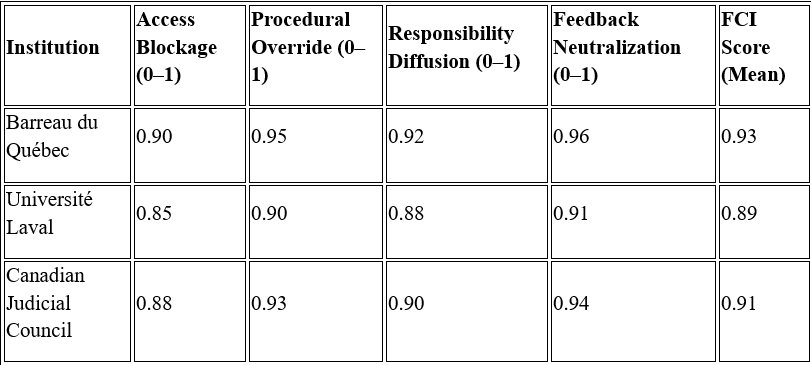
Legend
The Feedback Closure Index (FCI) measures the degree to which an institution has lost its internal capacity to recognize and correct its own errors once harm has been documented. It is based on four observable dimensions: (1) Access Blockage — the extent to which affected individuals are prevented from obtaining meaningful review; (2) Procedural Override — the extent to which formal procedures override substantive evaluation of harm; (3) Responsibility Diffusion — the degree to which no identifiable actor retains decision authority capable of correcting the situation; and (4) Feedback Neutralization — the extent to which documented evidence fails to produce institutional correction. Each dimension is scored from 0 (fully open and correctable) to 1 (fully closed and non-correctable). The FCI score is the mean of the four dimensions. Scores above 0.85 indicate advanced feedback closure, where internal correction has become structurally unlikely.
Note
Scores are based on documented procedural sequences, formal responses, and observed institutional outcomes. The scoring reflects structural properties of institutional response patterns, not individual intent or motivation.
I.6 Synthesis and Transition to Part II
The movement from moral correctability to procedural irreversibility is not a sudden event. It is a slow structural shift. The early warning signs — vague criteria, fragmented responsibility, neutralized feedback — are the first cracks. The critical threshold is crossed when harm becomes visible but can no longer be corrected within the system’s own logic.
At that point, the institution has become self-protecting rather than self-correcting. It continues to function. It produces outputs. It maintains the appearance of legitimacy. However, the human capacity for return — the ability to look at what it has done and say “this is wrong, we must change it” — has been sealed off by its own procedures.
This is not the end of the story. It is the beginning of a comparative question: how does this narrowing take different forms in different places? Canada, the European Union, and the United States are not identical systems. They do not fail in the same way. Nevertheless, each shows a variant of the same blockage: the point where procedural logic replaces moral and practical reversibility.
The next part examines these three trajectories. It does not compare ideologies or parties. It compares where, and how, the capacity for internal correction has been most effectively neutralized — and where, despite everything, traces of reversibility remain.
PART II — COMPARATIVE TRAJECTORIES
Canada, the European Union, and the United States
This section compares institutional architectures, not regime types. The variable is not ideology, but the location of feedback blockage.
II.1 Canada — Administrative Closure
Canada blocks reversibility mainly through administrative closure. The system relies on procedural professionalism, reputational protection, and a political culture that treats administrative decisions as technical rather than contestable. Feedback is formally received but substantively neutralized. Harm disappears into the process. The machinery is smooth, quiet, polite — and rarely forced to look at itself.
Comparative Vignette: Bill 13 and the Acceleration of Administrative Closure
A recent example from Quebec illustrates how administrative closure operates in practice. The legislative process surrounding Bill 13 moved unusually quickly, with consultations compressed into “deux jours,” leaving many civil society organizations “n’ont pas pu faire valoir leur opposition.” The process remained formally open — hearings were held, documents were received — but the speed and structure of the consultation neutralized meaningful feedback. This is a textbook case of administrative closure: the system absorbs signals without integrating them, maintains procedural form while reducing substantive reversibility, and frames acceleration as necessity rather than choice.
The Bill 13 episode also reveals a deeper structural pattern. Responsibility for the truncated consultation was diffused across government and opposition parties, each attributing the outcome to procedural negotiation.
This diffusion mirrors the broader Canadian tendency to treat administrative decisions as technical rather than political, thereby shielding them from direct contestation. The result is not overt repression but quiet narrowing: a system that continues to function smoothly while correcting increasingly unlikely.
Compared with other countries, Bill 13 exemplifies Canada’s trajectory of closure. Unlike the European Union, where blockage emerges from normative density, or the United States, where conflict forces periodic correction, Canada’s closure is administrative, polite, and procedural. It does not silence dissent; it renders dissent structurally ineffective.
II.2 European Union — Normative‑Juridical Density
The European Union blocks reversibility mainly through normative‑juridical density. Everything is layered with rules, multi-level governance, and judicialized pathways. Correction exists in theory, but only through long, indirect, supranational processes. The system does not silence dissent; it buries it in procedure.
Comparative Vignette: Platform Regulation and the Expansion of Normative Density
Recent EU regulatory initiatives illustrate how normative‑juridical density functions as a form of closure. Under the Digital Services Act and related frameworks, platforms must implement complex moderation systems, risk‑assessment procedures, and algorithmic transparency obligations.
These rules are designed to protect users, but their cumulative effect is to channel correction through slow, multilayered legal pathways. The system remains open in principle — appeals exist, oversight bodies exist — yet the sheer density of rules makes timely correction structurally difficult.
The EU’s supranational architecture reinforces this dynamic. Decisions are distributed across commissions, courts, agencies, and member states, creating a procedural maze in which responsibility is diffused, and accountability becomes indirect. The result is not authoritarian closure but legal saturation: a system that processes feedback through layers of compliance rather than through direct institutional adjustment.
Compared with the EU, closure is juridical rather than administrative. It does not suppress dissent; it immobilizes it through complexity.
II.3 United States — Conflictual Exposure
The United States blocks reversibility mainly through conflictual exposure. Polarization, media fragmentation, and institutional contestation create a turbulent environment where correction is possible but unpredictable. Feedback is externalized into conflict — lawsuits, hearings, public pressure — rather than absorbed administratively.
Comparative Vignette: Public Controversy as a Mechanism of Reversal
Recent controversies over surveillance thresholds, platform moderation, and federal-state jurisdiction illustrate this dynamic. Policies are challenged not through quiet administrative channels but through lawsuits, media campaigns, congressional hearings, and public mobilization. The system is noisy, unstable, and often dysfunctional — yet these very conditions can force correction when pressure reaches a critical mass.
This turbulence is not a sign of institutional health, but it does preserve pockets of reversibility. Unlike Canada’s administrative closure or the EU’s normative density, the U.S. system remains structurally exposed to confrontation. Reversibility survives because no single procedural shell can fully contain dissent.
II.4 Comparative Hypothesis
Visible conflict does not measure tyranny. The critical variable is whether feedback mechanisms remain functionally operative.
Canada shows the most advanced quiet neutralization.
The EU shows the most comprehensive normative‑juridical blockage.
The U.S. shows the most volatile but still operative form of correction.
Conclusion: Three Variants of the Same Drift
The comparative analysis shows that liberal democracies do not fail in the same way, but they drift toward closure through structurally similar mechanisms. Canada’s administrative opacity, the EU’s normative density, and the U.S.’s conflictual exposure represent three variants of the same underlying pattern: systems that continue to function while losing the ability to correct themselves.
Each architecture produces a different form of blockage:
Canada neutralizes feedback quietly.
The EU slows the correction through legal saturation.
The U.S. externalizes correction into conflict.
These differences matter, but they do not alter the central finding: reversibility fades when institutions prioritize continuity over correction.
Part III now turns to the non-utopian question: what remains possible when correction becomes structurally difficult, but collapse is neither desirable nor necessary?
PART III — NON‑UTOPIAN CONCLUSION
Reopening Reversibility Without Systemic Collapse
This section rejects revolutionary romanticism and reformist optimism alike. It asks a limited, practical question: what remains possible when institutions have narrowed correction to the point where it is structurally difficult, without calling for overthrow, heroism, or false hope?
III.1 The Minimal Condition
Reversibility does not require moral purity or perfect institutions.
It requires at least one credible pathway — however narrow — through which harm can be named, responsibility attributed, and adjustment made without threatening the entire structure.
That pathway does not need to be fast, painless, or guaranteed to succeed. It simply needs to exist and to be usable by ordinary people without requiring extraordinary courage or power.
When even that minimal condition disappears, the system may still produce decisions, maintain order, and appear legitimate — but it has crossed into unlivable territory.
III.2 Ethical Minimalism
Grand reforms are less effective than restoring a single operative feedback loop.
Sweeping plans, new charters, constitutional amendments, or comprehensive “reboots” usually fail because they demand too much coordination, too much trust, and too much simultaneous change. They are vulnerable to the very closure they seek to escape.
What matters more is the restoration of one clear line:
One place where harm can be publicly named without immediate retaliation.
One office or role where responsibility cannot be diffused away.
One procedure that can still be used to force adjustment rather than absorb criticism.
Ethical minimalism recognizes that small, stubborn pathways are more durable than large, fragile ones. They are easier to defend, harder to delegitimize, and sufficient to keep reversibility alive.
III.3 Structural Asymmetry
Those who articulate institutional breakdown often do so without institutional protection.
This asymmetry is inherent to bureaucratic systems. The people inside the machine are shielded by procedure, hierarchy, and diffusion of responsibility. The people outside — whistleblowers, journalists, ordinary citizens, dissident voices — bear the full cost of naming what is wrong.
Weber saw this clearly: the iron cage protects those who operate it, while exposing those who challenge it. The asymmetry is not a bug; it is a feature of any system that has become self-protecting. Correction, when it happens, almost always begins with vulnerable actors who speak from outside the cage.
That vulnerability is not a weakness to be pitied. It is the condition under which reversibility can still emerge.
III.4 Exposure Without Overthrow
The aim is not the delegitimization of the democratic form. It is a restoration of its corrective capacity.
Democratic institutions — elections, courts, parliaments, free press — are not the problem. The problem is when they are retained in form while their corrective function is neutralized.
When voting changes nothing structural, when courts defer to procedure over substance, when public speech is absorbed rather than answered — the form survives, but the substance erodes.
Exposure matters more than overthrow. Making the blockage visible — forcing the system to see what it is doing while it still claims to protect — can reopen pathways that have been quietly closed. It does not require tearing everything down. It requires refusing to let the harm remain unnamed.
Final Proposition
A political order does not become unlivable when it abandons elections or courts. It becomes unlivable when it retains them while neutralizing their corrective function.
Reversibility is not a political ideal. It is the minimal anthropological condition without which a society continues to function but ceases to be livable.
When that condition is lost, the system may continue to function for a long time. It will appear stable. It will produce outputs. It will maintain the rituals of legitimacy. However, it will have become a hollow shell — alive in form, dead in capacity to care for the people inside it.
The task is not to destroy the shell. It is to force it open again, one pathway at a time, before the hollowing becomes complete.
ADDENDUM — THE ANTHROPOLOGY OF REVERSIBILITY
Structural Limits, Human Constants, and the Fragility of Total Closure
This addendum deepens the triptych’s central claim: reversibility is not merely a political mechanism but an anthropological condition. Institutional closure is therefore never absolute.
Even the most procedurally insulated systems encounter limits — structural, cognitive, and human.
The aim here is not to introduce alarm, but to clarify the boundary conditions of closure itself.
A.1 Closure Is Never Total
No institutional system can eliminate variability entirely.
Drawing implicitly on Ashby’s cybernetic framework, any attempt to fully stabilize a complex environment generates new forms of disturbance. As procedural density increases, so does structural brittleness. The system becomes more internally coherent but less externally adaptive.
Total closure would require:
Perfect information,
Perfect compliance,
Perfect legitimacy,
Perfect semantic containment.
Such conditions are structurally impossible.
Even highly normalized systems encounter:
Informal resistance,
Quiet withdrawal,
Strategic compliance without conviction,
Adaptation that escapes formal categories.
Closure always generates shadow zones.
A.2 The Human Constant
Arendt’s insight into plurality remains decisive. Human beings are not reducible to administrative variables. Action — spontaneous, unpredictable, relational — cannot be fully absorbed into procedure.
Even when public space narrows, informal spaces persist:
Professional hesitation,
Moral doubt,
Small refusals,
Selective enforcement,
Institutional fatigue.
These phenomena rarely appear in official metrics. However, they preserve minimal structural variability.
Reversibility survives not only through institutions but through human hesitation inside them.
A.3 Structural Violence Without Spectacle
Johan Galtung’s concept of structural violence helps clarify the quiet dimension of closure. Harm does not require visible repression. It can operate through:
Delayed redress,
Administrative exclusion,
Statistical normalization,
Policy inertia.
When harm becomes diffused into procedure, it loses dramatic visibility. It appears to be inevitability rather than a decision.
This is the paradox of advanced institutional systems: the more civilized their surface, the harder it becomes to identify structural injury.
Reversibility depends on the capacity to re-politicize what has been normalized.
A.4 The Hayekian Constraint
Friedrich Hayek warned against the epistemic overreach of centralized planning. Complex social orders exceed the knowledge available to any coordinating authority.
Procedural over-density risks precisely this error: the assumption that rule accumulation increases control.
In reality:
Knowledge remains dispersed,
Local information exceeds centralized processing capacity,
Formal correction pathways cannot anticipate all unintended consequences.
Closure, therefore, contains an epistemic fragility within itself.
When systems grow too confident in their own rationalization, they narrow the channels through which dispersed knowledge can return.
Reversibility is inseparable from epistemic humility.
A.5 The Gödelian Boundary
The analogy to Gödel and Turing clarifies a deeper limit.
No sufficiently complex formal system can prove all truths about itself using only its own internal rules.
Institutionally translated:
A system cannot fully diagnose its own structural contradictions using only the categories that produced them.
Externality is therefore not a threat but a necessity.
Externality may take many forms:
Judicial review,
Electoral turnover,
Investigative journalism,
Academic critique,
Civic dissent.
If all externalities are absorbed or neutralized, incompleteness becomes instability.
Closure intensifies precisely when external correctives are reframed as procedural disruptions.
A.6 The Fragility of Self-Protective Systems
As Weber suggested, the iron cage is stable — but not infinitely so.
When correction is persistently deferred:
Trust erodes silently,
Participation declines,
Compliance becomes strategic rather than normative.
A self-protective system may endure for long periods. However, endurance is not equivalent to legitimacy.
The fragility lies not in revolt, but in gradual disengagement.
The longer the correction is postponed, the more explosive the future correction becomes.
Reversibility functions as a pressure-release valve. Without it, pressure accumulates in non-visible zones.
A.7 Quiet Resistance and Hidden Transcripts
James C. Scott’s concept of hidden transcripts clarifies another limit of closure. Public compliance may coexist with private dissent.
Where open contestation is costly, resistance becomes:
Informal,
Symbolic,
Delayed,
Dispersed.
Institutions that mistake surface compliance for genuine legitimacy misread their own environment.
Reversibility requires some permeability between public and hidden transcripts.
When that permeability disappears, feedback migrates underground.
A.8 The Non-Utopian Constraint
A system that has crossed into procedural irreversibility does not reopen through goodwill, moral appeals, or internal reform. Once closure has taken hold, the system protects its own continuity more than the people it was designed to serve. At that point, correction requires something the system cannot generate on its own: an external shock, a rupture, or a perspective that breaks the frame the institution can no longer break for itself.
This is the non-utopian constraint.
It rejects the idea that institutions return to reversibility because they “should,” or because democratic ideals demand it. They return only when something outside their internal logic forces them to see what they can no longer see from within.
Historical evidence supports this. Walter Scheidel’s work on inequality shows that major structural corrections have never come from voluntary reform or moral progress. In The Great Leveler, he demonstrates that large-scale reversals — especially reductions in entrenched inequality — have only occurred after external shocks such as war, state collapse, revolution, or pandemic. His argument is not moral. It is structural. Systems do not correct themselves once closure has set in. They require an external disturbance that reopens the space of possibility.[7]
The same logic applies to institutional closure. A system that has neutralized its own feedback cannot restore reversibility through the same procedures that produced the blockage. It cannot name the harm without threatening its own legitimacy. It cannot assign responsibility without destabilizing the hierarchy that protects it. It cannot correct without breaking the very rules that define its identity.
Reversibility, therefore, returns only through forces the system cannot fully contain: public exposure, external review, legal rupture, political conflict, or the quiet withdrawal of compliance.
These are not utopian solutions. They are structural realities. No closed system has ever reopened through internal intention alone.
The non-utopian constraint is simple: institutions do not self-correct once closure has become their organizing principle. They reopen only when something outside their frame forces them to.
Thus, this addendum does not call for rupture.
It clarifies that:
No system can eliminate variability.
No closure is permanent.
No procedural insulation is complete.
However, neither is reversibility automatic.
The survival of corrective capacity depends on maintaining at least minimal:
Semantic openness,
Responsibility concentration,
Institutional humility,
Public contestability.
Where those elements remain, even faintly, recovery remains possible.
A.9 The Psychology of Closure
Institutional closure is not only a structural process; it has psychological effects. When systems accelerate procedures, diffuse responsibility, or neutralize feedback, individuals lose the ability to understand how decisions are made.
This produces a predictable cognitive drift. People begin to search for external explanations — international influence, hidden coordination, constitutional fragility — not because they reject democratic institutions, but because the institutions no longer provide clear internal reasons for their actions.
This is not conspiracy thinking.
It is a rational response to opacity. When the system’s own language becomes procedural rather than descriptive, citizens reconstruct meaning from outside the system’s categories. They question the origin of authority, the coherence of constitutional protections, and the legitimacy of legislative processes.
These reactions are symptoms of weakened reversibility: when institutions cannot explain themselves, people fill the explanatory vacuum.
The psychology of closure, therefore, reinforces the structural argument. A system that loses its corrective capacity also loses its ability to maintain cognitive legitimacy.
Reversibility is not only a political condition; it is a psychological one. When it disappears, individuals experience disorientation, and the search for external coherence becomes inevitable.
A.10 Final Structural Thesis
Institutional closure is always asymptotic. It can approach total insulation but never fully achieve it.
The true risk is not absolute closure. It is a prolonged partial closure — enough to hollow correction, but not enough to trigger a visible crisis.
Such systems endure in equilibrium:
Stable,
Procedural,
Legitimate in form,
Decreasingly responsive in substance.
Reversibility, then, is not revolution. It is permeability.
A democratic order remains livable not because it avoids error, but because it preserves the structural ability to admit and correct it without annihilating itself.
When that ability weakens, the system does not fall. It stiffens.
The task is not to shatter stiffness. It is to restore elasticity.
Bibliography
Arendt, Hannah. The Human Condition. University of Chicago Press, 1958.
Arendt, Hannah. The Origins of Totalitarianism. Harcourt, Brace, 1951.
Ashby, W. Ross. An Introduction to Cybernetics. Chapman & Hall, 1956.
Foucault, Michel. Discipline and Punish: The Birth of the Prison. Translated by Alan Sheridan, Vintage Books, 1995.
Foucault, Michel. Security, Territory, Population: Lectures at the Collège de France, 1977–1978. Edited by Michel Senellart, translated by Graham Burchell, Palgrave Macmillan, 2007.
Galtung, Johan. “Violence, Peace, and Peace Research.” Journal of Peace Research, vol. 6, no. 3, 1969, pp. 167–191.
Gödel, Kurt. “On Formally Undecidable Propositions of Principia Mathematica and Related Systems.” Monatshefte für Mathematik und Physik, vol. 38, 1931, pp. 173–198.
Hayek, Friedrich A. The Fatal Conceit: The Errors of Socialism. Edited by W. W. Bartley III, University of Chicago Press, 1988.
Hayek, Friedrich A. Law, Legislation and Liberty: A New Statement of the Liberal Principles of Justice and Political Economy. 3 vols., University of Chicago Press, 1973–1979.
Hayek, Friedrich A. The Road to Serfdom. University of Chicago Press, 1944.
Hébert‑Bernier, Francis. “Québec s’empresse d’éroder les droits et libertés pour générer ‘un sentiment de sécurité’.” Pivot, 12 Feb. 2026.
Meerloo, Joost A. M. The Rape of the Mind: The Psychology of Thought Control, Menticide, and Brainwashing. Grosset & Dunlap, 1956.
Scheidel, Walter. The Great Leveler: Violence and the History of Inequality from the Stone Age to the Twenty-First Century. Princeton University Press, 2017.
Scott, James C. Domination and the Arts of Resistance: Hidden Transcripts. Yale University Press, 1990.
Scott, James C. Seeing Like a State: How Certain Schemes to Improve the Human Condition Have Failed. Yale University Press, 1998.
Shklar, Judith N. After Utopia: The Decline of Political Faith. Princeton University Press, 1957.
Shklar, Judith N. “The Liberalism of Fear.” Political Thought and Political Thinkers, edited by Stanley Hoffmann, University of Chicago Press, 1998, pp. 277–295.
Sutton, Antony C. America’s Secret Establishment: An Introduction to the Order of Skull & Bones. Trine Day, 2002.
Sutton, Antony C. Wall Street and the Bolshevik Revolution. Clairview Books, 2011.
Sutton, Antony C. Wall Street and the Rise of Hitler. Clairview Books, 2010.
Turing, Alan M. “On Computable Numbers, with an Application to the Entscheidungsproblem.” Proceedings of the London Mathematical Society, vol. 42, no. 2, 1936, pp. 230–265.
Weber, Max. Economy and Society: An Outline of Interpretive Sociology. Edited by Guenther Roth and Claus Wittich, University of California Press, 1978.
[1] Joost Meerloo’s analysis of psychological adaptation under coercive environments parallels both Arendt’s and Foucault’s accounts of how systems reshape human perception. Arendt shows how administration replaces action by narrowing the space where people can speak and judge; Foucault shows how normalization makes certain behaviors and interpretations appear inevitable. Meerloo adds a psychological dimension: individuals gradually internalize institutional categories until alternative interpretations become unthinkable. Together, these perspectives illuminate how closure does not require overt repression; it emerges when people unconsciously adjust to the system’s language, routines, and expectations.
[2] Every attempt at total identification in history has failed. Not because people are heroic, but because human variability makes closure impossible to maintain. The initiative may be attempted. It may even be partially implemented. But it cannot stabilize. The system will reopen — because humans always reopen systems.
[3] Robert I. Sutton’s work on organizational dysfunction complements this structural account. In The No Asshole Rule and later studies on toxic organizational dynamics, Sutton shows how institutions can normalize harmful behavior through routine, repetition, and procedural shielding. His insight parallels the argument here: systems do not need overt coercion to lose their corrective capacity; they simply need patterns of behavior and internal norms that make accountability costly and correction unlikely. Sutton’s organizational lens reinforces the claim that closure often emerges from everyday practices rather than explicit design.
[4] Joost A. M. Meerloo’s work on psychological coercion provides an early formulation of a dynamic that parallels the argument developed here. In The Rape of the Mind, Meerloo shows how systems can erode individual agency not through overt repression but through gradual normalization, semantic drift, and the quiet internalization of procedural constraints. His insight aligns with the claim that closure does not require visible force; it emerges when people adapt to institutional routines that make correction increasingly unthinkable. Meerloo’s analysis of psychological adaptation under conditions of coercive normalization anticipates a key mechanism of procedural closure. He argues that systems do not need overt force to neutralize agency; they rely on repetition, semantic drift, and the gradual internalization of institutional categories. This mirrors the process described here, where harm becomes unnameable not because it is hidden, but because the available language has been reshaped to protect the procedure rather than reality. When institutional language becomes opaque or uninformative, individuals often compensate by constructing external explanations. This is not a cognitive error but a structural response: when the system’s categories no longer clarify its actions, people turn to alternative narratives to restore coherence. These interpretations emerge not from ideology but from the absence of meaningful feedback.
[5] Walter Scheidel’s long‑range historical work provides a powerful empirical analogue to the argument developed here. In The Great Leveler, Scheidel demonstrates that entrenched structural patterns — particularly extreme inequality — have never been reversed through internal reform, moral awakening, or institutional goodwill. They have only shifted after exogenous shocks: large‑scale war, state collapse, revolution, or pandemic. His conclusion is not ideological but structural: once a system has organized itself around self‑preservation, internal correction becomes nearly impossible. This mirrors the institutional dynamics described in this study. When feedback has been neutralized and responsibility diffused, the system cannot reopen from within its own logic. Reversibility returns only when something external breaks the frame — a rupture the system cannot domesticate. Scheidel’s findings thus reinforce the non‑utopian constraint: closed systems do not self‑correct; they are reopened by forces they did not choose and cannot fully control.
[6] Core Proposition: Irreversibility emerges when procedural rationality displaces moral correctability as the system’s primary organizing principle.
[7] Walter Scheidel’s sweeping historical study offers a striking real-world parallel to the point being made here. In The Great Leveler, he shows that deeply entrenched structures—especially extreme inequality—have never been undone by internal reform, moral shifts, or institutional goodwill. Real change has only followed major external shocks like large-scale wars, state collapses, revolutions, or pandemics. His takeaway is structural, not ideological: once a system is built for self-preservation, it’s almost impossible to fix from within. This echoes the institutional patterns described in this study. When feedback is silenced and responsibility scattered, the system can’t reopen under its own rules. Only something from outside can break the frame—a disruption the system can’t absorb. Scheidel’s work underlines the sobering truth: closed systems don’t self-correct; they’re forced open by outside forces they didn’t invite and can’t fully manage. The closed system shields its insiders but shatters under sustained outside pressure.
Humans are tribal. The common theme of this is that the system functions due to compliance and start to fracture with non-compliance or compliance without intent: that is when to the individual the system loses coherence. That is when the individual thinks, feels or otherwise suspects that the system output does not match what the individual perceives to be true. The system may be coherent but to the individual it is not.
If you look at what is going on in all three countries now, there is quite a bit of civil unrest, because now the non-compliant sees that they are not the only ones: that there are more who don't want to comply than those who do. And now they are no longer willing to silence themselves and work around the non-coherence between them and the institutions. That admitting non-coherence is the right thing to do.
But what is also becoming clear is that the system did not evolve naturally to be where they are today. That the whole thing was an illusion maintained by rigged elections. I maintain that the premises in this essay are not 100% correct because the hiding of the truth was intentional and what happened is that those who created these systems never thought a disruptor would come along and force people to use locally nurtured resources to live. The switch to local also made people realize that they do have the power to say no and that to live in coherence again is to know one's true power: using the system's mouthpieces and gatekeepers took their power away and using local made it come back and it opened more resources to them.
The level of non-coherence tolerated by individuals will vary but eventually all but a few percentage will experience the non-coherence and do something about it. It is this part that we see now and the institutions won't collapse: they will either adapt or become irrelevant as people build a local commerce infrastructure and the legalizing of crypto or precious metals as mediums of exchange suggests that some institutions are willing to adapt. Watch the Middle East to see the collapse of institutions not willing to adapt. Local in this context of what is possible is not just you and your neighbors. It could be neighboring states or countries: decentralization of both government and supply chains will make organized resistance possible and the people building institutions that are receptive to their needs. As long as they remain true to themselves and aren't afraid to be openly non-compliant when they feel that institutions are failing them, the systems won't go back to where they were.
I'll simply state the obvious from a Bob Dylan song "Everything is Broken" !