
The DMSO Book
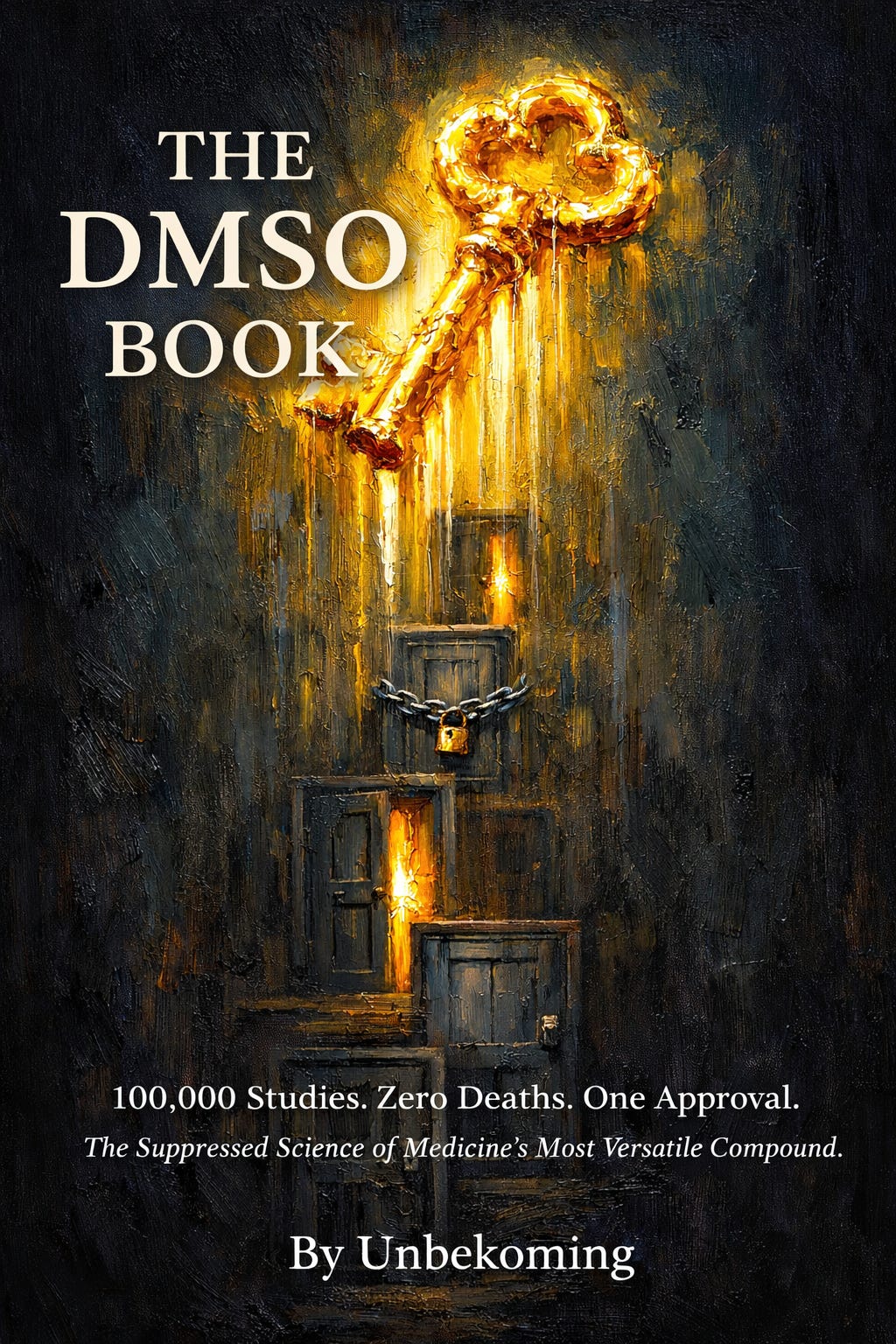
New Book by Unbekoming

In 1975, a team in Chile took 65 patients with cancers declared incurable by conventional oncology. They mixed low-dose cyclophosphamide with DMSO and three amino acid derivatives. Fifty-seven of the sixty-five were cured. The study was published. It was not retracted. It was not debunked. It was not pursued.
A six-year-old girl burned her finger in an electrical socket — cooked it through until the tip was ash white. Full-strength DMSO was applied within 30 minutes. The pain stopped. The next day the finger turned pink. It fully recovered. A study of 1,371 patients with skin disorders, including 173 with second and third-degree burns, found a 95% complete recovery rate using DMSO. No scarring.
A man blind for over 30 years after a dynamite explosion regained his vision with DMSO eye drops.
A 2002 stroke trial: 63% of patients treated with DMSO within 12 hours achieved markedly improved neurological outcomes. Standard treatment: 20%.
A Russian scleroderma study: disease progression stopped in 96.6% of patients. No relapses in five years.
Spinal cord injuries: patients with complete quadriplegia regained function when DMSO was administered within 90 minutes.
A child with Down Syndrome who couldn’t stand at 11 months was walking, reading, and doing arithmetic by age eight after DMSO treatment.
These findings come from published clinical research spanning six decades and multiple countries. The compound in question — dimethyl sulfoxide — has between 50,000 and 100,000 published studies behind it. It has been used by millions of people worldwide. It has never been linked to a single human death. NSAIDs kill tens of thousands of Americans every year. Opioids kill tens of thousands more.
The FDA approved DMSO for exactly one condition.
I’ve spent the past two years reviewing what I could find on this compound — six books, a 90,000-word article series, clinical data, regulatory filings, practitioner protocols — and compiling it into a single reference. The result is The DMSO Book, approximately 60,000 words across 195 pages, with nearly 330 questions and answers, four practical appendices, and detailed guides on preparation, dosage, and application.
This is not merely a collation of my previous DMSO Substack posts. Those were individual summaries. The book is a unified, cross-referenced work — the evidence established in the early sections makes the later claims hard to dismiss. The safety profile first, then the mechanism, then the combination therapies, then the regulatory story, then cancer. That sequence matters. It builds a case that no single essay can.
What’s in it:
The clinical science — drawn primarily from A Midwestern Doctor’s series — covers how DMSO combination therapies work. DMSO with antibiotics that reverse bacterial resistance. DMSO with chemotherapy that concentrates drugs at the tumour site — a 5% mixture with doxorubicin produced a 7 to 12-fold increase in drug concentration while cutting the required dose by 44%. DMSO with local anaesthetics applied through the skin for chronic pain, no injection needed. DMSO at concentrations as low as 3% in saline improving vision in conditions most ophthalmologists have no treatment for. A dedicated 50-question section on cancer covers differentiation, immune recognition, chemotherapy potentiation, and why this research largely stopped — the economics of oncology don’t reward it.
The regulatory history — reconstructed across three independent sources — documents how the FDA turned a reversible lens change in dogs given extreme doses into a six-decade research embargo, how they made trial requirements so expensive they functioned as a ban, and how they simultaneously approved DMSO as a “safe and inert ingredient” in patented drugs. Too dangerous to study, safe enough to sell. That’s not my characterisation. It’s the regulatory record.
The practical protocols — covering what you actually need to know if you want to use DMSO. Concentrations for every body area. Dilution methods. Eye drop preparation. Burn treatment. Oral dosing. Which plastics leach into DMSO and which don’t. Which drugs interact dangerously. How to source pharmaceutical-grade product. How to patch test. What the veterinary applications look like. And one entire section from a melanoma survivor documenting his daily use across half a dozen conditions — what it actually looks like to live with this compound.
The four appendices are built to be used. The Conditions Index maps every condition in the book to its exact section and question number — find your problem, find every relevant discussion across all six sources. The Dosage Guide consolidates every specific number into a single reference: concentrations, frequencies, recipes, interactions, materials compatibility. The Glossary covers every technical term and key figure. The Bibliography collects all sources, URLs, supplier information, and the strongest clinical trials with their data.
I wrote this to bring together the science, the history, the regulatory story, and the practical protocols in one place. Individual essays can present individual findings. They can’t cross-reference the same compound’s results in cancer, stroke, chronic pain, burns, and vision loss in a way that makes the underlying mechanism visible. When you see consistent outcomes across that many unrelated conditions, and then learn that DMSO operates at the level of cellular function and membrane transport rather than targeting specific diseases, the breadth starts to make sense.
It starts seeming inevitable. Suppress a compound this fundamental for six decades, and this is what the evidence looks like when you finally put it all in one place.
This book is the reference I wanted to exist when I started reading about DMSO. Nearly 330 questions answered. Six sources synthesised. Concentrations, protocols, clinical trials — in one volume, cross-referenced and searchable.
This compound has been studied for over sixty years. Most of what it can do remains largely unknown outside a small community of researchers and practitioners. This book is my attempt to change that.