
Postnatal Depression: The Depression They Built
An Essay on the Predictable Endpoint of Obstetric Intervention

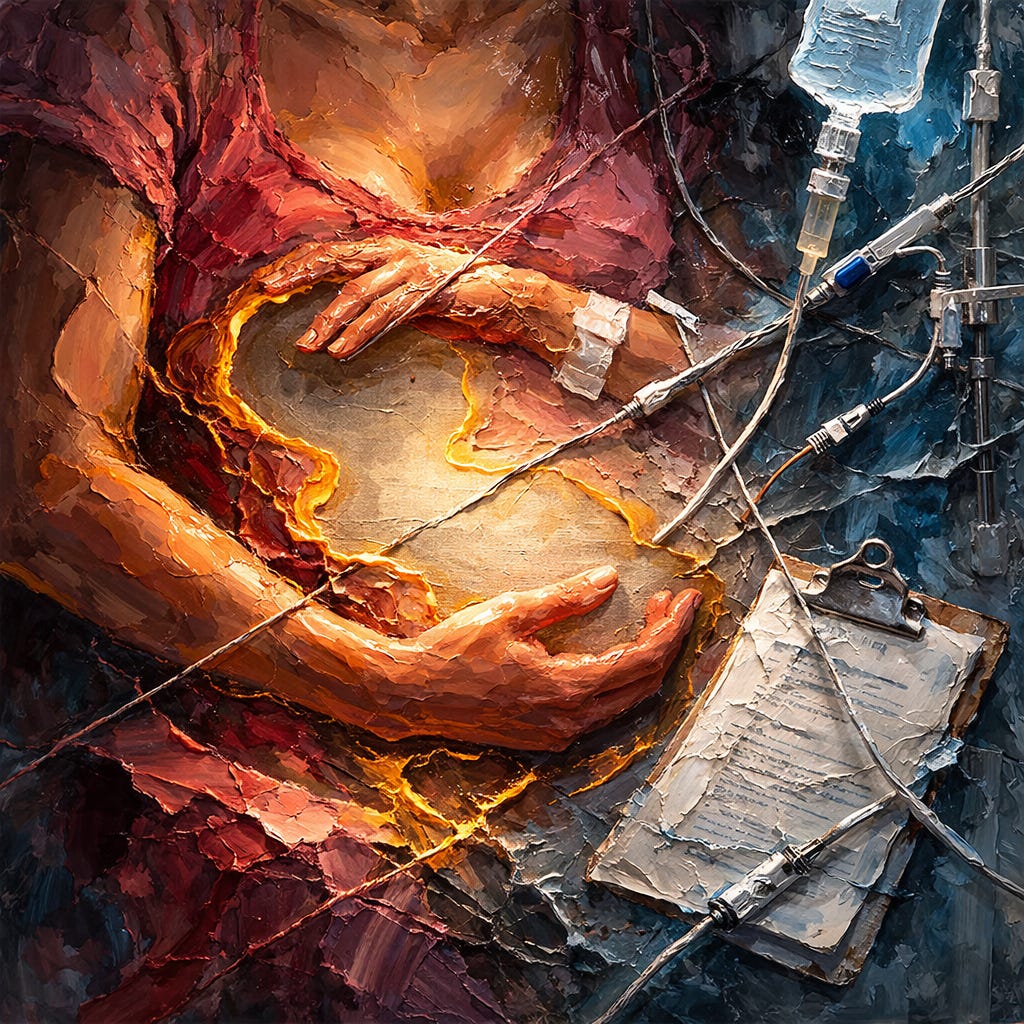
A woman lies in a hospital bed. She gave birth hours ago. She hasn’t slept in two days. Her hormones are crashing. Her body is in shock. A nurse hands her a clipboard. Ten questions. Have you been able to laugh and see the funny side of things? Have you blamed yourself unnecessarily? Have you felt scared or panicky for no very good reason?
She answers honestly. Her score triggers a conversation about antidepressants.
A 2021 study evaluated whether Edinburgh Postnatal Depression Scale (EPDS) scores obtained 3 to 24 hours after birth predict depression at six weeks. They don’t. At the standard cutoff of 9, the immediate postpartum score had a sensitivity of just 28.8% — meaning it missed more than 70% of women who would actually develop postpartum depression. The specificity was 93.2%, but that’s the easy part: most women don’t develop clinical depression, so a test that says “not depressed” to almost everyone will be “specific” by default.¹
A separate study found that on postpartum day three, the EPDS had moderate predictive value for screening positive at one month (AUC 0.754), but required a cutoff of just 5 to achieve sensitivity of 71.4% — with specificity of only 74.5%.² Other data are more blunt: 33% of women scored 9 or above on the Edinburgh Scale on day two postpartum, yet only 13% met criteria for postpartum depression at 30 to 40 days. Two-thirds of the women flagged by early screening were not depressed. They were recovering from birth.
The Edinburgh Scale, administered in the first days postpartum, is not detecting postnatal depression. It is detecting the acute aftermath of what was done to the woman during labour and delivery. The question that follows is obvious: what, exactly, was done to her?
This essay traces the answer backward — from the screening moment through the cascade of interventions that produced it.

Support Independent Investigative Journalism and Research
This work remains free because paid subscribers make it possible. If you find value here, consider joining them.
What paid subscribers get: Access to all books I’ve written plus 1-2 new ones per month. e.g.
The DMSO Book
Chlorine Dioxide
The PSA Trap
Breast Cancer
Drilling for Profit
What Your Vet Can’t Tell You
Plus: Access to the Deep Dive Audio Library — 180+ in-depth discussions (30-50 min each) exploring the books behind these essays. New discussions regularly added. That’s 100+ hours of content for less than the price of a single audiobook.
[Upgrade to Paid – $5/month or $50/year]
The oxytocin system was dismantled
Oxytocin is the central hormone of undisturbed birth. During physiologic labour, the mother’s body releases it in escalating pulses — increasing in frequency and amplitude through labour, peaking at a level three to four times above baseline at the moment of birth, and continuing in pulses through the third stage as the placenta separates.³ This is not merely a uterine contraction hormone. The same oxytocin pulses drive euphoria, endorphin release, pain modulation, bonding behaviour, and the neurological shift into motherhood. The system is elegant, and it is precisely what the cascade destroys.
Pitocin — synthetic oxytocin administered intravenously — is the most commonly used labour drug in hospital births. It produces uterine contractions. It does not replicate what endogenous oxytocin does in the brain, because intravenous oxytocin does not cross the blood-brain barrier. The systematic review by Uvnäs-Moberg et al. (2019) makes this distinction explicit: peripheral oxytocin effects (uterine contraction) are pharmacologically and physiologically separate from central effects (maternal neurobehavioural adaptations), and circulating synthetic oxytocin cannot substitute for brain oxytocin signalling.³
A second systematic review, focused specifically on plasma oxytocin measurements during clinical Pitocin administration, confirmed that the dose regimens used in obstetrics produce moderate plasma elevations but that direct transfer to the maternal brain or fetus is unlikely.⁴ The mother’s uterus contracts. Her brain receives nothing. The euphoria, the endorphin cascade, the bonding surge, the natural pain relief — none of it fires properly.
The damage extends beyond the labour itself. In a study measuring maternal oxytocin during a standardised breastfeed two days after birth, women who had received epidural analgesia combined with intravenous oxytocin during labour had the lowest mean oxytocin levels of any group (p=0.02).⁵ The combination of epidural and Pitocin didn’t just disrupt oxytocin during birth — it suppressed oxytocin release two days later, during the feeding that should have been rebuilding the mother’s hormonal protection.
Pitocin alone, without epidural, did not show the same suppression in that study.⁵ The interaction matters. This is a cascade effect, not a single-variable effect, and this distinction is critical to understanding why the research literature appears contradictory when studied through a single-variable lens.
A large retrospective cohort using electronic medical records found that women exposed to synthetic oxytocin during the peripartum period had significantly higher rates of postpartum depressive and anxiety disorders within the first year. For women with no prior psychiatric history: relative risk 1.32 (95% CI 1.23–1.42). For women with prior depressive or anxiety disorders: relative risk 1.36 (95% CI 1.20–1.55).⁶
One prospective cohort reported the opposite — a protective association between intrapartum synthetic oxytocin and postpartum depression (HR 0.65, 95% CI 0.49–0.85).⁷ The same study found that negative childbirth experience independently predicted higher depression risk (HR 1.39, 95% CI 1.04–1.85).⁷ This is not a contradiction. It is evidence that single-variable epidemiology cannot capture cascade effects. When you study Pitocin in isolation, you get noise — because Pitocin rarely acts in isolation. It initiates a cascade: Pitocin leads to epidural (because the contractions are unbearable), epidural leads to more Pitocin (because labour slows), fetal distress follows, and the endpoint is frequently emergency cesarean. The depression does not arise from one drug. It arises from the cumulative destruction of every system that would have prevented it.
The mechanistic evidence is more reliable than either epidemiological study, because it explains how the damage occurs rather than trying to detect it through confounded population-level data. Intravenous oxytocin does not reach the brain. Prolonged exposure desensitises oxytocin receptors — demonstrated directly in human myometrial cells, where receptor binding sites dropped from approximately 210,000 to 20,000 per cell over 20 hours of exposure.⁸ Higher cumulative oxytocin exposure during labour is associated with outcomes consistent with reduced uterine responsiveness postpartum.⁹ If the receptors in the uterus desensitise, the question of whether central receptors do the same is not speculative — it is the expected extrapolation from known biology. The study that would confirm it — direct measurement of brain oxytocin receptor density in postpartum women stratified by Pitocin exposure — has never been conducted.
Natural birth produces a massive oxytocin pulse at the moment of delivery, consistent with the Ferguson reflex. Continuous Pitocin infusion produces a flat plasma profile instead of narrow physiologic peaks.³ The woman on a Pitocin drip gets a pharmacological plateau where she should have had a crescendo.
The birth became surgery
Emergency cesarean section carries the clearest signal in the postpartum depression literature. A 2024 meta-analysis reported an adjusted odds ratio of 1.20 (95% CI 1.08–1.34) for postpartum depression following emergency cesarean compared with vaginal delivery. Elective cesarean was near-null: adjusted OR 0.96 (95% CI 0.83–1.10).¹⁰
This pattern destroys the simplistic “cesarean eliminates hormones, therefore depression” formulation. Elective cesarean — planned, consented to, experienced without the preceding hours of failed labour and escalating interventions — does not carry the same risk. What drives the depression is not the surgical delivery in itself. It is the traumatic cascade that precedes it: the induction that stalled, the Pitocin that caused fetal distress, the monitors screaming, the loss of control, the emergency that wasn’t an emergency until the interventions made it one.
The hormonal data confirm the magnitude of what’s lost. One study reported oxytocin levels immediately after birth of 65 ± 9 pg/mL following physiologic labour and vaginal delivery, versus 12 ± 9 pg/mL after prelabour cesarean (p<0.009).³ After physiologic labour and vaginal delivery, a woman has five times the oxytocin circulating at the moment she meets her baby compared to one delivered by prelabour cesarean. After emergency cesarean — preceded by hours of Pitocin augmentation and epidural analgesia — she has been depleted by the cascade and then denied the culminating hormonal event entirely.
The subjective experience carries its own weight as a predictor. In a prospective cohort of 2,204 women, negative childbirth experience independently predicted postpartum depression with a hazard ratio of 1.39 (95% CI 1.04–1.85).⁷ This measures something the hormonal data cannot — the psychological wound of having your birth taken from you. The woman who entered the hospital expecting to birth her baby and left having been cut open after hours of escalating interventions carries that wound into every subsequent interaction with her newborn. The confidence her body might have given her — I did this, I can do this — was replaced with evidence that her body failed, that she needed rescue, that she is not capable.
That psychological wound is not separate from the hormonal damage. It compounds it. The woman whose oxytocin system was disrupted by Pitocin, whose endorphin cascade was blocked by the epidural, whose bonding hour was replaced by an operating theatre, and who now believes her body is broken — she is not experiencing one risk factor for depression. She is experiencing all of them simultaneously.
She was separated from her baby
The first hour after birth — the “golden hour” — is a sensitive period when both mother and baby are primed for bonding. Newborns placed skin-to-skin exhibit a predictable sequence of nine instinctive behaviours culminating in self-attachment to the breast. This sequence requires uninterrupted contact. Every routine separation — for weighing, measuring, bathing, glucose screening, hearing tests, vitamin K injection — disrupts instinctive behaviours that may not fully recover.
Skin-to-skin contact triggers measurable physiological changes: it regulates the newborn’s temperature, heart rate, breathing, and blood sugar, while driving oxytocin release in the mother and suppressing cortisol.¹¹ The maternal stress-buffering effect is directly quantified — longer skin-to-skin contact prior to sucking is associated with lower maternal cortisol, and oxytocin shows a significant negative relationship with ACTH, the stress-axis hormone.¹¹ This is the mechanism by which uninterrupted contact protects against depression: sustained oxytocin release, sustained cortisol suppression, sustained bonding.
When the baby goes to the NICU, the mechanism breaks. A prospective study with prenatal baseline adjustment — meaning it controlled for depression that existed before birth — found that NICU admission was a significant predictor of postpartum depressive symptoms at six weeks.¹² This is not confounded by pre-existing mood. The separation itself predicts the depression.
Eighteen percent of newborns in the United States receive some NICU care. Many of these admissions are triggered by the cascade: glucose screening that flags normal transitional physiology, jaundice from vitamin K overloading an immature liver, respiratory concerns following Pitocin-driven fetal distress. The baby is separated to be treated for conditions the interventions created. The mother, alone in her room, fills out a questionnaire about how she’s feeling.
The randomised evidence on skin-to-skin and depression specifically is still developing. A 2025 systematic review of nine RCTs found that skin-to-skin may reduce short-term parental anxiety, but evidence for depressive symptoms remains low-certainty.¹³ One RCT of daily skin-to-skin in healthy term dyads found reductions in anxiety and fatigue but not depressive symptoms.¹⁴ The evidence gap is real — but it exists because the strongest skin-to-skin evidence has been designed around breastfeeding and infant physiological endpoints, not maternal depression as a primary outcome. The mechanism is established. The population-level RCT with depression as the primary endpoint has not been prioritised.
Breastfeeding was undermined before it began
Every successful breastfeed triggers oxytocin release. The hormone drives milk ejection, but it also modulates mood, reduces stress reactivity, and sustains the bonding physiology that began at birth. Breastfeeding is not merely nutrition delivery. It is a sustained oxytocin delivery system — one that fires multiple times daily for months, providing ongoing hormonal protection against depression.
A meta-analysis of eight studies (n=18,570) found that breastfeeding was associated with 14% lower odds of postpartum depression (OR 0.86, 95% CI 0.77–0.94). Longer duration showed stronger associations: breastfeeding for more than one month was associated with an OR of 0.63 (95% CI 0.47–0.79). Exclusive breastfeeding compared with never breastfeeding showed the strongest signal: OR 0.47 — a 53% reduction in depression odds.¹⁵
The bidirectionality caveat is obligatory in the literature: depression can reduce breastfeeding success, so the association may run in both directions. This is true as far as it goes. But it does not neutralise the physiological mechanism. The oxytocin release during breastfeeding is measurable. The stress-buffering effect is quantified. Successful breastfeeding amounts to a pharmacological intervention against depression — delivered by the woman’s own body, multiple times daily, at no cost and with no side effects. When breastfeeding fails, that protection disappears.
The upstream interventions systematically undermine breastfeeding before the first feed is attempted. The Takahashi study found that epidural exposure was associated with shorter infant rooting duration and lower rooting quality two days after birth.⁵ The baby drugged through the placenta by the epidural is groggier, less able to perform the instinctive behaviours that establish breastfeeding. A large cohort study confirmed that common intrapartum interventions are associated with less favourable breastfeeding outcomes both during the hospital stay and in the months following.¹⁶
Formula supplementation — offered for glucose concerns, for jaundice, for “cluster feeding” that staff interpret as insufficient milk — introduces a different sucking mechanism that can cause nipple confusion. The bottle given at 3am by a well-meaning nurse, while the mother sleeps and her breasts go unstimulated, begins the supply-demand mismatch that ends breastfeeding. Each missed feed is a missed oxytocin pulse. Each missed pulse is a brick removed from the wall protecting her against depression.
A systematic review found significantly lower breastfeeding self-efficacy among depressed versus non-depressed mothers — standardised mean differences of −0.62 on day one and −0.84 on day three (both p=0.0001).¹⁷ The confidence gap is measurable within 24 hours of birth. The woman whose body was told it couldn’t labour properly now receives evidence that it can’t feed properly either. The psychological wound from the birth cascade extends directly into the feeding relationship.
The study that will never be funded
No one has modelled cumulative intervention density against postpartum depression outcomes.
This is the central evidence gap, and it is not accidental. The research infrastructure that studies obstetric interventions is structured around single variables: epidural versus no epidural, cesarean versus vaginal, breastfeeding versus formula. Each intervention gets its own literature, its own meta-analyses, its own inconclusive results and calls for further research. The cascade — the way these interventions interact, compound, and amplify each other’s damage — is invisible to this methodology by design.
The closest the literature comes is a systematic review of midwifery continuity models, which found that continuity of care is associated with improvements in maternal anxiety, worry, and depression during the perinatal period.¹⁸ But even this evidence is small (eight articles) and attributes the benefit to relational continuity and shared decision-making rather than measuring the reduction in intervention density that midwifery models produce. The mechanism is left unstudied.
The meta-analysis on epidurals and postpartum depression found no pooled association: OR 1.02, 95% CI 0.62–1.66, with high heterogeneity (I²=74%).¹⁹ This is presented in the literature as evidence that epidurals don’t cause depression. It is equally evidence that studying epidurals in isolation — without accounting for the Pitocin that preceded them, the cesarean that followed, the breastfeeding that failed, the separation that occurred — produces meaningless noise. The heterogeneity itself (I²=74%) tells you the studies are measuring different things in different populations with different co-interventions. The pooled estimate is an average of incomparable situations.
When you triangulate across the evidence that does exist, the pattern is consistent:
Synthetic oxytocin disrupts central oxytocin signalling (mechanism established).³ ⁴
The epidural + Pitocin combination produces the lowest postpartum oxytocin during breastfeeding (direct measurement).⁵
Emergency cesarean — the typical cascade endpoint — carries a 20% increased depression risk (meta-analytic).¹⁰
NICU separation predicts maternal depression independent of pre-existing mood (prospective, baseline-adjusted).¹²
Breastfeeding failure is associated with up to 53% higher depression odds (meta-analytic).¹⁵
Negative birth experience independently predicts depression (prospective, HR 1.39).⁷
Six independent pathways. Different research teams. Different methodologies. All pointing in the same direction: toward the cascade.
The absence of the integrative study is not a gap in knowledge. It is a gap in willingness. The system that profits from each individual intervention has no incentive to measure what they do collectively. The research that would settle this question — a large prospective cohort tracking every intervention from admission to discharge, measuring cumulative exposure against validated depression outcomes at six weeks, three months, and one year — is straightforward to design. It has not been designed because the answer is commercially inconvenient. A finding that intervention density predicts depression would indict the standard model of hospital birth. No obstetric department will fund that study. No pharmaceutical company will sponsor it. No career will be advanced by publishing it.
In an epistemically captured research environment, the absence of a study is as informative as its presence. The questions that don’t get asked reveal what the system cannot afford to know.
The loop closes
The woman sits in her hospital bed. She has been induced with Pitocin. She received an epidural when the Pitocin contractions became unbearable. The epidural slowed her labour. More Pitocin was added. The baby’s heart rate dropped. She was taken to theatre for an emergency cesarean. Her baby spent four hours in the NICU for observation. She has not held her baby skin-to-skin for more than twenty minutes total. Her first attempt at breastfeeding was interrupted by the glucose check. Her baby, groggy from the drugs that crossed the placenta, could not latch. A nurse gave a formula bottle at 2am. She is exhausted, in pain, and feels like her body failed her.
A clipboard arrives. Ten questions. Her score is 14.
The score enters her medical record. A conversation about antidepressants follows. She is prescribed an SSRI — sertraline, the “safe” option — before she leaves the hospital.
If she becomes pregnant again, she will likely continue the SSRI through pregnancy. A population-based cohort study found that infants exposed to SSRIs in late pregnancy had a rate of delayed neonatal adaptation of 11.2%, compared to 4.4% in unexposed infants — a relative risk of 2.52 (95% CI 2.36–2.70), with dose dependence.²⁰ A continuation-versus-discontinuation cohort reported an adjusted odds ratio of 2.59 (95% CI 1.87–3.59) for postnatal adaptation syndrome with antidepressant continuation, and an adjusted odds ratio of 1.52 (95% CI 1.44–1.60) for neonatal admission.²¹
The estimates of how many exposed newborns are affected range from 3% to 30%, depending on how “adaptation syndrome” is defined — whether it includes only babies requiring respiratory support or extends to transient jitteriness and feeding difficulty.²⁰ ²² Even at the conservative end, these are babies who are harder to feed, harder to settle, and more likely to be separated for observation. A difficult newborn feeds maternal anxiety. Maternal anxiety elevates the Edinburgh score. The elevated score justifies the medication that produced the difficult newborn.
The loop is self-sustaining. The intervention cascade that caused the depression produces a diagnosis. The diagnosis produces medication. The medication, carried into the next pregnancy, produces neonatal complications. The neonatal complications produce separation. The separation produces depression. The depression is screened for and treated with more medication.
At no point does anyone in the system trace the depression back to the Pitocin drip that started the cascade. At no point does anyone ask whether the woman needed to be induced in the first place.
What this means
Postnatal depression is real. Women who develop persistent, severe, functionally impairing depression after birth deserve identification and support. Nothing in this essay argues otherwise.
What this essay argues is that the condition called “postnatal depression” — as it is currently screened for, diagnosed, and treated in hospital settings — is substantially iatrogenic. The interventions of modern obstetric care systematically dismantle the hormonal, physiological, and relational systems that protect women from depression. The screening tool then detects the damage the system created, names it a disorder, and treats it with medication that feeds the cycle forward.
A woman whose birth was undisturbed — who laboured on her own oxytocin, whose endorphins built through labour and peaked at birth, who held her baby skin-to-skin without interruption, who breastfed within the first hour — is not immune to depression. But she retains every hormonal and physiological protection that evolution developed over three hundred thousand years of human birth. Process her through the intervention cascade, and those protections are stripped away, one by one, by a system that then expresses concern about her mental health.
The research converges from six independent directions. The integrative study — the one that would measure the full cascade against depression outcomes — has never been conducted. Its absence protects a system that cannot afford to see itself clearly.
The Edinburgh Scale, administered while a woman is still bleeding into mesh underwear, is not measuring her mental health. It is measuring what was done to her. The score is not a diagnosis. It is an indictment.
References
Ezirim N et al. Reproducibility of the Edinburgh Postnatal Depression Scale during the postpartum period. American Journal of Perinatology. 2021. doi:10.1055/s-0041-1727226.
Ono M et al. Early Postpartum Screening: Predictive Value of Edinburgh Postnatal Depression Scale on postpartum day 3 for one-month outcomes. 2025.
Uvnäs-Moberg K et al. Maternal plasma levels of oxytocin during physiological childbirth – a systematic review with implications for uterine contractions and central actions of oxytocin. BMC Pregnancy and Childbirth. 2019. doi:10.1186/s12884-019-2365-9.
Buckley S et al. Maternal and newborn plasma oxytocin levels in response to maternal synthetic oxytocin administration during labour, birth and postpartum – a systematic review with implications for the function of the oxytocinergic system. BMC Pregnancy and Childbirth. 2023. doi:10.1186/s12884-022-05221-w.
Takahashi Y et al. Epidural analgesia with or without oxytocin, but not oxytocin alone, administered during birth disturbs infant pre-feeding and sucking behaviors and maternal oxytocin levels in connection with a breastfeed two days later. Frontiers in Neuroscience. 2021. doi:10.3389/fnins.2021.673184.
Kroll-Desrosiers AR et al. Association of peripartum synthetic oxytocin administration and depressive and anxiety disorders within the first postpartum year. Depression and Anxiety. 2017. doi:10.1002/da.22599.
Takács L et al. Intrapartum synthetic oxytocin reduces the risk of postpartum mood disorders: findings from a prospective observational study. Archives of Women’s Mental Health. 2018. doi:10.1007/s00737-018-0913-3.
Phaneuf S et al. Desensitization of oxytocin receptors in human myometrium. Human Reproduction Update. 1998.
Grotegut CA et al. Oxytocin exposure in women with postpartum hemorrhage secondary to uterine atony: a case-control study. American Journal of Obstetrics & Gynecology. 2011.
Ning J et al. Meta-analysis of association between caesarean section and postpartum depression risk. Frontiers in Psychiatry. 2024. doi:10.3389/fpsyt.2024.1361604.
Handlin L et al. Effects of sucking and skin-to-skin contact on maternal ACTH and cortisol levels during the second day postpartum. Infant Behavior and Development. 2009.
Wyatt T et al. Neonatal Intensive Care Unit Admission and Maternal Postpartum Depression. Journal of Reproductive and Infant Psychology. 2019.
Mendoza-Aucaruri L et al. Effects of skin-to-skin contact on mental health outcomes in parents and their newborn infants: a systematic review. Journal of Affective Disorders. 2025.
Cooijmans KHM et al. Daily mother–infant skin-to-skin contact and maternal mental health and well-being. Scientific Reports. 2022.
Xia M et al. Association between breastfeeding and postpartum depression: a meta-analysis. Journal of Affective Disorders. 2022.
Andrew MS et al. The association between intrapartum interventions and breastfeeding outcomes. BMC Pregnancy and Childbirth. 2022.
Ahmadinezhad GS et al. Association between postpartum depression and breastfeeding self-efficacy: a systematic review and meta-analysis. 2024.
The impact of midwifery continuity of care on maternal mental health: a systematic review. Midwifery. 2022.
Almeida M et al. The association between labor epidural analgesia and postpartum depression: a systematic review and meta-analysis. BMC Women’s Health. 2020. doi:10.1186/s12905-020-00948-0.
Cornet MC et al. Maternal treatment with selective serotonin reuptake inhibitors during pregnancy and delayed neonatal adaptation: a population-based cohort study. 2024.
Rommel AS et al. Antidepressant continuation versus discontinuation during pregnancy: postnatal adaptation syndrome and neonatal outcomes. 2022.
Brumbaugh JE et al. Poor Neonatal Adaptation After Antidepressant Exposure During the Third Trimester in a Geographically Defined Cohort. 2023.
When every normal natural biophysical event becomes a biomedical intervention...What could possibly go wrong..?
Dr. Eisenstein was a Oby guy in Elk grove village Illinois. In his career he delivered 15,000 infants in the homes of his patients. No hospital. In addition he didn't believe in vaccines. Autism didn't raise it's ugly head. AAP hated him and put their National Headquarters in the village to dominate the hospital scene and educate all the physicians. The mothers loved Dr. Eisenstein's caring ways. He has passed and AAP moved their headquarters to Naperville Illinois. Now AAP is being sued for lying to physicians.