
Interview with Michael Green (No.2)
Going Deeper into Ayurveda: On Emotional Residue, Mental Doshas, and What Health Actually Means

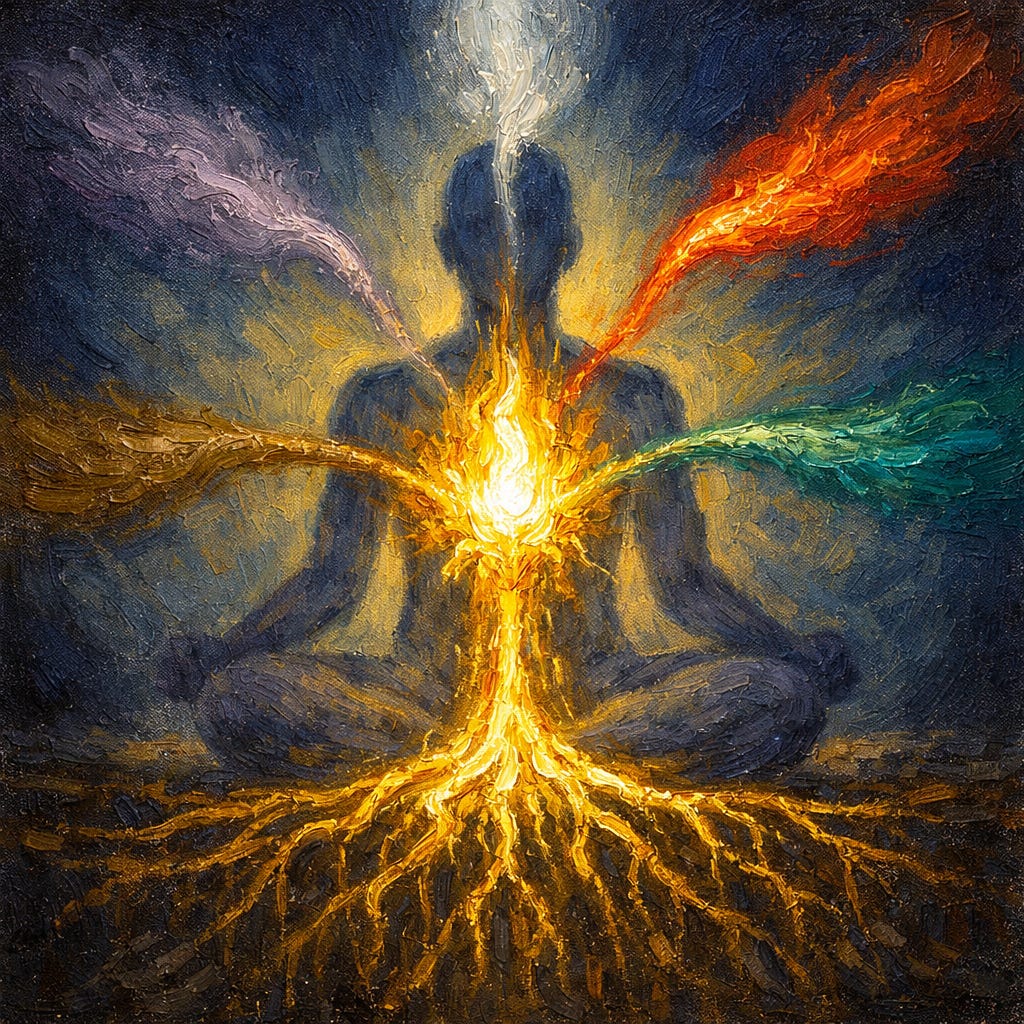
In November 2024, I interviewed Michael Green about Ayurveda — the 5,000-year-old Indian system of medicine that most Westerners have either never heard of or filed under “alternative.” That conversation covered the basics: doshas, digestive fire, daily routine, the role of nature. Michael explained how a client’s gastroenterologist diagnosed him with IBS and sent him home, while Michael discovered the man simply wasn’t chewing his food. Eighty percent better in two weeks. The interview struck a nerve with readers. This is the second conversation.

This one goes considerably deeper. Where the first interview introduced Ayurveda’s framework, this one explores what that framework reveals when applied to the mind, to emotional health, and to the question of what actually causes disease. Michael walks through concepts that have no equivalent in Western medicine: that unprocessed grief and trauma are toxic residue in the body, not metaphorically but mechanistically. That two of Ayurveda’s three root causes of disease reduce to a single problem — a lack of mindfulness. That health itself, in Sanskrit, doesn’t mean “absence of disease” but “settled in self.” That the design of your home, the quality of what enters through your five senses, and your relationship to your own attention are as much medicine as anything a doctor could prescribe.

Michael’s answers draw from Ayurvedic texts, Buddhist practice, Carl Jung, Candace Pert, and his own clinical work in Bali. His operating principle hasn’t changed since the first interview — the simplest interventions are often the most powerful — but the territory he covers here is wider and stranger than before. Readers who found the first conversation useful will find this one harder to shake.
With thanks to Michael Green.
Support Independent Investigative Journalism and Research
This work remains free because paid subscribers make it possible. If you find value here, consider joining them.
What paid subscribers get: Access to all books I’ve written plus 1-2 new ones per month. e.g.
The DMSO Book
Chlorine Dioxide
The PSA Trap
Breast Cancer
Drilling for Profit
What Your Vet Can’t Tell You
Plus: Access to the Deep Dive Audio Library — 180+ in-depth discussions (30-50 min each) exploring the books behind these essays. New discussions regularly added. That’s 100+ hours of content for less than the price of a single audiobook.
[Upgrade to Paid – $5/month or $50/year]
1. In Ayurveda, the Sanskrit word for health — Swasthya — doesn’t mean the absence of disease. It means “settled in self.” That’s a fundamentally different starting point from Western medicine, which defines health as the absence of pathology. What does “settled in self” actually look like in practice, and how does that definition change the way you approach a client who comes to you with a health complaint?
From my perspective, swasthya means being able to sit still and be in your body, feelings, and essence, and loving yourself, and remaining in self-sadhana, no matter how turbulent. Remaining in ‘one’s own self, essence, or nature’ is difficult, but it’s possible. You start by loving yourself as much as you would a child or friend, and increasing your attention span. Both are possible though meditation.
Mindfulness means presence in this moment, independent of circumstance. Self compassion means cultivating a relentless self love and forgiveness practice, a trust in self, courage to own your mistakes, and the fearlessness to not disassociate. Many people are merciless self critics, and treat themselves worse than they’d treat a friend or loved one. So many never give themselves respect, support, love, or compassion. Self compassion has become one of the primary areas of focus with clients. If you hate yourself (or can’t focus), healthy eating only goes so far. I know because I had both illnesses for a long time, which has given me x-ray vision to see them in others.
Swa (स्व) = one’s own self, essence, or nature.
Stha (स्थ) = to be established, rooted, or abiding.
Technically speaking, swasthya means balanced doshas (Vata, Pitta, Kapha), agni (digestive fire), dhatus (tissues), malas (proper elimination of waste products), and a calm mind and soul. The first four are mostly physical (agni, or digestive fire, can also mean mental and emotional digestion, as we’ll get to), but Ayurveda is holistic in mind, body, soul, and spirit. Stress, self criticism, and chronic avoidance or distraction negatively impact physical health. In the west, 75% of visits to the ER and doctors’ offices, as well as the leading causes of death, are stress related. The mind affects the body, and the body affects the mind. Swasthya means physical, spiritual, and mental health.
2. Most people who’ve encountered Ayurveda understand agni as digestive fire — the body’s ability to break down food. But you’ve said that agni operates on mental, emotional, and spiritual levels too. What does it mean to have strong or weak agni beyond the gut?
Physically, Ayurveda says that our health and immune system largely depend on our agni, or digestive fire. If agni is slow, undigested food waste, called ama, forms. Ama (“that which is not your true self”) is the cause of most physical disease in Ayurveda. For example, the west suffers from diseases of overconsumption, not malnourishment. Roughly 75% of the United States is overweight or obese. Modern science claims that 70-80% of our immune system is in the gut. The gut microbiome, gut motility, pre, pro, and post-biotics, and gut health are catching on, but Ayurveda has been emphasizing these concepts for thousands of years.
However, our mental and perceptive Agni processes, metabolizes, and digests mental and emotional experience. As much as we have undigested food waste that can make us overweight, constipated, or sick, unmetabolized mental and emotional experience can do the same. A sub-dosha of Pitta called Sadhaka Pitta, our perceptive fire, turns raw experience into understanding and meaning. Trauma work, therapy, etc., is catching on in the west, and thats great. From an Ayurvedic perspective, it helps metabolize unprocessed mental and emotional ama, as does meditation.
3. If agni is the fire, ama is what accumulates when that fire is weak — the toxic residue. And again, you’re saying ama isn’t only undigested food. Trauma, grief, unprocessed emotions — these are ama too. How does emotional ama manifest in the body? What do you see in clients carrying that kind of residue?
One of the core tenants of Ayurvedic medicine is that everyone is different. What works for you may not work for me; what is a superfood for you may be toxic to me. We all have different ages, genders, genetics, bodies, cultures, stressors, interests, jobs, hormones, cycles, partners, climates, tastes, and seasons of life. How ama, emotional and physical, manifests in the body is different for everyone.
There are, however, similarities of being a human being. The human experience asks we face and process what we’d rather not look at.
Different thinkers and cultures have pointed to unmetabolized experiences differently. Carl Jung said “until we make the unconscious conscious it will direct your life and you will call it fate.” Freud called it repetition compulsion. Jung also said “all neurosis is an avoidance of true suffering.” Ken Wilber says when we face unprocessed emotions for the first time, it will “hurt more, but bother us less.” In her book Molecules of Emotion, Candace Pert says that the unconscious mind is in the body, not isolated in one brain region. The Buddha said that meditators often shift their meditation position, for example, not because of discomfort but from a craving and need for comfort, suggesting even small movements are evocative of deep unconscious processes. Buddhists call emotional patterns sankharas. During Vipassana meditation, for example, old patterns may start to arise because body scan meditations may be giving you access to the unconscious for the first time. Meditation takes courage.
In Ayurveda, a lack of mindfulness is half of the three causes of physical and mental illness (more about this in question seven). Ayurveda always addresses the imbalance first, not your primary dosha (constitution), and nowadays our attention is scattered. When attention is scattered we’re more likely to make unskillful choices.
If we ignore mental, spiritual, or emotional ama, there will likely be mental and physical results, although they manifest differently in everyone. In a Vata-dominant constitution (air and space elements), emotional ama would likely first manifest as anxiety or stress and then constipation, for example. In a Pitta type (fire, a little water), emotional ama may be anger or emotional outbursts, followed by skin or eye irritation, or heart or liver issues, or hypertension. For a Kapha (earth, water) emotional ama would likely manifest first as depression or loneliness, followed by weight gain. These are generalities, not givens.
4. That connection between unprocessed emotional experience and physical disease — Western medicine is starting to acknowledge it under labels like psychosomatic illness or the stress-disease pathway, but it still treats mind and body as separate systems that happen to influence each other. In Ayurveda, how does stress actually move through the body to produce physical disease? What’s the mechanism?
A good example is what Dr. Robert Svoboda mentions in his book Prakriti: Your Ayurvedic Constitution, a favorite modern Ayurveda book. When we are unable to voice or speak a truth in our throat, heart, and gut, to a spouse or boss or family member, this energy gets trapped in our bodies, which create illnesses (specifically rheumatoid arthritis and autoimmune conditions) that get us out of the situation (relationship, job etc.) that the voice could not. When we’re sick, we can’t go to work, participate sexually, etc. In a sense, the body is protecting you, and doing for you what the voice couldn’t, similar to Internal Family Systems (IFS) and parts work. Chinese medicine, which I’m not an expert on, is, in my opinion, more sophisticated than Ayurveda on the relationship between organs and emotions, but Ayurveda still has a lot to say on it.
Western medicine is still figuring out the pathways, but one example is how stress, or cortisol, decreases hydrochloric acid in the stomach. This weakens our agni and power of digestion, creating ama, thus illness. Stress (cortisol) also reduces our concentration and mindfulness, leading to poorer choices and sleep disruption, putting us into sympathetic activation, which decreases agni, increases brain fog, creates immune complications, and increases the likelihood of negative feedback loops.
When we’re exhausted, our brains crave sugar. And caffeine. And more dopamine hits.
If western or functional medicine practitioner considers themselves ‘holistic,’ they’ll likely emphasize the body as a whole system. It’s a great start, but part of the picture. Ayurveda is holistic in mind, body, soul, and spirit. What makes you excited? Are you living your purpose. Do you know what your purpose is? What gets you out of bed? What do you do for fun? How are your relationships? How much time do you spend in nature? These are just as—if not more—important than diet and exercise.
5. That brings us to what Ayurveda calls the doshas of the mind — sattva, rajas, and tamas. Most of your readers will know about Vata, Pitta, and Kapha from our first conversation, but these mental qualities are less familiar. How would you introduce them?
Rajas is a distracted, turbulent state of mind. Tamas is slow, dull, and lethargic. Tamas almost always follows rajas.
Sattva is equilibrium, peaceful, and balanced. There isn’t a one-to-one relationship with the physical doshas, but there are correlations. Vata and Pitta types are more likely to have rajassic minds, and Kapha doshas are more prone to tamassic states.
6. How do rajas and tamas — that agitation and that inertia — directly affect physical health? Is there a relationship between someone’s dominant mental guna and the kinds of physical imbalances they develop?
A calm, clear mind can follow exercise, for example, and a rajassic/ tamassic mind may follow a day of binging on Netflix and ice cream. A relaxed nervous system and calmer body may result from meditation, and an activated nervous system may result from looping, discursive thoughts and a day of online meetings. The mind affects the body, and the body affects the mind. It works both ways.
Rajas can cause, and is a result of, anxiety, nervousness, constipation, and poor sleep. Tamas can cause, and is also a result of, weight gain, low blood pressure, lethargy, depression, etc.
7. Ayurveda identifies three root causes of disease, and you’ve pointed out that two of them essentially translate to a lack of mindfulness — the choices we make against our own better knowing. That’s striking, because it means Yoga, Ayurveda, and Buddhism all independently arrive at the same conclusion: that the quality of our attention is foundational to health. Can you walk us through those three root causes and that convergence?
Padmasambhava, the great Buddhist master, is rumored to have said “my view is as vast as the sky, but my attention to the law of karma is as fine as a grain of barley flour.” Neville Goddard, the 20th century mystic, says that our choices in the present moment don’t recede into the past, but meet us in the future to confront us, spent or invested. “Not gone is the last moment, but oncoming,” he says.
When we are present, in a state of clear-seeing, the likelihood of making a wiser choice increases, and the likelihood of making an unwise choice decreases. When we are distracted, the likelihood of making an unskillful choice increases, and the probability of making an skillful choice decreases.
For example, I had a strange experience a few months ago here in Bali. I found myself in an eyeglass store, attempting to fix a pair of blue-light blocking glasses I bought at the Biohacking Conference in Los Angeles in 2022. I remember standing at the booth at the conference years ago, deciding whether to buy the glasses. Never in my wildest imagination could I dream that 2.5 years later, as a direct result of that seemingly insignificant choice in Los Angeles, I would be standing in an eyeglass store in Bali. We are always downstream of past choices, even minor ones. Our own, our parents, grandparents, and on down the line. There’s no way of escaping it. Causes are effects; effects are causes.
Yet we are also, in every moment, creative. Every moment is both karma and creativity, destiny and free will. When we start to cultivate presence and mindfulness in our lives—not just on the cushion, but while driving, eating, talking, or fixing eyeglasses—and view every Now as infinitely creative, a potential choice that will meet us down the line, in a minute or years, this view creates a pause. Cultivating space between stimuli and response, or mindfulness, opens up room for wise choice.
In Ayurveda, there are three main causes of disease:
1- Prajnaparadha, or “crimes against wisdom.” Choices made, moment by moment, are the nidana (root cause) of many issues. For example, if we eat ice cream late at night and in the morning we have a belly ache and brain fog, it’s not surprising. We know how we’ll feel in the morning if we finish the tub of ice cream, but we do it anyway (“crimes against wisdom”). Prajnaparada says that the ‘root cause’ of poor sleep and the morning belly ache isn’t the ice cream but the ‘choice’ we made, bite after bite, to keep eating.
2- Asatmendryartha Samyoga: misuse of senses (covered more in depth in question 9).
3- Parinama: In one sense, this is time, change, and seasonal vagaries, like how changes in the weather or seasons or flying across time zones can create illness. Parinam, however, is also perception of time. When we live in the past or worry about the future, we are never in the present moment, and it’s only through presence in the moment where we can make wise choices (see prajnaparadh, #1).
8. In our first conversation, you told the story of a client whose gastroenterologist diagnosed him with IBS and sent him on his way. You discovered the issue was that he wasn’t chewing his food. He was 80% better in two weeks. You’ve since described a principle in Ayurveda that “the most subtle is the most powerful.” That story seems like a perfect example. What does that principle mean more broadly, and how do you apply it?
The subtle, simple things, be they choices, attitudes, worldviews, or patterns, really are the most powerful, and the driving force of almost all our behavior. Yet, we can’t measure, weigh, or examine them. Nor can we measure, weigh, or examine love, for that matter.
Take Prajnaparadh. Think about, for a moment, how subtle and invisible the choices we make are, and how enormous the consequences. Choices made are often so subtle we don’t notice we’re actually choosing, and imagine how powerful they are compounded over time, when we make the same choices, for better or worse. Even one small, seemingly insignificant choice, like the eye glass example, moves on out ahead of us, and doesn’t recede into the past. It’s really mind blowing.
Padmasambhava said that “as a thing is viewed, so it appears.” How we view the world determines how the world views us, which determines the world we view, and so forth. For example, I wasn’t doing great in some of my New York years. I was depressed and anxious and I viewed the world like it was a museum exhibit that noticed me only when I bought a sandwich or asked a question or something like that. I felt invisible. Few people smiled at me. I didn’t have a face anyone wanted to smile at, I guess! Yet, studying this principle, I came to understand that it could be—could be—that the world was cold, distant, and objective because I viewed it as such.
One day, after re-reading my friend Paul Levy’s writings on As Viewed, So Appears, I decided to put the principle to the test. I walked up to a booth in the farmers’ market to buy some oranges and I smiled ear to ear, although it felt fake, like I didn’t remember how to do it, exactly. The guy smiled back and it took my breath away. I couldn’t believe it really had been that easy all along, that I’d been a fool for so long! I was under the spell that the world was operating independently and conspiring to victimize me, which it was doing only because I believed it would! As Viewed, So Appears is such an important part of the fabric of existence that if we believe it not to be true, the world will shape shift and reflect back to us our belief that As Viewed, So Appears isn’t true.
The most subtle, invisible thing—my attitude toward the world—was one of the most important factors shaping my reality.
9. You’ve said that what we take in through the five senses is as important to health as the food we eat. That’s a significant claim. What does sensory intake look like as a health factor, and what happens when it’s out of balance?
In nature, all five senses are nourished: scents from trees, flowers, and rain; sights of the trees, river, and views; sounds of the wind and birds; tastes of spring water or fruits; touching the earth with our bare feet or the water on our bodies as we swim. In cities, our senses are undernourished, or receive hostile impressions: traffic, pollution, noisy neighbors, unpleasant views, etc. A chronic misuse of the senses can contribute to mental and physical disease.
I lived in New York City for 13 years. Some people, young and old, who spent their entire lives in the city, looked like the city had shaped them like a glob of clay on a potter’s wheel: tense body, tight eyes, armored energy. When I stepped out of the city, I saw that I too had been shaped by it more than I thought. Environments have a combination of sense impressions that affect people. Generally speaking, people who live in natural environments (or have easy access to them) have a different health profile, body, and affect than those who live in man-made environments.
10. In our first interview, you said something that stayed with me: “the more I study Ayurveda, the more I understand that there’s little that isn’t Ayurveda.” You mentioned astrology, home design, gemstones. Ayurveda uses Jyotish, Vastu Shastra, aromatherapy, and gemstones therapeutically. For readers encountering this for the first time, how do these modalities actually work within the Ayurvedic framework? What’s the logic connecting, say, the design of your home to your health?
Ayurveda literally translates to “the science of life.” Diet, food, and the doshas are important, of course, but a small part of the human ecosystem.
Ayurveda uses the qualities of the elements and their manifestations to balance the elements within us, which are represented by the doshas: Vata (air, space), Pitta (fire, a little water), and Kapha (earth, water).
Take gemstones. Rubies are considered heating so potentially good for Vata and Kapha, who run cold. Diamonds are considered cooling, so good for Pittas, who run hot. In aromatherapy, cooling scents like sandalwood and rose balance the heat of pitta, warming scents like cinnamon or clove warm the coolness of Vata and Kapha. It’s the same with climate. The Northwest of the United States, for example, is a cold, damp, rainy climate, the exact qualities of Kapha dosha, so Kapha imbalances—heaviness, depression, dampness, mold, isolation—can increase there. The heavy dampness of Kaphas would ideally be offset by a warm, dry climate. A cold, dry, windy desert, for example, would imbalance the Vata, who already has those qualities in excess. Vatas would be balanced by the tropics: warm, humid, moist.
I joke that if you see someone shoveling snow in shorts, or lingering in the ice bath for several minutes, they’re most likely a Pitta, because their excess heat is being brought to homeostasis.
Like increases like, opposites balance. Everything in nature has qualities. Not just food.
Vata doshas, who run cold, light, and dry, get imbalanced by cold, light, and dry foods, like popcorn and salads, for example, and are nourished by warm, grounding, unctuous foods, like a warm curry, or sweet potatoes. Pittas, who run hot, are imbalanced by pungent garlic and hot chili peppers, and balanced by cooling foods like coconuts, aloe vera filets, and cilantro. Kaphas run cold, heavy, stable, and unctuous, and are imbalanced by heavy, cold foods like ice cream and yogurt (especially at night), and balanced by warm, penetrating spices like turmeric and cumin, bitter greens like arugula and dandelion, and a heating and astringent raw honey.
In yoga, some asanas balance Vatas, Pittas, and Kaphas, and some imbalance. There are Pranayama and breathwork practices that heat you up, some that cool you down, some that wake you up, some that chill you out. Ayurveda seeks to balance what our needs are in that moment. It’s all about your vikruti (present state imbalance) more than your prakriti (original creation, dosha). And we balance through the principle of like increases like and opposites balance.
The sister science of Vastu Shastra, or Vedic architecture, maximizes the flow of prana in your home. Generally speaking, you use directions and angles to maximize prana flow and solar and magnetic energy. Studies show that facing desks east or north increases test scores, facing hospital beds east or north increases recovery time, facing east or north when sleeping (feet pointing east or north) increases sleep, keeping the center of your home empty, honoring the space element, creates better prana flow, etc.
Ayurveda views health as something to be cultivated, maintained, and protected. Ayurveda staves off and pre-empts disease. Some even say that if you’re practicing or using Ayurveda to address an illness or an imbalance, you’re behind.
There’s a quote in the Caraka Samhita, one of the ancient texts, that I often refer to:
Like the heat of fire and liquidity of water, Ayurveda, or the Science of Life, is innate and does not involve any human... [no] statements are indicative of any beginning of the science. The phenomena of ‘increase by homologous substances and decrease by heterogenous ones’ (like increases like and opposites balance) are nothing but natural manifestations.
In other words, just like the heat of fire and liquidity of water, like increases and opposites balance is just the way it goes. It’s just the way it is. Human beings didn’t invent it. It’s just the Way, the Tao, how to flow with life. Ayurveda, or the ‘science of life’ is how to flow with life, and everyone’s flow is different. That’s Ayurveda.
11. You also said in our first conversation that your sister’s oncologist at Sloan Kettering — one of the best breast cancer doctors in the country — shrugged when you asked about diet during chemotherapy. You described Western medicine as not just treating diet and lifestyle as auxiliary, but as being “completely illiterate on the topic.” In Ayurveda, medicine itself goes beyond food. It includes purpose, nature, meditation, how we treat others, self-compassion. How does Ayurveda define what constitutes medicine?
When I was in Ayurveda school, once per week we went to the clinic and trailed one of the main Ayurvedic doctors of the program. Everyone wanted to train with Dr. Jay and getting a slot with him was competitive. He was very intuitive and a great teacher, and during my last semester I was fortunate enough to trail him once per week. One day, a woman around 40 comes in. She’s overweight, depressed, not exercising, and had lost interest in life. I thought I had a good idea as to what herbs, supplements, or body treatments would be best, and was excited to run them by Dr. Jay. However, he surprised all of us by not recommending a single herb, treatment, supplement, or anything. He asked her to go for a one-hour walk every day for a month. That was his only prescription. It opened my eyes as to what medicine was, and what I thought it was, or must be. You meet people where they’re at, you use your intuition, and take your ego out of it.
What we eat is an important component of health or ill health, but it’s a component (and even this singular component western medicine often fails to address). Western medicine typically only prescribe medication and doesn’t ask much at all about what a patient eats, how they move, their stress, family and spiritual life, etc. There are great studies on how meditation can reduce blood pressure, for example, but there aren’t many cardiologists who’d take a call from a meditation teacher.
The majority of my clients exercise, eat well, and do more than the minimum for good health. I usually tweak diets and meal plans, but rarely do I identify the diet as the principal source of an imbalance. Most of the time, it’s the subtle things: reducing the inner critic and cultivating self compassion, reducing stress, increasing fun and joy in life. It’s finding their purpose and learning to trust their inner wisdom.
12. For someone reading this who is dealing with a specific health concern right now — chronic digestive issues, poor sleep, anxiety — what are two or three Ayurvedic practices they could begin this week that would make a meaningful difference?
1- Love yourself. When we love, forgive, empathize with, and validate ourselves, we stop seeking validation so much from the outside. It’s great when it comes, of course, but with self compassion external validation becomes less necessary. When we have our own back, no matter what happens, whether we make a mistake or a harm was done to us by others, we know we will be fine. This has become my most prescribed medicine.
2- Meditate. Learning how to be present with whatever is arising, within and without, is a superpower, and it’s becoming increasingly rare. It often blows my mind that my job as a meditation teacher is getting people to sit still and just be. To feel. Most people don’t know what it’s like to be in their bodies. I was one. I lived from my head up. The body was something I noticed only when it had a problem. When we become more present, kind, and compassionate, everyone benefits. It’s a service to self and other. Studies show that five minutes a day confer meaningful benefits like reduced stress, increased joy and presence, and more.
3- Walk after meals. Most people are good at taking their dogs for a walk, but few take themselves on a walk. A short 10-15 minute walk after each meal improves your agni, or digestive fire, and creates a “glucose sink” in your muscles to absorb the glucose, relieving the burden on the pancreas to secrete more insulin. Walking just 10 minutes per day (after one meal) equals around 2.5 full days of the year walking. Walking after lunch helps reduce afternoon crashes and can improve energy.
13. And for someone who’s already doing the basics — eating well, sleeping reasonably, exercising — what’s the next level? What does a more developed Ayurvedic daily routine look like?
Simple things like tongue scraping, oil pulling, and abhyanga (oil massage) most people can easily integrate, but the most beneficial and central daily practice is meditation. If you don’t meditate, it takes roughly 2.5 months for a new habit to become automatic. If you do meditate, continue!
Many Ayurvedic Dinacharyas (daily routines), like meditation, or pranayama, yoga, self compassion, and deepening your relationship with your body, heart, and mind, only deepen and deepen. Ayurveda and meditation just unfold to greater and greater depths.
There’s no end to it.
Keep going.
14. It’s been about 18 months since our first conversation. What have you learned or changed your mind about in that time, either in your practice or in how you understand Ayurveda?
That it works. My trust in Ayurveda, and Buddhist meditation practices, and the completeness of mother nature and the five elements, continues to deepen. The more I get to know and understand Ayurveda, the more astonishing she becomes. I’ve just fallen deeper in love.
Deepening my trust in these traditions helped me see that I was a member of a cult. I was indoctrinated into believing that I needed something outside myself to fix me. We all need help and assistance, of course, but the majority of healing, or medicine, comes from choices we make, habits we do or don’t, how we view and treat ourselves, how we view the world, respond to stress, and fulfill our dharma, or purpose, and more.
These are free, and come from within.
I used to take a lot of supplements, do a lot of modalities, and be into the whole biohacking thing: bloodwork, devices, measurements. The past year I’ve I stepped more and more away from it. My last remaining justification for taking supplements or tinkering with biohacking stuff was believing that my experimentation would help clients, but even this became an un-Ayurvedic repudiation of tradition. In Ayurveda, everyone is different. What works for me will likely not work for someone else. All the exogenous, expensive stuff started to seem superfluous and silly. I’m healthier now at 46 than at anytime of my life, and it’s from sleeping and pooping better, dancing, playing basketball, eating well, meditating, teaching, and enjoying my life.
Yes, I’m fortunate enough to live in Bali, so exposing myself to the elements, getting sun, fresh food, fresh air, etc., isn’t as complicated as it was in New York City or Los Angeles, but I also want to reiterate that my main practice—my core dinacharya—is maintaining Right View, that principle of As Viewed, So Appears. Showing up, at attention, each morning, with gratitude, excitement, discipline, optimism, you name it, damn the torpedos, for that profound ceremony that is a day is, without a doubt, the greatest, and sometimes the most difficult, practice.
15. If someone has read both of these interviews and wants to go further — they’re genuinely interested in understanding Ayurveda, not just sampling it — what would you want them to take away, and where should they start?
Ayurveda has many entry points: diet, dinacharya (daily routine), agni, meditation, panchakarma (detox), body work, yoga, Vastu (home design), Jyotish (astrology), herbology, philosophy, and more. Find your area of excitement and start there. There are many amazing educators in each discipline.
I run a seven-session Ayurvedic coaching program, a personalized, integral path tailored to the individual. I also do one-off consultations where each client receives customized practices, be it meditation, self love, diet, lifestyle, sleep, breathing, and more, depending on their needs.
Paid Substack subscribers get a free 30-minute exploratory session with me, occasional group Zoom calls, and exclusive access to my Substack paid subscriber chat. I teach meditation and Ayurveda regularly around Ubud, Bali, and I’m co-hosting a five-day Ayurveda and meditation retreat in Thailand the first week of September. I’m offering Unbekoming readers discounts on packages and consultations, so please DM through Substack (mention Unbekoming), or message me at: https://www.michaelgreenayurveda.com/contact.
🎭🌿 COMING SOON… 🌿🎭
🎶 AYURVEDA: THE MUSICAL 🎶
The ancient healing spectacular that’s 5,000 years in the making!
Set somewhere between a Himalayan monastery, a New York juice bar, and a Bali meditation retreat, AYURVEDA: THE MUSICAL follows one man’s journey from stress, snacks, and screen addiction to inner balance, digestive fire, and properly chewed lentils.
Prepare yourself for the healing hit parade!
🎤 “SWASTHYA: SETTLED IN SELF”🧘♂️
I sat down cross-legged to find my soul
But my knees complained and my phone took control
Guru said “Breathe slow… let the universe tell”
But first I must learn how to sit still… and not check email. 📱
🎤 “DIGESTIVE FIRE (AGNI ON THE DANCE FLOOR)”🔥
Turn up the heat, let the metabolism roar
No midnight pizza, no snacks anymore
The crowd chants loud while the lentils inspire
“Chew it thirty times—feed the digestive fire!” 🌶️
🎤 “AMA BLUES (UNDIGESTED FEELINGS)”😩
I swallowed my anger, my grief, and regret
Now my gut says “Buddy, we’re not done yet.”
The therapist nods while the sitar plays low
“Those feelings you buried… now they’ve got to go.” 🫠
🎤 “RAJAS IN THE CITY”🌆
Running fast, mind spinning like a caffeinated storm
Emails, deadlines, panic—modern life’s the norm
The yogi sighs gently and lowers the lights
“Less espresso tomorrow… more candlelit rites.” ☕
🎤 “TAMAS ON THE COUCH”🛋️
Ice cream tub, Netflix glow, motivation gone astray
Guru taps my shoulder: “Perhaps… a walk today?”
But tamas whispers softly, “Stay cozy… stay slow…”
Till Kapha hits the chorus: “Fine… I’ll go.” 🍨
🎤 “CRIMES AGAINST WISDOM”🍰
I knew I shouldn’t eat the cake at half past two
But enlightenment’s hard when frosting’s in view
The sages all warn with karmic precision
“Your stomach tomorrow… remembers the decision.” 😬
🎤 “THE FIVE SENSE SYMPHONY”🌺
Birdsong, river breeze, sandalwood in the air
Nature sings softly: “Relax… repair.”
Then taxis start honking and sirens complain
The city remixes the Ayurvedic refrain. 🚕
🎤 “LIKE INCREASES LIKE”⚖️
Too much heat? Coconut water will do
Feeling too chilly? Spice up the stew
The crowd chants loudly as cumin flies high
“Balance your doshas—or at least give it a try!” 🌿
🎤 “THE WALK AFTER DINNER WALTZ”🚶♂️
Ten minutes strolling under evening skies
Muscles drinking sugar before insulin cries
Pancreas applauds from somewhere inside
“Finally… someone took me outside.” 🌙
🎤 “AS VIEWED, SO APPEARS”✨
Smile at the world and the world smiles back
Frown all day and the cosmos goes slack
The chorus declares with mystical cheers
“The universe echoes whatever appears!” 😄
🎤 “THE BIOHACKER’S FAREWELL”📉
I sold my gadgets, supplements, and graphs
Now my wellness routine includes dancing and laughs
No lab report needed, no data to fear
Just sunshine, fresh air… and a basketball career. 🏀
🎭 Critics are already calling AYURVEDA: THE MUSICAL
🌟 “The only Broadway show that improves your digestion!”
🌟 “A spiritual spectacle with better bowel movements!”
🌟 “Finally—a musical where the gut microbiome gets a standing ovation!”
So bring your doshas, dilemmas, and digestive fire to the theater event of the millennium.
🎟️ AYURVEDA: THE MUSICAL
Where enlightenment meets entertainment…
…and everyone leaves the theater chewing their popcorn thirty times. 🍿😄
Ayurveda starts from a very different premise than modern medicine. Health isn’t just the absence of disease — it’s being settled in oneself. When digestion, emotions, attention, and environment are in balance, the body tends to follow.
What stood out to me is the idea that what we fail to digest emotionally can accumulate in the body the same way undigested food does. Western medicine is slowly rediscovering pieces of this through stress research, trauma work, and gut science, but Ayurveda has been describing the same terrain for thousands of years.
Also a reminder that the simplest interventions often matter the most: chew your food, walk after meals, calm the mind, and pay attention to the environment you live in. Not glamorous, but often more powerful than another supplement or device.
Good conversation.