
Birthgap
A Documentary Review

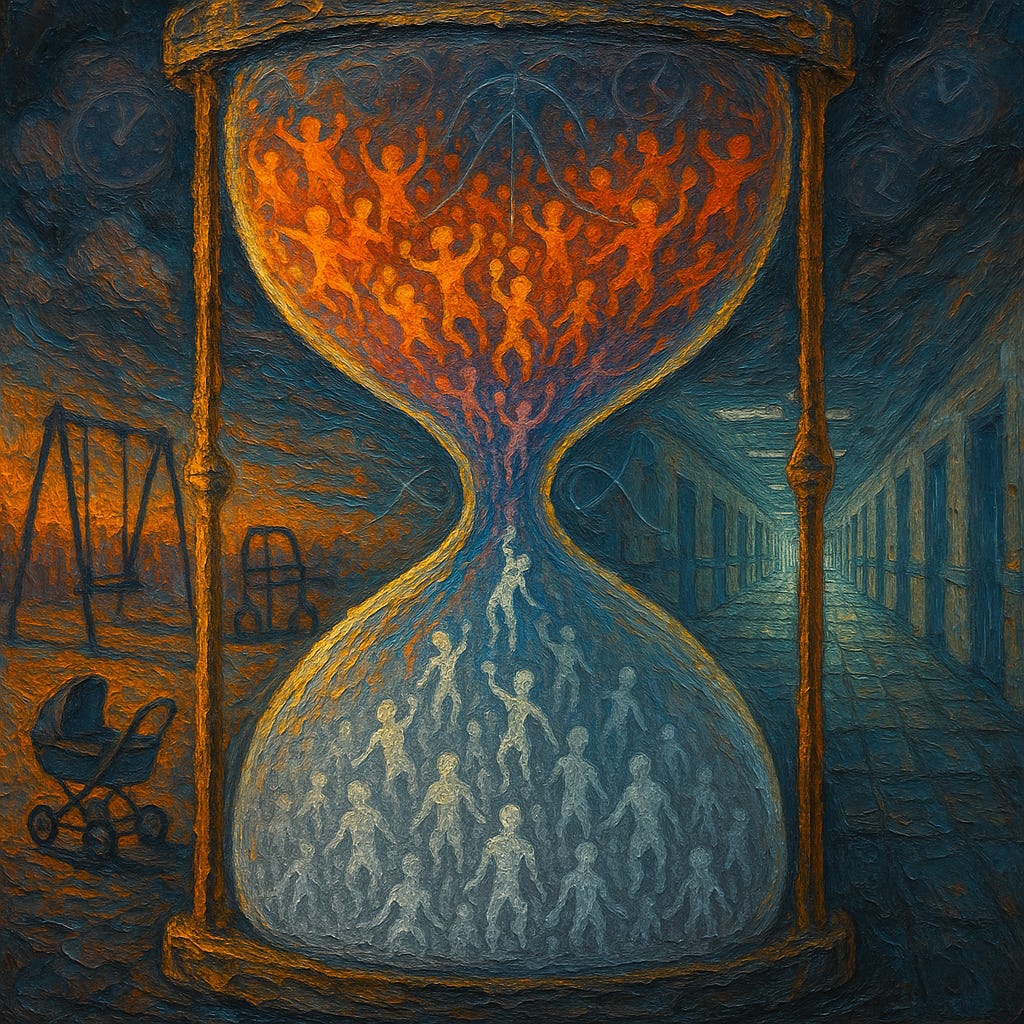
The Birthgap documentary presents a stark mathematical reality: across the industrialized world, the transition from having children in one’s twenties to delaying parenthood into the thirties has created a demographic trap that no society has ever escaped. The film’s creator, Stephen J. Shaw, spent eight years tracking a pattern that emerged simultaneously across vastly different cultures—Japan, Italy, Germany—all experiencing the same collapse in birth rates starting in the 1970s. The data reveals something counterintuitive: this isn’t about smaller families. Mothers who do have children are having the same number they always have—around 2.3 to 2.4 children on average. The crisis stems from a different source entirely: an explosion in unplanned childlessness, where the proportion of people who never become parents has risen from one in twenty to one in three, and in some countries, approaching one in two. Shaw’s “vitality curve”—a near-perfect bell curve showing new mothers by age—demonstrates why delayed parenthood mathematically guarantees mass childlessness, as the symmetry of the curve means that for every year parenthood is delayed past the peak age, an equal number of people fall off the other side, never having children at all.
The documentary’s most devastating revelation comes from its analysis of specific triggering events: the 1973 oil shock in Japan and Italy, the 1968 student protests in Germany, the 1990s currency crisis in South Korea, and the 2007 financial crisis in the United States. In each case, childlessness exploded from negligible levels to 20-30% within just three years—a demographic shift so rapid it defies conventional understanding of how societies change. Japan’s data proves particularly illuminating: in October 1973, when oil prices quadrupled overnight, young Japanese couples living in newly built apartment complexes suddenly faced sharp price rises in food and commodities. Precisely nine months later, across every prefecture in Japan, the number of first-time mothers plummeted and never recovered. The pattern repeats everywhere Shaw investigated—economic or social uncertainty causes young people to delay starting families “until things stabilize,” but that delay becomes permanent as they age out of their peak fertility years, creating what Shaw calls “unplanned childlessness.”
The human stories behind these statistics paint a picture of widespread grief that society refuses to acknowledge. Jody Day, founder of Gateway Women, describes how 80% of childless women had planned to have children someday—they’re “childless by circumstance” rather than choice. The documentary captures men gathering in support groups, breaking down as they describe spending years “going over what never was, what’ll never be,” while fertility doctors explain the cruel mathematics of aging eggs: even at 20, only three out of five eggs are viable, but by 45, good eggs become nearly impossible to find. The film follows couples through multiple failed IVF cycles, women discovering at 44 that adoption waiting lists stretch for years with thirty families competing for each available infant, and individuals who changed their minds about having children only to discover it was already too late. One Japanese woman’s simple statement - “I enjoyed my life, but now I regret” - encapsulates thousands of similar stories of people who believed they had more time than they actually did.
Shaw’s research across Latin America, India, Nepal, and Africa reveals this isn’t a rich-world problem but a global transformation hiding in plain sight. India already has a national birth gap, with 90% of states below replacement level by 2024. Nepal’s fertility rate crashed from 4.0 to 1.9 in just two decades. Even in Malawi, young students describe walking two hours each way to school while planning to delay children until after obtaining master’s degrees—eerily echoing the same life trajectory that led to mass childlessness in Tokyo and Milan a generation earlier. The documentary’s maps showing “birth gaps”—the shortfall between babies being born and the 50-year-olds they’ll need to support—reveal black holes spreading across every continent, with South Korea leading at 69%, parts of Europe at 60%, and even historically high-fertility regions of Latin America approaching 40%. The mathematical inevitability Shaw demonstrates is that societies with fertility rates of 1.4 children per woman will lose one-third of their population each generation, halving every 50-60 years in what he calls “exponential decay.”

The documentary concludes with Shaw’s proposed solutions—educating young people about the “vitality curve” before it’s too late, restructuring education and careers to support earlier parenthood, requiring employers to publish how many staff successfully become parents—while acknowledging that no country has ever reversed this trend once it begins. The film ends with haunting footage of Japan’s “yesterlands”: entire neighborhoods of vacant houses, elderly people throwing themselves from rooftops weekly with no family to care for them, and empty schools closing at a rate of two per day. In a separate essay accompanying the documentary, James Corbett ventures into more contested territory, arguing this demographic collapse represents deliberate social engineering rather than accidental consequence. Corbett points to phthalates and endocrine-disrupting chemicals that have halved global sperm counts in 50 years, the Rockefeller Foundation’s admitted funding of women’s liberation movements, and explicit depopulation advocacy in documents like NSSM 200. While Shaw’s documentary presents the crisis as an emergent phenomenon triggered by economic shocks and social changes, Corbett sees, and I agree with him, intentional design. Regardless of which interpretation one accepts, both works agree that societies have perhaps one generation to restructure everything around supporting younger parenthood, or face what Shaw calls “demographic winter”—a cascade of economic collapse, abandoned cities, and vanishing peoples that no amount of immigration or automation can prevent.
I appreciate you being here.
If you’ve found the content interesting, useful and maybe even helpful, please consider supporting it through a small paid subscription. While 99% of everything here is free, your paid subscription is important as it helps in covering some of the operational costs and supports the continuation of this independent research and journalism work. It also helps keep it free for those that cannot afford to pay.
Please make full use of the Free Libraries.
Unbekoming Interview Library: Great interviews across a spectrum of important topics.
Unbekoming Book Summary Library: Concise summaries of important books.
Stories
I’m always in search of good stories, people with valuable expertise and helpful books. Please don’t hesitate to get in touch at unbekoming@outlook.com
Baseline Human Health
Watch and share this profound 21-minute video to understand and appreciate what health looks like without vaccination.
Looking forward to watching this one! My mother (a Boomer) told me to never have children. Aside from this feeling like a direct insult, I didn’t want children (or so I thought) Then, by Grace, I had two children in my 30s. I wonder how many other kids in my generation were told it was better to work and travel than to have beautiful babies.
and so many abortions.