
Your Teeth Are Sweating
An Essay on the Dentinal Fluid Transport System That Dentistry Forgot

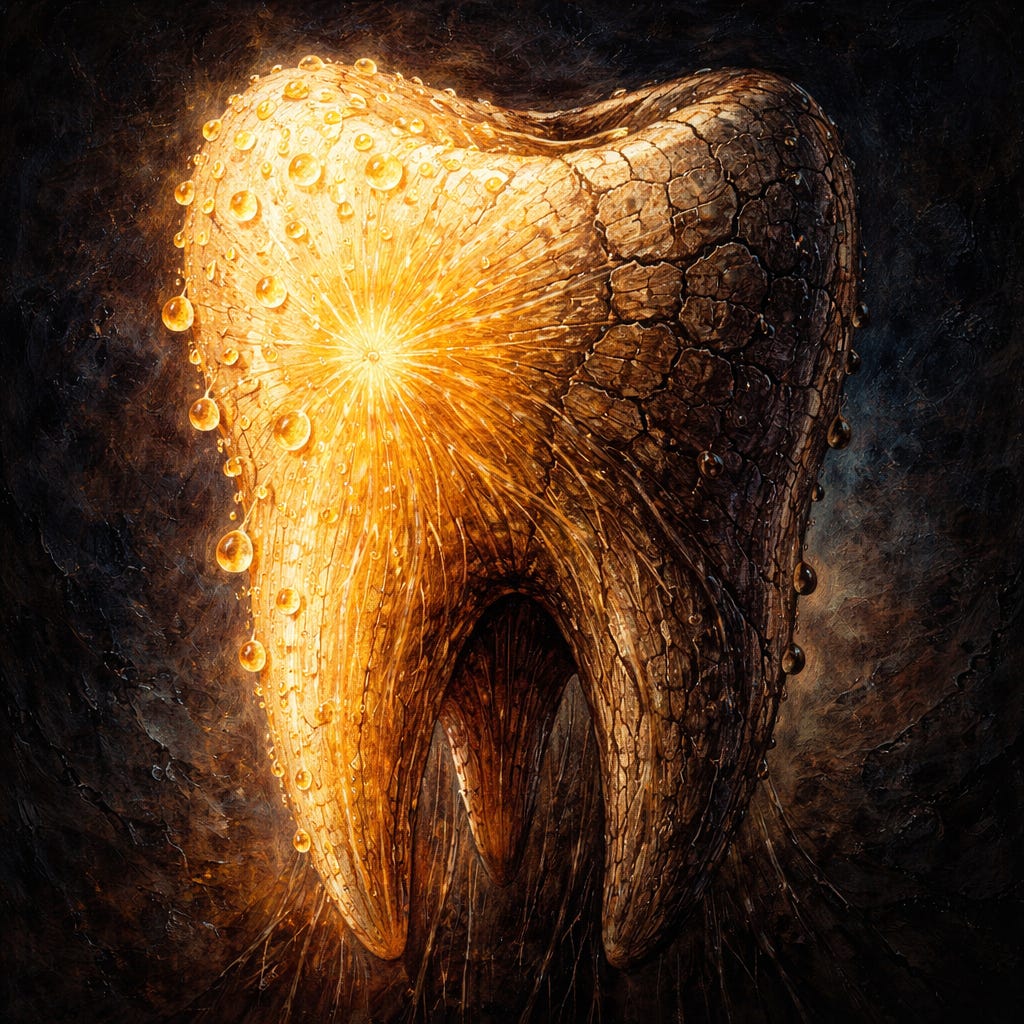
In 1958, a dentist at Loma Linda University injected fluorescent dye into a rat’s stomach. Six minutes later the dye appeared in the tooth’s inner pulp chamber. Within an hour it was visible in the enamel.¹ ²
The dentist was Ralph Steinman. He had just demonstrated that teeth are not inert mineral shells sitting passively in the mouth. They are organs with active internal circulation — a continuous fluid transport system connecting the bloodstream to the tooth surface. This was not a fringe observation or a single anomalous result. It was the beginning of a research program that would span decades, produce hundreds of studies, and be published in peer-reviewed journals including the Journal of Dental Research.³ It would also be almost entirely ignored by the profession it most directly concerned.
Three Miles of Hidden Plumbing
The standard image of a tooth is a hard, solid object — enamel on the outside, a nerve in the middle, and not much happening in between. Under a microscope, the picture is different.
Each tooth contains millions of microscopic tubes called dentinal tubules, running from the inner pulp chamber outward through the dentin to the enamel. These tubules are tiny — between 1.3 and 4.5 microns in diameter, roughly one thousandth the size of a pinhead.⁴ But there are so many of them that if the tubules from a single-rooted front tooth were laid end to end, they would stretch approximately three miles.⁵ ⁶ ⁷ That figure — from Weston Price's original research and corroborated by Levy, Breiner, Meinig, and Fife — appears consistently across the literature. A multi-rooted molar, with its larger mass of dentin, would contain proportionally more.
These are not empty channels. They are filled with a fluid estimated to be similar in composition to cerebrospinal fluid, the liquid that bathes the brain and spinal cord.⁸ The tooth enamel itself contains about two percent of this fluid.⁹ The tubules also contain portions of odontoblasts — the living cells that line the outer wall of the pulp chamber — along with nerve fibers and connective tissue.¹⁰ The density is staggering: between 20,000 and 45,000 tubules occupy a single square millimeter of dentin — roughly one thirty-second of an inch.¹¹
The architecture is intricate and alive. The capillaries in the pulp are fenestrated, meaning they have small openings that allow a nutrient-rich fluid to diffuse outward from the blood supply. Odontoblasts act as pumps, picking up this fluid and pushing it through the tubules toward the tooth surface.¹¹ The result is a constant, pressurized flow of nutrient-rich liquid moving from the inside of the tooth outward — from pulp, through dentin, into enamel, and ultimately onto the surface of the tooth itself.
Mark Breiner, in Whole-Body Dentistry, describes the process simply: in a healthy mouth, nutrients and oxygen travel via the bloodstream into the root, nourishing the tooth, with fluid passing outward through the tubules, through the dentin, and into the enamel.¹² This positive outward pressure serves as a defense system. It prevents the penetration of destructive substances from the mouth into the tooth.¹³
Nadine Artemis puts the image more vividly in Holistic Dental Care: the fluid appears on the enamel surface like microscopic beads of sweat. Tiny droplets coalesce, forming a protective fluid layer. If there is a crack in the enamel, the fluid volume increases to that area — like sap responding to a wound in a tree’s bark.¹⁴
Your teeth are sweating. And that sweat is what keeps them alive.
Support Independent Investigative Journalism and Research
This work remains free because paid subscribers make it possible. If you find value here, consider joining them.
What paid subscribers get: Access to the Deep Dive Audio Library — 180+ in-depth discussions (30-50 min each) exploring the books behind these essays. New discussions added weekly. That’s 100+ hours of content for less than the price of a single audiobook.
Plus 1-2 free books each month.
[Upgrade to Paid – $5/month or $50/year]
Get in touch Essay ideas, stories, or expertise to share: unbekoming@outlook.com
The Invisible Toothbrush
Steinman’s dye experiment proved the fluid existed. The next question was what controlled it. What regulated this flow — and what could disrupt it?
He partnered with endocrinologist John Leonora, and together they spent decades tracing the regulatory pathway. Hundreds of studies confirmed the answer: the fluid flow inside teeth is controlled by the hypothalamic–parotid gland endocrine axis.¹⁵ ¹⁶
The chain of command works as follows. When you chew, neural endings in the oral mucosa and tongue detect nutritive substrates in the food. These signals travel to the hypothalamus — the region of the brain that regulates the relationship between the nervous system and the endocrine system. The hypothalamus responds by signaling the parotid gland, the largest of the salivary glands, located adjacent to the inner ear near the jawbone. The parotid gland then releases a specific hormone — the parotid hormone — that synchronizes and sustains the outward flow of dentinal fluid.¹⁷
When the parotid hormone is produced in adequate amounts, fluid flows outward through the teeth, delivering minerals, flushing toxins, and repelling microbial biofilm on the surface.¹⁸ Artemis calls this the “invisible toothbrush” — a self-cleaning, self-mineralizing system built into every tooth.¹⁹
Ramiel Nagel documents the same mechanism in Cure Tooth Decay, arriving at the same physiology from a nutritional angle: the hypothalamus communicates with the parotid glands via parotid hormone releasing factor, and when the parotid gland is stimulated, it triggers the movement of mineral-rich dental lymph through microscopic channels in the teeth. This fluid cleans and remineralizes them.²⁰
The convergence across multiple independent authors is significant. Artemis documents Steinman’s experiments in detail. Breiner describes the fluid flow from a clinical perspective. Nagel approaches the same mechanism through nutritional biochemistry. Meinig traces the tubule architecture through Weston Price’s earlier work.²¹ Levy follows the implications of fluid flow disruption into root canal pathology.²² Five different practitioners and researchers, writing in different decades, describing the same system. The documentation is not thin. It is dense, overlapping, and consistent.
When the Flow Reverses
The system has a failure mode. And understanding this failure mode changes everything about how tooth decay should be understood.
When the hypothalamic–parotid axis is suppressed, the parotid hormone drops, and the outward flow of dentinal fluid slows and eventually reverses. The tooth shifts from pressurized defense to active vulnerability. Instead of pushing fluid outward, it begins drawing material inward from the mouth — like a straw.²³
This reversal is not theoretical. Steinman demonstrated it directly. He injected glucose under the skin of rats’ abdomens and documented the reversal of fluid flow in the dentinal tubules. He introduced sugar directly into their stomachs through a stomach tube and observed the same result.²⁴ George Meinig, in Root Canal Cover-Up, emphasizes the critical implication: sugar does not have to touch the teeth at all for its presence to result in severe tooth decay.²⁵ The damage is systemic, not local.
The mechanism runs through insulin. Foods that elevate blood insulin levels — refined carbohydrates and sugars — suppress the hypothalamus and inhibit proper parotid gland function.²⁶ The endocrine axis responds immediately; daily high blood sugar levels suppress dentinal flow. The axis also recovers immediately when dietary sugar normalizes.²⁷
Sugar is not the only suppressor. Steinman identified a range of factors that reverse dentinal lymph flow: processed foods, nutritional deficiencies, stress (via cortisol production), hormonal shifts including low thyroid activity and pregnancy, lack of exercise, medications, oral care chemicals, antibiotics, and fluoride.²⁸ The parotid gland is particularly vulnerable — fluoride suppresses its hormonal secretion, and cell-phone radiation can trigger tumors in the gland itself.²⁹
Once the flow reverses, the consequences cascade. Bacteria, acids, and fungi from the mouth are actively drawn into the tooth through the tubules.³⁰ The pulp chamber becomes inflamed. The tooth experiences oxidative damage and demineralization. Salivary enzymes begin to digest tooth structure.³¹ Bacteria proliferate — not because pathogens have invaded from outside, but because the internal terrain has shifted from vital to necrotic. Decomposition organisms respond to dying tissue. The microbial ecology changes as a consequence of the environmental shift, not as its cause.
This distinction matters. Under the conventional acidogenic model, bacteria attack the tooth from the outside, and the tooth is a passive victim. Under the dentinal fluid transport model, the tooth’s own maintenance system fails first, and bacterial colonization follows. The bacteria are responding to the terrain, not creating the disease.
What the Minerals Reveal
Steinman’s work also documented the specific minerals whose loss marks the onset of decay. Magnesium, copper, iron, and manganese — all active in cellular metabolism and necessary for the energy production that drives fluid flow through the tubules — decline as the system fails.³²
The mineral findings cut in both directions. Their loss correlates with decay, and their restoration correlates with recovery. In Steinman’s studies, adding copper, iron, and manganese to a sugar-producing diet almost abolished the decay rate. Phosphorus alone reduced decay by eighty-six percent and also prevented the atrophy and shrinking of the parotid gland associated with sugar ingestion.³³
Nagel notes that phytic acid — an anti-nutrient found in grains, nuts, seeds, and beans — has the capacity to block absorption of every one of these critical minerals.³⁴ The dietary pattern that suppresses dentinal flow (high in refined carbohydrates, low in bioavailable minerals, rich in phytic acid) is also the dietary pattern of modern industrial populations — the same populations experiencing epidemic rates of dental decay.
In a recorded conversation between Hal Huggins and Steinman, Huggins asked whether the fluid flow could be restored in a mouth already experiencing decay and acidic saliva. Steinman’s answer was direct: “Yes, simply by changing the diet. Most of the ‘flow-in’ foods are refined foods.”³⁵
The Researcher and the Research
Ralph Steinman was Professor Emeritus at Loma Linda University School of Dentistry. He was not a marginal figure. Loma Linda is one of the oldest dental schools in the United States. His work was conducted in university laboratories, published in peer-reviewed journals, and carried out with the collaboration of John Leonora, a credentialed endocrinologist. Their joint publication record spans from the mid-1950s through the 1990s.³⁶ ³⁷
The body of work was substantial enough that in 2004, Loma Linda University Press published Dentinal Fluid Transport, a compilation of the Steinman and Leonora publications edited by Clyde Roggenkamp.³⁸ This is not a self-published manuscript or an underground pamphlet. It is a university press volume collecting decades of the researchers’ own peer-reviewed work.
Steinman’s rat studies showed that while bacteria produce acid, there is no correlation between the acid produced by bacteria and the presence of tooth decay.³⁹ This finding directly contradicts the foundational premise of modern preventive dentistry — that bacterial acid is the primary cause of cavities. It was published. It was not refuted. It was simply not incorporated.
The conventional theory it contradicts — the acidogenic theory — was not established through experimental proof. It was adopted by vote at a meeting of the International Association of Dental Research in the 1940s. At that meeting, acid erosion was declared the official cause of cavities, and all competing systemic theories were relegated to the margins.⁴⁰ ⁴¹ The vote overrode not only Steinman’s later work but also the proteolysis-chelation theory of Albert Schatz, which proposed that enzymes and chelating agents — not bacteria and acid — were the drivers of decay, with diet, trace elements, and hormonal balance as key factors.⁴²
A theory adopted by vote. Contradicted by decades of published research. Still taught in every dental school.
Why It Was Never Taught
The suppression of Steinman’s work does not require a conspiracy. It requires only incentives.
If teeth maintain themselves when the internal terrain is right — when the hypothalamic–parotid axis functions properly and the dentinal fluid flows outward — then the primary intervention for dental health is nutritional, not mechanical. The question shifts from “how do we kill the bacteria?” to “how do we restore the flow?” The dentist’s role shifts from mechanic to something closer to nutritional advisor.
The profession is neither trained for nor economically structured to perform that role. Dental education does not teach endocrine regulation of tooth health. Dental practice is built on procedures — fillings, crowns, root canals, extractions — not dietary counseling. The economic model depends on the tooth being a passive object that breaks down and needs repair, not an active organ that maintains itself when properly supported.
Steinman’s research renders much of this structure unnecessary. That is not a conclusion the profession has any incentive to reach. And so the research sits in peer-reviewed journals and a university press compilation, documented by multiple independent authors across decades, read by almost no one who fills a cavity for a living.
The Document Exists
The publications are on record. The experiments were conducted at an accredited university by credentialed researchers. The mechanism — hypothalamus to parotid gland to dentinal fluid to enamel surface — is documented in detail across multiple independent sources. The fluid was tracked with dye. The reversal was demonstrated with glucose. The mineral correlations were measured. The hormonal pathway was mapped.
None of this was incorporated into dental education. None of it changed clinical practice. None of it altered the theory of tooth decay that was adopted by vote eighty years ago.
The research exists. It describes a self-maintaining organ with built-in circulation, mineral transport, and microbial defense — an organ that cleans itself from the inside out when the conditions are right. The question is not whether the evidence is there. The question is what happens to a profession, and to the patients it serves, when published science is left on the shelf because its implications are too inconvenient to absorb.
Your teeth have been sweating your whole life. No one told you, because no one was trained to know.
References
Artemis, N. Holistic Dental Care (Chapter 1). Steinman dye experiment documentation.
Breiner, M. Whole-Body Dentistry (Chapter 4). Fluorescent dye in rat dentinal tubules.
Steinman, R.R. and Leonora, J. “Effect of Selected Dietary Additives on the Incidence of Dental Caries in the Rat.” Journal of Dental Research 54 (May 1975): 570–77.
Nagel, R. Cure Tooth Decay. Dentinal tubule dimensions: 1.3–4.5 microns.
Levy, T. The Toxic Tooth. Tubule length: up to three miles per tooth.
Breiner, M. Whole-Body Dentistry (Chapter 18). Three-mile tubule estimate.
Meinig, G. Root Canal Cover-Up. Price quote: "dentinal tubuli of a single-rooted tooth comprise enclosed canals totaling approximately three miles of length."
Nagel, R. Cure Tooth Decay. Dentinal fluid estimated similar to cerebrospinal fluid.
Nagel, R. Cure Tooth Decay. Tooth enamel contains approximately two percent of this fluid.
Nagel, R. Cure Tooth Decay. Tubule contents: odontoblasts, nerves, connective tissue.
Meinig, G. Root Canal Cover-Up. Tubule density: 20,000 to 45,000 per square millimeter.
Artemis, N. Holistic Dental Care (Chapter 2). Odontoblast pump mechanism and fenestrated capillaries.
Breiner, M. Whole-Body Dentistry (Chapter 4). Nutrient delivery via fluid flow.
Breiner, M. Whole-Body Dentistry (Chapter 4). Outward pressure prevents destructive penetration.
Artemis, N. Holistic Dental Care (Chapter 1). Fluid on enamel surface; sap-wound analogy.
Artemis, N. Holistic Dental Care (Chapter 1). Steinman and Leonora: forty years of research confirming hypothalamic regulation.
Nagel, R. Cure Tooth Decay. Hypothalamus communicates with parotid glands via parotid hormone releasing factor.
Artemis, N. Holistic Dental Care (Chapter 1). Hypothalamic–parotid gland endocrine axis pathway.
Artemis, N. Holistic Dental Care (Chapter 1). Parotid hormone sustains outward fluid flow.
Artemis, N. Holistic Dental Care (Chapter 1). “Invisible toothbrush” description.
Nagel, R. Cure Tooth Decay. Parotid hormone triggers mineral-rich dental lymph movement.
Meinig, G. Root Canal Cover-Up. Fluid flow in dentinal tubules; nutritional reversal by sugar.
Levy, T. The Toxic Tooth. Loss of positive fluid flow in root canal-treated teeth enables bacterial colonization.
Artemis, N. Holistic Dental Care (Chapter 1). Reversal to centripetal flow; straw analogy.
Meinig, G. Root Canal Cover-Up. Steinman glucose injection and stomach tube experiments.
Meinig, G. Root Canal Cover-Up. Sugar need not touch teeth to cause decay.
Artemis, N. Holistic Dental Care (Chapter 1). Insulin elevation suppresses hypothalamus and fluid flow.
Artemis, N. Holistic Dental Care (Chapter 1). Endocrine axis responds immediately to sugar reduction.
Artemis, N. Holistic Dental Care (Chapter 1). Suppressors of dentinal lymph flow.
Artemis, N. Holistic Dental Care (Chapter 1). Fluoride suppresses parotid secretion; cell-phone radiation and tumors.
Artemis, N. Holistic Dental Care (Chapter 1). Reversed flow draws bacteria, acid, and fungi inward.
Artemis, N. Holistic Dental Care (Chapter 1). Salivary enzymes digest tooth structure; bacteria proliferate in response to dying tissue.
Nagel, R. Cure Tooth Decay. Magnesium, copper, iron, manganese loss in decay.
Artemis, N. Holistic Dental Care (Chapter 1). Mineral supplementation and decay rate reduction; phosphorus at eighty-six percent.
Nagel, R. Cure Tooth Decay. Phytic acid blocks absorption of key tooth-building minerals.
Artemis, N. Holistic Dental Care (Chapter 1). Huggins–Steinman conversation on diet and flow restoration.
Roggenkamp, C.L. and Leonora, J. Foreword to Dentinal Fluid Transport. Loma Linda, CA: Loma Linda University School of Dentistry, 2004.
Steinman, R.R. and Leonora, J. “Effect of Selected Dietary Additives on the Incidence of Dental Caries in the Rat.” Journal of Dental Research 54 (May 1975): 570–77.
Roggenkamp, C. Dentinal Fluid Transport. Loma Linda, CA: Loma Linda University Press, 2004.
Roggenkamp, C.L. and Leonora, J. Foreword to Dentinal Fluid Transport, p. VI.
Artemis, N. Holistic Dental Care (Chapter 1). Acidogenic theory adopted by vote at International Association of Dental Research, 1940s.
Nagel, R. Cure Tooth Decay. Vote at IADR meeting adopted Miller’s acid/bacterial theory despite contradictory evidence.
Nagel, R. Cure Tooth Decay. Albert Schatz’s proteolysis-chelation theory.
New Biology Clinic
For those of you looking for practitioners who actually understand terrain medicine and the principles we explore here, I want to share something valuable. Dr. Tom Cowan—whose books and podcasts have shaped much of my own thinking about health—has created the New Biology Clinic, a virtual practice staffed by wellness specialists who operate from the same foundational understanding. This isn’t about symptom suppression or the conventional model. It’s about personalized guidance rooted in how living systems actually work. The clinic offers individual and family memberships that include not just private consults, but group sessions covering movement, nutrition, breathwork, biofield tuning, and more. Everything is virtual, making it accessible wherever you are. If you’ve been searching for practitioners who won’t look at you blankly when you mention structured water or the importance of the extracellular matrix, this is worth exploring. Use discount code “Unbekoming” to get $100 off the member activation fee. You can learn more and sign up at newbiologyclinic.com
So the North American Boomer Generation, born anesthetized, often prematurely in those fluoridation experiment cities like Grand Rapids, with atom bomb test fallout already in their tiny bones, bottle-fed formula made from skim milk powder or canned condensed milk and corn syrup with a bit of vegetable oil and powdered iron filings in fluoridated tap water, weaned to Pablum, fed margarine on white bread with baloney and cheese-adjacent Velveeta, eating Hamburger Helper canned peas hot dogs fish fingers, peanut butter 'n jam sandwiches, corn, corn and more corn, drinking frozen condensed orange juice Kool Aid Freshie Coke Pepsi homogenized low fat milk and fluoridated tap water, consuming everything General Mills, Kellogg, Betty Crocker and Aunt Jemima had to offer, getting fluoride rinses at school and lining up there for vaccines with SV40 in them, getting mercury amalgam fillings every year for the new cavities, getting four teeth removed around puberty and orthodontic braces to pull the crowded parrot-beak jumble of teeth into some semblance of alignment, then wisdom teeth removed from the underdeveloped jaws that can't accommodate them, under fluorinated general anesthesia... well, our teeth never stood a chance.
Most interesting and valuable. Two points about phytic acid: (1) Grains, nuts, seeds, and beans are indeed part of the industrial diet but they long pre-existed it. (2) The reason for soaking the above foods before cooking them is to neutralize their phytic acid. Information about why and how to soak is provided on the Weston A Price website. One page for a quick reference is: https://www.westonaprice.org/wp-content/uploads/11Principles-chapter6.pdf .