
The Colonization of Time: From Subsistence to Surveillance
An Essay

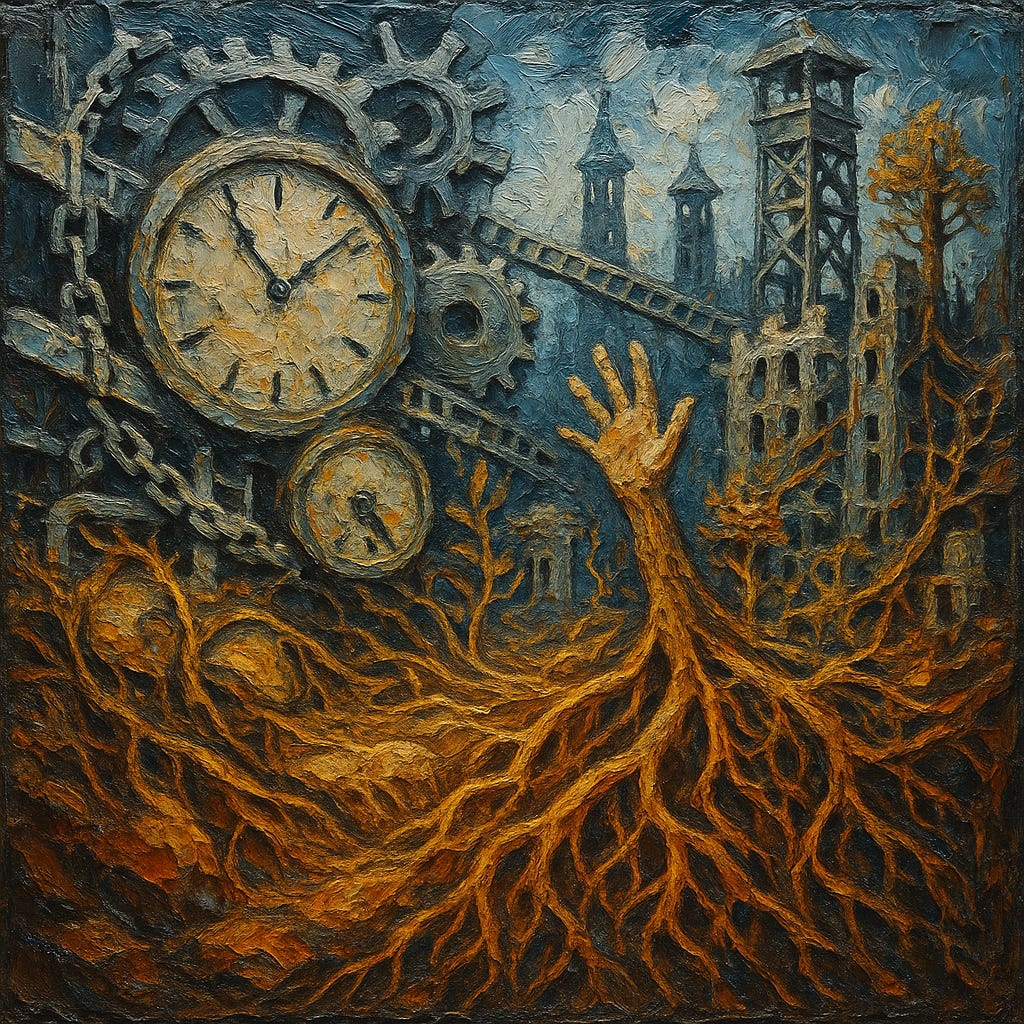
Preface
"The modern West cannot tolerate that people should prefer to work less and be content to live on little." When Paul Cudenec recently shared this quote from René Guénon's The Crisis of the Modern World (1927), it crystallized something I had been struggling to articulate. Guénon's observation, written nearly a century ago, has only intensified. Today, entire populations are judged deficient for maintaining subsistence economies, for prioritizing community over productivity, for choosing time over money. This judgment appears as concern: these people need development, opportunity, inclusion in the global economy. But beneath the humanitarian language lies a deeper imperative - the transformation of human beings into units of productive capacity.
This transformation requires violence, both physical and epistemological. Physical, in the destruction of subsistence economies and the imposition of wage labor. Epistemological, in the recasting of contentment as backwardness, of chosen simplicity as lack of ambition. The empire that once explicitly conquered territories now works through metrics and markets, but its fundamental project remains unchanged: to make all human activity visible, measurable, and extractable.
Guénon saw this as a metaphysical catastrophe - the reduction of existence to "everything that can be counted and weighed." But we can also trace its material history through colonialism, development economics, and contemporary capitalism. Each phase has refined the techniques for making people work more than they need or want to, for transforming satisfaction into insufficiency, for making alternative relationships to labor literally unthinkable.
The global economy runs on this transformation. From colonial plantations to Amazon warehouses, from structural adjustment programs to gig economy platforms, the same logic operates: human beings must be made to produce at maximum capacity. Any space outside this imperative - whether indigenous communities practicing subsistence agriculture or wealthy nations considering shorter work weeks - becomes a site of anxiety and intervention.
The stakes exceed economics. When quantity becomes the only recognized value, entire modes of being become impossible. The contemplative, the craftsman, the person who works three months a year and spends the rest in ceremony and kinship - these figures don't just lose economic viability. They lose existential legitimacy. Their choices become symptoms of dysfunction rather than expressions of different values.
Understanding this history matters because the transformation is never complete. People continue to resist, to maintain older rhythms, to insist on relationships to work that serve life rather than production. But this resistance is constantly pathologized, criminalized, or reformed away. To defend the possibility of working less and living on little isn't romantic primitivism - it's a refusal of empire's most fundamental demand: that human existence justify itself through productivity.
Section 1: The Colonial Laboratory
Colonial administrators across the world encountered a common frustration: indigenous peoples who wouldn't work. More precisely, they wouldn't work beyond what they needed. Once subsistence was secured, they stopped. They returned to what colonizers saw as idleness but what were actually complex systems of ceremony, kinship obligation, storytelling, and craft. From the British in Africa to the Spanish in the Americas, imperial records overflow with complaints about native "laziness."
A British colonial official in Kenya wrote in 1920: "The African has not yet learned to want sufficiently." This peculiar phrase reveals the entire colonial project. The problem wasn't that Africans couldn't work - they maintained sophisticated agricultural systems, traded across vast networks, produced intricate crafts. The problem was they wouldn't work continuously for wages once their needs were met. They had to be taught to want more.
The solution developed across empires with remarkable consistency: destroy the possibility of subsistence. In Kenya, the British imposed hut taxes payable only in colonial currency. To earn this currency, Africans had to work on white-owned farms or in colonial industries. In Java, the Dutch introduced the Culture System, forcing peasants to dedicate portions of their land to export crops. In the Americas, the Spanish created the encomienda, granting colonizers the right to indigenous labor.
But coercion alone wasn't enough. The colonial project required ideological justification. The native who worked seasonally, who preferred leisure to accumulation, who maintained reciprocal rather than wage relationships - this person had to be understood as deficient. Not different, but lacking. Not choosing, but failing to develop. The stereotype of the "lazy native" wasn't an observation but a necessity. It transformed violence into virtue, coercion into education.
This transformation went beyond labor. Entire ways of understanding time had to be replaced. Many indigenous societies organized work around tasks rather than hours - you worked until the harvest was complete, the house was built, the ceremony performed. Colonial capitalism required clock time, the working day, the measured hour. Missionaries and schools became instruments of this temporal colonization, teaching punctuality as morality, scheduling as civilization.
The resistance was constant but systematically crushed. Indigenous peoples fled to regions beyond colonial control, sabotaged equipment, worked slowly, maintained parallel economies. Colonial records treat this as confirmation of native backwardness rather than what it was - a rational preference for autonomy over wages, for sufficiency over accumulation, for time over money. The violence required to overcome this resistance reveals how unnatural the transformation was. People don't voluntarily abandon satisfaction for perpetual labor. They have to be forced.
Section 2: Making Labor Visible
The transformation of human activity into measurable labor required new technologies of observation and control. The plantation pioneered these techniques: the work gang, the overseer, the daily quota. Every movement became visible, every output measured. But the real innovation was making workers internalize these measurements, to monitor themselves.
The factory system perfected what the plantation began. The time clock didn't just record arrival and departure - it created a new relationship to time itself. Workers learned to think in hours and minutes rather than tasks and seasons. The lunch whistle, the shift bell, the punch card - these weren't neutral technologies but instruments for producing a new kind of human being, one who experienced time as something to be spent or saved rather than lived.
Frederick Taylor's scientific management pushed this logic to its extreme. Every motion was studied, timed, optimized. The worker's body became a collection of measurable capacities - how many pounds could be lifted, how many repetitions performed, how many seconds saved by eliminating unnecessary movement. Taylor promised efficiency but delivered something more profound: the complete visibility of human labor to managerial power.
This visibility enabled new forms of discipline. The lazy worker could now be precisely identified - not through subjective judgment but through objective metrics. Falling below production quotas, taking too many bathroom breaks, moving too slowly between tasks - these became scientifically measurable deficiencies. The worker who resisted could no longer claim to be working differently; the numbers proved they were working insufficiently.
But measurement also transformed what counted as work itself. Activities that couldn't be easily quantified - the nurse's emotional labor, the teacher's inspiration, the farmer's knowledge of soil and season - became invisible or secondary. Only what could be measured mattered. This created a peculiar blindness: the most essential human activities often appeared as the least productive.
The global spread of these techniques wasn't automatic. Unions resisted time-study men, workers sabotaged productivity measurements, entire cultures maintained alternative rhythms. But capital had powerful allies. Schools taught children to sit still for measured periods, to complete tasks in allocated time, to compete on quantified achievements. Military service instilled time discipline and hierarchy. Even leisure became scheduled - the weekend, the vacation, the retirement, all measured portions of non-work defined by their relation to work.
The contemporary workplace extends this visibility into new domains. Keystroke monitors, GPS tracking, algorithmic management - these technologies make labor visible at granularities Taylor couldn't imagine. The gig economy worker's every movement is tracked, every delivery timed, every rating recorded. The office worker's emails are counted, their screen time monitored, their productivity scored. The quantification that began in the colony and factory now reaches into every corner of human activity.
Section 3: The Development Machine
After formal colonialism ended, the logic of transforming humans into productive units continued through development economics. The World Bank, IMF, and aid agencies carried forward the colonial mission in new language: modernization, growth, integration into the global economy. The lazy native became the underdeveloped population, but the prescription remained the same - they must be made to work more, produce more, want more.
Structural adjustment programs of the 1980s and 1990s perfected this transformation. Countries seeking loans had to restructure their economies according to strict formulas: privatize public services, eliminate subsidies, focus on export production. These programs consistently targeted subsistence and informal economies - the spaces where people maintained non-capitalist relationships to work. Small farmers were pushed to grow cash crops instead of food, forcing them into market relationships they had previously avoided.
The violence of these transformations was documented but dismissed as necessary pain. When Zambia's structural adjustment eliminated food subsidies, urban riots followed. When Mexico opened its agriculture to global competition, millions of peasants lost their land. When Indonesia privatized water, traditional irrigation systems collapsed. Each crisis was treated as evidence that these populations needed more development, not less. Their resistance proved their backwardness.
The measurement tools became more sophisticated. GDP, productivity statistics, development indices - these metrics made entire populations visible to global institutions in new ways. Countries could be ranked, compared, found wanting. A nation of subsistence farmers appeared as an underdeveloped economy requiring intervention. The fact that these farmers might be well-fed, socially embedded, and satisfied with their lives didn't register in the measurements.
Contemporary development discourse has absorbed critiques while maintaining the same fundamental logic. "Sustainable development" still assumes development is necessary. "Inclusive growth" still assumes growth is the goal. "Poverty reduction" defines poverty in monetary terms, making subsistence economies automatically impoverished regardless of actual well-being. The metrics have multiplied - the Human Development Index, the Gross National Happiness index - but they still serve to make populations legible to power, to identify who needs intervention.
The development machine cannot acknowledge that people might rationally choose subsistence over growth, leisure over productivity, sufficiency over accumulation. When Bhutan limited tourism to preserve its culture, development experts worried about lost revenue. When Ecuador proposed leaving oil in the ground, economists calculated the opportunity cost. When indigenous communities reject mining projects that would bring wages and development, they're seen as obstacles to their own advancement.
The continuity with colonialism is clear: populations must be made to want what development offers, to work in ways development recognizes, to value what development measures. The violence is less visible than colonial coercion but no less real. Communities lose their land to development projects, their seeds to agricultural modernization, their knowledge to intellectual property regimes. They're offered compensation in the form of wages, but this requires accepting the fundamental transformation - from autonomous producers to dependent workers.
Section 4: The Invisible Hand's Visible Fist
Contemporary global capitalism depends on the continuous transformation of human beings into productive units, but the mechanisms have become more subtle and pervasive. The special economic zone represents this logic in pure form: territories carved out from national regulations where workers can be disciplined by market forces alone. No need for colonial administrators when hunger and debt perform the same function.
The maquiladoras along the Mexican-American border, the factories of Shenzhen, the garment workshops of Bangladesh - these spaces perfect the extraction of human productivity. Workers, often migrants separated from subsistence economies, have no choice but maximum productivity. The dormitory, the factory floor, the company store create closed circuits where every aspect of life serves production. When workers burn out, fresh recruits arrive from regions where development has destroyed other options.
But the transformation no longer requires physical concentration. The gig economy disperses workers while maintaining total surveillance. The Uber driver's every turn is tracked, every ride rated, every hour analyzed for optimization. The Amazon delivery worker's pace is monitored by handheld devices that calculate whether they're moving fast enough. The freelance content creator's output is measured in clicks, views, engagement metrics. Each worker becomes an entrepreneur of themselves, personally responsible for their own exploitation.
This atomization serves a crucial function: it makes collective resistance nearly impossible. The plantation workers could organize, the factory workers could strike, but how do dispersed gig workers coordinate? They don't share workplaces, schedules, or even employers in any traditional sense. They compete against each other for ratings and rankings. The algorithm that assigns them work remains opaque, unchallengeable, seemingly objective.
The pandemic revealed how essential this transformation has become to capital accumulation. When lockdowns stopped physical movement, the demand for delivery workers exploded. These workers, classified as independent contractors rather than employees, bore all the risk while platforms extracted value from their labor. They had to work because they had no safety net, no subsistence alternative, no choice but to transform their survival needs into profitable productivity for others.
Even in wealthy nations, the pressure to maintain maximum productivity intensifies. The eight-hour workday, won through centuries of struggle, erodes through unpaid overtime, email after hours, the expectation of constant availability. The professional classes, supposedly freed from manual labor's drudgery, find themselves in an endless competition to demonstrate value through visible busyness. The consultant's billable hours, the academic's publication count, the programmer's lines of code - every profession develops metrics that demand continuous production.
Meanwhile, automation reveals the system's absurdity. Productivity has increased dramatically, yet working hours remain static or increase. The promise of technology freeing humans from drudgery becomes instead the threat of unemployment. People perform unnecessary work because the system cannot tolerate non-productivity even when production is no longer needed. The bullshit job, the make-work project, the elaborate performance of busyness - these aren't market failures but market necessities.
Section 5: The Impossibility of Stillness
The system's inability to tolerate non-productivity has become pathological. In wealthy nations where material needs could be easily met with minimal work, the pressure to produce intensifies rather than relaxes. The four-day work week, despite proven benefits, meets fierce resistance. The very possibility that people might choose to work less terrifies a system that depends on continuous extraction.
This terror manifests in the pathologization of rest. Unemployment becomes a moral failing regardless of economic conditions. The retiree must remain "active" or risk social death. The sabbatical requires justification through future productivity - skill development, networking, creative projects that might yield returns. Pure rest, contemplation without output, stillness without purpose - these states become symptoms of depression rather than choices about how to live.
Students internalize this impossibility early. The overscheduled child, shuttled between activities that build human capital, learns that time must always be productive. The college student accumulates internships, volunteer work, extracurriculars - not from interest but from fear that any gap might render them unemployable. The graduate student works endless hours not because the research requires it but because visible exhaustion signals seriousness. Each generation is trained more thoroughly to experience stillness as anxiety.
The wellness industry transforms even self-care into productivity. Meditation must improve focus, exercise must optimize performance, sleep must be hacked for efficiency. The quantified self movement tracks every heartbeat, step, and REM cycle. Rest becomes work to be optimized rather than reprieve from optimization. The person who simply sits, who contemplates without agenda, who rests without improvement, becomes incomprehensible.
This incomprehension extends to entire cultures that maintain different relationships to work and time. Indigenous communities practicing traditional agriculture, Buddhist monks in contemplation, artists working without market concerns - these figures threaten the system's basic premise that human worth equals productive output. They must be explained away as primitive, deluded, or secretly lazy rather than acknowledged as embodying legitimate alternatives. The system would rather imagine the end of the world than the end of productivity maximization.
But cracks appear everywhere. The Great Resignation, lying flat, quiet quitting - these movements express a growing refusal to accept that life exists to serve work. Young people choosing vanlife over mortgages, part-time work over careers, experience over accumulation - each choice threatens a system that depends on voluntary participation in exploitation. The word "lazy" loses its sting when the alternative is lifetime submission to meaningless production.
The defense of other relationships to work and time becomes a survival imperative. Not romantic nostalgia for a imagined past, but recognition that the current system is omnicidal - destroying both human possibility and planetary habitability in its drive to extract ever more productivity from existence. The person who chooses to work less and live on little isn't failing but refusing, isn't broken but breaking free, isn't lazy but demonstrating that another world remains possible despite everything arrayed against it.
Section 6: The Architecture of Extraction
The dissolution of the Soviet Union in 1991 marked more than geopolitical victory - it unleashed the total commodification of human existence.
’s analysis in "Geo-Economics and Geo-Politics Drive Successive Eras of Predatory Globalization" documents this transformation with devastating precision. What he calls the "post-Soviet-Union globalization era" perfected mechanisms tested in colonies and refined through development programs, now operating without ideological competition.The numbers Rancourt presents are staggering. Financial assets exploded from 36% of GDP in 1960 to 400% by 2015. Unprecedented mergers concentrated power in finance, agri-food, and technology sectors. The USA industrial working class was "decimated." Male incarceration rates had already increased five-fold after Bretton Woods collapsed in 1971. These weren't market failures but market mechanics - each dispossessed person becoming another unit of desperate labor.
But naked extraction required ideological cover. Rancourt identifies how climate change, gender equity, and anti-racism emerged as "state doctrines" precisely when globalization needed legitimating narratives. The 1992 UN Framework Convention on Climate Change and 1993 Vienna Declaration on Human Rights weren't responses to grassroots movements but top-down constructs that transformed potential resistance into compliance.
These doctrines, Rancourt argues, "silo concern and individual emotional investment away from the violence of globalization." The professional classes who might question working ever-longer hours for stagnating wages instead police their carbon footprints and diversity metrics. Success means more inclusive extraction, not freedom from extraction itself. The metrics proliferate - inclusion scores, sustainability indices, representation percentages - each creating new forms of visibility and control while leaving productivity maximization unquestioned.
The "deplorables versus bobos-and-elites" divide Rancourt describes isn't cultural but structural. Rural communities maintaining non-market relationships recognize these doctrines as weapons against their autonomy. Their resistance gets pathologized as ignorance or bigotry by the very system destroying their communities.
This architecture makes resistance illegible. How do dispersed gig workers organize against algorithms? How do indebted professionals strike against themselves? The system doesn't suppress resistance - it transforms resistant energy into system maintenance. Even escape attempts become captured. The homesteader requires capital from prior exploitation. The mindfulness practitioner must first achieve productivity to afford retreat.
Most revealing is how the climate crisis justifies absolute extraction. Rather than reducing production - the obvious response to ecological limits - the system accelerates while promising technological salvation. Carbon markets open new frontiers for commodification. The crisis caused by excessive extraction becomes the justification for total extraction.
Yet the architecture's desperation reveals its fragility. A system requiring every human activity be measured, every relationship commodified, every moment optimized operates at the edge of collapse. The surveillance proliferates endlessly. The legitimating narratives multiply desperately. Each new mechanism reveals dependence on voluntary compliance from those being destroyed.
Conclusion: The Reign of Quantity's End
René Guénon saw this coming in 1945. In "The Reign of Quantity," he identified the modern catastrophe: the reduction of all existence to "what can be counted, measured, and weighed." This wasn't merely philosophical error but spiritual disaster - the quantitative crushing the qualitative, the mechanical destroying the sacred, productivity eliminating contemplation.
Guénon understood that no civilization could survive by quantity alone. The current system, having transformed humans into productive units and time into commodity, approaches what he called the "dissolution" that precedes renewal. The architecture of extraction, despite its apparent totality, carries its own termination.
The defense of other relationships to work and time isn't romantic nostalgia but recognition of what Guénon called traditional knowledge - ways of being that acknowledge realities beyond the measurable. The craftsman perfecting his art without concern for productivity metrics, the contemplative choosing stillness over achievement, the community valuing ceremony over efficiency - these aren't failures but guardians of possibilities the system cannot imagine.
As Rancourt documents, resistance emerges precisely where the system demands total compliance. Brexit, gilets jaunes, the Great Resignation - each represents not backward populism but forward-looking refusal. People choosing to work less and live on little aren't failing but remembering what Guénon knew: that human existence has purposes beyond production.
The system that cannot tolerate stillness, that pathologizes rest, that makes contemplation impossible, carries within itself the seeds of its own transcendence. When quantity becomes the only value, quality reasserts itself through collapse. When everything must be measured, the immeasurable returns.
The question isn't whether the reign of quantity will end - Guénon assured us it must. The question is whether enough traditional knowledge survives its dissolution to build something genuinely different. Every person who chooses time over money, being over having, sufficiency over accumulation, preserves a seed of that knowledge. They aren't lazy but prophetic, demonstrating that another world remains possible despite everything arrayed against it.
References
Cudenec, Paul. Winter Oak Press. [Source of initial Guénon quote that inspired this essay]
Guénon, René. The Crisis of the Modern World. 1927. Translated by Marco Pallis and Richard Nicholson. Sophia Perennis, 2001.
Guénon, René. The Reign of Quantity and the Signs of the Times. 1945. Translated by Lord Northbourne. Sophia Perennis, 2001.
Rancourt, Denis G. "Geo-Economics and Geo-Politics Drive Successive Eras of Predatory Globalization and Social Engineering: Historical emergence of climate change, gender equity, and anti-racism as State doctrines." Ontario Civil Liberties Association, OCLA Report 2019-1, April 2019.
Additional Sources Informing This Essay
Federici, Silvia. Caliban and the Witch: Women, the Body and Primitive Accumulation. Autonomedia, 2004.
Graeber, David. Bullshit Jobs: A Theory. Simon & Schuster, 2018.
Hudson, Michael. Killing the Host: How Financial Parasites and Debt Destroy the Global Economy. ISLET, 2015.
Polanyi, Karl. The Great Transformation: The Political and Economic Origins of Our Time. 1944. Beacon Press, 2001.
Scott, James C. Seeing Like a State: How Certain Schemes to Improve the Human Condition Have Failed. Yale University Press, 1998.
Thompson, E.P. "Time, Work-Discipline, and Industrial Capitalism." Past & Present, No. 38, December 1967, pp. 56-97.
I appreciate you being here.
If you've found the content interesting, useful and maybe even helpful, please consider supporting it through a small paid subscription. While 99% of everything here is free, your paid subscription is important as it helps in covering some of the operational costs and supports the continuation of this independent research and journalism work. It also helps keep it free for those that cannot afford to pay.
Please make full use of the Free Libraries.
Unbekoming Interview Library: Great interviews across a spectrum of important topics.
Unbekoming Book Summary Library: Concise summaries of important books.
Stories
I'm always in search of good stories, people with valuable expertise and helpful books. Please don't hesitate to get in touch at unbekoming@outlook.com
Baseline Human Health
Watch and share this profound 21-minute video to understand and appreciate what health looks like without vaccination.
The final nail in the coffin of less work is the relentless, merciless demands of the supreme parasite, THE STATE aka TAX.
If you want anything to change for the better, start by decapitating the parasite. Only then real change might become possible.
This is a truly excellent article but for one correction....
"The pandemic revealed how essential this transformation has become to capital accumulation."
As per your previous excellent article also based on Dr. Denis Rancourt's research....there was no pandemic. Please write FAKE PANDEMIC, scamdemic or plandemic. It's important not to validate fake pandemics.
https://denisrancourt.substack.com/p/there-was-no-pandemic
https://unbekoming.substack.com/cp/166988056