
Interview with Nick Thompson
Thirty Years of Raw Truth

Nick Thompson is a UK-based veterinary surgeon with over 39 years of experience, the Founding President of the Raw Feeding Veterinary Society, and the founder of Holisticvet, a specialist holistic practice near Bath, Somerset. He has spent more than three decades advocating for species-appropriate raw feeding at a time when most of the veterinary profession was taught — largely by the pet food companies themselves — to recommend kibble and discourage fresh food. He is currently writing a book on the ultraprocessed dog food scandal, runs courses on raw feeding and canine health, and writes regularly on his Substack.
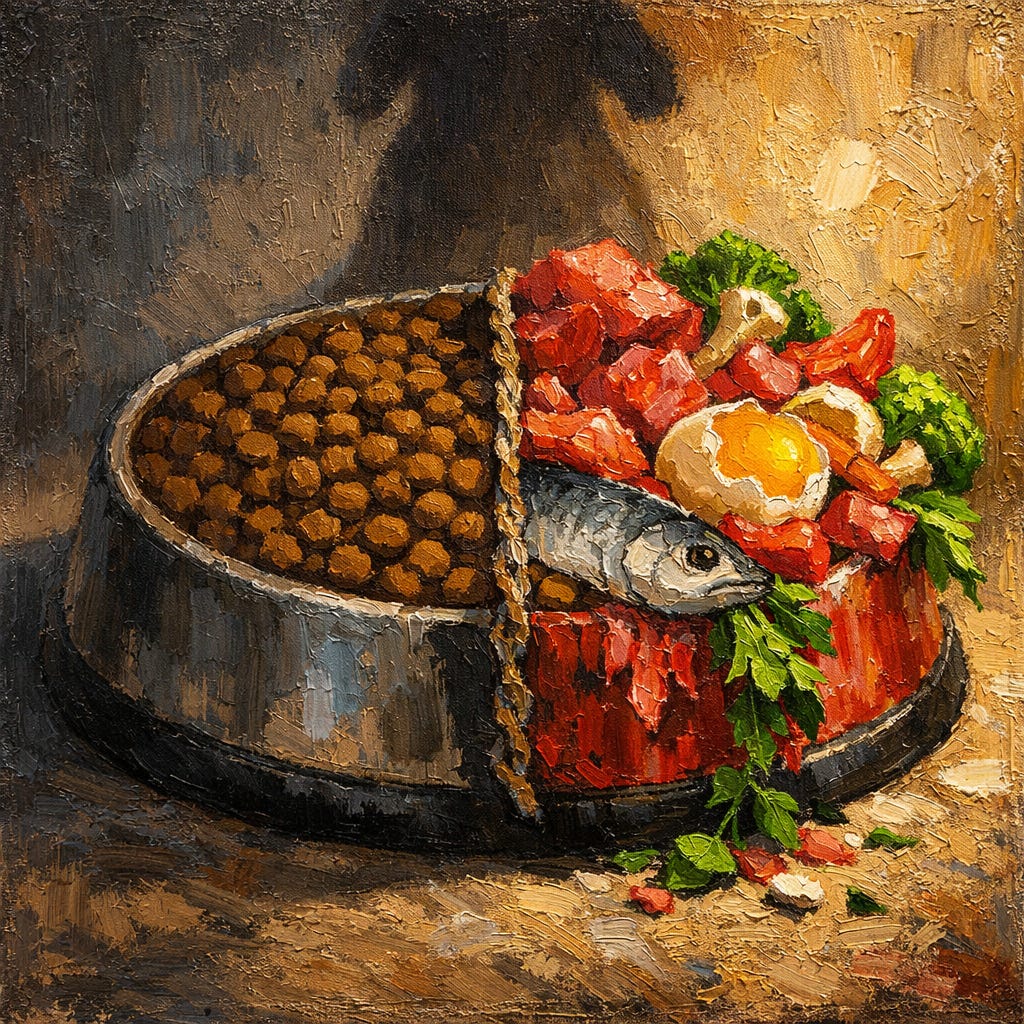
Most of us are now familiar with the case against ultraprocessed food in human diets — the chronic inflammation, the metabolic disruption, the engineered palatability designed to override our satiety signals. What Nick has spent his career trying to get people to see is that the same industrial logic, the same cheap ingredients, and the same high-heat processing are being applied to what we put in our dogs’ bowls — only the exposure is total. No variety, no fresh meals to offset the damage, no choice. Your dog eats what you pour. And unlike you, your dog will eat that same product twice a day, every day, from weaning to death.
This interview explores how a conventionally trained vet ended up dedicating his career to fighting the very food most vets recommend — what the science says, what he’s seen in over three decades of clinical practice, why the profession has been so slow to engage, and what you can do about it this week.
With thanks to Nick Thompson.
BSc (Hons) Path Sci., BVM&S, VetMFHom, MRCVS
Support Independent Investigative Journalism and Research
This work remains free because paid subscribers make it possible. If you find value here, consider joining them.
What paid subscribers get: Access to all books I’ve written plus 1-2 new ones per month. e.g.
The DMSO Book
Chlorine Dioxide
The PSA Trap
Breast Cancer
Drilling for Profit
What Your Vet Can’t Tell You
Plus: Access to the Deep Dive Audio Library — 180+ in-depth discussions (30-50 min each) exploring the books behind these essays. New discussions regularly added. That’s 100+ hours of content for less than the price of a single audiobook.
[Upgrade to Paid – $5/month or $50/year]
1. Most of our readers are already questioning ultraprocessed food in their own diets. You’ve spent over 30 years arguing that the same problem is playing out in our dogs’ bowls, only worse. How did a conventionally trained vet end up dedicating his career to fighting the very food most vets recommend?
It crept up on me, and then hit me all at once.
I grew up in a medical household. My father was a GP who reached for conversation before he reached for the prescription pad. My mother, a nurse, was into aromatherapy, nutrition, homeopathy. As a teenager, naturally, I rejected all of it. I went off to Edinburgh to become a vet, got swept up in the bright lights of modern medicine, and for the first few years of practice, I was pushing kibble like everybody else.
Hills came into vet school, gave us an afternoon lecture, told us if the dog has kidney disease, you give it k/d, if it has gut disease, you give it i/d, and then they gave us beer and sandwiches. That was the totality of my practical small animal nutritional education. Painting by numbers.
But within six months of getting into practice, something started to nag at me. I had this lovely old chap as a client whose wife had died. He had a little Sheltie with kidney disease. Every three weeks, I was giving her an anabolic steroid injection, she was on Hills k/d, and we were just sort of tipping along. And I thought: if I got ill, the last thing I’d do is reach straight for a drug. I’d look at what I was eating, how I was living, and whether I was sleeping. And yet here I was, trained to hand out pharmaceuticals and ultraprocessed food as the first and only answer.
That mismatch gnawed at me. I went to my boss and asked if we could get some homeopathic remedies in. God bless him; he was a diehard sceptic, but instead of saying no, he said: don’t just get remedies in; go and do some training. He paid for me to study at the Royal London Homeopathic Hospital. A homeopathic sceptic funded my homeopathic education. I’ve never forgotten that generosity and foresight.
And it was during that training that I encountered Samuel Hahnemann’s principle of eliminating obstacles to cure. That phrase landed like a thunderbolt. Because the biggest obstacle to cure I could see, day after day in practice, was what was going into the bowl.
You could give the most brilliant remedy or the cleverest drug, but if the dog was eating ultraprocessed food twice a day for its entire life, you were building on sand.
Once I saw that, I couldn’t unsee it. I started feeding my own animals raw in the mid-1990s, at a time when people thought you were quite mad. I haven’t looked back since.
I’ve been covering this territory on my Substack at substack.com/@holisticvetuk — and I’ve got at least 157 more topics queued up to write about over the coming months. Canine nutrition, microbiome, vaccination, itch, IBD, supplements, behaviour, the gut-brain axis, cancer and diet, and much more.
Anyone who wants to follow that work can find it at substack.com/@holisticvetuk.
2. You established Holisticvet near Bath back in 1999. For readers who haven’t encountered holistic veterinary medicine before, what does that actually mean in practice?
Actually, I started the practice in Petersfield, Hampshire, in 1999. I moved to Bath four years later because it was beautiful and I needed to feed my soul. The city, the people, the architecture — it did the trick. I also met my then wife-to-be at the YMCA gym there, so that was a bonus.
In a standard veterinary consultation, you might get ten minutes. The vet examines the symptoms, makes a diagnosis, and prescribes accordingly. That’s not a criticism. Within that model, many vets do excellent work.
What I do is different in one fundamental respect: I start with food.
My primary clinical approach is based on nutrition and lifestyle, and I aim to minimise the use of pharmaceuticals whenever possible. Dewormers are administered every one to three months, even in the absence of worms. Flea and tick treatments are used throughout the year, even during the depths of winter when no fleas are present. Annual boosters are given, even though the WSAVA recognises that immunity from core DHP vaccination can last well beyond yearly intervals. None of this is malicious — it’s simply what the system produces when no one questions whether it’s truly necessary.
It’s the basics. But getting the basics right helps enormously.
A typical consultation with me lasts an hour, sometimes longer, and a large part of it is spent reviewing exactly what the dog is eating, what the stools look like, what the skin looks like, and what the energy levels are. I want to understand the whole picture before I reach for anything.
I also have postgraduate training in homeopathy and herbal medicine, and I’ll use them where appropriate. Very occasionally, I’ll use pharmaceuticals. I’m not anti-drug. If a dog has a raging lungworm infection and is coughing blood, you reach for ivermectin, and you reach for it now.
But for the vast majority of chronic conditions — skin disease, gut disease, behavioural problems — the answer is often in the bowl. Change the food, support the gut, remove the obstacles, and the body does a remarkable amount of the work itself.
The results can be extraordinary. I’ve seen dogs come off years of steroids and immunosuppressants within weeks of switching to species-appropriate food. Not every case — and I’m always honest about that. But often enough that I know the food is doing the heavy lifting, not me.
The courses are at holisticvet.co.uk for anyone who wants to go further.
3. Most dog owners see “complete and balanced” and “scientifically formulated” on the label. When you look at a typical bag of kibble through the lens of the NOVA ultraprocessed food classification, what are people actually pouring into their dog’s bowl?
They’re pouring an ultraprocessed product that’s been through an industrial extruder at extremely high temperatures and pressures, using ingredients that often bear little resemblance to anything a dog would recognise as food.
Start with the base. Most kibble is built on a foundation of starch — corn, wheat, rice or potato. That starch is essential to the manufacturing process because you can’t form a pellet without it, but it’s not essential to the dog. Dogs have no absolute dietary requirement for carbohydrate — they can synthesise glucose from protein and fat, though they can use it in moderate amounts. In the quantities found in most kibble, which can be 40 to 60 per cent of the product, it’s far beyond anything their biology expects.
Then you have protein sources that may include meat meals, by-product meals, and plant proteins like pea or soy, often chosen for cost rather than biological value. The extrusion process subjects everything to temperatures that can exceed 150 degrees Celsius. That denatures proteins, destroys heat-sensitive nutrients, and generates compounds like advanced glycation end products (AGEs) that the dog has to deal with every single meal, every single day. More on those in a moment.
After extrusion, the pellets are typically sprayed with fats and palatants to make them appealing, because without those coatings, most dogs would walk past them. The synthetic vitamins and minerals added back in are there precisely because the processing has destroyed the naturally occurring ones.
“Complete and balanced” means the product meets a set of minimum nutrient profiles on paper. It tells you nothing about the quality of those nutrients, their bioavailability, what’s been done to them during processing, or what novel compounds have been created along the way. It’s a regulatory checkbox, not a measure of health.
I go into all of this in considerable detail in my upcoming book on ultraprocessed dog diets and the healthier alternatives. The science of what extrusion actually does to food is genuinely shocking and not well understood by most dog owners — or, if I’m honest, by most vets. I didn’t until I studied the process.
Raw and fresh food companies or supplement manufacturers looking for evidence-based consultancy support can find details at holisticvetconsultant.com.
4. The human will eat something different for lunch and dinner, while the dog gets the same brown pellets for the next eight to twelve years. How does that picture get worse when you apply it to dogs?
This is the point most people miss, and it’s the one that should really stop you in your tracks.
When a human eats a bowl of ultraprocessed cereal for breakfast, that’s one ultraprocessed meal out of perhaps twenty or more different meals they’ll eat that week. Some will be fresh. Some will be home-cooked. The body gets variety, respite from processing, and a range of nutrients from different sources. It’s not ideal, but there’s a buffer built into human eating habits simply because we don’t eat the same thing twice a day for years on end.
Now look at the dog. The average kibble-fed dog eats the same ultraprocessed product, from the same bag, twice a day, every day, for eight, ten, or twelve years. Sometimes from weaning to death. There’s no variety. There’s no respite. There’s no fresh meal at lunchtime to offset the damage.
And the human research gives us a sobering yardstick. The NutriNet-Santé cohort study — 104,000 French adults followed from 2018 — found that a 10 per cent increase in the proportion of ultraprocessed food in the diet was associated with a significant increase in overall cancer risk, including breast cancer. (Fiolet et al., BMJ, 2018.) That’s in humans eating a mixed diet with plenty of fresh food alongside the ultraprocessed stuff. Dogs don’t get that mixed diet. They get the ultraprocessed food and nothing else. If we’re seeing those signals in humans with respite built in, what on earth are we doing to dogs with none?
Cancer is now the leading cause of death in dogs over the age of two in many Western countries. I’m not saying kibble is the sole cause. But I am saying that a lifetime of ultraprocessed food, with its AGE load, its oxidised fats, its synthetic additives and its near-total absence of the bioactive compounds found in fresh food, is not a plausible background against which cancer rates should be falling.
Every single exposure to high levels of AGEs, every single hit of synthetic additives, every single meal devoid of the living enzymes and bacteria found in fresh food — it’s compounded by the next one, and the next, and the next.
We’d never dream of feeding a human child the same ultraprocessed meal twice a day for their entire childhood. The idea is self-evidently absurd. And yet that’s precisely what we do to our dogs.
5. Researchers at the University of Georgia found that dogs on standard extruded kibble may be consuming roughly 120 times more AGEs than humans eating a typical Western diet. Can you explain what AGEs are and why that figure matters?
Advanced glycation end products — AGEs — are compounds formed when proteins or fats react with sugars under high heat. They occur naturally in small amounts during normal cooking, but they’re generated in vastly greater quantities during industrial processing, particularly extrusion.
In the body, AGEs promote chronic inflammation, oxidative stress, and tissue damage. They’re implicated in a growing list of conditions in human medicine: type 2 diabetes, cardiovascular disease, kidney disease, neurodegeneration. The research community is paying increasingly serious attention to dietary AGE exposure as a driver of chronic disease. (Ramasamy et al., 2005; Uribarri et al., 2015.)
Now consider that University of Georgia finding. A dog eating standard extruded kibble may be consuming roughly 120 times the AGE load of a human eating a typical Western diet — which is itself far from healthy. And that dog is consuming that load at every meal, with no variation, for its entire life. (Oba et al., 2022; Palaseweenun et al., 2020.)
We’re seeing epidemic levels of cancer, kidney disease, diabetes and inflammatory conditions in domestic dogs. I’m not saying AGEs are the sole cause. But when you look at the scale of exposure and the known biological effects, it would be extraordinary if they weren’t a significant contributing factor.
The dog sitting at your feet right now, if it’s eating kibble, is carrying a cumulative AGE burden that dwarfs anything you or I will experience in our lifetimes.
6. You list the microbiome as one of your special interests. What’s happening inside a dog that’s been fed nothing but kibble since weaning?
The gut microbiome is the community of trillions of bacteria, fungi, viruses and other organisms living in the digestive tract. It’s not just along for the ride. It plays a central role in immune function, nutrient absorption, mood, inflammation and disease resistance.
When you feed a dog the same ultraprocessed product every day for years, you’re providing a monotonous substrate for those microbes. The fibre is largely synthetic or heavily processed. The proteins have been denatured. There’s very little of the varied, living, minimally processed material that a diverse microbial community thrives on.
What the emerging research supports — and what I see clinically — is that long-term ultraprocessed feeding tends to narrow microbial diversity and favour pro-inflammatory bacterial species over beneficial ones. (Sandri et al., 2017; Schmidt et al., 2018; Lyu et al., 2025.)
Compare that with a dog fed a varied raw or fresh diet. You’re providing a wide range of substrates: raw muscle meat, organ meat, bone, connective tissue, vegetables, seeds, herbs. The microbial community has variety to work with.
I write about this in some depth over at substack.com/@holisticvetuk — it’s one of the areas where the science has moved fast in recent years, and new research drops into my inbox almost every week. The canine microbiome is going to be a major topic over the next decade. And I think it’s going to vindicate a lot of what raw feeders have been observing clinically for years.
There’s more on the microbiome at substack.com/@holisticvetuk for anyone interested.
7. You cite a Purina study showing lean dogs lived nearly two years longer than their overfed littermates. Critics would say that’s a portion control issue, not a food quality issue. What would you say?
I’d say they’re half right, which is the most dangerous kind of right.
Yes, the Purina lifespan study was fundamentally about caloric restriction. The lean-fed Labradors lived a median of nearly two years longer than their littermates who were allowed to eat more. That’s a remarkable finding, and it’s absolutely about how much was in the bowl. But it’s worth knowing what the study was and wasn’t.
It used a single breed, Labradors, who are famously prone to obesity and carry a specific variant of the POMC gene that drives food-seeking behaviour — so they’re not exactly a representative sample of all dogs. Both groups ate the same Purina kibble throughout their lives, so the study tells us nothing about food quality, only quantity.
It included 48 dogs across both groups, which is a modest number for conclusions that are cited as broadly as this one. And it was funded and conducted by Purina, which doesn’t invalidate it, but is worth noting when the findings are used to defend the food rather than question it. (Kealy et al., JAVMA, 2002.)
But here’s what the portion-control argument misses. When you feed a dog an ultraprocessed, calorie-dense, nutrient-poor diet loaded with refined carbohydrates, the dog’s hunger signalling is disrupted. These foods are engineered to be palatable. They’re coated with fats and flavourings specifically designed to encourage consumption. They provide a big caloric hit with relatively little satiety.
So the dog eats more than it needs — not because it’s greedy, but because its body isn’t receiving the correct signals.
Feed that same dog a species-appropriate raw diet, and something interesting happens. The food is nutrient-dense, moisture-rich, high in quality protein, and free of the refined starches that spike blood sugar. Dogs on raw diets tend to self-regulate their intake far more effectively. Obesity on a well-managed raw diet is genuinely rare in my clinical experience.
So yes, obesity is a matter of portion control. But the food itself determines how easy or difficult portion control is. Blaming the owner for overfeeding while ignoring the fact that the food is designed to make overfeeding almost inevitable is like blaming someone for being thirsty while handing them salted crisps.
8. You took three steroid-dependent allergy dogs, switched them to raw, and within weeks they were off medication. When you brought those results to the vets involved, what was the reaction?
This was early in my career, and it’s one of those cases that stays with you forever — because it confirmed everything I suspected and showed me exactly how hard the road ahead was going to be.
Three seriously unwell dogs. A Labrador, a Cocker Spaniel and a Labradoodle, all on long-term steroids for chronic allergic skin disease. Between them, they’d racked up nineteen vet visits in five months before the dietary switch. Classic revolving-door patients: flare up, steroid course, temporary improvement, flare up again. The owners were exhausted. The dogs were miserable.
We switched them to raw. Within weeks, all three were off their medication. The coats started growing back. The itching stopped. The vet visits essentially stopped.
In my view, we’d removed the primary dietary trigger and given the body what it needed to repair itself.
When I took those results back to the vets involved, the reaction was largely silent. Not hostility, not engagement — just a sort of polite blankness. It didn’t compute within the framework they were working in.
And I genuinely don’t blame them for that. Every vet I’ve ever met is sincerely dedicated to their patients’ health. That’s not in question. What’s missing isn’t commitment — it’s tools. Most vets simply don’t have access to what I’ve spent decades learning: real, raw, and fresh-food feeding, homeopathy, and herbal medicine. I used to add acupuncture to that list, but I’ve stepped back from it now. The point is that these approaches exist, they work in the right hands, and they’re not taught in veterinary school. That’s not the individual vet’s fault. It’s a curriculum problem, and behind that, a funding problem.
9. What does the evidence actually say about the safety of responsible raw feeding, and what do you say to people who argue the bacterial risk makes it irresponsible?
I say the bacterial safety question is a real one, and it deserves an honest answer, not a dismissive one.
Yes, raw meat contains bacteria. Salmonella, Campylobacter, E. coli and others can be present in raw pet food, just as they can be present in the raw chicken you buy from the supermarket for your own dinner. Anyone who pretends otherwise isn’t being straight with you.
But here’s what we need to weigh against that. Dogs are not humans. They have a shorter, more acidic digestive tract that’s evolved to handle bacterial loads that would make a human very unwell. A healthy dog eating raw meat is doing what its biology is designed to do.
What rarely gets mentioned in this debate is the scale of harm that’s already occurred on the kibble side. There have been documented outbreaks and recalls involving microbial contamination of dry and processed pet food, causing serious illness in children, immunocompromised adults, and pets. These are not hypothetical risks — they’re in the published literature, and the FDA recall databases, and they keep happening. (Behravesh et al., Pediatrics, 2010; FDA recall records, ongoing.)
The practical measures for raw are the same ones you already use when handling raw meat in your own kitchen. Wash your hands. Clean surfaces. Don’t leave food sitting out. Pick up the stools promptly. Store raw food properly. Basic hygiene that any sensible raw feeder follows.
For households with very young children, elderly or immunocompromised people, extra care is warranted, and I always discuss that with clients. Lightly cooked food is a perfectly good option in those circumstances. The important thing is to get away from ultraprocessed food — not to insist on raw at all costs.
The risk from raw is real and it’s manageable. And it needs to be weighed honestly against the long-term risks of feeding ultraprocessed food for an entire lifetime — which are substantial and, outside of our community, largely ignored.
10. A significant proportion of contamination incidents actually involved kibble and processed pet foods. Do you feel the hygiene narrative has been weaponised against raw feeding?
Weaponised is a strong word, but yes, I think the hygiene narrative has been applied very selectively.
If you look at food recall data, you’ll find that kibble and processed pet foods account for a significant proportion of recalls where human health was at risk. Salmonella contamination in dry pet food has caused human illness in multiple documented outbreaks. These are products that people handle without gloves, store in open bags on kitchen floors, and scoop into bowls with their bare hands, which may not be washed daily. Nobody calls that irresponsible.
Meanwhile, raw pet food — handled by people who are generally aware of the need for hygiene and who treat it exactly as they would treat raw meat for their own kitchen — is presented as uniquely dangerous.
There’s a double standard at work, and it’s not difficult to see who benefits from that framing.
I’m not saying raw food is risk-free. I’m saying the risk is manageable, well understood, and when you account for kibble’s dominant market share, the argument that raw feeding presents a uniquely greater public health risk becomes very hard to sustain.
The narrative that raw feeding is a public health menace serves the interests of companies selling ultraprocessed alternatives. I think it’s fair to point that out.
The RFVS is a good place to start for anyone wanting a balanced, evidence-based view — rfvs.info.
11. What are the first practical steps someone can take this week to start shifting their dog’s diet, and how do they bring their vet along for that conversation?
First, don’t panic. And don’t try to do everything at once. This is not an all-or-nothing proposition.
The simplest thing you can do this week is start adding some fresh food to your dog’s diet. A raw egg. Some lightly steamed vegetables. A spoonful of tinned sardines in spring water. A bit of raw or lightly cooked meat. You’re not replacing the kibble overnight. You’re just beginning to introduce some real, recognisable food alongside it.
Next, think about variety. If your dog’s been eating the same product for months or years, its gut microbiome has been shaped by that monotony. Different protein sources, different vegetables, different textures. The gut thrives on variety.
If you want to go further, investigate a good quality commercial raw food. There are excellent UK companies producing complete raw meals that take the guesswork out of it. Start by replacing one meal a day and see how your dog responds. Most dogs take to it immediately.
As for bringing your vet along: be honest and straightforward. Tell them you’re interested in improving your dog’s diet and you’d like their support. A good vet, even one who’s not personally enthusiastic about raw feeding, should be willing to monitor your dog’s health through the transition. If they flatly refuse to engage, that tells you something worth knowing.
I’ve actually put together a course specifically for owners on how to have that conversation graciously and constructively — with your vet, not at them. You’ll find it at billinghurst.institute/courses/raw-conversations. And if there are any vets reading this, there’s a companion course on the same site to help you talk to owners positively about raw feeding. Both sides of that conversation matter, and both can go better than they usually do.
And here’s a tip that has nothing to do with the bowl. If your dog doesn’t have fleas or ticks, ask yourself — and your vet — why you’re giving a flea and tick product. If you haven’t tested for worms, ask yourself — and your vet — why you’re giving a wormer. You can get a faecal worm count kit from wormcount.com in the UK. I’m sure there are similar services in Europe, the USA, Australia and other countries — it’s worth a quick search for your region. Test first, treat if needed. Sometimes the most powerful thing you can do for your dog’s health isn’t what you add — it’s what you stop giving.
Practical posts and course details at substack.com/@holisticvetuk and holisticvet.co.uk.
12. Where do you see this going in the next five to ten years, and what gives you genuine hope?
The conversation is shifting, and it’s shifting faster than I ever expected.
When I started talking about raw feeding in the mid-1990s, I was a voice in the wilderness. Vets weren’t just sceptical — some were actively hostile. Thirty years on, the hostility has largely given way to neutrality. That might not sound like much, but it’s an enormous shift. Vets who would have looked at you very sceptically indeed for suggesting raw food a decade ago are now saying, well, I wouldn’t do it myself, but I can see some people are getting results. Give it another few years, and I think we’ll see genuine engagement from the mainstream.
The human ultraprocessed food conversation has broken through in a way that’s directly helping our cause. When people read about the harms of ultraprocessed food in their own diets, they look at their dog’s bowl with fresh eyes. That connection is being made by millions of people, and it’s very difficult to unmake once it lands.
The Raw Feeding Veterinary Society is growing. Independent research is emerging from institutions like the University of Helsinki, where the DogRisk group has been doing genuinely important work on canine nutrition. The evidence base is growing, and it’s becoming harder to dismiss.
Writing my upcoming book — a deep dive into ultraprocessed dog diets and the healthier alternatives — has also opened the floodgates for me in a way I didn’t anticipate. I’ve now got at least 157 topics queued for my Substack covering everything from vaccination schedules and the gut-brain axis to cancer and diet, regenerative agriculture, and the corporate funding of veterinary nutrition education. There’s a lot to say, and I intend to say it.
I see a future in which fresh, species-appropriate feeding is the norm, not the fringe. Not in every household, and not overnight. But the direction of travel is unmistakable. I’m more optimistic now than I’ve ever been.
13. Your dog cannot read the label and cannot choose. If someone is ready to learn more, where should they start?
Yes, you’re right; your dog can’t read that well and can’t choose what they eat. That’s your job. And once you know what you’re looking at, the choice gets a lot easier.
If you want to understand what’s really in your dog’s bowl and why it matters, I write regularly on my Substack at Substack, and I’ve got online courses at holisticvet.co.uk. They cover raw feeding basics, bones, and canine skin health — simple, cheap, practical, evidence-based, and designed for dog owners who want to understand the science without needing a veterinary degree.
The Raw Feeding Veterinary Society at rfvs.info is free to join and open to everyone, not just vets. Professionals and owners learning from each other. We park our minor differences, lay out the picnic blanket, and try to have an honest, adult conversation about how to feed dogs well.
For worm testing, wormcount.com in the UK is a good starting point, with similar services available worldwide. Test before you treat.
For books, I recommend The Forever Dog by Rodney Habib and Karen Becker, and Feeding Dogs by my colleague Dr Conor Brady — both accessible, well-researched, and likely to change your perspective on the bowl. Conor and I, together with Dr Brendan Clarke, also co-host Raw Pet Medics on Facebook each month, where we explore much of this in a more conversational manner. We’ve been recording shows since 2021, so there’s a lot of free stuff for people to look at and learn from.
For raw food or supplement companies seeking rigorous, independent, evidence-based consultancy support, my details are available at holisticvetconsultant.com.
And if you’re a vet or vet nurse reading this and feeling a little uncertain about any of this, that’s completely understandable. Most of us weren’t given these tools at vet school, and the conventional toolkit can feel very limited when you’re staring at a dog who’s been on steroids for three years and isn’t getting better.
There are other approaches. They’re not difficult to learn. And the results, when the food changes and the pharmaceutical burden lifts, can be genuinely surprising. Come and find us at rfvs.info. We’d love to have you.
We’re a global hub where people truly dedicated to the holistic health of pets can come together to learn and share information, helping our cats and dogs live their best lives.
Disclosure
Nick Thompson consults with raw and fresh pet food and supplement companies commercially through holisticvetconsultant.com. He is the Founding President of the Raw Feeding Veterinary Society. These views are his own and are offered for general information only. Always consult your own vet before making changes to your dog’s diet or healthcare regimen.
Could someone post a resource for cats and how to feed a non commercial diet? Thank you in advance.
Unfortunately the vets and their associations are just as guilty as Big Pharma and lack of education in vet schools is only part of the problem; the promotion of dry kibble by vets themselves is often for monetary gain as the pet food companies sell a great deal of their products through vet clinics which often support specific brands in return for compensation; the medical industry has been killing us, both human and animal, in the same ways, by maintaining this false paradigm to ensure its on-going profit-making at the expense of healthy alternatives which have been known for many decades.