
Heredity Without Genes
An Essay on the Failure of the Genetic Story and the Question of Where Family Resemblance Actually Comes From

The Human Genome Project was launched in 1990 with a stated goal: map every gene in the human body. The working assumption was that there would be roughly one gene for each protein, and that the human body, being the most complex organism on the planet, would contain somewhere between one and two hundred thousand genes. When the project completed its first draft in 2001 and its final sequence in 2003, the figure had been revised downward to approximately 20,000.¹
A nematode worm has around 20,000. Rice has more than the person eating it.
The human body produces somewhere between 200,000 and 400,000 distinct proteins, depending on which counting method is used.² The foundational principle of modern molecular biology — that each gene codes for a specific protein — requires the gene count and the protein count to be roughly equal. They are not roughly equal. They differ by a factor of ten or more. The Human Genome Project, conceived to confirm the central dogma of molecular biology, instead falsified it.
Mainstream science noticed. The response was not to revisit the central dogma. The response was to invent rescues. The most common one is that enzymes cut and splice the 20,000 genes into many different combinations to produce the missing 180,000 proteins.³ This is described in textbooks as alternative splicing, post-translational modification, and similar phrases. What is being described is a process for which no mechanism has been demonstrated, performed by enzymes whose own origin requires explanation under the same theory, generating the precise additional proteins required to rescue the framework from the data its own flagship project produced.
This work stays free because paid subscribers make it possible. They get the full book library, the Deep Dive Audio Library, and the Questions for Your Doctor, Before You Consent, and Package Insert series. No grants, no gatekeepers — your subscription is what keeps it that way.
The Foundational Paper That Doesn’t Establish the Foundation
Ask any geneticist for the paper that proved genes code for proteins, and the trail leads back to a single 1961 Nature paper titled General nature of the genetic code for proteins, by Crick, Barnett, Brenner, and Watts-Tobin.⁴ This is the paper cited by every subsequent paper that requires the gene-protein principle as background.
The paper presents evidence from acridine-induced mutations in T4 phage as consistent with a triplet codon hypothesis. What it does not present is direct demonstration that genes code for proteins. The authors work from the triplet hypothesis as a working assumption and build the framework — the redundancy of the code, the mapping of nucleotides to amino acids — on top of it. Sixty-five years later, the direct demonstration has not been done. The assumption has hardened into doctrine, the doctrine has been taught to every medical student for two generations, and the failed Human Genome Project has not unsettled it.
The same pattern appears in the field’s other foundational paper. Watson and Crick’s 1953 model of DNA structure — the paper that gave the world the double helix — used the words “suggested,” “assumed,” and “believed” repeatedly. The authors acknowledged that their structure needed to be “checked against more exact results” and that the available X-ray data was “insufficient for a rigorous test.”⁵ They proposed a model. They did not demonstrate one.
The gene-protein principle is contradicted by the data its own flagship project produced. It was also never directly established to begin with. Neither was the structure on which the principle rests.
What Cystic Fibrosis Actually Shows
The conventional response is to point to the conditions that are known to be genetic. Cystic fibrosis is the standard example. A specific mutation on a specific gene on a specific chromosome, identified in 1989, producing a specific protein defect, producing a specific disease.⁶
The 1989 paper that established the claim made several admissions that the public-facing summary has dropped. It noted that the clinical expression of cystic fibrosis is heterogeneous — some patients have severe lung disease, some have digestive insufficiency, some have neither, and a meaningful fraction have entirely normal pancreatic function. The companion paper also acknowledged that the relationship between the identified mutation and the disease’s primary defect remained unresolved.⁷
Since then, more than 2,000 separate alleged mutations in the CFTR gene have been catalogued.⁸ Some patients with the diagnosis don’t have any of them. Some people with the mutations never develop symptoms. The variability is now managed by reference to modifier genes, environmental factors, and variable penetrance — each of which is itself an additional epicycle on the failing model.
This pattern is examined at length elsewhere in this series.⁹ Cystic fibrosis is the case held up as the strongest example of a genetic disease, and even that case requires a thicket of post hoc rescues to remain coherent.
The 100% Problem
Cystic fibrosis is not unusual. Every condition labelled genetic shows the same pattern. Some patients have the named mutation. Some have variants. Some have neither. Some people with the mutation never develop the condition. Some people with two copies of the alleged “recessive disease” mutation live healthy lives.
This is the 100% problem. If a mutation causes a disease, every person with the mutation should have the disease, and every person with the disease should have the mutation. This is what causation means. Nothing in human genetics meets this standard. Not the condition labelled cystic fibrosis. Not the conditions labelled sickle cell or Huntington’s. Not BRCA1 or BRCA2 — a 2018 study of women under forty with breast cancer found no significant difference in survival between BRCA carriers and non-carriers, and a 2015 systematic review of BRCA studies concluded that no evidence-based conclusion could be drawn about BRCA mutations and breast cancer prognosis.¹⁰
The pattern holds at scale. The genome-wide association studies launched after the Human Genome Project were the establishment’s second flagship — more than 700 separate studies covering roughly 80 common diseases, at a combined cost in the billions, designed to find the genetic causes of common illness. They found that genetic contribution accounts for at most 5 to 10 percent of cases, and that the effects identified are scattered across dozens of genes per condition — 40 for type 1 diabetes, 27 for prostate cancer, 32 for Crohn’s disease — each with minute individual effect. The response was not to revisit the framework. It was to invent a new term, “missing heritability,” and propose hiding places for the 90 to 95 percent of variation that should have appeared and did not. The rescue was formalised in a 2009 Nature paper authored by 27 senior scientists including Francis Collins, the man who had run the Human Genome Project.¹¹
When the 100% standard fails, the framework does not get reconsidered. Instead, three rescues appear. First: variable penetrance — the mutation causes the disease sometimes, depending on other factors. Second: modifier genes — other genes affect whether the first gene’s effect is expressed. Third: environmental triggers — the genetic predisposition is real, but something in the environment determines whether it manifests.
Each rescue moves the explanatory weight further from the gene itself. By the time the framework has been adjusted to fit the data, what’s actually doing the work is the environment, the modifiers, the timing, and the conditions — which is what terrain medicine said in the first place. The gene has become a vestigial term, retained because the institution cannot afford to drop it.
DNA Testing and the Unfalsifiable Rescue
In 2002, Lydia Fairchild applied for state assistance in Washington and submitted to a court-ordered DNA test to establish maternity. The test showed she was not the genetic mother of her own children. The court began proceedings to remove her children from her custody. Doctors who had delivered the children testified that they had personally watched her give birth. The DNA test said otherwise.
Fairchild was pregnant during the proceedings. The judge ordered that the third child be tested immediately at birth, with witnesses present. The child emerged from her body. The DNA test said the child was not hers.¹²
The honest interpretation is that DNA testing does not measure what it claims to measure. The actual interpretation, retained by the system, is that Fairchild has a condition called DNA chimerism — her DNA has somehow changed in a way that makes it not match her offspring, but DNA is still the hereditary material, the test is still definitive, and any case that contradicts the theory is evidence of a previously-undetected condition in the person, not a flaw in the theory.
The same diagnosis was issued to Karen Keegan, whose DNA was found not to match two of her three children during family testing for a kidney transplant.¹³ When two women fail the same biological test and the system labels both with the same rare condition rather than questioning the test, the test has been protected from falsification by structural design.
This is what philosophers of science call an unfalsifiable hypothesis. The theory cannot be wrong, because every case that would prove it wrong becomes, on contact, evidence of a new condition that explains the apparent contradiction. The maternity test that fails on the woman who just gave birth in front of witnesses is not a failed test. It is a successful test that has revealed her chimerism. The framework absorbs the contradiction and moves on.
The forensic and paternity-test failures of DNA testing are documented elsewhere in this series.¹⁴ The response to DNA testing’s failures, in mainstream practice, is not to question DNA. It is to invent new conditions in the people the tests fail on. The theory must be true. The tests must be reliable. The patient must therefore be unusual.
What Remains After the Destructive Case
What remains of the genetic story is a framework that contradicts its own flagship data, rests on an assumption its founders acknowledged was a working hypothesis, fails the basic test for causation in every disease it claims to explain, and rescues itself from contradictions by inventing additional unfalsifiable conditions. This is not a theory in the scientific sense. It is a system of belief retained because the institutions, the funding structures, and the pharmaceutical pipelines built on top of it cannot afford to let it fall.
The mechanism of heredity is not understood. People are born with characteristics that resemble their parents’. People are born with conditions that medicine labels innate. The fact that something runs in a family does not establish that genes are doing the running. Families share food, water, soil, electromagnetic environments, emotional patterns, and toxic exposures. Families share the conditions under which bodies form. The shared conditions could account for most of what genetics claims to explain, and the gene-based explanation has not been demonstrated.
That is where the documented case ends. What follows is a different register, and it should be read as such.
A Different Register
Tom Cowan, whose work this essay draws on at length, has offered a positive answer to the question of where heredity comes from if not from genes. He has been explicit that the answer is speculation. His exact words, in a recent webinar: “I can’t prove that. That’s just me making up a story.”¹⁵
What follows is a working hypothesis. It is offered as a direction, not a conclusion. The reader can stop at “we don’t understand heredity” and the case still holds.
Where Twentieth-Century Physics Already Arrived
Max Planck, who originated quantum theory, said the following in 1931: “I regard consciousness as fundamental. I regard matter as derivative from consciousness. We cannot get behind consciousness. Everything that we talk about, everything that we regard as existing, postulates consciousness.”¹⁶
Erwin Schrödinger, in Mind and Matter, wrote: “Their multiplicity is only apparent, in truth there is only one mind.”¹⁷
These are the men who built quantum physics. They arrived, by following the experimental evidence of their own field, at the conclusion that consciousness is the ground of physical reality rather than its product. Their view has never been refuted within physics. It has been ignored by biology and medicine, which continued to operate on the eighteenth-century mechanical assumption that consciousness must emerge from matter, that mind must be downstream of brain, that life must be downstream of DNA.
The view that consciousness is fundamental and matter is derivative is consistent with twentieth-century physics. The view that DNA is the master molecule, the gene is the instruction, and the body is the assembled product is consistent with the framework physics replaced a hundred years ago.
If consciousness is fundamental, then the question of where the pattern of a particular human comes from changes shape. The pattern is not stored in molecules. The molecules are organised by something that operates at a level the molecules themselves do not contain.
The Radio
Cowan’s image for this is the radio.
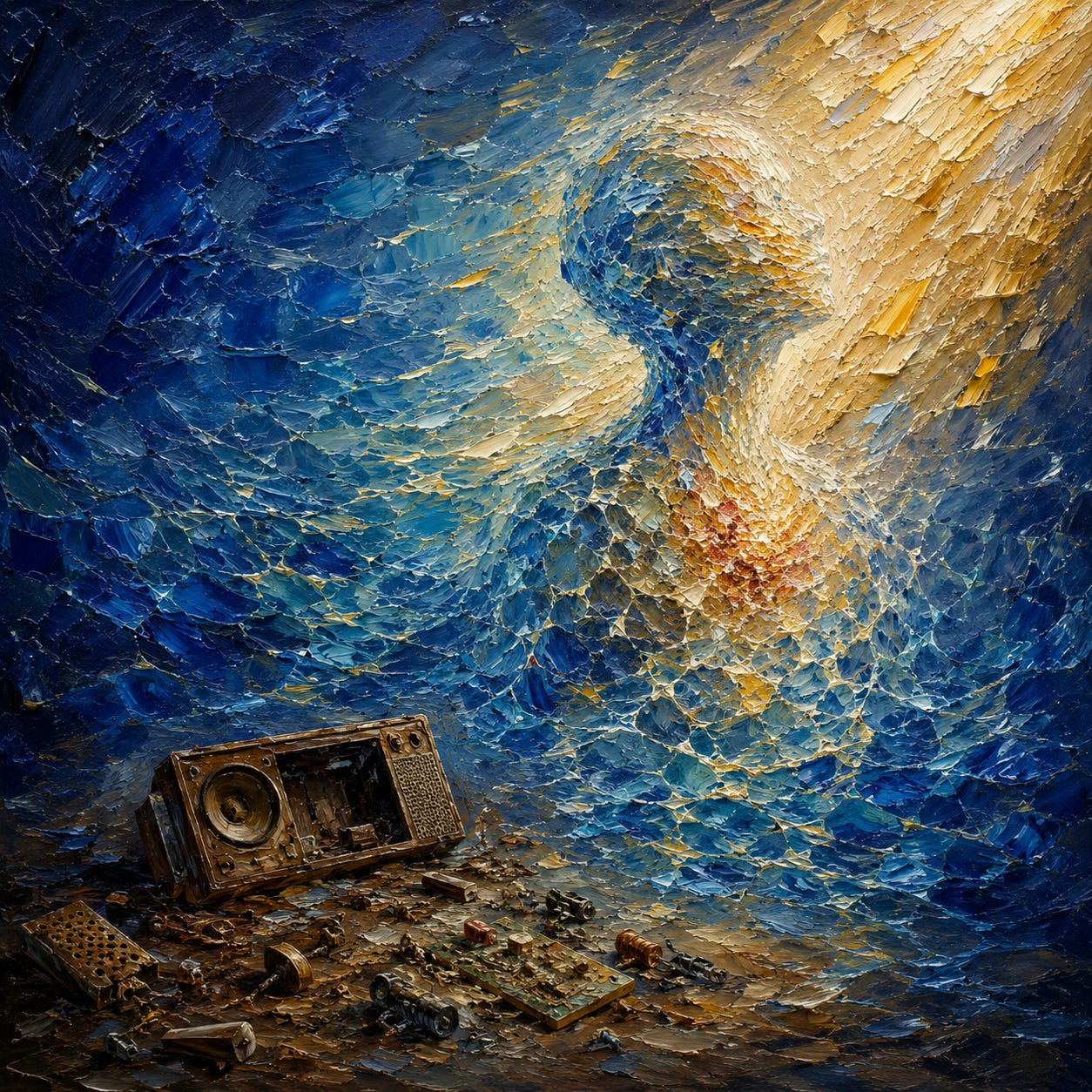
You can take a radio apart down to the smallest screw and the most carefully labelled wire. You can map every component, characterise every circuit, and account for every resistor. You will not find the music inside the radio. The music is not in the radio. The radio is what receives the music. The music is somewhere else.
For decades, scientific medicine has been taking the human body apart looking for the source of what makes a person who they are. It has mapped what it calls the genome, sequenced the proteins, catalogued the metabolites, imaged the brain at every scale from cell to network. It has not found the person inside the body. It has not found the music inside the radio. What is being sought is not located where the search is being conducted.
The body is the radio. The pattern of a particular human — the form, the temperament, the resemblance to family, the gestures, the susceptibilities — is the broadcast. The body receives the pattern and translates it into flesh. If the pattern cannot be found inside the body’s molecular machinery, perhaps the pattern was never there to be found.
What Has Already Been Demonstrated
Michael Levin’s laboratory at Tufts University has spent two decades documenting what happens when the bioelectric field of a developing organism is altered without any change to its DNA. The findings are published in peer-reviewed journals.¹⁸
Planaria — flatworms famous for their capacity to regenerate from fragments — can be made to regenerate with two heads through manipulation of the bioelectric gradient alone. Two-headed planaria created this way maintain their altered pattern through subsequent generations of cutting and regrowth, with no change to their DNA. The pattern the worm rebuilds is held in the bioelectric field, not in the genome.
Xenopus frogs have been induced to grow functional eyes on their flanks and tails through voltage manipulation. The eyes are anatomically complete, wired into the central nervous system. The DNA was not altered.
Planarians trained to associate a textured surface with food have been decapitated and allowed to regrow their heads over fourteen days. The regenerated worms retain the memory of the training. The memory was not stored in the brain that was removed.
These are documented experiments at a credentialed research institution. The pattern that builds and rebuilds the body is not stored in the DNA. It is stored somewhere the framework does not look.
How the Body Receives
The medium through which the body receives, in this framing, is water. The human body is roughly seventy percent water by weight, and the water inside the body is not the bulk water of a glass on a counter. It is structured — organised into ordered layers by its contact with proteins and membranes — and the ordering carries information.¹⁹
Mainstream biology has partially conceded the broader point through what it calls epigenetics — the observation that environmental factors determine outcomes the gene-centric framework cannot account for.²⁰ The mainstream version retains DNA as the master molecule and treats the environment as a modifier of its expression. The framing offered here inverts the relationship: the environment, broadly conceived to include the field of information surrounding a developing body, is the source, and the molecular machinery is part of the receiving apparatus rather than the source of the pattern.
On this framing, the body is not built from instructions encoded in DNA. The body is shaped by information the body’s water receives from outside, and the cellular machinery is the medium through which the reception is translated into physical form.
How to Explain It to a Six-Year-Old
There is a thing called a radio. It plays music.
If you took the radio apart with a screwdriver and laid every piece on the table — every wire, every screw, every little black box — you would not find any music. The music is not inside the radio. The music is in the air. The radio is a special machine that catches music out of the air and makes it loud enough for us to hear.
When you look like your mum, scientists used to think there was a little instruction inside you that said “look like your mum.” They counted up all the little instructions and there weren’t enough of them. There aren’t enough instructions in you to make all the parts of you. So the instructions can’t be the answer.
Your body might be like a radio. Your body might be catching the pattern of what you look like out of the air around you, the same way the radio catches music. We don’t know for sure. But we know the instructions inside you can’t be the whole answer, because there aren’t enough of them.
What the Observation Was, All Along
Your daughter has your eyes. Your son walks the way your father walked. The twin separated at birth, raised in a different country, makes a gesture her sister also makes — a gesture neither of them learned, that neither of them ever saw.
These observations are real. They are what every parent has watched, every grandparent has noticed, every family has discussed. The conventional explanation is that genes carry the pattern from one generation to the next. The conventional explanation has been shown not to work. The protein/gene gap is too large. The foundational paper acknowledged the principle was a working hypothesis. The conditions held up as proof of the framework have never met the basic standard for causation. The DNA tests that the system treats as definitive fail on women who have given birth in front of witnesses.
Something is happening when the daughter inherits her grandmother’s expression. Something is happening when the twins make the same gesture across an ocean. The conventional story about what is happening has failed. The answer is not “genes.” That much is established.
References
International Human Genome Sequencing Consortium. “Finishing the euchromatic sequence of the human genome.” Nature 431, no. 7011 (2004): 931–945.
Ponomarenko, E. A., et al. “The Size of the Human Proteome: The Width and Depth.” International Journal of Analytical Chemistry (2016): 7436849.
Thomas S. Cowan, Cancer and the New Biology of Water (Chelsea Green, 2019), Chapter 5.
Crick, F. H. C., Barnett, L., Brenner, S., and Watts-Tobin, R. J. “General nature of the genetic code for proteins.” Nature 192, no. 4809 (December 30, 1961): 1227–1232.
Watson, J. D., and Crick, F. H. C. “Molecular Structure of Nucleic Acids: A Structure for Deoxyribose Nucleic Acid.” Nature 171, no. 4356 (April 25, 1953): 737–738.
Riordan, J. R., et al. “Identification of the cystic fibrosis gene: cloning and characterization of complementary DNA.” Science 245, no. 4922 (1989): 1066–1073.
Kerem, B., et al. “Identification of the cystic fibrosis gene: genetic analysis.” Science 245, no. 4922 (1989): 1073–1080.
The Cystic Fibrosis Mutation Database, hosted at the Hospital for Sick Children, Toronto, catalogues over 2,000 CFTR variants.
Unbekoming, “Cystic Fibrosis and the Genetic Claim” (Substack essay).
Copson, E. R., et al. “Germline BRCA mutation and outcome in young-onset breast cancer (POSH): a prospective cohort study.” Lancet Oncology 19, no. 2 (2018): 169–180; van den Broek, A. J., et al. “Worse breast cancer prognosis of BRCA1/BRCA2 mutation carriers: what’s the evidence? A systematic review with meta-analysis.” PLoS ONE 10, no. 3 (2015): e0120189.
Latham, J., and Wilson, A. “The Great DNA Data Deficit: Are Genes for Disease a Mirage?” Independent Science News (2010); Manolio, T. A., et al. “Finding the missing heritability of complex diseases.” Nature 461, no. 7265 (2009): 747–753.
I Am My Own Twin, documentary, Discovery Health Channel, 2006. The Lydia Fairchild case is also documented in the medical literature on tetragametic chimerism.
Yu, N., Kruskall, M. S., Yunis, J. J., et al. “Disputed maternity leading to identification of tetragametic chimerism.” New England Journal of Medicine 346, no. 20 (2002): 1545–1552.
Unbekoming, “Fool’s Gold Standard” and “The DNA Myth” (Substack essays).
Thomas S. Cowan, webinar of May 20, 2026, “Questions and Answers on Heredity, Light, and Contagion.”
Max Planck, interviewed by J. W. N. Sullivan, “Interviews With Great Scientists. VI. — Max Planck,” The Observer, 25 January 1931, p. 17.
Erwin Schrödinger, What Is Life? With Mind and Matter and Autobiographical Sketches (Cambridge University Press), from the Mind and Matter section, Chapter 4 (”The Arithmetical Paradox: The Oneness of Mind”).
Representative work from the Levin Lab, Tufts University: Beane, W. S., Morokuma, J., Lemire, J. M., and Levin, M. "Bioelectric signaling regulates head and organ size during planarian regeneration." Development 140, no. 2 (2013): 313–322; Pai, V. P., Aw, S., Shomrat, T., Lemire, J. M., and Levin, M. "Transmembrane voltage potential controls embryonic eye patterning in Xenopus laevis." Development 139, no. 2 (2012): 313–323; Shomrat, T., and Levin, M. "An automated training paradigm reveals long-term memory in planarians and its persistence through head regeneration." Journal of Experimental Biology 216, no. 20 (2013): 3799–3810; Durant, F., Morokuma, J., Fields, C., Williams, K., Adams, D. S., and Levin, M. "Long-Term, Stochastic Editing of Regenerative Anatomy via Targeting Endogenous Bioelectric Gradients." Biophysical Journal 112, no. 10 (2017): 2231–2243.
Gerald H. Pollack, The Fourth Phase of Water (Ebner & Sons, 2013).
Jirtle, R. L., and Skinner, M. K., “Environmental epigenomics and disease susceptibility,” Nature Reviews Genetics 8, no. 4 (2007): 253–262.
..."used the words “suggested,” “assumed,” and “believed"...this is the foundation for 90% of the modern stone age medical mafia. They have built a false doctrine over the last 100-200 years on which the two main prongs of "medicine", vaccination and drugs, rest as the main operatives in the process of providing health. We see its constant failures which they refuse to admit.
DNA is more than likely another false God. Exactly as the government and politicians always do, when threatened by outcomes that deviate from medical gospel, they make exceptions to explain them away. The dogma remains etched in granite. After a time, the failures will not be able to be explained away. Hopefully we are closer to that time.
But the DNA thing is kind of perplexing for my understanding. My brother passed away in 1997 at the age of 45. Then in 2009 my daughter gave birth to her second son. As he was growing up in his first dozen years, he looked more and more like my brother did during his early years.
Now that he is 17, he has deviated from those early similarities, but still some resemblance remains. How this has happened is a mystery and I don't believe it has anything to do with genes. Nothing appears to have passed from me to my daughter to her son.
Silly scientists are far too engrossed in bending their experiments to fit their already forgone conclusions to ever change. The money and fake prestige are too much to give up.
🤔 Since "DNA" has never been proven to exist, "genes" must be the scientific equivalent of imaginary friends. 😄