
Fire Cider
An Essay on a Folk Preparation That Survived a Plague and a Trademark

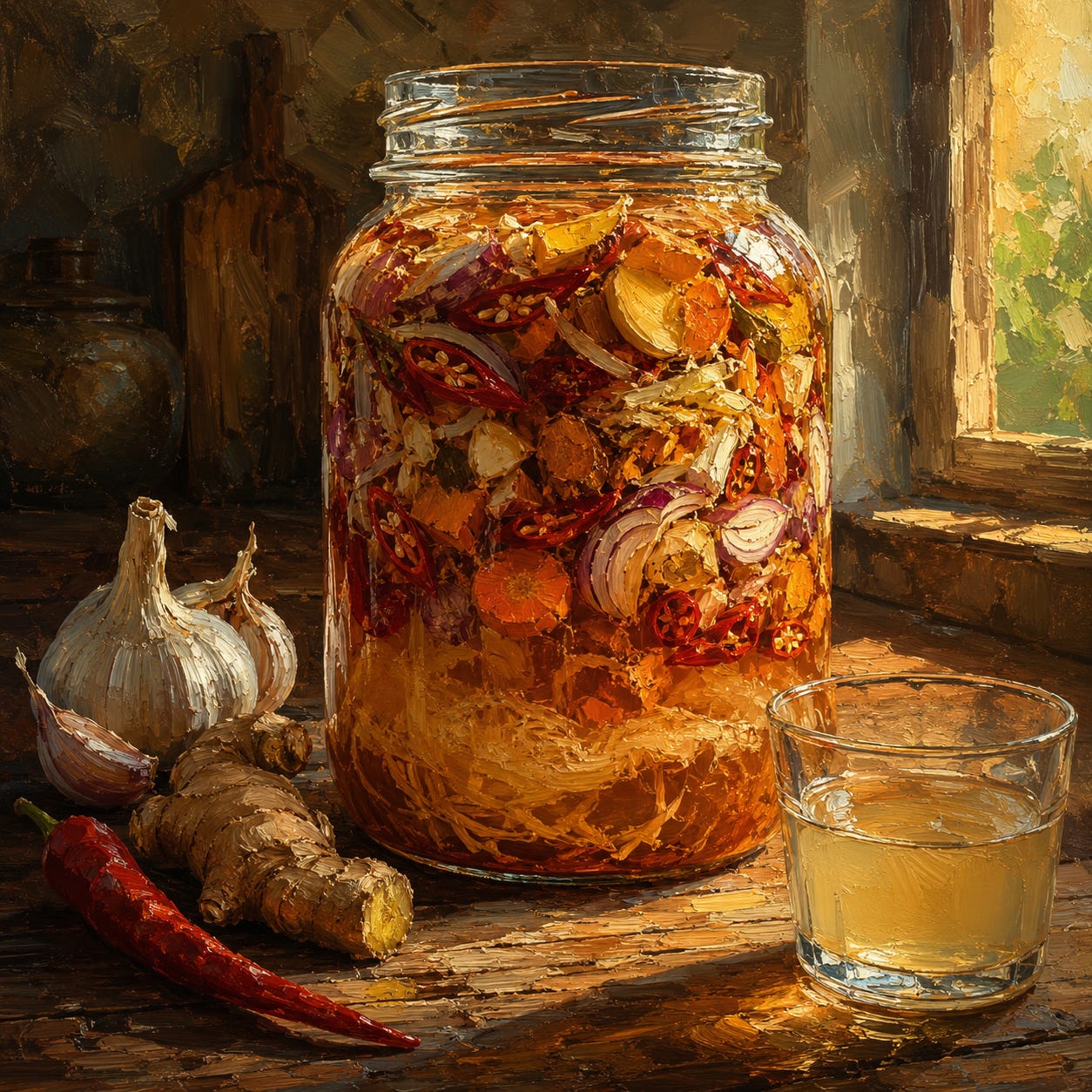
Four Thieves
In the spring of 1720, a ship called the Grand-Saint-Antoine arrived in Marseille from the Levant. Within months, somewhere between 50,000 and 100,000 people in the city were dead, roughly half the population. The event entered history as the Great Plague of Marseille. The municipal authorities, in the middle of the dying, were said to have caught a band of grave-robbers stealing from the bodies of the plague dead. The question put to the prisoners at trial was not why they had stolen but how they had managed to spend weeks among the sick without falling ill themselves.
Their answer was a recipe.
The preparation went by several names over the following century and a half: vinaigre des quatre voleurs, Marseille vinegar, thieves’ vinegar. The contents varied in retellings but the architecture was constant. Apple or wine vinegar steeped for several weeks with garlic, wormwood, rosemary, sage, mint, rue, lavender, sometimes camphor or cloves or cinnamon. The thieves rubbed it on their hands and faces, took it by mouth in small doses, and went about their work. A version of the recipe was reportedly posted on the walls of Marseille for public use and recorded in the apothecary registers of southern France.¹
Whether four grave-robbers actually invented this preparation or merely repeated an older folk formula is the kind of question historians of medicine debate. What is not debated is that vinegar steeped with pungent herbs was a recognized preparation in European apothecary practice through the eighteenth and nineteenth centuries, sold by French pharmacies into the late 1800s. Three hundred years after Marseille, the same architecture is sitting in the kitchens of contemporary American herbalists under a different name.
This work stays free because paid subscribers make it possible. They get the full book library, the Deep Dive Audio Library, and the Questions for Your Doctor, Before You Consent, and Package Insert series. No grants, no gatekeepers — your subscription is what keeps it that way.
The Lineage
The combination is older than the Marseille story.
Hippocrates wrote about oxymel (vinegar mixed with honey, sometimes with herbs added) as a respiratory remedy in the fifth century BCE. Greek and Roman physicians used vinegar-based herbal preparations for digestive complaints, wound care, and what they called the catarrhs.² Persian medicine developed sekanjabin, built on the same vinegar-honey-aromatic spine, used both medicinally and as a summer beverage. Medieval European apothecaries continued the tradition. Vermont farmers, working with what they had on hand, made switchel (vinegar, honey or molasses, ginger, water) and drank it during haymaking. D. C. Jarvis, the country doctor who practiced in Vermont for over fifty years and wrote two books on folk medicine, documented switchel as a staple used by people who reached their nineties working in the hayfields.³
The American herbalist Rosemary Gladstar, working in New England in the 1970s, named one particular preparation in this lineage fire cider. Her version retained the vinegar base and added a specific set of aromatics: garlic, onion, fresh ginger, horseradish root, cayenne pepper, sometimes turmeric, sometimes citrus zest. The combination became standard across the American herbalist community over the following four decades. Mary Blue made it in Rhode Island. Katheryn Langelier made it in Maine. Nicole Telkes made it in Texas. Thousands of small herbalists made it. None of them invented it.
The lineage shows something the synthesis thesis predicts. The same architecture has been independently arrived at across different cultures, separated by oceans and centuries. Vinegar as the solvent. Pungent aromatics as the active material. Humans observing themselves and each other have kept noticing what the combination does, and the noticing has been consistent enough across enough centuries to produce a recognizable family of preparations.
Isolation and Combination
Modern pharmacology proceeds by isolation. A plant is observed to do something useful: quinine bark for fever, willow bark for pain, foxglove for the heart. The plant is taken apart chemically. A single compound is identified, synthesized, tested in controlled trials, patented, and marketed. The original plant is set aside.
Folk medicine proceeds by combination. A plant observed to do something useful is combined with other plants observed to do other useful things. The combination is observed to do something the individual plants do not. The combination is refined across generations of trial and error. The original plants are not set aside.
These are two different epistemologies. The pharmacological model assumes that the activity of a plant resides in a single compound and that everything else in the plant is inert dilution. The folk-medical model assumes that the activity resides in the whole, and that the body responds to the whole. One model produces patents. The other produces remedies anyone with a kitchen can reproduce.
Fire cider is a worked example of the second model. Garlic alone is a remedy. Onion alone is a remedy. Ginger alone is a remedy. Horseradish, cayenne, and apple cider vinegar each have their own folk-medical traditions. Folk medicine combined them anyway. The combination has been in continuous use somewhere in the world for at least three thousand years. Pharmacology has never funded a trial of the combination because the combination cannot be patented. The streetlight effect is precisely this: a remedy is studied only when there is something to sell at the end of the study.
The Vinegar Question
The vinegar component invites a specific objection from within the alternative-health and terrain-medicine traditions, and the objection deserves a direct response.
Herbert Shelton, a leading twentieth-century proponent of Natural Hygiene, called cider vinegar “the poisonous product of fermentation of apple juice” and provided quantitative figures on acetic acid’s inhibition of salivary amylase: one part in five thousand appreciably reducing starch digestion, one part in five hundred arresting it altogether.⁴ The Williams and Bailey Terrain Therapy lineage, a more recent terrain-medicine compilation, excludes vinegar from every dietary protocol in the book, formatted in capital letters in the original: NO VINEGAR.⁵ Dawn Lester, co-author of What Really Makes You Ill?, argues that stomach acid is self-regulating in a healthy person and that adding external acid is unnecessary.⁶ These are not weak objections.
The response is that fire cider is not standalone apple cider vinegar consumed as a daily protocol. It is a herbal extract in which acetic acid functions as the solvent. The role acetic acid plays in fire cider is the same role it plays in countless laboratory and pharmaceutical extractions: drawing the active compounds out of the plant material and holding them in suspension. The body responds to what the vinegar has drawn out. Allicin and sulfur compounds from garlic. Gingerols from ginger. Quercetin and additional sulfur compounds from onion. Allyl isothiocyanate from horseradish. Capsaicin from cayenne. Sometimes curcumin from turmeric. The vinegar itself, diluted in water at a tablespoon dose taken on rising, is doing carrier work.
The Shelton concern about amylase suppression applies most acutely when vinegar is taken in volume with a starch-heavy meal. A tablespoon diluted in a glass of water before food is not the use case Shelton was describing. The Terrain Therapy concern about vinegar’s acidity sits inside a framework that prioritizes mineral-alkaline foods, and the response is that fire cider is taken in tablespoon doses, not by the cup. The Lester concern about externally added acid is real for standalone vinegar protocols and effectively bypassed when the acetic acid is functioning as an extraction medium for compounds the body responds to in their own right.
The question fire cider answers is therefore not “is acetic acid good for you.” That is a question about a single compound consumed in isolation. The question fire cider answers is whether the matrix (garlic, onion, ginger, horseradish, cayenne, and the other aromatic compounds drawn into a vinegar suspension and consumed in small doses) does what folk medicine has claimed it does across three centuries of continuous use. That is a different question. The evidence base is different. So is the conclusion.
What Is in the Jar
The architecture is easier to see when each component is taken in turn.
Apple cider vinegar provides the solvent. Acetic acid limits microbial growth in its own right, but its primary work in fire cider is extraction, pulling water-soluble and acid-soluble compounds out of the plant material over the weeks of steeping. Raw, unfiltered vinegar with the mother carries some additional bacterial culture that the filtered version does not.
Garlic supplies allicin, the sharp-tasting compound that does not exist in the intact clove. It forms the moment the clove is crushed: an enzyme called alliinase converts a precursor (alliin) into the active form. Allicin is unstable and water-soluble, which is part of why crushed garlic does its work most strongly within hours of preparation, and why a vinegar extraction captures it well.⁷ Garlic was the active ingredient in the 1901 Venice tuberculosis ward where two hundred patients showed improvement across all stages of the condition, in the 1917 Metropolitan Hospital trial in New York where garlic produced the best results among fifty-six different treatments for tuberculosis, and in the folk-medical traditions of nearly every culture that has cultivated Allium sativum.⁸
Onion adds quercetin and additional sulfur compounds. Dr A. P. Seligman, a public health vaccine physician in 1903, reported that immigrant communities in his district consuming large quantities of onions remained free of smallpox without vaccination.⁹ The folk respiratory tradition for onion is extensive enough to support its own essay.
Ginger contributes gingerols. Fresh ginger and dried ginger are pharmacologically different. The heat and time involved in drying convert gingerols to shogaols, a different compound profile. Fresh ginger in the fire cider matrix preserves the gingerols. The folk tradition covers digestion, circulation, nausea, and what nineteenth-century texts called weakness of the stomach.
Horseradish works on the same principle as garlic. Crushing the root releases an enzyme called myrosinase that converts a precursor compound (sinigrin) into allyl isothiocyanate, the volatile substance responsible for the sinus-clearing effect of wasabi and certain mustards. The folk tradition is respiratory and sinus-decongestant.
Cayenne provides capsaicin. The folk tradition is circulatory stimulation and what older texts described as warming the blood. Capsaicin is fat-soluble, which is part of why it is extracted into vinegar less efficiently than the other compounds. The vinegar matrix combined with the small amount of plant lipids present in the other ingredients is sufficient to carry meaningful quantities into the final preparation.
Turmeric, when included, adds curcumin. The pepper-like compounds in the matrix (capsaicin from cayenne, isothiocyanate from horseradish) modestly improve curcumin absorption compared with isolated turmeric taken alone.
Each compound, taken alone, is a remedy. Taken together in the vinegar matrix, they become something else: a preparation the body responds to as a unified intervention rather than as a sum of separate ones. Folk medicine arrived at this synthesis without trials because folk medicine had three thousand years of trial-and-error observation to work with.
How to Make It
The recipe varies across herbalists, but the core ratios are stable.
Take a quart-sized glass jar. Half-fill it with chopped raw aromatics: one medium onion, half a head of garlic roughly crushed, a four-inch piece of fresh ginger sliced, a four-inch piece of fresh horseradish root grated, two or three fresh cayenne peppers or one to two teaspoons of dried cayenne powder. Add, optionally, a one-inch piece of fresh turmeric and the zest of half a lemon. Fill the jar to within an inch of the top with raw, unfiltered apple cider vinegar with the mother. Cover with a non-metallic lid (the acid corrodes metal). Shake daily for four weeks. Strain through cheesecloth or a fine mesh strainer. Add raw honey at the end if desired, typically a quarter cup per quart of strained liquid.
The standard dose is one to two tablespoons in a glass of water on rising, before food. Some herbalists take a smaller dose two or three times during the day in cold weather, or when household members are coming down with respiratory complaints. The preparation keeps in a cool dark cupboard for at least a year.
For acute use during an active respiratory complaint, a teaspoon taken neat or in a small amount of water every few hours is the traditional protocol. It is intense, and most people prefer the diluted morning dose for regular use.
Cost per quart, made at home with raw aromatics from a farmers’ market and good vinegar, is under five dollars. The time investment is roughly fifteen minutes at the start and a daily shake for a month.
Cowan
Thomas Cowan has identified fire cider as one of his five daily substances. A tablespoon added to the morning glass of water alongside the plasma seawater and the shilajit. The full case for his protocol is set out elsewhere.¹⁰
Cowan is a practising physician with a body of work directly hostile to the supplement industry as currently constituted. He has no financial relationship with any fire cider producer. He takes it every morning because, inside his framework, it does what he wants a daily preparation to do: deliver a complex of compounds from real foods in their natural matrix, support digestion, and provide what he calls the introduction of acidity for the stomach’s own work. The position is unremarkable inside his framework. It is unusual mostly because the alternative is so dominant: a wall of capsules in the supplement aisle, each promising what fire cider has been doing for three centuries.
The Enclosure Attempt
In October 2012, a Massachusetts-based company called Shire City Herbals filed a trademark application with the United States Patent and Trademark Office for the term fire cider.¹¹ The trademark was registered in 2013. In 2014, Shire City began sending cease-and-desist letters to small herbalists across the country who were selling their own fire cider preparations under that name.
Three herbalists in particular refused to comply. Mary Blue of Farmacy Herbs in Rhode Island. Katheryn Langelier of Herbal Revolution in Maine. Nicole Telkes of the Wildflower School of Botanical Medicine in Texas. They became known in the herbalist community as the Fire Cider Three. Their argument, supported by a broader coalition under the banner Free Fire Cider, was that the term was generic, used by herbalists for over forty years before the trademark, with documented prior use traceable through Rosemary Gladstar and her students back into the broader herbal tradition that preceded her.
The legal battle ran for years. Shire City filed a federal trademark infringement suit against the Fire Cider Three in the U.S. District Court of Massachusetts. The herbalists counterclaimed for cancellation. Documentation of pre-trademark use was assembled across the herbalist community. In October 2019, a federal court ruled that fire cider was a generic term in widespread use prior to the trademark filing, and the trademark was cancelled.¹²
The case is what the synthesis thesis predicts. A preparation in continuous folk use across three centuries (Marseille in 1720, oxymel before that, Vermont switchel in the nineteenth century, Gladstar’s reformulation in the 1970s, ten thousand kitchen jars by 2012) was nearly enclosed by a single corporate filing. The enclosure was reversed only because herbalists were prepared to spend years and considerable money fighting it. Most folk remedies do not have a community organized enough to fight an enclosure attempt. Most folk remedies, on first contact with the patent or trademark system, simply disappear from public use under the name everyone knew them by.
The four grave-robbers in Marseille in 1720 refused to die when half the city did. The Fire Cider Three in 2014 refused to let a corporation enclose the preparation that had survived three centuries of continuous use. Both fights protected the same thing: the right of ordinary people to keep using what worked, without permission from a system that produced nothing comparable but claimed jurisdiction over what was already there.
How to Explain It to a Six-Year-Old
If you eat raw garlic by itself, your mouth will burn and your stomach will feel hot for a while afterwards. If you eat raw onion by itself, your eyes will water and your breath will smell. If you eat fresh ginger by itself, your tongue will tingle and your nose will run. If you eat horseradish by itself, your sinuses will open all the way up and you might cry a little. If you eat cayenne pepper by itself, your face will turn red and your mouth will be on fire.
Each one of these things, on its own, does something to your body. People noticed this thousands of years ago. They used each one for different problems: garlic for chest colds, onion for coughs, ginger for an upset stomach, horseradish for a stuffy nose, cayenne for cold hands and feet.
Then someone figured out that if you put all of them in a jar with vinegar, and waited a month, all the work the plants do gets pulled into the vinegar. You only need to take a spoonful. And it does all the things the separate plants do, at the same time, in one drink.
People have been making this for a very long time. It is called fire cider, and the ingredients are probably already in your kitchen.
References
The Four Thieves Vinegar story appears in multiple historical sources from the late seventeenth and eighteenth centuries. The Toulouse and Marseille provenance forms part of the folkloric tradition surrounding the recipe; the preparation itself was a documented element of European apothecary practice through the nineteenth century, sold under names including vinaigre des quatre voleurs and Marseille vinegar.
Hippocrates. On Regimen in Acute Diseases, c. 400 BCE. Oxymel preparations are described in multiple Hippocratic texts and remained standard apothecary practice into the medieval period.
Jarvis, D. C. Arthritis and Folk Medicine. Henry Holt and Company, 1960. The Vermont switchel tradition is documented throughout, alongside the broader vinegar-and-honey folk medicine framework that grounded Jarvis’s fifty-year rural practice.
Shelton, Herbert M. Multiple articles in the Natural Hygiene tradition. The quantitative figures on acetic acid inhibition of salivary amylase are cited and discussed in the What Is Inflammation essay archive.
Williams, Ulric (Bailey lineage compilation). Terrain Therapy, 2022 edition. The vinegar prohibition appears in the Eliminating Diet and Hotel Diet protocols, formatted in capitals in the original.
Lester, Dawn, and Parker, David. What Really Makes You Ill? Why Everything You Thought You Knew About Disease Is Wrong, 2019. On stomach acid as self-regulating, see the discussion of digestive disorders and antacid mechanism.
Block, Eric. Garlic and Other Alliums: The Lore and the Science. Royal Society of Chemistry, 2010. The standard reference on allicin chemistry, formation, and instability.
“Garlic in Pulmonary Tuberculosis,” Merck’s Archives, vol. III, 1901. “The Therapeutic Uses of Garlic,” Medical Record, September 1, 1917. Both cited in Humphries, Suzanne, and Bystrianyk, Roman, Dissolving Illusions: Disease, Vaccines, and the Forgotten History, 2013. See also Unbekoming, “The Healing Powers of Garlic,” September 2024.
“Vegetables’ Medicines,” The Small Farmer, September 1903. The Seligman quotation on immigrant onion consumption and smallpox resistance. See also Unbekoming, “The Humble Onion,” January 2026.
Unbekoming, “Five Bottles, No Vitamins: An Essay on What the Body Needs, What the Industry Sells, and the Five Substances That Sit Between Them,” May 29, 2026.
United States Patent and Trademark Office trademark records for FIRE CIDER, filed by Shire City Herbals (Pittsfield, Massachusetts), October 2012, registered 2013. Trademark documentation is available through USPTO public records.
Shire City Herbals LLC v. Blue et al., U.S. District Court for the District of Massachusetts. The federal court ruled in October 2019 that fire cider was a generic term in widespread use prior to the trademark filing. The Fire Cider Three were supported by the Free Fire Cider campaign, with documentation of pre-trademark herbalist use drawn from Rosemary Gladstar’s publications, teaching materials, and her students’ practices going back to the 1970s.
Author's Note
On the contagion question. A careful reader asks how to read the Four Thieves story inside a terrain framework that rejects contagion. The thieves were not "preventing contagion." They were supporting their own terrain in a genuinely toxic environment. Decomposing bodies are a real toxic exposure: volatile breakdown products, ammonia, cadaverines and putrescines, the sheer load of biological decay. A city in mass death is a real toxic exposure: compromised water, compromised food, fear at sustained intensity, rest deprivation. The vinegar applied topically limits microbial growth on contact, which matters when handling decomposing tissue. The vinegar taken internally supported digestion during a period when everything else was compromised. The story does not require the contagion model. It requires the terrain model.
On the "alkalizing" claim. Several commenters raised the folk argument that vinegar is acidic outside the body but alkalizing once metabolized. The claim has a long history in the alkaline-ash dietary tradition. It is also not load-bearing for the case the essay makes. Blood pH is tightly regulated regardless of what you eat. The terrain question about acid-alkaline balance operates at the tissue and cellular level, not as a residue calculation from foods. Fire cider's case rests on the aromatic compounds drawn into the vinegar matrix. Whether the residual acetate metabolizes net-alkaline is a different framework's question.
On reductionism. A commenter extended the synthesis thesis to willow bark and salicylic acid. The example is exact. Whole willow has been used for centuries without the ulcers and kidney complications that follow isolated salicylic acid and synthesized aspirin. The compounds in the bark that buffer the acid are stripped away in isolation. Folk medicine kept the buffers. Pharmacology kept the acid.
Awesome article! Thank you for sharing!!! I will be taking this to my doctor because he is always looking for more herbal/holistic remedies.