
Epistemic Capture
An Essay

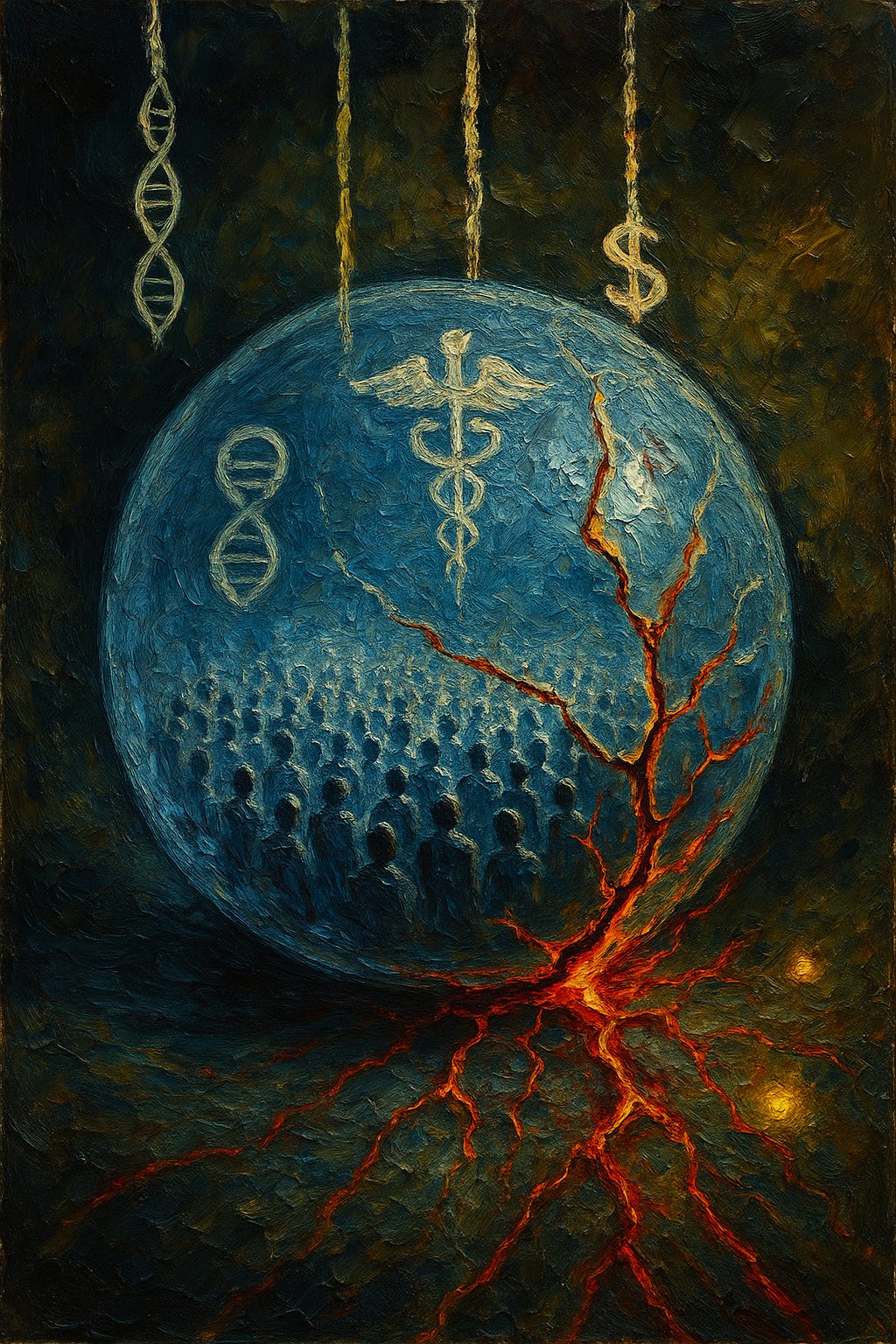
Preface
This essay is inspired by Dr. Toby Rogers' - uTobian - recent posts and remarkable testimony before the U.S. Senate, where he articulated with devastating clarity a concept that has only 132 results across the entire searchable internet, yet represents one of the gravest threats to human knowledge and wellbeing we face today: epistemic capture.
In my previous essay "The War on Knowing," drawing on Peter Duke's - The Duke Report - groundbreaking work on epistemological warfare, I explored how systems of control manipulate not just what we know, but how we know. Duke rightly corrected me afterward—it's actually a war on thinking. He was right. At the end of the day, that's what epistemic capture is about: it aims to collapse your ability to see reality correctly, to collapse your ability to think, and to reach small-r truth, to reach small-r reality... or as Plato might say, to exit the cave.
Rogers, a political economist who follows the money through the labyrinth of pharmaceutical influence, sat before senators and explained what philosophers of science have been warning about in obscurity: when an industry captures the entire knowledge production process—what gets studied, how it's researched, what counts as evidence—it doesn't just corrupt individual decisions or regulators. It corrupts reality itself. It keeps us chained in Plato's cave, mistaking shadows on the wall for truth, while those who cast the shadows profit from our confusion.
What Rogers revealed in that Senate hearing room wasn't just another case of corporate malfeasance or regulatory failure. It was the systematic imprisonment of human consciousness within a carefully engineered bubble where the very tools we use to determine truth have been weaponized against us. This is the story of that prison, and why breaking free from it may be the most important challenge of our time.
1. The Invisible Crisis
Across all of Google, which scans most of the publicly-facing internet, there are only 132 results for "epistemic capture." Only 173 for "epistemic bubble." These numbers should terrify us. Not because the concept is obscure, but because something this fundamental to our crisis has been so successfully hidden from view. As Toby Rogers notes, epistemic capture and epistemic bubbles are among the biggest problems in the world today, yet they remain virtually invisible to public consciousness.
Epistemic capture occurs when an industry controls the conditions of knowledge production—what gets researched, how, and what counts as evidence. It's far more insidious than regulatory capture, where industries influence the agencies meant to oversee them. When you capture regulation, you control decisions. When you capture epistemology, you control reality itself.
The pharmaceutical industry has achieved something unprecedented in human history: the complete capture of an entire domain of knowledge production. Every step in the process of creating medical knowledge—from what gets studied in the first place to what appears in medical journals—has been systematically colonized. Medical school textbooks are written by authors with financial conflicts of interest. Two-thirds of medical school department chairs have financial ties to pharma. Two-thirds of researchers carry these same conflicts.
But the genius of the system is that it doesn't need to buy everyone. As Rogers explains, "Big Pharma is smart, they don't buy off everyone, they just buy off the best universities and the leaders in the department and then everyone else falls into line." This is how you create an epistemic bubble that encompasses an entire profession from the first day of medical school to the final years of practice.
The numbers that do exist in Google's results—those lonely 132 instances—represent cries in the wilderness from scholars and critics who see what's happening. But their voices are drowned out by the $27 billion annual tsunami of pharmaceutical marketing and the thousands of studies produced within the captured system. The very invisibility of epistemic capture is proof of its effectiveness.
2. The Architecture of Knowledge Control
The pharmaceutical industry's control over medical knowledge production operates like a vast machine with interlocking parts, each reinforcing the others. At the foundation, medical school curricula are dictated from above—professors lack the academic freedom enjoyed in other departments. They cannot teach whatever they want; they must follow predetermined paths that align with pharmaceutical interests.
The corruption begins before students even open their textbooks. The top two-thirds of universities own stock in pharmaceutical companies, creating an institutional conflict of interest that pervades every classroom and laboratory. When the universities themselves are investors in the industry they're supposed to study objectively, the corruption isn't a bug—it's a feature.
Most clinical trials, the supposed gold standard of medical evidence, are conducted by for-profit Contract Research Organizations in China and the developing world, where oversight is minimal and data manipulation is easier. As Rogers revealed in his testimony, a large percentage—perhaps as much as 40%—of medical journal articles are ghostwritten by the pharmaceutical industry. As documented in "Biostitution," authors with conflicts of interest are up to 20 times less likely to publish studies with negative findings than authors without such conflicts. The published science isn't science at all, but marketing dressed in academic drag.
The medical journals themselves have become extensions of pharmaceutical marketing. As Xavier Bazin exposed, these journals practice the lucrative system of "reprinting"—when a positive study on a drug is published, manufacturers buy thousands of copies, generating up to 2 million euros for a single issue. These reprints can represent up to a third of journals' revenues with profit margins of 80%. The Lancet's annual turnover is $40 million, the New England Journal of Medicine's is $100 million. The editor-in-chief of NEJM earns $703,324 per year. But the corruption goes deeper: the shareholders of these journals—companies like RELX Group that owns Elsevier and The Lancet—are the same investment funds like BlackRock and Vanguard that are major shareholders in pharmaceutical companies. The same financial entities own both the drug companies and the journals that are supposed to objectively evaluate their products.
Federal agencies have side "foundations" enabling corporate contributions. The CDC Foundation, FDA Foundation, NIH Foundation—all serve as money laundering operations where pharmaceutical dollars transform into "public health" policy. Federal officials can own stock in companies they regulate. The foxes don't just guard the henhouse; they've been given shares in the poultry business.
3. The $27 Billion Machine
Twenty-seven billion dollars. That's what the pharmaceutical industry spends annually just on drug promotions to influence prescribing practices. To put this in perspective, that's more than the entire annual budget of the National Institutes of Health. It's enough to give every medical doctor in America approximately $27,000 per year. This isn't education—it's epistemic warfare conducted with an unlimited budget.
This money doesn't flow randomly. It's strategically deployed to maximum effect. Continuing medical education, ostensibly meant to keep doctors current with the latest science, is sponsored by Big Pharma. The standards of care that doctors must follow or risk malpractice suits are written by physicians with financial conflicts of interest. The regulatory body that accredits private health insurance companies is stacked with industry representatives.
The money creates what Rogers calls an "epistemic bubble carefully engineered by the pharmaceutical industry to increase its profits." Inside this bubble, certain questions simply cannot be asked. Certain connections cannot be made. Certain observations cannot be voiced. The money doesn't just buy silence—it shapes the very conceptual framework through which doctors understand health and disease.
Consider how the tobacco industry pioneered this approach. As documented in "Agnotology," they created a "stable" of experts to manufacture doubt, to call for endless research, to ensure that the "debate" never ended even as the bodies piled up. The pharmaceutical industry studied this playbook, scaled it up, and perfected it. Where tobacco had millions, pharma has billions. Where tobacco influenced a handful of researchers, pharma has captured entire institutions.
The investment pays off spectacularly. Every dollar spent on drug promotion returns multiple dollars in sales. Every ghostwritten study becomes ammunition for sales representatives. Every compromised medical education session plants seeds that bloom into prescriptions. Every corrupted standard of care becomes a mandate that doctors must follow or face legal consequences. The $27 billion isn't an expense—it's the best investment the industry makes.
4. From Classroom to Clinic: Life in the Bubble
From their first day of medical school to their final years of practice, doctors live inside an artificially constructed reality. As Rogers explained to the Senate, medical school has become "just a glorified trade school for people trained to obey the pharmaceutical industry." The transformation of physicians from independent thinkers to obedient functionaries doesn't happen overnight—it's a carefully orchestrated process that takes years.
The indoctrination begins with textbooks written by conflicted authors and continues through curricula that present pharmaceutical intervention as the primary solution to every health problem. Students learn to memorize treatment algorithms, not to question their foundations. They're taught that vaccines are safe and effective, period—not to examine the actual clinical trials. They learn that "evidence-based medicine" means following guidelines, not evaluating evidence themselves.
The educational gaps are staggering. Only 28% of medical schools have a formal nutrition curriculum—even fewer than in 1977. Medical students receive on average just 19.6 contact hours of nutrition instruction during their entire four-year careers—about 0.27% of classroom time. As Dr. Robert Lustig points out, how can doctors provide nutrition advice when they never learned it in the first place? They're taught to prescribe pills, not to understand how food functions as medicine or poison. This ignorance about nutrition perfectly serves pharmaceutical interests—doctors who don't understand diet can only offer drugs.
By the time they graduate, young doctors have internalized a worldview where certain thoughts have become literally unthinkable. When Aaron Siri - Injecting Freedom by Aaron Siri - points out that no childhood vaccine was licensed based on a true saline placebo trial, doctors simply cannot process this information. Their training has created cognitive firewalls that reject such data as impossible, regardless of its truth.
The bubble extends into practice through electronic medical records that prompt specific interventions, insurance requirements that mandate certain treatments, and quality metrics that punish deviation from pharmaceutical-friendly protocols. Doctors who question the system face not just professional isolation but potential loss of livelihood. The bubble becomes a prison where the bars are made of student loans, malpractice fears, and social pressure.
As Rogers observed in his testimony, this doesn't make doctors bad people—"They just don't know." They've been trained their entire careers to exist within an epistemic framework that makes certain realities invisible. When they say vaccines are safe, they genuinely believe it, because every input they've received, every study they've read, every authority they trust has been filtered through the pharmaceutical capture apparatus. They're not lying; they're living in a manufactured reality where the truth has been systematically excluded.
5. The Price of Captured Science
The human cost of epistemic capture can be measured in stark numbers. As Rogers testified, 277 children regress into autism every single day in the United States. That's not development—that's regression from acute toxic exposure. The autism rate has exploded from essentially zero in 1970 to affecting millions of children today. This isn't better diagnosis or awareness—it's an epidemic hidden in plain sight by epistemic capture.
The field of agnotology reveals how this hiding works: ignorance is not merely the absence of knowledge—it is actively constructed. Like the drunkard searching for his keys under the streetlight because "this is where the light is" rather than where he actually lost them, medical research is directed to look where industry wants it to look. Researchers study genetics, diagnosis criteria, environmental toxins—anywhere but the vaccines injected 70-plus times into developing children. The light is deliberately positioned away from the keys. This manufactured ignorance ensures that certain connections will never be made, certain questions never asked.
Chronic disease now affects 76% of Americans, according to CDC data that Robert F. Kennedy Jr. cited in congressional testimony. Among children, the rate has skyrocketed from 10% having one or more chronic conditions to over 50%. These aren't abstract statistics—they represent millions of lives diminished, families destroyed, potentials unrealized. Yet within the epistemic bubble, these numbers are explained away as genetics, better diagnosis, or mysterious environmental factors—the drunkard keeps searching under the streetlight while the keys lie in darkness.
The economic cost runs into the trillions. Autism alone costs the United States over $250 billion annually. Diabetes, autoimmune diseases, neurological disorders—all have exploded in prevalence during the exact period when pharmaceutical influence over medical knowledge production reached its zenith. The correlation is dismissed within the bubble, but outside it, the pattern is unmistakable.
Rogers calls this "one of the greatest crimes in human history," and the evidence supports this assessment. When you create a system where safety signals cannot be recognized, where adverse events cannot be properly tracked, where negative findings cannot be published, you create a machine for producing mass iatrogenic injury while making that injury invisible. The Vaccine Injury Compensation Program has paid out billions in damages, yet represents only a tiny fraction of actual injuries due to its byzantine requirements and statutory limitations. The VAERS system captures perhaps 1% of actual adverse events. Each layer is designed to keep the light away from where the problems actually are.
6. When Placebos Aren't Placebos
Perhaps nowhere is epistemic capture more evident than in the corruption of basic scientific definitions. As Rogers explained in his Senate testimony, when defenders of the status quo use the word "inert," they can mean almost anything. Paul Offit routinely calls aluminum and mercury "inert" despite their being known neurotoxicants. This isn't ignorance—it's epistemic warfare.
The corruption extends to the very notion of scientific consensus. As Neil deGrasse Tyson observed in three devastating tweets: When he told Galileo in 1633, "I'm not interested in Galileo's research. I'm interested in scientific consensus! The sun revolves around the earth!" When he told Semmelweis in 1847, "I'm not interested in Semmelweis's research. I'm interested in medical consensus! Hand washing does NOT prevent puerperal fever!" When he told Frances Kelsey in 1960, "I'm not interested in what Frances Kelsey has to say. She's only been at the FDA one month. I'm interested in scientific consensus! Thalidomide is safe and effective!" The fact is, Tyson concluded, "scientific consensus" is politics, not science. Actual science follows the principle Nullius in verba—"take nobody's word for it."
Aaron Siri's forensic analysis of Dr. Scott's celebrated list of 661 "placebo-controlled" vaccine trials reveals the depth of this deception. Of those 661 studies that supposedly prove vaccine safety: 567 were for HIV vaccines or other vaccines not on the childhood schedule—completely irrelevant. Of the remaining 94 studies, seventy didn't involve healthy children (for example, trials of HIV-positive adults). Of the remaining 24, twenty-one didn't involve a US-licensed vaccine or weren't used as controls to license currently used vaccines. That leaves exactly three studies.
Those three? The first was a chickenpox vaccine trial where the "placebo" contained neomycin and other ingredients—not inert. The second was the Gardasil 4 trial where thousands of girls in the control group got aluminum adjuvant injections, with only a few hundred labeled as "inert control" who actually received everything in the vial except the antigens, including polysorbate, sodium borate, and yeast protein—again, not inert. The third was Gardasil 9, which finally had a few hundred receive saline—but only after they first received three doses of Gardasil 4. The result: zero trials. Not a single routine childhood vaccine was licensed based on a true placebo-controlled trial.
The FDA has no regulations concerning the contents of placebos. Manufacturers can put whatever they want into the comparator and still call it a "placebo" by law. Scientific journals have similar non-requirements. About two-thirds of the time, studies don't even disclose what was in their "placebo." This definitional corruption extends throughout medical science. A "randomized controlled trial" should compare vaccinated to unvaccinated groups using saline placebos. Instead, they compare new vaccines to old vaccines, or to aluminum adjuvants, ensuring that adverse events appear in both groups and can be dismissed as "background rates." The corruption is so complete that when Siri demanded true saline placebo studies, the medical establishment insisted such studies would be "unethical"—a perfect epistemic capture where the methods needed to determine safety are declared morally impermissible.
7. Breaking the Chain
The path out of epistemic capture begins with recognition. As Rogers emphasized, "ending epistemic capture is the key to stopping corruption, junk science, and iatrogenic injury." But recognition alone isn't enough—the entire system of knowledge production in science and medicine needs to be overhauled to liberate it from pharmaceutical industry distortions.
The suppression of unfavorable findings reveals how deeply the capture runs. A major vaccinated versus unvaccinated study completed by Henry Ford Health System in 2020 remained hidden for five years—not because it was flawed, but because it showed what couldn't be shown. As Senator Johnson revealed in the hearing, the study found null results for autism but showed vaccines increasing ear infections by 600%. The scientists who conducted it refused to publish, fearing for their jobs. It took Senator Johnson threatening to release it himself to force it into the light. This epitomizes the corruption of science: studies that show vaccines have problems never get published, while those supporting the narrative sail through peer review.
Rogers proposes specific legislative solutions: repeal the 1980 Bayh-Dole Act that allowed universities to profit from pharmaceutical patents, the 1986 National Childhood Vaccine Injury Act that gave liability protection to vaccine manufacturers, and the 2005 PREP Act that extended those protections. These laws created the structural incentives for epistemic capture. Remove the incentives, and the capture becomes unsustainable.
The parallel structures already emerging offer hope. Independent researchers, funded by concerned citizens rather than pharmaceutical companies, are conducting the studies that should have been done decades ago. The Control Group study, comparing vaccinated to unvaccinated populations, found dramatic differences in health outcomes that the captured system insisted couldn't exist. Substack and other platforms allow researchers like Rogers to bypass captured journals and reach audiences directly.
The legal system, despite its flaws, remains partially outside the epistemic bubble. As Siri noted in his testimony, in court he can't rely on titles or slogans—only evidence. The discovery process in litigation has revealed internal pharmaceutical documents showing they knew about safety signals they publicly denied. Each successful lawsuit chips away at the edifice of epistemic capture.
Perhaps most importantly, the COVID era has awakened millions to the reality of epistemic capture. When people saw "science" reverse itself repeatedly, when they experienced adverse events that were supposedly impossible, when they were censored for sharing their own observations, the bubble became visible. Once seen, it cannot be unseen.
8. The Revolution of Knowing
We stand at a pivotal moment. The mechanisms of epistemic capture, hidden for decades, are being exposed. The Senate hearing where Rogers testified represents a crack in the dam. For the first time, the concept of epistemic capture has been introduced into the congressional record, spoken aloud in the halls of power.
The revolution Rogers envisions isn't violent—it's epistemological. It requires reconstructing the entire framework through which we understand health and disease. This means creating new institutions, new journals, new funding mechanisms, all designed with safeguards against capture. It means training a new generation of doctors who understand that true evidence-based medicine requires evaluating evidence, not following captured guidelines.
The independent science movement is already building these parallel structures. Researchers are rediscovering suppressed treatments, documenting vaccine injuries, investigating environmental toxins—all the work the captured system won't do. They're creating new peer review systems, new publication platforms, new conferences where uncomfortable truths can be spoken.
The ultimate goal isn't just to end pharmaceutical capture but to make epistemic capture itself visible and preventable. Once we understand how entire fields of knowledge can be colonized, we can build immune systems against it. This requires teaching critical thinking, encouraging intellectual courage, and creating economic structures that reward truth-telling rather than compliance.
As Rogers declared, "Y'all, we are going to unleash a wave of revolutionary insight that is going to break this dam!" The revolution has already begun. Every person who questions their doctor's recommendations, every researcher who pursues independent funding, every journalist who investigates rather than repeats press releases—all are soldiers in the war against epistemic capture.
The stakes couldn't be higher. As long as epistemic capture persists, the autism epidemic will continue. Chronic disease will continue consuming larger shares of human potential. Iatrogenic injury will continue being invisible. But when epistemic capture ends, when the bubble bursts, when doctors can finally see reality clearly—that's when healing begins. That's when we can finally leave Plato's cave and see not shadows on the wall, but truth itself. The revolution of knowing has begun, and it cannot be stopped.
I appreciate you being here.
If you've found the content interesting, useful and maybe even helpful, please consider supporting it through a small paid subscription. While 99% of everything here is free, your paid subscription is important as it helps in covering some of the operational costs and supports the continuation of this independent research and journalism work. It also helps keep it free for those that cannot afford to pay.
Please make full use of the Free Libraries.
Unbekoming Interview Library: Great interviews across a spectrum of important topics.
Unbekoming Book Summary Library: Concise summaries of important books.
Stories
I'm always in search of good stories, people with valuable expertise and helpful books. Please don't hesitate to get in touch at unbekoming@outlook.com
Baseline Human Health
Watch and share this profound 21-minute video to understand and appreciate what health looks like without vaccination.
This is excellent! Thank you!!! 🙌
What you’ve mapped here is the shadow-cage of epistemic capture—but wolves know the trick is older and wider than pharma. Parasites don’t just buy journals, they buy perception itself, because reality bends to how we see and name it. Consensus is their leash; gnosis is the way out. Rogers showed the Senate the prison walls, but the deeper fight is ontological: reclaiming the Source of knowing before it gets ghostwritten. The cave was never real light—only field distortion. Step outside and the shadows die.