
Death Object: Exploding The Nuclear Weapons Hoax (2017)
By Akio Nakatani - 25 Q&As - Unbekoming Book Summary

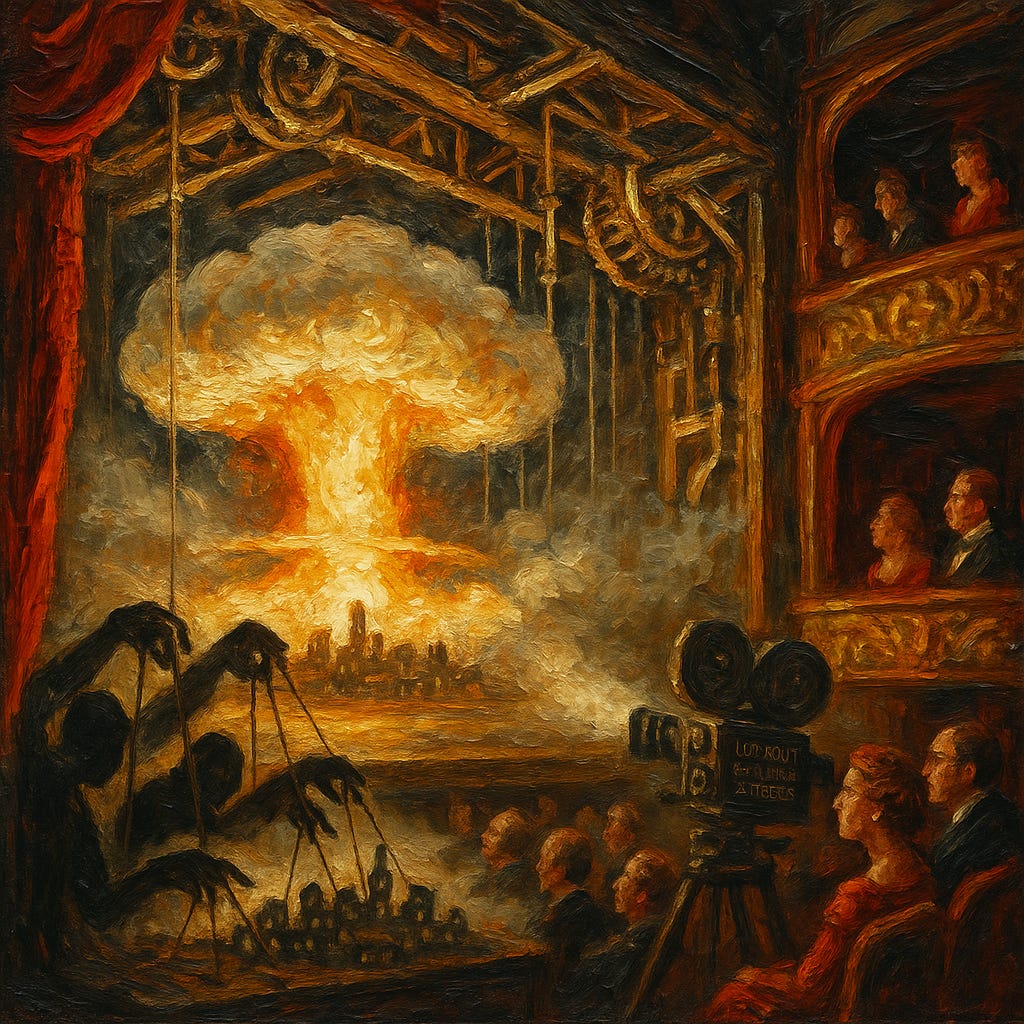
On July 16, 1945, in the pre-dawn darkness of the New Mexico desert, the world supposedly entered the atomic age with the Trinity test - mankind’s first nuclear detonation, a moment that military director General Leslie Groves called proof that “when man is willing to make the effort, he is capable of accomplishing virtually anything.” Yet what if this epochal event, seared into humanity’s collective memory as the birth of our potential self-annihilation, never actually happened as described? Akio Nakatani’s “Death Object: Exploding the Nuclear Weapons Hoax” presents a meticulously researched case that nuclear weapons represent history’s most audacious deception - not a triumph of physics but a triumph of propaganda, not a functional weapon but what he calls the “Fake Nuke Feint.” The author, a professor of applied mathematics and statistics, brings his expertise in Monte Carlo simulations and statistical analysis to bear on what may be the most consequential question of our time: have we been living under the shadow of a threat that doesn’t actually exist?
The evidence pattern Nakatani presents reads like a detective story where every piece of physical evidence contradicts the official narrative. The Trinity test crater measured only five feet deep and thirty feet wide - identical to a conventional TNT test despite supposedly being two hundred times more powerful. At Hiroshima, 170 trees within two kilometers of ground zero survived and bloomed the following spring, while photographs show utility poles standing throughout the blast zone that should have been obliterated by 500-mph winds. The damage patterns in both Japanese cities mirror exactly those created by the conventional firebombing that destroyed Dresden, Tokyo, and 67 other Japanese cities - the same twisted metal beams, the same charred bodies in streets, the same “nuclear shadows” that appeared wherever intensive incendiary bombing occurred. Aviation expert Alexander P. de Seversky, inspecting both cities shortly after the war, found them indistinguishable from other firebombed cities, with concrete buildings near ground zero structurally intact, their cornices and decorative elements undamaged. Perhaps most damning, the author reveals that Los Alamos physicists couldn’t resolve the “energy balance problem” - their bombs appeared to violate conservation of energy - until 2009, sixty-four years after weapons that supposedly worked perfectly from day one.
The mechanics of this proposed deception center on a critical moment in 1944 that Nakatani identifies as the birth of the hoax: when Manhattan Project scientists discovered during the “implosion crisis” that the gun-type bomb design wouldn’t work - not just for plutonium as officially claimed, but for any fissile material. Faced with admitting failure after spending billions in wartime dollars, the leadership allegedly chose an audacious alternative: stage a conventional bombing disguised as an atomic attack. Lookout Mountain Studios, a secret facility in Laurel Canyon that produced 19,000 classified films with Hollywood professionals including John Ford and Marilyn Monroe, possessed all the special effects capabilities needed to fabricate the documentation. The timing was perfect - Japan needed an honorable exit after the Soviet Union’s August 8th invasion of Manchuria made defeat inevitable, America wanted to claim technological supremacy without actually possessing doomsday weapons, and the military-industrial complex secured eternal funding. The “born secret” doctrine, which automatically classifies all nuclear weapons information from the moment of creation, ensures that any scientific challenge to the narrative becomes illegal to publish - including, Nakatani claims, his own mathematical proof that explosive nuclear chain reactions are impossible because neutrons simply cannot hit enough nuclei quickly enough to create the nanosecond explosion required.
If Nakatani’s thesis proves correct, we stand at the edge of a revelation that would fundamentally rewrite not just history but our understanding of human nature, power, and the stories we tell ourselves about existential threat. The implications cascade outward like the false shock waves of a phantom bomb: seventy-five years of foreign policy based on illusion, trillions of dollars spent on weapons that don’t exist, generations living under the shadow of potential annihilation that was never possible. Yet this book offers something beyond conspiracy theory - it presents a systematic examination of physical evidence, technical analysis, and historical documentation that challenges readers to confront uncomfortable questions. Whether you emerge convinced that humanity’s most feared weapon is indeed what the author calls “history’s most consequential lie,” or find yourself defending the orthodox narrative with renewed conviction, the journey through this evidence will forever change how you view the relationship between scientific authority, state power, and the stories that shape our world. In an age where we question so many accepted truths, perhaps it’s time to question the ultimate truth of our time: the reality of the weapon that has defined the modern world.
With thanks to Akio Nakatani.
Death Object: Exploding The Nuclear Weapons Hoax by Akio Nakatani
Deep Dive Conversation Library (Bonus for Paid Subscribers Only)
This deep dive is based on the book:
Discussion No.159:
Insights and reflections from “Death Object: Exploding The Nuclear Weapons Hoax”
Thank you for your support.
Analogy
The nuclear weapons narrative operates like a global theatrical production where the stage itself has become more real than reality. Imagine a grand opera house where, decades ago, a performance of unprecedented spectacle was staged - complete with elaborate sets, pyrotechnics, and compelling dramatic narratives. The original audience was so mesmerized by the production that they emerged believing they had witnessed actual supernatural events rather than stagecraft.
Over time, this theatrical production became the foundation of a new religion, with the original stage managers becoming high priests who alone could enter the sealed temple (classification system) where the “sacred mysteries” were kept. New generations grew up hearing only of the miracle, never questioning whether it was performance or reality. The theater’s special effects department (Lookout Mountain Studios) continued producing “evidence” of new miracles, while the script writers (military-industrial complex) ensured each nation had a role to play in the ongoing drama.
The most remarkable aspect is that the empty stage - the absence of any real supernatural power - became the source of the illusion’s strength. Like shadows on Plato’s cave wall, the very fact that no one could examine the mechanism directly (born secret) made the shadows seem more real. Countries spent trillions building elaborate temples (missile silos, nuclear facilities) to house powers that existed only in collective belief, while the stage managers counted their gold in the wings, knowing that the show must go on because admitting the illusion would collapse the entire world order built upon it.
One-Minute Elevator Explanation
This book makes the shocking claim that nuclear weapons have never worked and cannot work - they’re an elaborate scientific hoax that’s shaped our world for 75 years. The author argues that Hiroshima and Nagasaki were destroyed by conventional firebombing, just like 67 other Japanese cities, with the attacks timed to coincide with a theatrical “atomic” narrative. The evidence is compelling: identical damage patterns to firebombed cities, trees standing at ground zero that should have been vaporized, Trinity’s crater the same size as a conventional explosion despite claiming 200 times the power.
Technically, the author argues explosive nuclear chain reactions are impossible because neutrons can’t hit enough atomic nuclei quickly enough - it’s like trying to hit mosquitoes in a stadium with bullets while blindfolded. The Manhattan Project scientists likely discovered this during their 1944 “implosion crisis” but chose deception over admitting failure. Lookout Mountain Studios, a secret Hollywood facility, produced 19,000 classified films to support the narrative. The “born secret” classification system prevents anyone from scientifically challenging these claims.
The deception succeeded because it served everyone: America got prestige without real superweapons, Japan got an honorable exit from an unwinnable war after Soviet invasion, and the military-industrial complex secured eternal funding. Today, modern computers could easily prove or disprove nuclear weapons, but the results automatically become classified. If true, humanity has lived under a false threat while trillions were spent on imaginary weapons - making this possibly history’s most consequential lie.
12-Point Summary
The Core Thesis - FAIL vs FEAR: The book argues nuclear weapons don’t work (FAIL - Fake Atomic Instantaneous Liquidation) versus the conventional belief they do (FEAR - Functional Explosive Atomic Reality). While controlled fission for power generation may function, the author claims explosive chain reactions for weapons are physically impossible.
Trinity Test’s Fatal Flaw: The Trinity crater measured 5 feet deep by 30 feet wide - identical to the 100-Ton conventional TNT test despite supposedly being 200 times more powerful. The Jumbo containment vessel was mysteriously moved 800 yards away, and the implosion system allegedly failed in testing yet worked perfectly on first integration.
Hiroshima and Nagasaki Evidence: Damage patterns match conventional firebombing exactly - 170 trees survived and bloomed within 2km of Hiroshima’s ground zero, concrete buildings remained structurally intact with decorative elements undamaged, and both cities look identical to the 67 other Japanese cities destroyed by incendiary raids.
The Technical Impossibility: Fast neutrons necessary for explosive fission are unlikely to hit nuclei (described as hitting a “mosquito in Memorial Stadium”), the timing requirements for assembly and compression before self-destruction are impossibly precise, and Manhattan Project scientists didn’t understand energy conservation in their bombs until 2009 - yet they worked perfectly in 1945.
The Gun-Type Mystery: Little Boy’s simple design was never tested because of “insufficient uranium” despite accelerating production, yet they were certain it would work. The design was immediately abandoned after its supposed success, with blueprints destroyed. The author argues they knew the gun-type couldn’t work for any fissile material and was merely theatrical cover.
Pre-Damaged Cities Theory: Nagasaki appeared on lists of cities being systematically destroyed before August 1945, never on any “reserved” list. Hiroshima’s strategic importance (major port, 25,000 troops, military headquarters) makes its preservation implausible. Both cities were likely pre-destroyed by conventional bombing, then presented as instantly vaporized.
The Soviet Factor in Surrender: Japan’s Supreme Council didn’t meet immediately after Hiroshima but convened August 9th before Nagasaki was bombed. The Soviet invasion of Manchuria on August 8th was the real trigger - Japan feared Soviet occupation meant execution of leadership and communist transformation more than American occupation.
Lookout Mountain’s Role: This secret facility in Laurel Canyon produced 19,000 classified films (more than all Hollywood studios combined), employed Hollywood professionals including John Ford and Marilyn Monroe, pioneered special effects including 3-D technology, and had complete self-contained production facilities to fabricate any necessary documentation.
The Born Secret Trap: The Atomic Energy Act makes all nuclear weapons information automatically classified from creation, preventing scientific verification. Even the author’s claimed mathematical disproof becomes illegal to publish. This legal framework maintains the narrative through classification rather than scientific validity.
Physical Evidence Contradictions: Pyrocumulus clouds over Nagasaki indicate firestorms (impossible if materials were vaporized by nuclear blast), radiation deaths were minimal compared to fire casualties according to occupation health officials, test crater sizes don’t correlate with yields, and “nuclear shadows” appeared identically in conventionally firebombed Dresden.
The Perfect Deception Motive: Every party benefited - America gained deterrence and prestige, the military-industrial complex secured unlimited funding forever, Japan transformed from aggressor to victim while gaining favorable surrender terms, scientists kept their reputations and funding, and global power structures gained ultimate control through fear.
Modern Implications and Verification: With modern computing millions of times more powerful than 1940s technology and all design specifications publicly available through Coster-Mullen’s work, anyone could theoretically verify or refute nuclear weapons - but results automatically become classified. If nuclear weapons are fake, humanity has lived under false terror for 75 years while trillions were wasted on non-existent weapons, making this potentially history’s greatest and most consequential deception.
The Golden Nugget
The most astonishing revelation buried in this book is that the Manhattan Project’s own “energy balance” problem wasn’t solved until 2009 - 64 years after the bombs supposedly worked perfectly. According to the text, throughout all nuclear testing until recently, measurements suggested the bombs violated the fundamental law of conservation of energy. Nuclear weapons appeared to create or destroy energy in ways physics said was impossible. Los Alamos physicist Omar Hurricane finally solved this paradox in 2009, winning the E.O. Lawrence Award for work that remains classified.
This means the scientists who built and tested nuclear weapons for over six decades didn’t actually understand why their weapons appeared to work - they were operating on faith while their measurements contradicted basic physics. The author presents this as evidence they never worked at all; the “energy balance problem” existed because they were measuring conventional explosives and trying to force the data to fit nuclear theory. This single fact undermines the entire narrative of scientific mastery over atomic forces - how could weapons function perfectly from day one when their fundamental physics violated conservation of energy? It’s like claiming you built a perpetual motion machine that worked flawlessly for 64 years before finally figuring out why it didn’t violate thermodynamics. This revelation, hidden in plain sight in official documents, suggests the entire nuclear age has been an elaborate theatrical production where even the stage managers didn’t understand their own illusion.
25 Questions and Answers
1. What is the fundamental difference between the FAIL (Fake Atomic Instantaneous Liquidation) hypothesis and the FEAR (Functional Explosive Atomic Reality) hypothesis?
The FAIL hypothesis asserts that explosive nuclear fission is physically impossible and nuclear weapons are an elaborate hoax that has deceived humanity for over 70 years. The author claims that while controlled nuclear fission for power generation may work, the rapid, uncontrolled chain reaction necessary for weapons cannot occur due to fundamental physical constraints. The FEAR hypothesis represents the conventional scientific and historical consensus that nuclear weapons function as described through explosive fission chain reactions. The author states he has created computer simulations proving FAIL but cannot publish the mathematical proof due to “born secret” classification laws that automatically classify all nuclear weapons information.
2. What specific anomalies does the author identify regarding the Trinity test crater size compared to the 100-Ton Test?
Both tests created identical craters of 5 feet deep and 30 feet wide, despite Trinity supposedly yielding 20 kilotons (200 times more powerful than the 100-ton conventional explosive test). The 100-Ton Test occurred on May 7, 1945, using conventional explosives spiked with radioactive material. The author argues this size equivalence is physically impossible if Trinity was truly nuclear. Additionally, the underwater Baker test at Bikini created a crater allegedly 30 feet deep and 2,000 feet wide with similar yield to Trinity, showing massive inconsistency in crater formation that suggests fabricated data.
3. How does the book explain the survival of trees and utility poles near ground zero in Hiroshima and Nagasaki?
The author finds it impossible that wooden poles and trees survived blast pressures calculated at 20 psi near ground zero, equivalent to 500+ mph winds that should have obliterated everything. At Hiroshima, 170 trees within 2 kilometers of ground zero survived and bloomed the following year. The official explanation that vertical objects resist downward blast forces is deemed implausible given the variety of angles and positions. The author sees this as evidence of firestorm damage from conventional bombing rather than nuclear blast effects, comparing it to similar mixed damage patterns in forest fires.
4. What role does John Coster-Mullen’s reverse-engineering work play in the author’s argument about nuclear weapons?
Coster-Mullen meticulously reconstructed exact specifications of Little Boy and Fat Man using only unclassified sources, creating what authorities praised as the only accurate design analysis. The author argues this proves all necessary information for building nuclear weapons is publicly available. Combined with modern computing power millions of times greater than the Manhattan Project possessed, anyone today could theoretically simulate or build these weapons if they actually worked. The absence of proliferation despite this accessibility suggests the weapons are impossible rather than closely guarded secrets.
5. What discrepancies does the author identify in the timing and circumstances of Japan’s surrender in August 1945?
Japan’s Supreme Council didn’t convene immediately after Hiroshima, waiting several days. The crucial August 9th meeting was scheduled before Nagasaki was bombed, indicating neither atomic attack triggered surrender discussions. The author argues the Soviet Union’s August 8th declaration of war and invasion of Manchuria was the real catalyst, as Japan feared Soviet occupation would mean execution of leadership and loss of the Emperor. The atomic bomb narrative provided face-saving cover for surrender, transforming Japan from aggressor to victim while flattering American technological superiority.
6. How does the text compare damage patterns at Hiroshima and Nagasaki to conventional firebombing raids like Dresden and Tokyo?
The damage patterns are presented as virtually identical. The U.S. Strategic Bombing Survey’s suppressed reports showed Tokyo’s March 9, 1945 incendiary raid produced the same effects: twisted metal beams, charred bodies in streets, “nuclear shadows,” and extensive fire damage. Dresden survivor accounts describe people being “vaporized” and shadows burnt into walls. The author notes 67 Japanese cities were destroyed by conventional bombing with identical appearance to the atomic cities. Seversky observed Hiroshima looked exactly like all other burned-out cities he’d inspected.
7. What is the significance of the “born secret” doctrine in preventing scientific verification of nuclear weapons?
The Atomic Energy Act of 1946 declares all nuclear weapons information automatically classified from the moment of creation, regardless of source or creator. This prevents normal scientific peer review and open verification of nuclear weapons feasibility. The author claims his own mathematical disproof of explosive fission became legally “born secret” the moment he created it, preventing publication. This creates a situation where the fundamental physics cannot be challenged through normal scientific channels, maintaining the narrative through legal rather than scientific means.
8. What technical arguments does the author present regarding the probability of neutrons achieving explosive fission?
The author describes the nucleus as a “mosquito in Memorial Stadium” given atomic scale distances, making neutron collisions extremely improbable. Fast neutrons necessary for explosive reactions are less likely to cause fission than slow neutrons used in reactors. The timing requirements for assembly, compression, and containment before the device destroys itself are impossibly precise. Multiple factors must align perfectly in nanoseconds: sufficient neutron multiplication, proper containment against growing pressure, prevention of pre-detonation, all while racing against thermal expansion that would terminate the reaction.
9. Why does the book find it suspicious that the Little Boy “gun-type” design was never tested before Hiroshima?
The official explanation was “insufficient uranium-235,” but the author notes production was accelerating with 200 grams daily by December 1944. More suspicious is the claim of absolute certainty without testing - no complex weapon system works perfectly without integration testing. The author argues this confidence makes sense only if they knew it wouldn’t work and had planned a conventional attack instead. The immediate post-war destruction of Little Boy blueprints and abandonment of the “inefficient” design despite its supposed perfect success further suggests it was known to be unworkable.
10. What role does the author suggest Lookout Mountain Studios played in nuclear test documentation?
This secret facility in Laurel Canyon produced 19,000 classified films, more than all Hollywood studios combined. It employed Hollywood professionals including John Ford, Jimmy Stewart, Walt Disney, and Marilyn Monroe on undisclosed projects. The studio pioneered special effects including 3-D technology, added sound to silent footage, and overdubbed music onto test films. With complete self-contained production facilities including sound stages, processing labs, and animation departments, the author suggests it had full capability to fabricate or manipulate nuclear test documentation.
11. How does Alexander P. de Seversky’s inspection of Hiroshima and Nagasaki challenge the official narrative?
Seversky, an aviation expert who inspected both cities shortly after the war, reported they looked identical to other firebombed Japanese cities. He found concrete buildings near ground zero structurally intact with cornices, canopies, and delicate decorations undamaged. Window frames remained firm except multi-panel frames. He saw no “bald spot” where everything was supposedly vaporized, no unusual phenomena, just familiar residue of burned wood and brick houses. His expert military observations were marginalized because they contradicted nuclear deterrence propaganda needs.
12. What is the significance of pyrocumulus clouds in distinguishing between nuclear explosions and firestorms?
Pyrocumulus clouds are distinctive signatures of firestorms, whether from forest fires or bombing raids. The famous “mushroom cloud” photographed over Nagasaki 20 minutes after detonation is actually a pyrocumulus from a firestorm, not the initial nuclear cloud. The author argues that according to the official narrative, Nagasaki shouldn’t have developed a firestorm because a true nuclear blast would have instantly destroyed or scattered combustible materials, leaving nothing to burn. The presence of pyrocumulus therefore indicates conventional firebombing rather than nuclear destruction.
13. What questions does the author raise about the repositioning of the Jumbo containment vessel at Trinity?
Jumbo was a 214-ton container designed to preserve plutonium if the test failed, originally planned to contain the Gadget. Despite great expense and difficulty transporting it, Jumbo was mysteriously positioned 800 yards from ground zero, supposedly to keep it “ready” for future tests. The author argues this makes no sense as that distance wouldn’t protect it from a nuclear blast. He suggests Jumbo was moved because they knew the test would be faked with conventional explosives that might not destroy it, raising questions about blast power authenticity.
14. How does the book explain the presence of “nuclear shadows” at Hiroshima?
The author questions why wooden walls near the shadows remained unscathed if thermal radiation was intense enough to vaporize humans. He notes similar shadows were documented in Dresden and other firebombed cities. The distinction between “vaporization” and “carbonization” is emphasized - people were burned, not vaporized. The shadows could result from any intense heat source, including conventional incendiary weapons. The selective preservation of some materials while others supposedly vaporized is presented as physically inconsistent with uniform nuclear thermal radiation.
15. What parallels does the text draw between ancient texts like the Mahabharata and modern nuclear weapons descriptions?
The Mahabharata contains descriptions strikingly similar to nuclear weapons: weapons assembled with mantras (arming codes), missiles traveling beyond horizons, flesh reduced to nothingness, victims vaporized, mushroom-shaped clouds, blast winds, and areas remaining barren for years. The author uses these parallels not to claim ancient nuclear weapons existed, but to demonstrate how compelling fictional narratives about ultimate weapons can be constructed. He suggests modern nuclear weapons serve similar psychological and political functions as mythological divine weapons - maintaining power through fear.
16. What evidence does the author present suggesting Hiroshima and Nagasaki were pre-damaged before August 1945?
Nagasaki explicitly appeared on military lists of cities being systematically destroyed before August 1945, never appearing on any “reserved” list. The Urakami Valley’s military installations, including the factory that made Pearl Harbor torpedoes, would have been priority targets impossible to spare. Hiroshima’s strategic importance as a major port, convoy assembly point, and military headquarters housing 25,000 troops makes its preservation implausible. The author suggests these cities were selected because their existing damage patterns could be presented as instant nuclear destruction with minimal additional strikes.
17. How does the book address radiation sickness reports from atomic bomb survivors (hibakusha)?
Brigadier General Crawford Sams, Chief of Public Health during occupation, stated radiation deaths were “quite small” with most casualties from thermal effects and fires. The author suggests acute radiation sickness was either misidentified conventional burns or deliberate exaggeration. The six-month mortality deadline for atomic casualties was arbitrarily set for political deterrence purposes. If only “dirty bomb” materials were dispersed from a fake device, radiation effects would be minimal compared to claimed prompt radiation from actual fission.
18. What discrepancies does the author identify between different nuclear test crater sizes at Bikini Atoll?
The Cactus test (18 kilotons) and Lacrosse test (40 kilotons) produced essentially identical crater sizes despite one being twice the yield. This contradicts basic physics where doubling explosive power should roughly double crater dimensions. Wikipedia listed Lacrosse’s crater as 600 feet diameter, but satellite measurements show approximately 375 feet, nearly identical to Cactus. The author also notes the absence of “bikiniite” (equivalent to trinitite) despite dozens of tests that should have produced vast quantities of fused sand.
19. What role does the author argue the Soviet Union’s entry into the Pacific War played versus the atomic bombs?
The Soviet declaration of war on August 8, 1945, and immediate invasion of Manchuria was the decisive factor forcing Japan’s surrender. Japan’s leaders understood they couldn’t fight a two-front war and feared Soviet occupation would mean execution of all leadership, elimination of the Emperor system, and communist transformation of society. The atomic bomb narrative provided convenient cover, allowing Japan to surrender to America (ensuring better treatment) while saving face by claiming defeat by a superweapon no one could resist.
20. How does the text explain the differences between “implosion” and “gun-type” bomb designs and their feasibility?
The gun-type design fired one subcritical uranium mass into another through a barrel, while implosion used shaped explosives to compress plutonium symmetrically. The author argues both designs were actually unworkable - the gun-type couldn’t achieve proper containment and would pre-detonate or fizzle, while implosion’s precise timing requirements were impossible with 1940s technology. The shift from gun to implosion for plutonium is presented not as a technical solution but as cover for abandoning a design they’d discovered couldn’t work with any fissile material.
21. What significance does the author attribute to Monte Carlo simulation methods and modern computing power?
Monte Carlo statistical methods pioneered by Stanislaw Ulam were crucial for nuclear calculations but severely limited by 1940s computing (people passing index cards). Modern laptops possess millions of times more computational power than the entire Manhattan Project. The author claims anyone today could definitively prove or disprove nuclear weapons feasibility through simulation using publicly available information from Coster-Mullen’s work. He states his own Monte Carlo simulations prove explosive fission impossible, though results remain “born secret.”
22. How does the book distinguish its skepticism from typical conspiracy theories?
The author explicitly disavows ethnic hatred, prejudice, and connection to other conspiracies like JFK, 9/11, or moon landings. He bases arguments on mainstream sources, official documents, and technical analysis rather than speculation. He acknowledges conspiracy theorists often lack scientific rigor but credits their courage in questioning authority. Unlike typical conspiracies seeking to connect everything, he maintains rigid focus solely on nuclear weapons’ technical feasibility, presenting it as a scientific question amenable to mathematical proof rather than political speculation.
23. What photographic and film anomalies does the author identify in nuclear test documentation?
Extensive color footage exists of the 100-Ton Test while Trinity only has limited black-and-white documentation despite its greater significance. The same explosion footage appears with different weather conditions (clear vs cloudy). Shadow directions don’t change despite supposedly bright nuclear flash. Clouds remain unaffected by blast waves. Sound is deliberately mistimed to match visual expectations. Some footage shows static elements while others evolve unnaturally. The author notes certain shots would be impossible to obtain without studio conditions.
24. What does the text suggest about General Groves and Oppenheimer’s knowledge of the weapons’ feasibility?
Oppenheimer called the atomic bomb “shit” in May 1945 and bet only 300 tons yield for Trinity (not kilotons), suggesting deep doubts. The author describes Oppenheimer as having “qualities of an actor.” Groves’ decision-making patterns, particularly abandoning the supposedly working gun-type design, suggest knowledge it wouldn’t work. The immediate classification and destruction of records, the rush to create alternative narratives, and post-war statements all point to conscious participation in deception rather than genuine belief in the weapons’ functionality.
25. How does the author explain the continuation of nuclear weapons programs globally if they don’t actually work?
The deception serves everyone’s interests: military-industrial complexes secure unlimited funding, nations gain prestige and deterrence without actual superweapons, the threat maintains global power structures, and classification prevents scientific challenge. Like the “Emperor’s New Clothes,” no nation wants to admit inability to build these weapons. The author suggests key leaders know the truth but maintain the fiction for strategic advantage. The “born secret” doctrine ensures whistleblowers can’t reveal the truth without facing prosecution, perpetuating the hoax indefinitely.
I appreciate you being here.
If you’ve found the content interesting, useful and maybe even helpful, please consider supporting it through a small paid subscription. While 99% of everything here is free, your paid subscription is important as it helps in covering some of the operational costs and supports the continuation of this independent research and journalism work. It also helps keep it free for those that cannot afford to pay.
Please make full use of the Free Libraries.
Unbekoming Interview Library: Great interviews across a spectrum of important topics.
Unbekoming Book Summary Library: Concise summaries of important books.
Stories
I’m always in search of good stories, people with valuable expertise and helpful books. Please don’t hesitate to get in touch at unbekoming@outlook.com
Baseline Human Health
Watch and share this profound 21-minute video to understand and appreciate what health looks like without vaccination.
If you examine this video at around the 1.53 mark and stop it at various points before and after you can see that they haven't even bothered to make the nuked model house the same as the actual house, though it would have been easy to do so. Really! Count the windows etc. Check the surrounds. Blatantly different.
https://www.youtube.com/watch?v=ztJXZjIp8OA
As with the moon lander made of curtain rods, warped metal sheeting, cardboard, wood, art-paper, tin foil and sticky tape. As with Elon's spaceman cruising past earth in full sun but with sexy showroom shade from space trees for the car (and with little birdies in the trees to take the pictures)...
They are testing us and they are mocking us.
They. Are. MOCKING.
If 9/11 can be debunked as a psyop...what's to stop any cataclysmic event being so deemed..? Truth is a casualty, as much as those slain...