
Clarkson’s Cows
What the Bovine TB Test Actually Measures

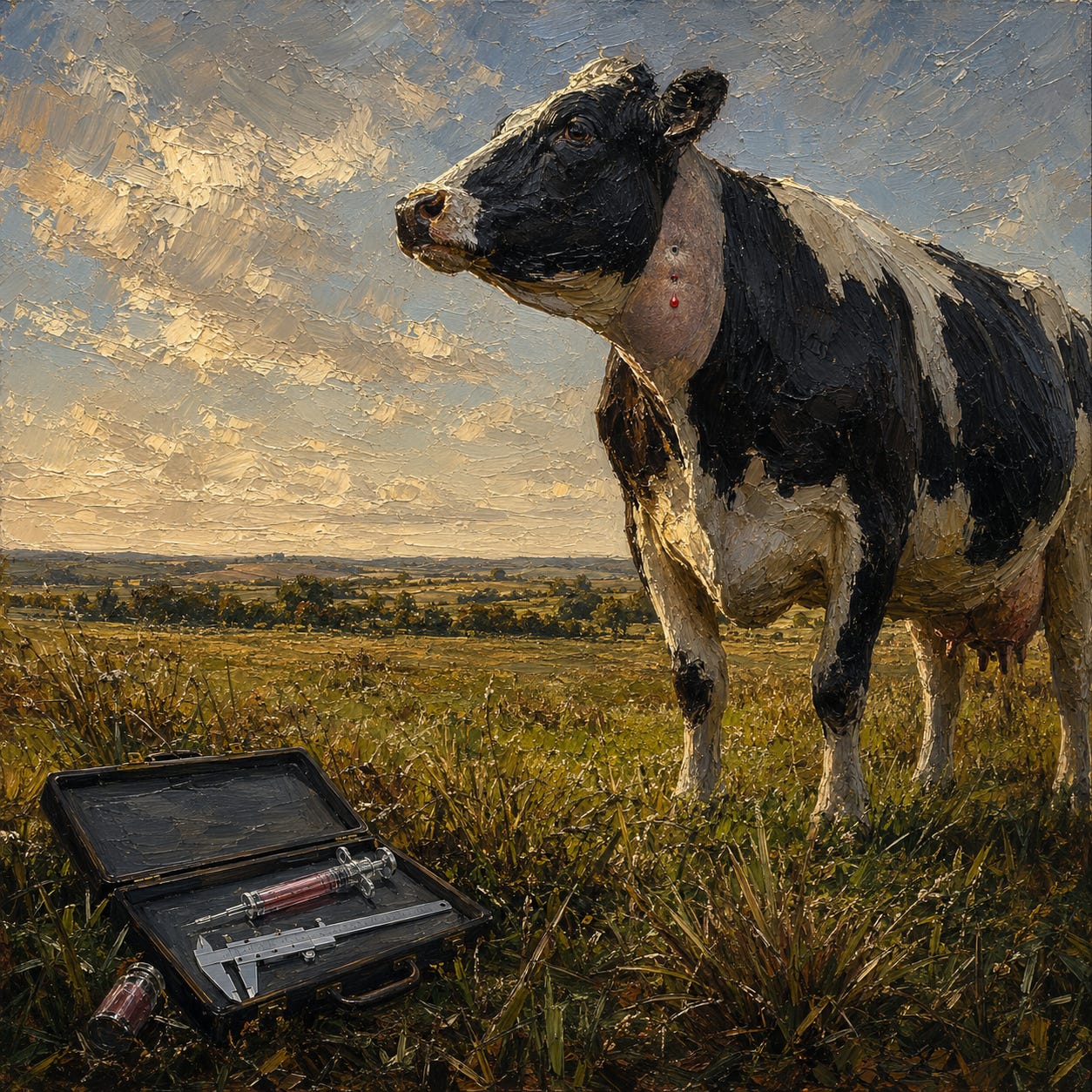
Take a healthy cow. Clip a patch of skin on her neck. Measure the thickness with calipers. Inject 0.1 milliliters of bovine tuberculin purified protein derivative into the skin. At a second site a few inches away, inject 0.1 milliliters of avian tuberculin purified protein derivative. Wait 72 hours. Return with the calipers. Measure both sites again. If the bovine site has thickened past a set threshold and the bovine reading exceeds the avian reading by 4 millimeters or more, the cow is classified as a reactor and sent for slaughter.
That is the test. That is the entire procedure on which the modern bovine tuberculosis eradication regime rests. In the Republic of Ireland in the twelve months to June 2025, approximately 43,000 cattle were removed from herds on the basis of skin reactions to this test.¹ In the United Kingdom the figure runs to tens of thousands annually. Behind each number is a small farmer pushed closer to insolvency by the loss of stock he had no power to refuse.
Jeremy Clarkson watched the procedure run on his own farm. The cameras were rolling. One of his cows was taken away. He used the platform of his television program to express disbelief at what was happening, while accepting the explanation he was given. The cow had tuberculosis. The law required her death. What he did not interrogate, because few people do, is what the test actually measures, what is in the syringe, and what relationship that procedure has to anything that could meaningfully be called disease.
This work stays free because paid subscribers make it possible. They get the full book library, the Deep Dive Audio Library, and the Questions for Your Doctor, Before You Consent, and Package Insert series. No grants, no gatekeepers — your subscription is what keeps it that way.
Inside the Syringe
The procedure is called the Single Intradermal Comparative Cervical Tuberculin test, abbreviated as SICCT. It is the primary screening tool for what the establishment classifies as bovine tuberculosis throughout the United Kingdom and Ireland. The Department for Environment, Food and Rural Affairs, through its TB Hub guidance for farmers, describes what the test does in language that should already give a careful reader pause. The test measures the response of the animal to injected tuberculin, which the same guidance defines as “a complex mix of proteins extracted from cultures of M. bovis” grown in the laboratory and killed by heat.²
That sentence is the regime’s own admission of what it is doing. It is injecting protein extract from killed bacteria into the skin of healthy cattle and measuring the swelling that results. Whatever else the test is, it is not detection. It is provocation.
The package leaflet for the Bovine Tuberculin PPD 3000 product manufactured by Prionics, the most widely used preparation in the United Kingdom and Ireland, lists what each 0.1 milliliter dose contains.³ The active substance is bovine tuberculin purified protein derivative from culture of Mycobacterium bovis strain AN5, at 3,000 International Units. The other declared ingredients are phenol at 0.4 to 0.5 milligrams per dose, glucose, disodium phosphate dihydrate, potassium dihydrogen phosphate, and water for injections.
Phenol is the preservative. It is also a synthetic industrial chemical, the historic active ingredient in carbolic acid, used today in resin manufacture, plastics, and as a precursor in the synthesis of pharmaceuticals and herbicides. At higher concentrations it is corrosive to tissue and toxic to nerves. The dose in the syringe is small, but it is being injected directly into living skin alongside foreign protein.
The avian PPD, injected at the second site for comparison, has a similar formula with one additional ingredient: Ponceau 4R, also known as E124, a synthetic azo dye at 5 micrograms per dose. Its function is cosmetic. It tints the vial red so the veterinarian can tell at a glance which preparation is which. It is the same dye banned for use in food in the United States, Norway, and Finland over concerns regarding hyperactivity reactions in children and possible carcinogenicity. In the avian PPD vial, it sits alongside the protein extract and phenol, ready for injection.
That is what is in the syringe. A heterogeneous mixture of proteins extracted from heat-killed bacteria, preserved in a synthetic industrial chemical, dyed for the operator’s convenience, injected intradermally into healthy cattle.
The phrase “purified protein derivative” deserves examination of its own. The procedure for producing PPD has not changed materially since Florence Seibert standardized it in the 1930s. A culture of the relevant Mycobacterium species is grown on a synthetic medium, killed by heating in a steam autoclave, and then subjected to repeated chemical processing with acids, ammonium sulfate, and trichloroacetic acid until a protein-rich precipitate is obtained. The result is called purified, but it is not pure in any meaningful single-molecule sense. Proteomic analysis of the final preparation identifies hundreds of distinct mycobacterial proteins, with considerable overlap between bovine PPD, avian PPD, and the PPD used in human tuberculin testing.⁴ The active substance is a heterogeneous protein soup, the specific composition of which varies between manufacturing batches.
The cow does not know any of this. The cow knows only what her skin knows. Something has been injected into her. The injection contains foreign material. The skin responds in the manner that skin responds to foreign material introduced beneath it. After 72 hours, the operator returns with calipers, measures the swelling, and compares it to a number printed on a chart.
If the swelling is large enough, the cow is classified as a reactor. The classification triggers compulsory slaughter under the relevant Animal Health Act. The farmer receives compensation at a rate calculated by reference to market value, typically below replacement cost. He may not sell the carcass into the food chain or introduce new animals to the herd until further testing clears the entire holding. His movement restrictions can last months or years.
This is what was set in motion when Clarkson’s cattle returned a positive reading. He believed, as the regime intends every farmer to believe, that his cattle had a disease that warranted their death and posed a threat to other cattle. He had been told that the test was 99.98 percent specific, and that the small risk of error was the necessary cost of an eradication program nearing completion.⁵
What he had not been told, and what the brochure does not contain, is the data the slaughterhouse produces when those cattle are killed.
The Lesions That Aren’t There
When a reactor animal is killed at the abattoir, an official veterinarian performs a post-mortem inspection. The carcass is cut open. The lungs, lymph nodes, and other typical sites of tuberculous lesions are examined. If lesions consistent with bovine tuberculosis are found, the lesions are recorded and tissue samples are taken for laboratory confirmation through culture and, where available, PCR.
The Department for Environment, Food and Rural Affairs publishes the resulting data, and the data presents a problem the brochure does not address. In England, depending on year and region, between 40 and 60 percent of the cattle killed as reactors have no visible lesions at slaughter.⁶ This is the regime’s own language. The animals are designated NVL, no visible lesions, in the official statistics. They were healthy enough on visual post-mortem inspection that no tuberculous pathology was found anywhere in the carcass.
The regime anticipates the obvious question. The official guidance issued by the Northern Ireland Department of Agriculture, Environment and Rural Affairs poses the question on the farmer’s behalf: “If an animal has ‘no visible lesions’ how can it have TB?” The answer the regime supplies is that lesions may be microscopic, that infection may be at an early stage, or that the post-mortem inspection may have missed them. The official guidance is explicit that NVL does not mean the animal was healthy.⁷
Examine that move. The test produced a positive result. The slaughter was carried out on the basis of that positive result. The carcass shows nothing. The regime’s response is not to question the test, but to declare the absence of pathology consistent with the test’s verdict. The cow had tuberculosis, the regime asserts, even though the carcass shows no tuberculosis. The lesions are absent because they are too small, too early, or were overlooked.
This is the structure of an unfalsifiable system. There is no possible post-mortem finding that could falsify the test, because every finding is interpreted as confirming it. Visible lesions confirm the diagnosis. Absent lesions confirm an early diagnosis. The verdict is the same in either case, the slaughter is necessary, and the regime is vindicated. No observation is allowed to count against the premise that a reactor is truly infected.
What happens when researchers go further than visual inspection? Sensitive laboratory methods exist. Enhanced bacteriological culture combined with immunomagnetic separation can detect M. bovis at concentrations far below what visual inspection or standard culture would catch. When these methods are applied to NVL reactor cattle, the result is not what the regime’s framing predicts. A field study published in Research in Veterinary Science applied enhanced immunomagnetic separation and PCR detection to tissue from reactor cattle and reported that among NVL animals, approximately 11 percent yielded any detectable M. bovis on these methods.⁸ Among lesion-positive animals, the detection rate exceeded 80 percent. The contrast is the central finding. Where there are lesions, the bacterium is generally found. Where there are no lesions, the bacterium is almost always absent, even using methods more sensitive than the regime’s standard confirmation procedures.
This is the regime’s own data, applied through its own methods, by researchers working within its framework. The skin test produced positives, the slaughter followed, and the slaughterhouse found no lesions in roughly half the cases. The laboratory then found no bacterium in roughly 89 percent of those no-lesion cases.
The official 99.98 percent specificity figure, the one that appears in the brochures and the policy documents, comes from theoretical modeling under controlled assumptions. It is a calculated value, not an observed one. The observed downstream confirmation rate, expressed as the proportion of reactors in which the disease the test purports to detect is actually found at slaughter and laboratory, is dramatically lower. The regime preserves the high specificity figure for public communications and reframes the low confirmation rate as a failure of post-mortem inspection or culture sensitivity, not as evidence about the test.
Mark Purdey, the organic farmer and self-taught researcher who spent the last years of his life investigating bovine tuberculosis before his death from a brain tumor in 2006, observed the same pattern in his dealings with the Ministry of Agriculture. The government’s official TB questionnaires sent to affected farmers, he wrote, were structured around the assumption that badger-to-cow transmission was the cause, “dubbing the badger the culprit before investigative work begins.”⁹ Environmental factors, soil chemistry, nutritional status, and industrial chemical exposure were excluded from consideration by the structure of the inquiry itself. The framework determined the answer before any data was gathered.
The institutional history of this framework reaches back further than the modern regulations. In 1910, the Carnegie Foundation published the Flexner Report, a survey of medical and veterinary education in the United States authored by Abraham Flexner and underwritten by the Rockefeller philanthropies. The report recommended the closure of schools that taught what it classified as non-scientific approaches, including those grounded in nutrition, hygiene, and environmental causation. Within a generation, the number of medical schools in the United States dropped sharply, and the surviving institutions converged on the germ-theory framework and the pharmaceutical model of intervention.¹⁰ Veterinary education followed the same trajectory. The bacterial-cause model of disease was institutionalized not by the weight of evidence, since the evidence was contested and incomplete at the time, but by the redirection of philanthropic capital and the elimination of the schools that taught alternative paradigms. By the time the bovine tuberculosis eradication programs of the mid-twentieth century were designed, the germ-theory framework was the only framework on offer.
The regime has not been blind to the failures of the skin test. When the SICCT’s poor confirmation rates became impossible to ignore, the establishment introduced the interferon-gamma blood test as a supplementary diagnostic. The test measures the production of a signaling protein, gamma interferon, by white blood cells exposed in a tube to mycobacterial antigens. The logic is functionally identical to the skin test: take cells from the cow, expose them to a mycobacterial protein cocktail, and see whether they respond. A response is interpreted as evidence of prior infection.
The interferon-gamma test produces more false positives than the skin test in herds with low actual prevalence. The published literature acknowledges that the test’s positive predictive value in low-prevalence settings is poor, with the majority of positive results in such settings unconfirmed by any subsequent detection of M. bovis.¹¹ The regime’s response has been to deploy the test selectively, primarily in herds that have already returned reactors on the skin test, where the prior probability of confirmation is higher. The test is positioned not to challenge the skin test’s verdicts, but to amplify them.
Inside the regime’s own published reviews, the uncertainty is acknowledged in language carefully calibrated for technical audiences. The 2013 evidence restatement commissioned by the UK government concluded that the natural science evidence base “cannot by itself determine policy” and that key aspects of the epidemiology of bovine tuberculosis remain uncertain.¹² An Irish eradication review stated that eradication by the target date was unlikely under current strategies and acknowledged considerable uncertainty about the relative contribution of different infection sources.¹³ These admissions appear in technical reviews. They do not appear in the farmer-facing materials, which continue to assert that the science is settled, that reactors are almost certainly infected, that NVL means early detection rather than absence of disease, and that compulsory slaughter is the necessary instrument of eradication.
A finding documented by the New Zealand researcher Bette Overell deserves particular attention. Overell catalogued cases in which cattle rejected by the Ministry of Agriculture as tubercular were, after a period of natural treatment that included rest, improved nutrition, and removal from the conditions that produced their initial positive test, readmitted to the herd as sound and continued to pass the tuberculin test on subsequent rounds.¹⁴ The cattle had not been treated with antimycobacterial drugs. They had not been treated for an infection. They had been allowed to recover. They subsequently tested negative.
That finding, if taken seriously, is fatal to the regime’s interpretation of the test. A test that calls cattle tubercular and then, weeks or months later, calls the same cattle non-tubercular, after no treatment of any tubercular condition, is not measuring tubercular condition. It is measuring something that can be present at one time and absent at another, with no intervening cure. That something is the body’s responsiveness to being injected with foreign protein. Which is the subject of the next section.
The Injection Injury
In 1901, the French physiologist Charles Richet, working with Paul Portier, conducted a series of experiments aboard the yacht of Prince Albert I of Monaco. They were investigating the toxicity of extracts from the tentacles of Portuguese man-of-war and certain sea anemones. In dogs that had received a non-lethal first dose, they observed that a second dose given some days later produced a dramatic and often fatal reaction, far more severe than the first dose, sometimes triggered by a quantity that would have been harmless in a previously unexposed animal.
Richet named the phenomenon anaphylaxis, from the Greek meaning the opposite of protection. The first injection of foreign protein did not protect the animal. It sensitized the animal. The second exposure, even at lower dose, produced an exaggerated response: blood vessels dilated, smooth muscle contracted, blood pressure dropped, the tissues swelled, and in severe cases the animal collapsed and died. The mechanism of sensitization through repeated foreign protein exposure was characterized through subsequent work.
In 1913, Charles Richet was awarded the Nobel Prize in Physiology or Medicine “in recognition of his work on anaphylaxis.”¹⁵ The Nobel ceremony acknowledged that the discovery was foundational. The body responds with increasing intensity to repeated exposure to foreign protein. The mechanism is not pathology. It is observation. The body recognizes foreign protein injected past its barriers and mounts a response of escalating intensity each time the protein returns.
Later researchers classified the resulting hypersensitivity responses into types according to timing and mechanism. The immediate cardiovascular collapse Richet had documented (now categorized as Type I) is distinguished from the slower inflammatory reaction the skin test reads at 72 hours (now categorized as Type IV). The underlying observation is shared across the types. A body that has been exposed to a foreign protein once responds with increasing vigor each time the protein returns, and the response is, in every case, a response to the protein, not evidence of the disease the protein was extracted from.
The skin test for bovine tuberculosis injects foreign protein into the skin of a cow. The protein is a heterogeneous mixture extracted from heat-killed cultures of M. bovis grown on synthetic media, processed through repeated chemical fractionation, preserved in phenol, and delivered intradermally. The skin responds. The vascular bed dilates. Fluid and cells accumulate at the injection site. The tissue thickens. After 72 hours, the operator returns with calipers and measures the thickening.
The reading is interpreted as evidence of prior sensitization to mycobacterial antigens. That interpretation is correct as far as it goes. The animal whose skin thickens has been sensitized to something in the protein mixture. Mycobacterial antigens are widely shared across the genus, and many of the antigens in the bovine PPD preparation are present in environmental mycobacteria found in soil, water, and the rumen of healthy cattle. Sensitization can arise from exposure to non-pathogenic environmental mycobacteria, from prior tuberculin testing itself, or from any number of unrelated environmental exposures. The regime acknowledges this by maintaining the avian PPD comparison, which is supposed to control for cross-reactivity with non-tubercular mycobacteria. The control is imperfect, since the avian and bovine PPD preparations share a substantial fraction of their constituent proteins.
The deeper point is that the inflammatory response at the injection site is not pathology. It is the body’s normal repair process at a site of injury. The skin has been pierced. Foreign material has been deposited beneath it. The tissue mounts an inflammatory response to wall off the material, recruit cells to break it down, and initiate repair of the damage. This is what skin does, and what skin is supposed to do.
The vigor of the response tracks the animal’s vitality. A cow with healthy terrain and well perfused tissues will mount a robust inflammatory response to being injected with foreign protein. A debilitated cow with depleted reserves and compromised circulation will mount a weaker response. The test, by reading vigorous skin response as evidence of disease, selects against the most responsive animals. Cattle whose tissues are most vital are the cattle most likely to register positive on the test. Compromised cattle, with reduced inflammatory capacity, are the ones most likely to pass it as clear.
This is not speculation. Veterinary practitioners working within the regime are familiar with the phenomenon of “anergic” cattle, animals that have advanced tuberculous pathology in the carcass but fail to react to the skin test because their tissues no longer have the capacity to mount the inflammatory response. The regime’s literature treats anergy as a problem to be overcome by adjusting test thresholds and adding supplementary tests. Approached from a different direction, anergy is the regime’s own admission that the test does not measure pathology. It measures responsiveness. Healthy responsive cattle test positive. Compromised cattle with actual pathology can test negative. The test is doing the opposite of what the regime claims.
What about the bacterium itself? Mycobacterium bovis, the bacterium attributed to bovine tuberculosis, is a real organism that can be cultured and observed under the electron microscope. The terrain framework does not deny its existence. What the framework rejects is the assigned causal role: M. bovis as the agent that invades healthy cattle and produces the pathology subsequently labeled tuberculosis.
The first problem with that assigned role is that the bacterium is, on the regime’s own evidence, pleomorphic. A 2010 paper in the Indian Journal of Medical Microbiology titled “Pleomorphic appearance in Mycobacterium tuberculosis” stated plainly that “this organism exhibits extreme pleomorphism in certain circumstances,” with morphological forms ranging from typical rods to coccoid bodies to filamentous structures, depending on environmental conditions in the surrounding medium.¹⁶ The work of Lida Mattman, whose research on cell-wall-deficient L-forms received widespread scientific recognition, demonstrated that mycobacteria and many other bacterial species transform into wall-free forms under stress, pass through standard filters, and revert to walled forms when conditions change.¹⁷ The bacterium that monomorphic germ theory presented as a fixed species with a fixed disease is, on closer inspection, a variable organism that adapts its form to the conditions of its environment.
Pleomorphism implies that the bacterium is responding to conditions rather than imposing them. The form M. bovis takes in damaged cattle lung tissue is the form that suits the chemistry of damaged cattle lung tissue. The bacterium is in the lesion because the lesion is the kind of place where this form of this bacterium can persist. Antoine Béchamp, whose nineteenth century work on pleomorphic microzymas was eclipsed by the Pasteurian framework but never refuted on the evidence, described bacteria as “flies to a garbage heap,” appearing where conditions of damage and decay called them forth. Mark Bailey makes the same point in modern terms: bacteria are saprophytic in nature, decomposing decaying material, and their presence at the scene of pathology no more indicts them as the cause than the presence of firefighters at a burning building indicts the firefighters as arsonists.¹⁸
The second problem with the assigned causal role is that the cattle in which the bacterium is found are not random samples of the cattle population. They are concentrated in particular geographies, particular farming systems, and particular husbandry contexts. The geographic clustering of bovine tuberculosis is the regime’s own data, and the regime explains it through wildlife reservoirs and movement of infected cattle. There is a competing explanation, documented over years of field work by Mark Purdey before his death.
Purdey’s farm in Somerset remained free of bovine tuberculosis through years in which the surrounding farms experienced repeated breakdowns. His cattle and his neighbors’ cattle moved through the same terrain and were exposed to the same badger populations the regime identifies as the reservoir. The badger transmission model predicts that his farm should have shown the same incidence as the surrounding area. It did not. This anomaly should have prompted investigation. Within the regime, it did not.
Purdey investigated. He compared his soil chemistry, pasture composition, husbandry practices, and cattle nutrition to those of the affected farms. The pattern he identified, set out in detail in his book Animal Pharm, centered on iron. The bovine tuberculosis hotspot regions of the United Kingdom (the Forest of Dean, Exmoor, Cornwall, Devon, the Mendip Hills) correlate strongly with areas where iron has historically been mined and where rainfall is high.¹⁹ Acidified topsoil, the result of reduced lime application combined with sustained use of nitrogen-based artificial fertilizers and increased winter rainfall, releases iron into pasture herbage and watercourses in elevated bioavailable form. Pasture species such as ryegrass and plantain concentrate iron. Cattle grazing these pastures accumulate iron in their tissues.
Iron, Purdey observed, is an obligate requirement for mycobacterial proliferation. The bacteria acquire iron from host transferrin and ferritin through specialized iron-capturing molecules. In iron-replete tissue, mycobacteria proliferate. In iron-restricted tissue, they do not. This is established mainstream microbiology, not terrain speculation. The implication, however, is one mainstream microbiology has not been willing to follow: if iron availability is the limiting factor for mycobacterial proliferation in cattle tissue, then iron availability is the parameter that determines what the regime calls bovine tuberculosis incidence. The bacterium is the responder. The iron is the condition.
Purdey marshaled corroborating evidence. A Michigan field study in dairy cattle suffering high rates of Mycobacterium paratuberculosis infection found that systematic lime application to the affected farms produced a tenfold reduction in cattle infection rates after three years.²⁰ The intervention was soil chemistry, not antimycobacterial therapy. Treatment of TB-infected mice with lactoferrin, the iron-binding protein found in colostrum, produced a hundredfold reduction in mycobacterial counts in laboratory studies. A colleague at the United States Environmental Protection Agency confirmed to Purdey that the agency’s protocol for cleansing land of mycobacterial contamination involved spraying the environment with iron-chelating microcrystals. The EPA already knew what removed mycobacteria from soil. It was iron control.
Purdey conducted a pilot study on his own farm with five cattle that had returned inconclusive results on the official skin test. He fed four of the five an iron-chelating mineral and protein supplement formulation designed to lower iron bioavailability. The fifth was left untreated as a control. The four treated cattle reverted to TB-clear status on subsequent testing. The single untreated control progressed to full reactor status and was condemned. The pilot was small, the sample was modest, and Purdey was clear about the limits of the data. He proposed a properly funded trial. The Ministry of Agriculture declined to fund one. His subsequent papers were dismissed by the veterinary establishment as lacking scientific rigor.
What, then, is the picture if we step back? The cattle being slaughtered as bovine tuberculosis reactors are not random. They are concentrated in regions of acidified, iron-rich soil and in farming systems that produce additional terrain stress: confined feeding, grain-based rations replacing the pasture that ruminants require, intensive milking with the mechanical and inflammatory stresses on the udder that the regime calls mastitis, routine antibiotic exposure, vaccination schedules that load the system with adjuvants and foreign protein, transport stress, and chronic exposure to herbicides and pesticide residues in pasture and water. These conditions together compromise the bovine terrain. In compromised terrain, mycobacterial forms proliferate. The mycobacteria are not invaders. They are responders to a chemistry the cattle’s bodies cannot cleanse.
The skin test, applied to these cattle, does what skin tests do: it injects foreign protein and reads the inflammation that follows. The cattle whose tissues are most reactive register the largest reactions. Some of these cattle are accumulating mycobacterial forms in their lymph nodes and lungs. Most of them are not. Either way, the test reads positive and the regime slaughters them. The herd’s collective vitality is degraded with each round of culling, and the conditions that produced the original terrain stress remain in place.
The mechanism is identical when scaled to humans. The Mantoux skin test, used worldwide for screening of human tuberculosis exposure, is the SICCT’s direct cousin. It injects PPD, the same heterogeneous mycobacterial protein extract preserved in the same phenol-buffer base, intradermally into the forearm. It reads the swelling at 48 to 72 hours. A wheal above the threshold is interpreted as evidence of prior exposure to mycobacteria, which the regime calls latent tuberculosis infection.
The World Health Organization estimates that approximately one quarter of the world’s population carries this “latent infection.”²¹ Two billion human beings, the WHO reports, carry the bacterium and 90 percent of them will never develop the disease the bacterium is said to cause. The figure should be sufficient to dismantle the model on its own terms. A pathogen that infects two billion people and produces disease in less than one in ten is not a pathogen in any operationally useful sense of that term. It is a marker of something present in some bodies and responding to some conditions, largely irrelevant to the question of who actually becomes ill.
What it is a marker of, in the framework the test was built on, is exposure. In the framework the test actually measures, it is a marker of responsiveness. The vital body, exposed to the injected protein, responds vigorously. The compromised body responds weakly. The same body, tested twice, may produce different readings depending on its condition at the time of the second test. The infection comes and goes with the body’s reactive capacity, which is to say it was never present as an infection in the first place. It is a state of the testing system, not a state of the person.
This does not mean people never die of what is called tuberculosis. They do. Bodies whose terrain has been compromised by sustained malnutrition, chronic toxic exposure, overcrowded living conditions, and the cumulative wear of poverty develop the lung pathology the establishment labels tuberculosis, and some of them die of it. The mycobacteria appear at the scene in the form the chemistry of damaged lung tissue calls forth. They are not the cause of the damage; they are responders to it. The pathology is the body’s attempt to wall off and expel material it can no longer handle through normal channels. Recovery, when it occurs, follows rest, sun, fresh air, restored nutrition, and removal from the conditions that produced the original terrain damage. This was the practice of the sanatorium movement before antibiotics, and it is reflected in the great decline of tuberculosis mortality across the West, which the epidemiologist Thomas McKeown calculated had completed roughly 96 percent of its eventual reduction before streptomycin was introduced in the late 1940s. The antibiotics took credit for what the changing conditions of life had already accomplished.
PCR testing for mycobacterial DNA fragments, increasingly promoted as the more objective successor technology to skin testing, encounters the same problem in a different form. It amplifies fragments of mycobacterial genetic material from sputum, lymph fluid, or other samples, up to detection threshold by repeated cycles of replication. The detection of fragments establishes that fragments are present. It does not establish that an infectious agent in the regime’s sense is present, that the fragments are derived from a replicating organism, or that the fragments have any causal relationship to the patient’s symptoms. The cycle threshold at which detection is called positive is a setting on the machine, not a biological fact. Set the cycles high enough, and a positive result can be produced from almost any human sample. This is the same engine that ran the COVID testing program in 2020 and 2021, retooled for a different target.
Clarkson’s cow was not sick. She was, on the available evidence, healthy enough to mount a vigorous inflammatory response to being injected with mycobacterial protein extract preserved in phenol. Her skin thickened in the manner of healthy skin responding to injury. The thickening was measured. The threshold was exceeded. The regime classified her as a reactor and ordered her death. She was killed not because she was diseased, but because her body did what bodies do.
The wider regime, applied across millions of cattle, is selecting for the depleted and against the vital. The eradication target is not the bacterium, which is not eradicable because it is not the cause. The eradication target, in practical effect, is the small mixed farm with sufficient pasture, robust bloodlines, and tractable economics. The cui bono is straightforward. Industrial concentration of beef and dairy production benefits from the elimination of independent producers. Land use politics conducted through wildlife protection regimes gains a tool for constraining sovereign property rights. The pharmaceutical and diagnostic industries collect revenue at every round of testing, with cattle vaccination on the horizon as a future market that would require universal injection of the herd. None of this serves the farmers, the cattle, or the land they share.
The architecture that holds this configuration in place is the trade framework administered by the World Organisation for Animal Health. WOAH maintains an Officially Tuberculosis Free status that countries and regions either hold or pursue. The European Union encodes this status into the Animal Health Law, which restricts the movement of cattle between member states based on classification. Japanese, South Korean, and Middle Eastern buyers prefer or require TB-free origin verification. The premium markets are gated by status. A herd that loses its clear status cannot move cattle out for normal sale, and a country that loses its national or regional status loses access to the markets that pay above commodity prices for beef and dairy exports. The path back to status requires demonstrated absence of reactors, which means more rounds of testing and more rounds of slaughter. Unlike the foot-and-mouth disease regime, which at least permits emergency vaccination as an inferior route to reinstatement, the bovine tuberculosis regime offers no vaccination route at all. BCG-vaccinated cattle test positive on the SICCT and cannot be distinguished from cattle the test classifies as infected. Cattle vaccination for bovine tuberculosis has been blocked for decades on the explicit grounds that it would interfere with the SICCT-based diagnostic regime on which the trade architecture rests.²³ The architecture leaves only one path: successive rounds of testing and slaughter until the regime declares the herd clear.
The structure is not unique to bovine tuberculosis. The same apparatus governs the foot-and-mouth disease regime that slaughtered between 6.5 and 10 million animals across the United Kingdom in 2001 and that ran again across Germany, Hungary, and Slovakia in 2025. The components recur unchanged across the cases: a diagnostic system that operates on presumption rather than observation, a trade framework that makes mass slaughter the rational policy response, environmental and husbandry causes left uninvestigated, and institutional inquiries that document the excess without altering the framework that produced it. What varies is which microorganism the apparatus is built around in any given decade.²⁴
For human tuberculosis, the parallel runs unchanged. The same heterogeneous protein extract is injected into human skin. The same inflammatory response is read as the same disease. Two billion people are classified as latently infected, with the WHO recommending extension of prophylactic antibiotic treatment, with its acknowledged hepatotoxicity, to those whose only sign of disease is a skin response to injected protein. The antibiotics damage the liver, which is the body’s primary cleansing organ. The damaged liver is less able to handle the next round of toxic burden. The terrain is degraded. The body responds in the only ways open to it. Some of those responses are subsequently read as new disease, requiring new intervention.
The mechanism scales without modification from cattle to humans. Foreign protein is injected, the body’s response is measured, and the response is read as evidence of the disease the test was designed to find. The model survives not because the evidence supports it but because the institutions and funding streams built around it would have to be dismantled if it were abandoned. The cattle and the people inside the model are not its beneficiaries. They are its substrate.
What the SICCT test measures is whether the body has retained the capacity to respond to insult. The most responsive animals are the ones the regime kills. What is left at the end of the eradication program, if it succeeds on its own terms, is a national herd selected for diminished reactive capacity and dependent on elaborate pharmaceutical interventions to maintain even a semblance of production on increasingly depleted soils. The mycobacteria will still be there, the damaged tissues will still call them forth, and the slaughter will continue.
Clarkson watched it begin on his own farm and reacted with the disbelief any honest observer would when the procedure runs in front of them. He has not, so far, asked the deeper question. The deeper question is whether the test that condemned his cow was ever doing what he was told it was doing. The evidence, drawn from the regime’s own data and the regime’s own admissions, indicates that it was not. The skin test injects an injury into the cow. The swelling that follows is the body’s repair response to that injury, mounted most vigorously by cattle whose tissues retain the capacity to respond. Those are the cattle the regime sends to slaughter. Charles Richet documented the underlying mechanism in 1901, and the Nobel committee acknowledged it in 1913. The bovine tuberculosis eradication regime was built on top of that mechanism as though it did not exist.
The brochure does not include any of this. The package leaflet for the bovine tuberculin product lists phenol, glucose, phosphate salts, water, and a red dye, but it does not explain what the body does with what is in the syringe, or why what the body does is then called a disease.
Author’s Note
For readers approaching this material from inside the establishment frame, the standard account runs as follows. Bovine tuberculosis is a bacterial disease of cattle caused by Mycobacterium bovis, a member of the M. tuberculosis complex. The disease is transmitted between cattle through close contact and inhalation of aerosolized droplets, and from wildlife reservoirs, particularly badgers in the United Kingdom and Ireland, through contamination of pasture and feed. Diagnosis is by intradermal tuberculin testing, with positive results triggering compulsory slaughter under animal health legislation. The eradication program aims to eliminate the disease from national herds through testing, slaughter, movement restrictions, and wildlife management. Compensation is paid to farmers whose cattle are removed. The public health justification rests on the prevention of zoonotic transmission to humans, primarily through the milk supply, now mitigated through pasteurization but historically a significant cause of human tuberculosis cases.
From the terrain framework within which this essay is written, the same data look different. Cattle become ill from the cumulative load of industrial conditions: depleted soils, acidified pasture, iron-rich water, grain feeding of ruminants, confinement, transport stress, vaccination schedules, antibiotic exposure, and chronic pesticide and herbicide burden. Damaged bovine lung and lymph tissue provides the chemical conditions in which pleomorphic mycobacterial forms proliferate. The mycobacteria are responders to terrain damage, not causes of it. The skin test, by injecting foreign protein and reading the inflammatory response, measures the body’s reactive capacity, not the presence of disease. The cattle most likely to test positive are the cattle whose tissues remain most responsive to injection injury, and those are by and large the healthiest animals in the herd. The eradication regime is, in operational effect, selecting against vitality. The bacterium will return as long as the conditions that call it forth remain in place, which the slaughter regime does nothing to address. The deeper investigation of human tuberculosis through the same lens has been undertaken in a separate essay.²²
The argument advanced here does not require that all medical or veterinary intervention be abandoned. Acute care saves lives by conventional measures, and the essay does not deny that antibiotic and surgical interventions can serve a purpose in genuine emergencies where the body’s reserves are depleted past the point of self-recovery. The contention is about the diagnostic framework and the slaughter regime built on top of it. The test is not measuring what the regime says it is measuring, and the slaughter is not preventing the disease the regime says it is preventing. The conditions that produce damaged tissue in cattle and humans remain in place after every round of intervention, and they are the conditions that determine who becomes ill.
Explain It To A Six Year Old
A farmer has a cow. The cow is healthy. She eats grass, gives milk, and walks around on her four legs the way cows do.
One day a man comes to the farm. He has a small needle. The man pricks the cow’s skin on the side of her neck. Into the prick he pushes a tiny drop of liquid. The liquid has bits of dead germs in it, mixed with a chemical that keeps the germ bits from going off, and a little water.
The cow’s skin does what skin does when something gets pushed under it. It puffs up a little, the way your finger would puff up if you got a splinter. The puffing is the body fixing the prick.
Three days later, the man comes back. He has a little ruler. He measures how puffy the skin is. If the puff is bigger than a certain size, he says the cow is sick. The cow is sent away to be killed.
But the puff is not sickness. The puff is the body fixing the prick. A healthy cow’s body fixes pricks faster and makes bigger puffs. A tired or weak cow’s body cannot puff up as much.
This means the man’s ruler is picking the healthiest cows. The ones who puff up most are the ones who get killed. The ones whose bodies are too tired to puff up much get to stay.
The farmer is told the cow had to die because she was sick. The cow was not sick. The cow was healthy, and her healthy body did what healthy bodies do when something pricks them.
The hardest part of the story to understand is why this keeps happening. The cow is healthy. The farmer knows the cow is healthy. The farmer would like to say no to the man with the needle. But the farmer cannot say no, because of something that happens very far away from the farm.
It is about who buys the meat and the milk.
There are some countries that are very rich. They like to buy meat and milk from other countries. But they have a rule. They will only buy from places that promise their cows do not have a sickness called TB. To prove there is no TB, every farm in every country that wants to sell to them has to do the puffing test on every cow. And every puffing cow has to be killed.
If a country stops doing the test, or stops killing the puffing cows, the rich countries stop buying. The farmers in that country cannot sell their cows for as much money. The whole country gets poorer. So the farmer has to let the man with the needle come. The country has to let the killing happen.
A long time ago, when one country wanted to control another country, they sent soldiers. Today they do it differently. They make rules about who can sell what to whom, and the rules do the same job that soldiers used to do.
The puffing test is one of these rules. It looks like it is about sick cows. It is really about who gets to tell other countries what to do with their land and their animals.
The same thing happens with another sickness called foot-and-mouth. A different test but the same trick. Millions of healthy cows get killed in both, because the rich countries’ rules say the killing has to happen.
The only ones who do not get a vote in any of this are the small farmers, the cows, and the land. The big farms like the rule because the small farmers go broke and sell up. The companies that make the tests and the medicines like the rule because they get paid every time. The rich countries like the rule most of all, because it gives them a kind of power over every country that wants to sell them food.
A man called Charles Richet figured out the puffing part of this story a long time ago, in 1901. He got a Nobel Prize for figuring it out, in 1913. But the people who run the farms and the laws today do not talk about Charles Richet. They talk about the ruler, and the puff, and the cow that has to die.
References
¹ Department of Agriculture, Food and the Marine, Republic of Ireland, Bovine TB Statistics Summary, twelve months to June 2025.
² TB Hub, Department for Environment, Food and Rural Affairs, “How the skin test for bovine TB works,” guidance for cattle farmers.
³ Prionics (Thermo Fisher Scientific), Bovine Tuberculin PPD 3000 and Avian Tuberculin PPD 2500, summary of product characteristics and package leaflet, EU marketing authorization.
⁴ Borsuk, S. et al., “Identification of proteins from tuberculin purified protein derivative (PPD) by LC-MS/MS,” Tuberculosis, vol. 89, 2009.
⁵ TB Hub guidance, “Sensitivity and specificity of the SICCT test.”
⁶ Animal and Plant Health Agency, official statistics on bovine TB in Great Britain, annual reports 2018 to 2024, NVL reactor proportions by region.
⁷ Northern Ireland Department of Agriculture, Environment and Rural Affairs, TB program guidance for farmers, frequently asked questions.
⁸ Stewart, L. D. et al., “Detection of Mycobacterium bovis from tissues of skin-test-positive cattle by phage-based and immunomagnetic separation methods,” Research in Veterinary Science, 2013.
⁹ Mark Purdey, Animal Pharm: One Man’s Struggle to Discover the Truth about Mad Cow Disease and Variant CJD, Clairview Books, 2007.
¹⁰ Abraham Flexner, Medical Education in the United States and Canada, Carnegie Foundation Bulletin Number Four, 1910.
¹¹ Published reviews of interferon-gamma testing performance in low-prevalence bovine tuberculosis settings, Veterinary Record and related journals, 2015 to 2020.
¹² Godfray, H. C. J. et al., “A restatement of the natural science evidence base relevant to the control of bovine tuberculosis in Great Britain,” Proceedings of the Royal Society B, 2013.
¹³ Department of Agriculture, Food and the Marine, Republic of Ireland, Bovine TB Eradication Strategy review, 2021.
¹⁴ Bette Overell, Animal Research Takes Lives: Humans and Animals Both Suffer, NZAVS, 1993.
¹⁵ Nobel Foundation, Nobel Prize in Physiology or Medicine 1913, presentation speech and laudation for Charles Richet.
¹⁶ “Pleomorphic appearance in Mycobacterium tuberculosis,” Indian Journal of Medical Microbiology, 2010.
¹⁷ Lida H. Mattman, Cell Wall Deficient Forms: Stealth Pathogens, CRC Press, third edition, 2001.
¹⁸ Mark Bailey and Samantha Bailey, A Farewell to Virology, 2022, and supplementary work on bacterial roles in tissue clearance.
¹⁹ Mark Purdey, Animal Pharm, chapter on bovine tuberculosis and the iron hypothesis.
²⁰ Michigan dairy cattle paratuberculosis lime application field study, cited in Sally Fallon Morell, “Solving the Mystery of TB: The Iron Factor,” Weston A. Price Foundation.
²¹ World Health Organization, Tuberculosis fact sheet, latent tuberculosis infection epidemiology.
²² Unbekoming, “What Is Tuberculosis? An Environmental Illness Misdiagnosed for 140 Years,” January 2026.
²³ World Organisation for Animal Health, Terrestrial Animal Health Code, chapter on Infection with Mycobacterium tuberculosis complex; European Union Regulation 2016/429 (Animal Health Law) and Commission Implementing Regulation (EU) 2018/1882; EU and UK regulatory frameworks prohibiting BCG vaccination in cattle.
²⁴ Unbekoming, “What Is Foot and Mouth Disease? Trade Policy Disguised as Disease Control.”
Additional Sources
Thomas Cowan and Sally Fallon Morell, The Contagion Myth, Skyhorse Publishing, 2020.
Charles Dulles, “Consumption Not Contagious,” Philadelphia, 1897.
Dawn Lester and David Parker, What Really Makes You Ill: Why Everything You Thought You Knew About Disease Is Wrong, 2019.
Daniel Roytas, Can You Catch a Cold? Untold History and Human Experiments, 2024.
Mike Stone, “TB or not TB? Where is the infection?” ViroLIEgy Newsletter, January 2023.
Roman Bystrianyk, “Tuberculosis: The Latest Microbe Fear Campaign,” May 2025.
Antoine Béchamp, The Blood and Its Third Anatomical Element, English translation by Montague R. Leverson, 1912.
Torsten Engelbrecht, Claus Köhnlein, Samantha Bailey, Virus Mania, third edition, 2021.
Sally Fallon Morell, “Solving the Mystery of TB: The Iron Factor,” Weston A. Price Foundation.
Mark Gober, Dr Sam Bailey, Dr Mark Bailey, Stefan Lanka, An End to Upside Down Medicine, Waterside Productions, 2023.
Thomas McKeown, The Role of Medicine: Dream, Mirage, or Nemesis?, Princeton University Press, 1979.
Everything, literally everything the public servants are involved in is some form of grift or corruption.
Farmers need to revolt about this. Call out the blatant lies. Sue the pharma companies for compensation and throw these corrupt “vets” in prison.
I throughly enjoyed all seasons of Clarkson's Farm. Jeremy learned what all farmers in England face when things get tough (drought, farm machinery breaking down, rain when crops need to be harvested, sick livestock, and idiotic government rules and regulations). The "TB Hub guidance, “Sensitivity and specificity of the SICCT test" claims 99.98% sensitivity. When I saw those calipers being used do determine the fate of Jeremy's cow, I was stunned. The calipers are manual. I'm sure the readings would vary tremendously depending on the force you use to squeeze the skin swelling. It also depends on how robust the cow's immune system is (which is good). So many factors (as outlined in this magnificent essay) determine the outcome of the TB test.
Imagine if humans were treated like this? You get a COVID19 shot. Your arm swells up. You are put in quarantine. If the swelling doesn't go down and you start to get respiratory symptoms you are given the choice of MAID (like the poor little calf that did not survive pneumonia) or a slow death in a leprosarium-like COVID19 disease hospice centre where you die gasping for air. I love the deep dive that Unbekoming did on the bovine TB test. Nicely done.