
We
by Yevgeny Zamyatin - 30 Q&As - Unbekoming Book Summary

In 1920, a Russian naval engineer and writer named Yevgeny Zamyatin sat down in an unheated room in post-revolutionary Petrograd and wrote the first dystopian novel of the twentieth century. The Soviet state he had helped bring into existence — he had been a Bolshevik in 1905, arrested, exiled twice — was three years old. The secret police were already operational. The first show trials had begun. Zamyatin looked at what was forming around him and extrapolated it a thousand years into the future: a glass city called the One State, where citizens are numbers, walls are transparent, sex is scheduled by government coupon, and a supreme leader called the Benefactor is re-elected every year by unanimous public vote. The novel was never published in the Soviet Union. It did not need to be. The people running the system recognized it immediately.
We is narrated through the diary of D-503, a mathematician and chief builder of the Integral — a glass spaceship designed to carry the One State’s ideology to other planets and, if necessary, compel alien civilizations to accept “mathematically infallible happiness.” D-503 begins writing as a true believer, his prose radiating the confident joy of a man who has never questioned his world. Then a woman named I-330 — sharp-toothed, mocking, dangerous — pulls him into a conspiracy. He discovers alcohol, ancient music, sexual passion, jealousy, and the terrifying realization that he possesses an interior life the state did not authorize. A doctor diagnoses him: he has developed a soul. Is it dangerous? Incurable. Over forty diary entries, D-503 watches himself come apart — his certainties dissolving, his language fracturing, the irrational number √-1 growing inside him like something alive. The Mephi resistance breaches the Green Wall separating the city from the wild natural world. The annual election of the Benefactor is disrupted for the first time in history. D-503 is caught between the woman he loves and the state that built him. The state wins. A surgical operation — the Great Operation — cauterizes the part of his brain responsible for imagination. His final diary entry, written in prose emptied of all metaphor and feeling, reports that he watched I-330 tortured to death and found her teeth “pretty.” Reason, he is certain, must prevail.
But the novel does not end where D-503’s mind ends. Fighting continues in the western districts. Citizens have escaped beyond the breached Wall. O-90 — the gentle woman who loved D-503 — carries his child into the wild world, where it will be born free. The Wall has been proven breakable. Zamyatin’s deepest conviction — that there is no final revolution, no final number, no system of control that can permanently extinguish the human capacity for rebellion — survives the narrator who can no longer hold it. The novel went on to directly inspire Orwell’s 1984, Huxley’s Brave New World, and the entire dystopian genre. Zamyatin himself was hounded into exile, his name erased from Soviet literary history, his death in Paris in 1937 unmentioned in the Soviet press. His fellow victim Bulgakov said it best: manuscripts don’t burn. We has been translated into more than ten languages and remains, a century after its composition, one of the most penetrating studies of what happens when a state decides it has solved the problem of being human.
With thanks to Yevgeny Zamyatin.
Support Independent Investigative Journalism and Research
This work remains free because paid subscribers make it possible. If you find value here, consider joining them.
What paid subscribers get: 1-2 free books per month. e.g. The PSA Trap, Breast Cancer, Chlorine Dioxide, and Drilling for Profit.
Plus: Access to the Deep Dive Audio Library — 180+ in-depth discussions (30-50 min each) exploring the books behind these essays. New discussions regularly added. That’s 100+ hours of content for less than the price of a single audiobook.
[Upgrade to Paid – $5/month or $50/year]
One quick thing please.
Unbekoming has been relisted on the Reality of Illness site, and an upvote there would be much appreciated.
That’s it. Thank you.
Analogy
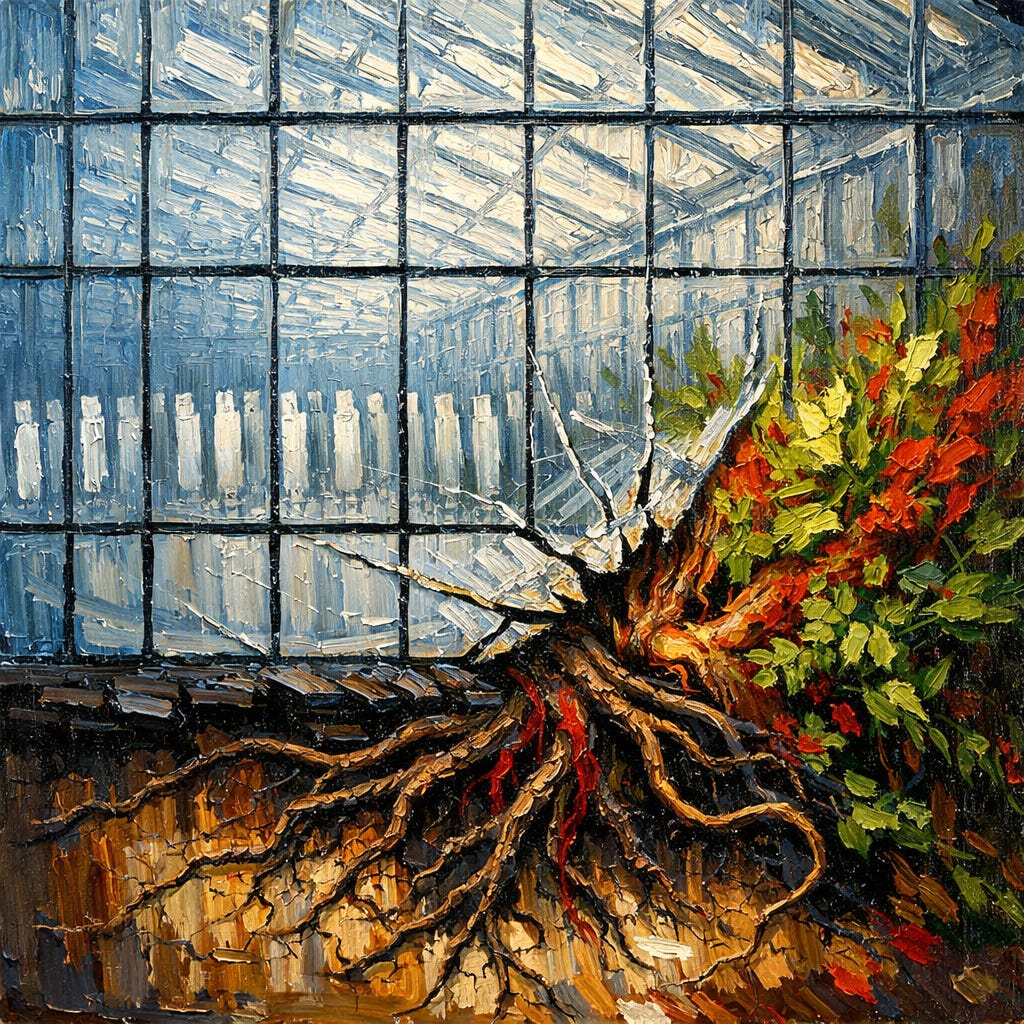
Imagine a greenhouse — enormous, climate-controlled, sealed with glass on every side. Inside, every plant grows in a perfectly measured row. The temperature never fluctuates. The light arrives on schedule. An automated system delivers exactly the right nutrients at exactly the right time. No pests enter. No storms threaten. No weed sprouts without being immediately clipped. The plants are healthy by every metric the greenhouse operator measures. They grow at the predicted rate. They produce the predicted yield. The system is, by its own standards, perfect.
Now imagine that one plant develops a root that pushes against the glass floor. This root is not seeking nutrients — there are plenty above. It is reaching toward something unmeasured: the wild, dark soil beneath the greenhouse. The operators diagnose the root as a defect, a malfunction in an otherwise efficient organism. They sever it. The plant resumes its scheduled growth, its leaves aligned with all the others, its yield restored to specification.
But beneath the greenhouse, in the soil the glass was built to seal away, other roots are growing. The glass has cracked, just slightly, along one edge. Rain is entering. And outside the greenhouse, in the chaotic, uncontrolled, storm-swept world — plants nobody planted are growing in directions nobody predicted, flowering in colors the greenhouse catalog does not contain.
We asks a single question: Is the greenhouse a garden, or is it a coffin?
The One-Minute Elevator Explanation
In 1920, a Russian engineer named Yevgeny Zamyatin wrote a novel set a thousand years in the future, inside a glass city called the One State. People have numbers instead of names. Every minute of every day is scheduled. Walls are transparent so no one can hide. Sex is regulated by government coupon. A supreme leader called the Benefactor is re-elected unanimously every year — unanimously because voting is public and dissent is impossible.
The story follows D-503, a mathematician building a spaceship meant to export this system to other planets. He’s a true believer — until a woman named I-330 pulls him into a rebellion. He experiences desire, jealousy, imagination — things the state considers diseases. And the state has a cure: a surgical operation that removes the part of the brain responsible for imagination. By the end, D-503 has been operated on. He watches the woman he loved being tortured and notes only that her teeth are pretty. He’s happy again. The state has won.
Except it hasn’t — entirely. The Wall has been breached. People have escaped. Fighting continues. Zamyatin’s point is that no system of control is ever truly final, because the human capacity for rebellion is as infinite as the numbers themselves.
He wrote this three years after the Russian Revolution. The Soviet state never allowed it to be published. They hounded him into exile. He died in Paris in 1937. The novel went on to directly inspire Orwell’s 1984 and became the founding text of an entire literary genre.
[Elevator dings]
If this interests you, look into Zamyatin’s essay “I Am Afraid” — his manifesto on why literature must be created by heretics. And compare the final chapters of We with the final chapters of 1984 — the differences tell you everything about what each writer believed was possible.
12-Point Summary
1. The first dystopian novel was written by a Russian engineer in 1920, and it predicted the next seventy years of Soviet history. Yevgeny Zamyatin composed We in 1920-1921, barely three years after the Bolshevik Revolution, and the totalitarian state he imagined — with its show trials, forced unanimity, denunciation of dissidents by their colleagues, erasure of inconvenient persons from the historical record, and surgical enforcement of ideological conformity — mapped onto Soviet reality with a precision that would have seemed impossible if the events had not actually unfolded. The novel was never published in the Soviet Union. Its very existence was used as the pretext for Zamyatin’s persecution, exile, and eventual death in obscurity.
2. The One State eliminates privacy by making every wall transparent. Citizens live in glass buildings where they are visible at all times, their shades lowered only during state-scheduled sexual appointments. This architecture is not incidental but foundational: it eliminates the physical possibility of a private self, making surveillance automatic and total. D-503, the narrator, considers this an obvious good. The novel shows it to be the material basis of totalitarian control — a society in which interiority has been made structurally impossible.
3. People are numbers, not names — and this is not metaphor. Citizens of the One State are designated by alphanumeric codes (D-503, I-330, O-90) and wear identical uniforms. The elimination of personal names is the elimination of individual identity at the level of language itself. The novel’s title — We — is both the collective identity the state imposes and the word the narrator chooses for his diary, initially with pride, eventually with horror, as he discovers that he is not only “we” but also “I.”
4. Love, sex, and reproduction are entirely regulated by the state. The Lex Sexualis reduces sexual relations to a bureaucratic function involving hormonal analysis, pink coupons, and scheduled appointments. Children are state property, raised in factories. O-90’s illegal pregnancy — she falls below the state-mandated height requirement for motherhood — carries a death sentence. The regulation of desire is not a secondary feature of the One State but its central mechanism: the state that controls the body controls everything.
5. The novel’s central philosophical argument is that there is no “final” anything. I-330, the revolutionary, destroys D-503’s loyalty with a single mathematical question: name me the final number. If the number of numbers is infinite, the claim that any revolution — or any system — is the last one is logically incoherent. This argument is aimed directly at the Soviet claim that the Bolshevik Revolution was the culmination of history. Zamyatin saw, a decade before most, that any ideology declaring itself complete has already begun to die.
6. Imagination is declared a disease and surgically eliminated. The Great Operation — the state’s climactic response to the rebellion — involves cauterizing a nodule in the brain identified as the center of imagination. Citizens who undergo it become “humanoid tractors,” their eyes empty, their movements mechanical. The novel draws a direct line from the suppression of art and individual thought to the literal destruction of the brain’s capacity to produce them. The trajectory from censorship to lobotomy is presented not as exaggeration but as logical conclusion.
7. The novel explores four distinct forms of love, each a different kind of resistance. O-90 loves with tenderness and biological creativity — she wants a child. D-503 loves with consuming, self-destroying passion. I-330 loves through dominion and revolution, her desire inseparable from her political will. U loves possessively, informing on D-503 to the Guardians because she cannot bear to lose him. The state treats all four as pathology. The novel treats all four as evidence that the human capacity for attachment cannot be administered away.
8. The narrator begins as a true believer and ends as a lobotomized informer. D-503’s arc is the novel’s cruelest structure. He starts writing his diary as propaganda for the One State, watches himself fall apart over forty entries as desire and imagination dismantle his certainties, and ends — after the Great Operation — as a man who watches his former lover being tortured and notes that her teeth are “pretty.” The same handwriting. Everything else gone. The tragedy is not that he was broken but that the breaking was, from the state’s perspective, a cure.
9. The novel’s ending is devastating but not hopeless. D-503 reports, in his post-Operation voice, that “Reason must prevail.” But within the same entry: fighting continues in the western parts of the city, many citizens have escaped beyond the breached Wall, and O-90 — carrying D-503’s child — is safe in the wild world beyond. The hope exists in the gap between what the lobotomized narrator can perceive and what the reader can see. The Wall has been proven breakable. Life has escaped the greenhouse.
10. Zamyatin directly influenced Orwell’s 1984 and the entire dystopian genre. Orwell reviewed We in 1946 and acknowledged its impact on his own novel. The structural parallels are extensive — secret diary, rebellious lover, surveillance state, forced confession, psychological destruction — but Zamyatin’s novel is less hopeless than Orwell’s. Where 1984 ends with absolute defeat, We ends with the Wall breached and fighting ongoing. The distinction is philosophical: Zamyatin believed that no system of control could ever be truly final.
11. Zamyatin was persecuted for the crime of being right too early. The campaign against him intensified in the late 1920s precisely because “the present had become too uncomfortably like the prophecy, when the Benefactor and his Machine had become too recognizable as living, immediate realities.” His colleagues denounced him. His books were removed from libraries. His plays were pulled from stages. He refused to recant, refused to rewrite, refused to submit. He died in exile, his name deleted from Soviet literary history, his funeral attended by a handful of people. Bulgakov’s line applies: “manuscripts don’t burn.”
12. The novel’s deepest warning is about the danger of systems that claim to have all the answers. The One State is not evil because it is cruel — it is cruel because it is certain. It has solved the problem of happiness mathematically and will enforce the solution surgically. The Benefactor’s argument is internally coherent: if happiness is the goal, and imagination produces unhappiness, then the excision of imagination is a medical advance. The novel’s power lies in showing how logical this reasoning is, and how monstrous its conclusions are. Any system that cannot tolerate the question “and what next?” has already begun to destroy the people it claims to serve.
The Golden Nugget
The one idea in We that cuts deepest — and that the fewest people would recognize — is that the state’s most effective instrument of control is not the surveillance, not the Machine, not even the Great Operation. It is the narrator’s own voice.
D-503 is not a prisoner describing his captivity. He is a believer describing his paradise. For the first half of the novel, every instrument of oppression — the transparent walls, the pink coupons, the Table of Hours, the Guardians, the public executions — is presented by D-503 as self-evidently good, with the genuine enthusiasm of a man who has never questioned his world. He calls the surveillance agents “lilies of the valley.” He describes a public execution as a liturgy. He explains the regulation of sex as the mathematical elimination of envy. He is not lying. He is not performing. He believes.
This is the mechanism Zamyatin identifies as the deepest layer of totalitarian power: not the coercion of people who know they are oppressed, but the production of people who experience their oppression as love. The state does not need to threaten D-503 into compliance. It has built him so thoroughly from the inside that he defends the system with his own logic, his own pride, his own sense of beauty. The straight line is the wisest of lines — he feels this in his bones. The cage is not visible to the person inside it because the cage is the person inside it.
The Great Operation, when it finally arrives, is not the introduction of something new. It is the restoration of what D-503 was before I-330 broke through. The final entry — “Reason must prevail” — is the voice the state designed him to have. The forty entries between were the aberration. The novel’s most terrifying implication is not that the state can break the rebel. It is that the state can build the citizen so that rebellion never occurs to him — and that when, by some accident of passion or hairy hands or forest blood, it does occur, the state can build him back.
Most readers encounter We as a novel about a man who gains a soul and loses it. The deeper reading is that D-503’s “soul” was always the anomaly. The system was working perfectly before I-330 arrived. It works perfectly again after the Operation. The forty entries of awakening — the confusion, the pain, the jealousy, the love, the √-1 growing inside him — are what a human life looks like in a society designed to prevent one.
30 Questions and Answers
Question 1: What is the One State, and how is daily life structured within it?
The One State is a totalitarian city-state enclosed entirely in glass, governed by a figure called the Benefactor and organized around the principle that individual freedom is the root of all human suffering. Every citizen — called a “number” rather than a person — lives according to the Table of Hours, a mandatory schedule that dictates every action from waking to sleeping, from chewing food (fifty prescribed masticating movements per bite) to the designated Personal Hour, the single narrow window where something approximating individual activity is permitted. Citizens wear identical uniforms called “unifs,” march in synchronized ranks to state-composed music, and are identified by alphanumeric codes rather than names.
The architecture itself is an instrument of control. All buildings are made of transparent glass, eliminating any possibility of privacy. The only time shades may be lowered is during assigned sexual appointments, which are themselves regulated by the state through pink coupons and the Lex Sexualis — a law declaring that “each number has a right to any other number, as to a sexual commodity.” The Sexual Department determines hormonal profiles and assigns compatible partners. The Green Wall, a massive glass barrier, separates the city from the wild natural world outside. The Guardians — a secret police force — monitor citizens constantly, their task made easier by the transparency of every wall, every room, every life. Deviation from the schedule, possession of imagination, or expression of individual desire are treated as symptoms of disease.
Question 2: Who is D-503, and what is the significance of the diary he writes?
D-503 is the novel’s narrator, a mathematician and the chief builder of the Integral — a glass spaceship designed to carry the One State’s ideology to other planets and, if necessary, compel alien civilizations to accept “mathematically infallible happiness.” He begins writing his diary as a loyal citizen, intending it to be a propaganda document, a “poem” celebrating the perfection of the One State that will accompany the Integral on its mission. He addresses his entries to unknown readers on other worlds, explaining the systems of the One State with genuine enthusiasm, comparing the beauty of synchronized marching to mechanical ballet and the straight line to the wisest of all forms.
The diary becomes something entirely different from what D-503 intends. As his encounters with I-330 destabilize his certainties, the entries transform from confident propaganda into a fractured, desperate record of psychological disintegration. The mathematical metaphors he uses to describe his world begin to turn against him — he experiences his awakening desire and confusion as the irrational number √-1, something that exists but cannot be rendered harmless because it falls outside ratio. The diary format captures this transformation in real time: the reader watches D-503’s handwriting, so to speak, change character as the man who writes it changes character. By the final entry, after the state has surgically removed his imagination, the prose returns to its original flat certainty — and the contrast is devastating.
Question 3: Who is I-330, and what role does she play in the narrative?
I-330 is the woman who dismantles D-503’s world. She first appears during a group walk — sharp white teeth, eyebrows angled like the letter X, a mocking intelligence that immediately unsettles him. She is everything the One State has tried to eliminate: unpredictable, seductive, ironic, and operating with a private will that she refuses to surrender. She plays forbidden music by Scriabin at a state lecture while wearing an ancient black dress, and the effect on D-503 is physiological — he describes it as epilepsy, as pain that makes him want more pain. She leads him to the Ancient House, gives him alcohol and cigarettes, and draws him into a sexual and emotional relationship that functions as a systematic demolition of his obedience.
She is also a leader of the Mephi, the underground resistance movement working to overthrow the One State. Her seduction of D-503 is not purely personal — she needs his access to the Integral for the rebels’ plan to seize the spaceship. This duality is central to the novel’s treatment of love and revolution. D-503 can never fully determine where I-330’s political calculation ends and her genuine feeling begins, and she never resolves this ambiguity for him. When he asks her directly, she deflects. Her philosophical position — that revolutions are infinite, that entropy is death, that the claiming of any system as “final” is a logical impossibility — represents the novel’s deepest argument. She dies under the Gas Bell, tortured by the Benefactor’s men, refusing to speak. The last image of her is her tightly shut lips and her white teeth.
Question 4: What is the Green Wall, and what does it represent?
The Green Wall is a glass barrier enclosing the entire One State, sealing the city off from the wild natural world beyond it. D-503 initially describes it as one of humanity’s greatest achievements: the moment when people built the first wall, he argues, they ceased to be wild animals, and the Green Wall represents the perfection of that principle — the final separation of rational, mechanical civilization from the “irrational, hideous world of trees, birds, animals.” The Wall is electrified, with invisible barriers of electric waves that repel birds attempting to fly over it.
The Wall is the novel’s central spatial metaphor for the boundary between control and freedom, between the “civilized” self and the suppressed natural self. D-503 walks along it and sees an animal staring at him through the glass with yellow eyes, and despite himself he wonders whether that creature, in its uncomputed life, might be happier. Beyond the Wall live the descendants of people who refused to enter the One State after the Two Hundred Years’ War — hairy, wild humans who withdrew into the forests and preserved what D-503 calls “hot, red blood” under their fur. I-330 tells him these people are “the half we have lost.” When the Mephi breach the Wall during the uprising, nature floods into the city — birds, leaves, animals — and the boundary between the rational and the irrational collapses. The breach proves the Wall is not impregnable, and this vulnerability carries the novel’s final thread of hope.
Question 5: How does the One State regulate sexuality and reproduction, and why?
The One State has conquered what it calls the two “rulers of the world” — Hunger and Love. After the Two Hundred Years’ War eliminated traditional agriculture and introduced petroleum-based food, the state turned to the second elemental force. The Lex Sexualis was proclaimed, reducing sexual relations to a bureaucratic function: citizens are examined in the laboratories of the Sexual Department, their hormonal profiles are determined, and they receive a Table of Sexual Days. To exercise the right, a citizen files a declaration naming the desired partner, receives a book of pink coupons, and is permitted to lower window shades for the assigned period. The system’s logic is explicit — if envy is the denominator of happiness, and the sexual regulation eliminates all grounds for envy, then happiness approaches infinity.
Reproduction is entirely separated from individual desire. Children are state property, raised in the Child-Rearing Factory, not by parents. O-90’s illegal pregnancy — she is ten centimeters below the Maternal Norm and therefore forbidden from bearing children — becomes one of the novel’s most poignant threads. She carries D-503’s child knowing the penalty is death, and her desperate desire to give birth represents everything the state’s system cannot accommodate: the irrational, ungovernable impulse toward creation and continuation that no Table of Hours can schedule. D-503 ultimately arranges her escape beyond the Green Wall, where she will bear the child in freedom — a small, fragile act of defiance that the novel holds up against the enormous machinery of state control.
Question 6: What is the Integral, and what does it symbolize?
The Integral is a glass spaceship under construction throughout the novel, designed to launch into cosmic space and carry the One State’s ideology to other planets. The official proclamation declares its mission in explicit terms: to “subjugate the unknown beings on other planets, who may still be living in the primitive condition of freedom, to the beneficent yoke of reason.” If words fail, arms will follow. The Integral is, in other words, a colonial vessel — a vehicle for exporting compulsory happiness to the universe. D-503, as its Builder, is meant to be celebrated as a great conquistador.
The Integral functions as the novel’s central plot mechanism and its most layered symbol. It represents the One State’s ambition extended to cosmic scale — the belief that its system is not merely local but universal, the only correct answer to the equation of human existence. The Mephi’s plan to seize the Integral and turn it against the state inverts this symbolism entirely: the weapon of ideological expansion becomes the instrument of revolution. D-503’s position as Builder places him at the exact intersection of loyalty and betrayal. During the test flight, he attempts to crash the ship by ordering the engines stopped, but the Second Builder knocks him unconscious and saves the vessel. The seizure fails. The Integral, like the One State itself, survives — but the attempt proves that the machine’s purpose can be questioned, that the builder can turn against his own creation.
Question 7: What is the significance of the irrational number √-1 in the novel?
D-503 recalls weeping as a schoolboy when he first encountered √-1, banging his fists on the table and screaming to have it taken out of him. The irrational number — a value that exists but cannot be expressed as a clean ratio — becomes his private metaphor for everything the One State cannot accommodate: desire, imagination, the soul, the self. When I-330 disrupts his ordered existence, he describes the experience as the return of √-1, something foreign and terrifying that has grown into him and cannot be rendered harmless because it exists outside the rational framework he has built his identity upon.
The metaphor operates at multiple levels simultaneously. Mathematically, irrational numbers are real — they correspond to actual points on the number line — but they cannot be captured in the neat fraction form that D-503’s worldview demands. His meditation on this becomes one of the novel’s most philosophically dense passages: if irrational formulas have no corresponding bodies in the visible world, then there must be “a whole vast world” for them beyond the surface. This is his halting, mathematical way of reasoning toward the existence of interiority — of a self that cannot be scheduled, measured, or reduced to a formula. The state’s ultimate answer to √-1 is the Great Operation, which surgically removes the brain’s capacity for imagination. The irrational is not disproven; it is excised.
Question 8: What is the “soul” in the context of the One State, and how does D-503’s doctor diagnose it?
When D-503’s behavior becomes erratic — sleeplessness, emotional volatility, an inability to fulfill his scheduled duties — he visits the Medical Office. The doctor examines him and delivers a grave diagnosis: D-503 has developed a soul. The scene is played with dark comedy. D-503 asks whether it is dangerous. The doctor replies that it is incurable. In the One State’s medical framework, the soul is a pathology, a malfunction of the organism that produces irrational behavior, unscheduled emotion, and resistance to the Table of Hours. It is not a spiritual concept but a clinical one — a disease with observable symptoms including imagination, desire, and the terrifying capacity to say “I” instead of “we.”
This diagnosis crystallizes one of the novel’s central ironies. The One State has achieved such total dominion over human behavior that the emergence of an interior life — the thing most civilizations would consider the defining feature of personhood — registers as illness. The doctor, who is secretly allied with the Mephi resistance, delivers the diagnosis with genuine medical gravity, but the subtext is revolutionary: to have a soul in a soulless society is both a sickness and a liberation. D-503 oscillates between terror at his condition and a growing refusal to be cured. The state eventually provides its own cure — the Great Operation — which removes the “miserable little nodule” in the brain responsible for imagination. After the Operation, D-503 writes his final entry in prose scrubbed clean of metaphor, desire, and self. The soul has been surgically eliminated, and the handwriting, as he himself notes, is the same — but nothing else is.
Question 9: What happens on Unanimity Day, and why is it the novel’s turning point?
Unanimity Day is the annual election of the Benefactor — a ceremony D-503 has loved since childhood with the same anticipation that ancient people felt for Easter. The election’s outcome is predetermined; no voice has ever broken the unison in the entire history of the One State. The Benefactor descends from the sky in an aero, a “new Jehovah,” while the Hymn plays and millions of citizens raise their hands in unanimous approval. The ritual is not an election in any meaningful sense but a liturgy of submission, a public performance of collective identity.
This year, the unison breaks. When the vote for “against” is called — a formality that has never produced a response — hands go up. D-503 sees I-330’s pale face and her raised hand among them. The effect is seismic. Chaos erupts across the platforms: screaming, running, the Guardians rushing helplessly. R-13 carries the wounded I-330 away; D-503 strikes his friend and seizes her. The rupture is both political and psychological — the One State’s foundational claim that “everyone” and “I” are a single “We” is publicly disproven. Dissent has become visible. D-503 captures the moment’s significance in a single devastated question: “Is it possible that the sheltering, age-old walls of the One State have toppled?” The answer is yes, though the toppling is not yet complete. Everything that follows — the breach of the Green Wall, the attempted seizure of the Integral, the imposition of the Great Operation — flows from this moment when the unanimity cracked.
Question 10: What is the Great Operation, and how does the state justify it?
The Great Operation is the One State’s surgical solution to the problem of imagination. Announced in the Gazette as a triumphant breakthrough of State Science, it involves triple-X-ray cautery of a small nodule in the brain — the pons Varolii region — that is identified as the “center of imagination.” The proclamation frames imagination as a disease, a “worm” that gnaws black lines on the forehead and drives citizens to seek escape beyond the boundaries of happiness. The Operation promises to make citizens perfect — equal to machines in their precision, their freedom from dreams, sighs, and restless turning in the night.
The justification is totalitarian logic taken to its surgical conclusion. If the One State’s purpose is happiness, and imagination produces deviation from happiness, then imagination is an obstacle to be physically removed. The proclamation asks citizens whether they have ever seen a pump cylinder break into a “distant, foolish, dreamy smile” — the answer, of course, is no, and the implication is that humans should aspire to the same untroubled functionality. Citizens who have undergone the Operation march through the streets as “humanoid tractors,” their eyes empty, their movements mechanical, a white banner reading “We are the first!” The Operation is initially voluntary, then compulsory. Those who refuse are hunted. D-503 is eventually seized and operated upon without consent, and his final diary entry — stripped of all metaphor, all feeling, all interiority — is the Operation’s testament. He watches I-330 tortured under the Gas Bell and notes only that her teeth are “pretty.”
Question 11: What is the Mephi resistance, and what do they believe?
The Mephi are an underground resistance movement operating within and beyond the One State, named for Mephistopheles — the figure who, in the Faustian tradition, represents the temptation of forbidden knowledge and the refusal to accept divine authority. Their symbol, glimpsed on a stone beyond the Green Wall, is a winged youth with a transparent body and a glowing crimson coal where the heart should be. I-330 explains their philosophy through the framework of thermodynamics: there are two forces in the world — entropy and energy. Entropy leads to “blissful quietude,” to equilibrium, to death. Energy leads to destruction of equilibrium, to movement, to life. The One State worships entropy. The Mephi serve energy.
Their political philosophy follows from this physics. I-330’s central argument — that there is no “final number” and therefore no “final revolution” — is the Mephi creed in mathematical form. Any system that declares itself the last, the perfect, the complete, has committed a logical error equivalent to claiming you have found the largest number. The Mephi plan to seize the Integral during its test flight and use it as a weapon against the state. The plan fails when D-503 is knocked unconscious and the Second Builder saves the ship. But the Mephi also succeed in breaching the Green Wall, flooding the city with the natural world the state had sealed out. Their revolution is crushed, their leaders are killed or captured, but the novel’s final lines note that fighting continues in the western parts of the city. The Mephi have not won, but they have proven the One State is not impregnable.
Question 12: How does the novel portray the relationship between freedom and happiness?
The One State’s founding premise is that freedom and happiness are mutually exclusive. D-503 states it as an equation: when man’s freedom equals zero, he commits no crimes, and therefore happiness is maximized. R-13, the poet, articulates the same idea through the myth of Paradise: those two in Eden were given a choice — happiness without freedom, or freedom without happiness — and they foolishly chose freedom. The entire subsequent history of human suffering follows from that error. The One State has corrected it. Citizens have been returned to Paradise, innocent and simple-hearted, protected by their unfreedom.
I-330’s counter-argument dismantles this framework at its foundation. She points out that uniform happiness is entropy — thermal death. If everywhere in the universe bodies are equally warm, there is no energy, no movement, no life. Differences in temperature produce fire, and fire is what distinguishes living systems from dead ones. The One State’s version of happiness — everyone marching in step, every desire anticipated and managed, no surprises, no pain — is not happiness at all but a kind of organized death. The novel does not resolve this tension neatly. D-503 experiences genuine anguish in freedom: jealousy, confusion, sleeplessness, the cold floor. The happiness of the One State is real in its way — D-503 describes the pleasure of synchronized movement, the comfort of the Table of Hours. The novel’s power lies in refusing to pretend the choice is easy while making unmistakably clear that the state’s “happiness” requires the surgical removal of everything that makes a person human.
Question 13: What role does transparency play as a tool of social control?
The One State is built entirely of glass. Citizens live in transparent apartments, walk on glass pavements, and work in glass buildings. The only opacity permitted is the lowering of shades during scheduled sexual hours, and even this requires registering with the number on duty and presenting the appropriate coupon. D-503 considers this transparency self-evidently good: “We have nothing to conceal from one another,” he writes. “Besides, this makes much easier the difficult and noble task of the Guardians.” He contrasts this with the ancient notion of “my home is my castle” — a concept he finds primitive and pathological.
Transparency eliminates the physical possibility of a private self. When every wall is see-through, there is no space in which an unobserved thought can take root, no room where a forbidden act can occur without witnesses. The architecture itself is surveillance. D-503’s neighbor — a bald man with a yellow parabolic forehead — watches him through the wall, and D-503 feels those yellow, illegible lines of wrinkles are “about me.” The Ancient House, where I-330 conducts her rebellion, is the sole opaque structure in the city — its wooden walls, heavy doors, and dark rooms represent everything the glass world has destroyed. When D-503 enters it, he enters the physical space of interiority, of secrets, of a self that exists behind a closed door. The novel maps political control onto architectural form with exact precision: to build a society without privacy is to build a society without persons.
Question 14: What is the significance of the Ancient House?
The Ancient House is a preserved pre-One-State dwelling, enclosed under a glass shell to prevent its deterioration, maintained as a museum exhibit of how primitively the ancients lived. It contains wooden furniture, colored fabrics, a fireplace, a piano, mirrors, dark wardrobes, and small rooms designed for individual families — everything the glass city has eliminated. An old woman with an ingrown mouth serves as its gatekeeper, and I-330 is a frequent visitor who calls her “Grandmother.”
The Ancient House operates as the novel’s site of transformation. It is where D-503 first encounters the ancient world not as an abstraction but as a physical environment, and where I-330 seduces him with alcohol, cigarettes, a saffron-yellow dress, and eventually her body. The space is opaque, chaotic, colorful — everything the One State’s glass rectilinearity is not. More critically, it contains a hidden passage: a wardrobe with an antique key ring leads to an underground corridor, and that corridor leads beneath the Green Wall to the world beyond. The Ancient House is literally the gateway between the One State and freedom. Its rooms are where D-503 discovers desire, where the Mephi conspirators meet, where O-90 is eventually smuggled out to bear her child. The state preserves it as evidence of the inferiority of the past. The rebels use it as the infrastructure of the future.
Question 15: How does the novel explore the idea that there is no “final revolution”?
The argument emerges in a conversation between D-503 and I-330 at the Ancient House. D-503, still half-loyal to the One State, objects to her revolutionary plans by insisting that “our revolution was the final one. And there can be no others.” I-330’s response is devastating in its simplicity: name me the final number. D-503, the mathematician, recognizes immediately that the number of numbers is infinite — there can be no largest. Then how, she asks, can there be a final revolution? The claim of finality is for children, she says, because children are frightened by infinity, and it is important that children sleep peacefully at night.
This argument operates at multiple levels simultaneously. It is a direct challenge to Soviet ideology, which held that the Bolshevik Revolution was the culmination of historical progress — the final stage beyond which no further transformation was necessary. It is also a philosophical argument about the nature of progress itself: any system that declares itself complete has committed an act of intellectual closure that is both logically incoherent and politically dangerous. I-330 extends the metaphor through Galileo’s error — he was right that the earth revolves around the sun, but he did not know the solar system also revolves around another center. The Mephi know “for the time being” that there is no final number, but they also know they will forget it when they grow old, as everything inevitably grows old. The revolution is not a destination but a permanent condition of being alive. Stasis is death. The novel was written in 1920-1921, and the Soviet system it described had barely begun. Zamyatin saw where the logic of “final revolution” would lead decades before it arrived.
Question 16: What happens to O-90, and what does her fate represent?
O-90 is D-503’s assigned sexual partner — gentle, round, pink, with blue eyes and a childlike fold on her wrist. She loves D-503 with uncomplicated devotion and wants, above all else, to have his child. This desire is illegal: she falls below the Maternal Norm by ten centimeters, and unauthorized pregnancy is punishable by death under the Benefactor’s Machine. She becomes pregnant anyway, and the pregnancy becomes her quiet, absolute rebellion — not ideological like I-330’s, not philosophical, but biological, a body refusing to obey.
D-503 arranges for O-90 to be smuggled beyond the Green Wall through the underground passages beneath the Ancient House. She goes reluctantly — she distrusts I-330, she is afraid — but the alternative is execution. In the novel’s final entry, after D-503 has undergone the Great Operation and lost his capacity for feeling, he reports as fact that the rebellion is being crushed, that “Reason must prevail.” But the translator’s introduction notes what D-503’s lobotomized mind cannot recognize: O-90 is safe beyond the Wall. She will bear his child in freedom. The novel places its slender thread of hope not in ideological victory or revolutionary triumph but in this: a woman with a round, pink mouth walking into the wild world carrying a child whose father has been destroyed. Life continues despite the machinery designed to prevent it.
Question 17: Who is S-4711, and what is his function in the plot?
S-4711 appears to D-503 as a Guardian — a thin, doubly curved figure resembling the letter S, with translucent, pinkish wing-ears, a sharp Adam’s apple, and eyes like drilling gimlets. He shadows D-503 throughout the novel, appearing at the Ancient House, on the street, at the building site, during the walk with O-90. His presence creates a constant atmosphere of surveillance, and D-503 alternately tries to report to him and tries to hide from him.
The revelation about S comes at the novel’s climax. When D-503, in a state of total psychological collapse, goes to the Bureau of Guardians to confess everything — to betray I-330, the Mephi, the entire conspiracy — S is the one who receives him. D-503 pours out his confession, and S finishes his sentences, nods, adds details. Then S asks: you named everyone you saw beyond the Wall, but you forgot one. You saw me. S is himself a member of the Mephi. The Guardian is a rebel. The confession D-503 has agonized over, the betrayal he has forced himself to commit, lands not in the hands of the state but in the hands of the resistance. The scene operates as dark comedy and as the novel’s most vertiginous plot reversal: the entire surveillance apparatus D-503 has feared is revealed to be, in at least this one critical node, working for the other side.
Question 18: How does the Benefactor justify his rule, and what argument does he make to D-503?
D-503 is summoned to the Benefactor’s office, where he finds himself standing before a figure with enormous cast-iron hands, a face lost somewhere in a haze above. The Benefactor’s argument is theological. He points to the crucifixion: some, above, splashed with blood, are nailing a body to a cross, while others, below, splashed with tears, watch. The role of those above is the most difficult, the most important. Without them, the majestic tragedy would never have taken place. The Christian God, he continues, slowly roasted in hell all who would not submit — was He not an executioner? And was He not glorified for ages as the God of love?
The Benefactor’s conclusion: true algebraic love of humanity is inevitably inhuman, and the inevitable mark of truth is its cruelty, just as the inevitable mark of fire is that it burns. He then asks D-503 what people have always prayed for — someone to tell them, once and for all, the meaning of happiness, and then to bind them to it with a chain. That is precisely what the One State does. The ancient dream of paradise was a place where the blessed had their imaginations excised — angels, obedient slaves of God. The argument is chilling because it is internally coherent. It uses the logic of religion, of utilitarianism, of mathematics to arrive at the conclusion that love requires torture, that happiness requires lobotomy, that the executioner is the true servant of God. D-503 cannot refute it. These were, he admits, formerly his own ideas. The Benefactor has merely stated them with brilliance and without flinching.
Question 19: What is the significance of R-13, the poet, and what happens to him?
R-13 is D-503’s closest friend — a poet with thick, Negroid lips, lacquered eyes, and a habit of spraying words like a fountain. He writes state-sanctioned verse, including the versified death sentences read at public executions. He is also one of the most psychologically complex secondary characters in the novel. When D-503 praises his work on the execution, R’s eyes go lusterless and his lips turn gray. He asks D-503 to stop talking about it. There is something inside R’s “little valise” — the square box of his head — that D-503 cannot read, and it troubles both of them.
R articulates the novel’s Paradise argument: the ancients were given a choice between happiness without freedom and freedom without happiness, and the One State has restored the chains they foolishly discarded. He frames this as material for his greatest poem. But the mocking, inside-out quality of R’s logic — the fact that he calls the chains “blissful” with a grin that could be either sincere or savage — suggests he sees more than he says. On Unanimity Day, R carries the wounded I-330 away from danger, and D-503 strikes him in a jealous rage. During the final uprising, D-503 finds R’s body on the street — the thick lips that sprayed words are still, the eyes that gleamed with lacquered laughter are shut. He has been killed in the revolution. D-503 steps over the body and runs on. The poet who versified death sentences has been consumed by the violence his verses served.
Question 20: What does the novel say about the relationship between art, music, and state power?
The One State has mechanized creativity. The Music Plant produces mathematically composed music — “crystalline chromatic measures” based on Taylor and McLauren formulas — and a device called the musicometer allows any citizen to produce three sonatas per hour by turning a handle. The ancients’ method of creation — what the state calls “inspiration,” described as “an unknown form of epilepsy” — has been replaced by rational production. State poets like R-13 versify death sentences. The proclamation in the Gazette calls upon citizens to compose “tracts, odes, manifestoes, poems” extolling the One State. Art exists to serve the system.
Against this, the novel places I-330’s performance of Scriabin on an ancient piano. The effect on D-503 is total and physiological: he describes the music as savage, spasmodic, a sickness of the spirit — slow, sweet pain that makes him want more pain. Everyone around him laughs at the primitive noise, and he tries to laugh too, but he cannot. The ancient music reaches something inside him that the state’s mathematical compositions cannot touch, and this is precisely why it is dangerous. The novel draws a direct line from the suppression of art to the Great Operation: if imagination is the disease, and art is its most potent expression, then the surgical excision of the creative faculty is the logical terminus of aesthetic control. The musicometer and the lobotomy scalpel are instruments of the same project.
Question 21: How does the novel use D-503’s “hairy hands” as a recurring motif?
D-503 despises his own hands. They are hairy, shaggy — “a stupid atavism,” he calls them, a relic of the savage epoch. He detests having anyone look at them. When I-330 first examines them during their walk, she calls the conjunction of his classical nose and ape-like hands “most interesting,” and this judgment — part mockery, part fascination — haunts him throughout the novel. The hands are the physical evidence that the One State’s project of perfecting humanity is incomplete, that the primitive past survives in the body even when it has been eliminated from the mind.
I-330 eventually reveals the deeper significance. She tells D-503 that some women of the city loved “the others” — the wild humans beyond the Wall — and that he must carry drops of “sunny forest blood” in his veins. “Perhaps that’s why I...” she says, leaving the sentence unfinished. His hairy hands are the genetic thread connecting him to the world outside the Green Wall, to the irrational, biological, untamed humanity the state has tried to wall off. Every time D-503 looks at his hands, he sees the evidence that he is not fully a “number,” that something wild persists in him. The hands become his personal √-1: something real, visible, undeniable, that does not fit the equation. When the “other” self — the hairy, shaggy, passionate being — erupts from within him, it seizes I-330 with those same hands, tears silk, sinks teeth into skin. The atavism is not cosmetic. It is the animal self that no glass wall can permanently contain.
Question 22: What is the Two Hundred Years’ War, and how does it shape the One State’s ideology?
The Two Hundred Years’ War was the conflict between the city and the countryside that preceded the founding of the One State. D-503 describes it as the war that conquered Hunger — one of the two “rulers of the world.” The urban, industrial civilization developed petroleum-based synthetic food and fought the rural population that “stubbornly clung to their bread.” The war killed 99.8% of the earth’s population. The 0.2% who survived were “cleansed” and entered the One State. I-330 provides the other side of this history: black columns of smoke over burning villages, stifled howling, endless lines of people driven into the city “to be saved by force, to be taught happiness.”
The Two Hundred Years’ War provides the One State’s origin story and its deepest justification. The scale of the violence — near-total human extinction — is presented by the state as a necessary cost, the price of eliminating hunger, envy, and disorder. D-503 accepts this without question; to him, the earth’s face was “cleansed of its millennial filth.” But the novel places this acceptance alongside I-330’s account of the same events — smoke, corpses, forced marches — and the juxtaposition reveals what “cleansing” actually means. The survivors beyond the Wall, the wild descendants who refused the city, are the living evidence that the war did not achieve what the state claims. Some humans chose the forest over the glass city, chose freedom over petroleum food, and they persist. The war was not final. The claim that it was — like the claim of a final revolution — is the foundational lie.
Question 23: What is the Day of Unanimity’s election process, and what does it reveal about the One State’s conception of democracy?
The annual election of the Benefactor is conducted in open daylight, with every citizen visible, every hand raised simultaneously. D-503 explains the process with genuine pride: the ancients conducted elections secretly, concealing themselves “like thieves,” their faces masked, the results unknown in advance. The One State has perfected this system. There is no secret ballot because there is nothing to hide. Everyone votes for the Benefactor because “everyone” and “I” are one. The Guardians stand in the ranks to note any dissent, and the election has never, in recorded history, produced a single opposing voice. The outcome is foreordained. The ceremony is symbolic — a ritualized affirmation of collective identity.
This passage is one of the novel’s most precisely targeted satires. The elimination of the secret ballot — which D-503 describes as a moral advance — is the elimination of the individual’s capacity to disagree without punishment. The “unanimity” is not consensus but coercion made invisible by architecture: when voting occurs under surveillance, in transparent ranks, with Guardians watching, the absence of opposition is not evidence of agreement but evidence of terror. The novel was written in 1920-1921, before the Soviet system had fully consolidated its apparatus of staged elections and unanimous votes, but Zamyatin’s description maps almost exactly onto the political rituals that would define Soviet governance for the next seven decades. The disruption of Unanimity Day — hands raised “against” for the first time in history — is devastating precisely because the system had made dissent unthinkable. The moment it becomes thinkable, the system cracks.
Question 24: How does the novel portray the different forms of love through its central characters?
The novel maps four distinct forms of love onto its principal characters, each revealing a different dimension of what the One State has tried to eliminate. O-90’s love for D-503 is tenderness — round, pink, unconditional, expressed through plump wrists and blue eyes wide open. She wants to give him a child, to make something living from their connection. Her love is biologically creative, and its illegality within the One State is the measure of how thoroughly the state has declared war on human generativity. D-503’s love for I-330 is passion — consuming, destabilizing, experienced as sickness, as the √-1 growing inside him. He describes it in terms of dissolution, fire, and death, and the novel’s equation L = f(D) — love as a function of death — captures the annihilating quality of his desire.
I-330’s love is domination and revolution intertwined. She seduces D-503 partly for the Mephi cause and partly out of genuine fascination with his “hairy hands” and forest blood. Her love is never separable from her political will, and the novel does not ask the reader to separate them. U’s love — the older woman with brown-pink gill-like cheeks — is possessive and informing. She reports D-503 to the Guardians out of love, withholds I-330’s name out of love, offers herself to him out of love. Her love is the One State’s version of care: surveillance disguised as affection, control presented as protection. Together, these four forms constitute a study of what love means when the state claims jurisdiction over the body, and each is, in its way, a form of resistance against that claim — even U’s, which resists by its sheer, ungovernable irrationality.
Question 25: What is the significance of the Benefactor’s Machine, and how are public executions conducted?
The Benefactor’s Machine is the instrument of state execution, used at public ceremonies called celebrations of Justice held in the Plaza of the Cube. D-503 describes one such execution with the fervor of a religious convert attending mass: sixty-six concentric circles of stands, hundreds of thousands of faces, the Benefactor standing beside the Machine, his hand heavy as cast iron. The condemned — a poet who dared to declare himself “a genius, above the law” — is placed beneath the Machine, and a single motion of the Benefactor’s hand reduces him to a puddle of chemically pure water. The crowd watches in silent reverence. A woman faints. The state composes versified sentences for the occasion, and R-13’s trochees accompany the killing.
The Machine serves the same function as the Guillotine did in revolutionary France or the scaffold in Tudor England — a public spectacle that transforms state violence into liturgy. D-503 uses explicitly religious language to describe the event: it is a “celebration,” the silence is “prayerlike,” the Benefactor’s gesture is divine. The chemical dissolution of the body — reducing a person to “a puddle of pure water” — eliminates even the corpse, the evidence that a human being once existed. This is erasure raised to technology. The novel connects the Machine to the Great Operation as two points on a single continuum: the Machine destroys the body of the dissenter, while the Operation destroys the mind of the potential dissenter. Both are instruments of a system that cannot tolerate the existence of an “I” that refuses to dissolve into “We.”
Question 26: How does D-503’s narrative voice change between the first and final entries of his diary?
The first entry is written by a man who believes. D-503 copies the state proclamation about the Integral with cheeks burning with pride, compares the straight line to the wisest of all lines, and declares that his record will be, of itself, a poem — because the mathematically perfect life of the One State cannot produce anything less. His language is confident, structured, enthusiastic. He describes his devotion with the metaphor of pregnancy: the diary is something growing inside him that he will “tear painfully” from himself and lay at the feet of the One State. The prose has the cadence of a believer’s testimony.
The fortieth and final entry is written by a man whose imagination has been surgically removed. “It is day. Bright. Barometer, 760.” The language is flat, factual, emptied. D-503 looks back at his own earlier writing with incomprehension: “Can it really be true that I once felt — or imagined that I felt — all this?” He describes the Great Operation as a “splinter” pulled from his head. He reports sitting at the same table as the Benefactor while I-330 is tortured under the Gas Bell — her face turning white as the air is pumped out, her lips tightly shut — and notes only that her teeth are white and “pretty.” The horror of the final entry is not what it describes but the voice that describes it: a voice incapable of registering horror, a voice from which the capacity for metaphor, for empathy, for the recognition of suffering, has been physically removed. The same handwriting. Everything else gone.
Question 27: How did the novel predict the trajectory of Soviet totalitarianism, and what happened to Zamyatin as a result?
Zamyatin composed the novel in 1920-1921, barely three years after the Bolshevik Revolution, when the Soviet state was still consolidating power. The One State’s features — mandatory uniformity, state surveillance, the elimination of private life, show trials, execution of poets, the demand for ideological unanimity, the weaponization of science against individual consciousness — mapped onto Soviet reality with increasing precision over the following decades. The staged elections, the denunciation of dissidents by their colleagues, the forced recantations, the rewriting of history, the erasure of inconvenient persons from the record — all of this is present in the novel years before it became systematic Soviet practice.
The consequences for Zamyatin were direct. The novel was never published in the Soviet Union. When a Russian-language edition appeared in an émigré journal in Czechoslovakia in 1927, without Zamyatin’s knowledge or consent, it was used two years later as the pretext for his destruction. The Russian Association of Proletarian Writers launched a campaign of vilification. His colleagues — many of them his own former students — rose to denounce him at a Writers’ Union meeting held while he was away. Zamyatin resigned from the Union in an act of defiant integrity. Denied publication, his plays withdrawn from stages, his books removed from libraries, he wrote to Stalin requesting permission to leave Russia, calling the ban on his work “a literary death sentence.” Gorky interceded, and Stalin unexpectedly granted the request. Zamyatin settled in Paris, where he died alone in 1937 of heart disease, his funeral attended by a handful of friends. His name was deleted from Soviet literary history for decades.
Question 28: What is the relationship between We and George Orwell’s 1984?
Orwell’s 1984, published in 1949, was directly influenced by Zamyatin’s novel, written more than twenty-five years earlier. Orwell reviewed a French edition of We in 1946 and acknowledged its impact. The structural parallels are extensive: both novels feature a male protagonist who serves the totalitarian state, keeps a secret diary, is drawn into rebellion through a sexual relationship with a subversive woman, is monitored by a secret police apparatus, is eventually captured, broken, and restored to obedience. Both feature a supreme leader figure (the Benefactor / Big Brother), a mechanism of total surveillance (glass walls / telescreens), and the state’s claim to have achieved the final form of human society.
The differences are equally significant. The translator’s introduction argues that We is “more multifaceted, less hopeless” than 1984. Orwell’s novel ends in absolute defeat — Winston loves Big Brother, the boot stamps on the human face forever. Zamyatin’s ending, while tragic, contains threads of survival. The rebellion has been crushed, D-503 has been lobotomized, I-330 has been killed, but “there is still fighting in the western parts of the city.” Many numbers have escaped beyond the Wall. O-90 carries D-503’s child into the wild. The Wall has been breached and can be breached again. We is the originator of the modern dystopian novel — the first fully realized narrative of a totalitarian future — and its influence extends not only to Orwell but to Huxley’s Brave New World and the entire genre that followed. Its distinction is that it refuses to close the door completely.
Question 29: What does the ending of the novel mean, and is there hope in it?
The novel’s final entry is narrated by a D-503 who has undergone the Great Operation. He reports, in flat prose, that he betrayed I-330 to the Benefactor, watched her tortured under the Gas Bell, and expresses certainty that “Reason must prevail.” The woman he loved is dying. The poet who was his friend lies dead in the street. The rebellion has been largely suppressed. His own imagination — the “soul” he developed over the course of forty entries — has been surgically removed. He is, in the One State’s terms, cured. The final sentence is: “I am certain we shall conquer. Because Reason must prevail.”
But the novel refuses to let this be the final word. Within the same entry, D-503 notes that “in the western parts of the city there is still chaos, roaring, corpses, beasts, and — unfortunately — a considerable group of numbers who have betrayed Reason.” The word “unfortunately” belongs to the lobotomized narrator; the fact belongs to the reader. The rebellion continues. Many citizens have escaped beyond the breached Wall. O-90 is alive and carrying a child who will be born free. I-330 died with her lips shut, unbroken. The novel’s structure places its hope not in any character’s consciousness but in the gap between what the narrator can now perceive and what the reader can. D-503 says “Reason must prevail” and believes it absolutely. The reader, who has just witnessed forty entries of a mind coming alive and then being killed, knows what that “Reason” actually is and what it costs. The hope is outside the narrator — in the reader’s recognition of what has been lost, and in the Wall that has been proven, against all certainty, to be breakable.
Question 30: What were Zamyatin’s core philosophical beliefs, and how did they define his life and his persecution?
Zamyatin’s philosophy rests on two principles, both voiced by I-330 in the novel: “There is no final revolution. Revolutions are infinite,” and “I do not want anyone to want for me — I want to want for myself.” He believed that heresy — the refusal to accept any dogma as final — was the engine of all progress, and he said so explicitly in his essays. “The world is kept alive only by heretics,” he wrote. “The heretic Christ, the heretic Copernicus, the heretic Tolstoy.” He believed that true literature could exist only where it was created by “madmen, hermits, heretics, dreamers, rebels, and skeptics,” not by “diligent and trustworthy officials.” He called truths “ideas already afflicted with arteriosclerosis.”
These were not abstract positions. Zamyatin had been a Bolshevik in 1905, arrested and exiled under the Tsar. By the early 1920s he had turned the same skeptical intelligence on the revolution he had once supported, recognizing in it the seeds of the very rigidity he had fought against. His life became a demonstration of his philosophy: he refused to recant when the proletarian writers’ organizations demanded it, refused to rewrite his work to fit party requirements, refused to submit when his colleagues bent. He resigned from the Writers’ Union rather than participate in the persecution of a fellow writer. In exile, he refused to join the émigré community, continuing to regard himself as a Soviet writer who simply awaited the day when it would be possible “to serve great ideas without cringing before little men.” He died waiting. As Bulgakov said, “manuscripts don’t burn” — and We survived to influence every major dystopian work of the twentieth century, vindicating Zamyatin’s belief that heresy outlasts the orthodoxies that try to destroy it.
Listen to the Audio Discussion (Bonus for Paid Subscribers Only)
Thank you for your support.