
Vicious
An Essay

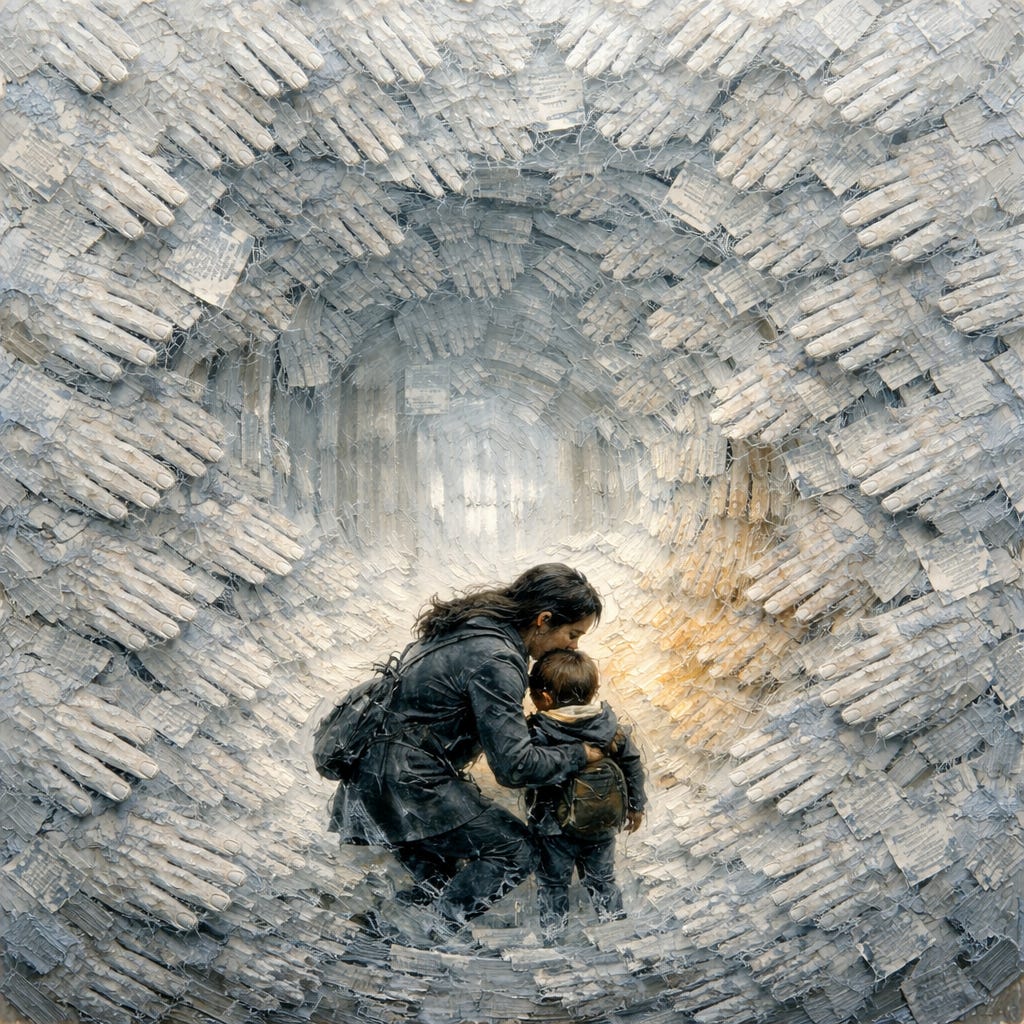
The waiting room is clean. The receptionist is polite. The forms ask reasonable questions. Nothing in the physical environment suggests danger. The magazines are current. The hand sanitizer dispenser works. Someone has chosen calming colors for the walls.
A pregnant woman sits in a chair designed for her comfort. She has been told to be here. Not ordered—no one orders. Recommended. Strongly recommended. Everyone does this. Her mother did this. Her friends did this. The women in her prenatal group compare notes about their appointments the way they compare notes about nursery furniture. Which provider did you choose? What tests have you had? The questions assume the answers. The answers assume the questions.
She will be offered things today. Offered is the word used. The offers will come with information sheets that list risks and benefits in tabular form. She will sign consent documents. Everything will be voluntary in the legal sense. No one will hold her down. No one will threaten her. She will choose, and her choices will feel like choices, and she will leave feeling she has done the responsible thing.
What she will not feel is the weight of what has been arranged before she arrived. The scheduling software that ensures the appointment is short enough to be profitable. The protocol that determines which tests are “standard” regardless of her individual circumstances. The liability calculations that make defensive intervention safer for the provider than watchful waiting. The training her provider received, which did not include the word “cascade” and did not question the premises. The pharmaceutical representative who visited last month. The professional guidelines written by committees with financial ties to the interventions they recommend. The insurance code that reimburses procedures but not conversations. The architecture of the building itself, which presumes birth is a medical event requiring medical facilities.
None of this is secret. All of it is documented, published, occasionally debated in journals that no one outside the profession reads. The machinery operates in plain sight. It has operated for so long that its operation feels like nature—the way medicine works, the way pregnancy is managed, the way responsible people behave.
She cannot see it because she is inside it. The water she swims in. The air she breathes. The climate of her experience.
Support Independent Research
This work remains free because paid subscribers make it possible. If you find value here, consider joining them.
What paid subscribers get: Access to the Deep Dive Audio Library — 180+ in-depth discussions (30-50 min each) exploring the books behind these essays. New discussions added weekly. That’s 100+ hours of content for less than the price of a single audiobook.
[Upgrade to Paid – $5/month or $50/year]
Get in touch Essay ideas, stories, or expertise to share: unbekoming@outlook.com
For years I used the word “predatory” to describe this system. Predatory captured something true—the targeting, the extraction, the conversion of healthy people into revenue streams. The pharmaceutical company identifying a market. The screening program generating patients. The intervention that creates the need for the next intervention. Predation implies a hunter and prey, a calculation, a strategy.
But predatory is not quite right. A predator needs its prey. A predator pays attention to what it hunts. A predator, in some sense, respects the thing it consumes—respects it enough to study it, track it, understand its patterns. The lion watches the gazelle. The con artist studies the mark.
This system does not watch. It does not study. It processes.
The word that came to me after documenting 123 medical interventions across the arc of pregnancy and birth is different. Starker. Less strategic and more indifferent.
Vicious.
Viciousness is not cruelty, though cruelty may be one of its expressions. Cruelty requires attention. The cruel person watches suffering and derives something from it—pleasure, power, confirmation. Cruelty is a relationship, however deformed.
Viciousness requires no such relationship. A vicious mechanism can operate without anyone watching the effects. A vicious system can grind through populations while everyone involved believes they are helping. The viciousness is in the structure, not the intention. It emerges from the interaction of parts, none of which are vicious in isolation.
The doctor who follows the protocol is not vicious. The protocol is not vicious. The committee that wrote the protocol is not vicious. The pharmaceutical company that funded the research the committee relied on is not vicious—or rather, its viciousness is diffused through so many quarterly earnings reports and shareholder meetings and marketing budgets that no single person experiences themselves as causing harm. The regulator who approved the product is not vicious. The politician who mandated its use is not vicious. The parent who complies is not vicious. The neighbor who judges the parent who doesn’t comply is not vicious.
And yet.
A 13-year-old girl in London, who declined a vaccine, is being pressured about a screening test she is not eligible for. The vaccine was Gardasil, marketed as preventing cervical cancer. The screening is the smear test—cervical screening that begins at age 25 in the UK, designed to detect what the vaccine supposedly prevents. The two programs are presented as separate, but they function as a single apparatus: refuse our prevention and you must submit to our surveillance. I have documented elsewhere, in my essay The HPV Lie: Pap Smears, Gardasil, and a Cancer Caused by Something Else, why the foundational claim—that HPV causes cervical cancer—does not survive scrutiny. But for the purposes of this essay, the truth of the claim matters less than the machinery built on it.
The pressure comes from somewhere. It reaches her through channels—through school, through health messaging, through the questions of peers whose parents made different choices. No single person decided to punish her. No committee met to discuss her case. The system does not know her name.
The pressure is automatic. It is the system maintaining itself, closing gaps, ensuring that even those who refuse one element remain captured by another. The vaccine and the screening are presented as separate programs, but they function as a single apparatus. Refuse the prevention and you will be reminded, persistently, of your need for surveillance.
She is 13. The screening she is being pressured about begins at 25. There is no medical reason for anyone to be discussing it with her. The pressure is not medicine. It is correction. It is the system registering a deviation and applying force to resolve it.
No one in her life who transmits this pressure experiences themselves as being vicious. The teacher who mentions it is concerned. The nurse who brings it up is following guidelines. The friends who ask why she didn’t get the shot are simply curious, or perhaps uncomfortable with difference. Everyone is doing what people do. Everyone is being normal.
The viciousness is in the normal. The viciousness is that “normal” has been constructed, over decades, through thousands of small decisions, each one defensible, none of them examined, until the accumulated weight presses down on a 13-year-old whose only crime was asking questions.
The system is vicious. Say it plainly.
The government that approves the products, mandates their use, shields manufacturers from liability, and funds the campaigns that manufacture consent—the government is vicious.
The society that has been engineered to enforce compliance through social pressure, to treat refusal as deviance, to make the unvaccinated child a problem and the questioning mother a danger—this society is vicious.
But here is where the analysis must be careful. “The system” is an abstraction. “Government” is an abstraction. “Society” is an abstraction. These words make it easy to express outrage while leaving everyone blameless. If the system is vicious, I am not. If government is the problem, I am just a citizen. If society has been engineered, I am merely a victim of the engineering.
This is too easy. It is also untrue.
The system is made of people. Every protocol was written by a person. Every guideline was approved by persons sitting in a room. Every prescription is written by a hand attached to a body that contains a mind capable of doubt. The government is not a machine. It is people who could choose differently and do not. Society is not weather. It is the accumulated choices of everyone who participates in it—which means everyone.
The viciousness is emergent. No one designed the full harm. But the viciousness is also composed. Each component is a human decision. The emergence does not erase the composition. The fact that no one intended the complete picture does not mean no one is responsible for their corner of it.
This is the moral difficulty the essay cannot resolve, because reality does not resolve it. The harm is everyone’s and no one’s. The choices are individual and the outcome is collective. A woman loses her uterus to a surgery she did not need, and the surgeon who performed it was following the standard of care, and the standard of care was set by a committee, and the committee relied on studies, and the studies were funded by companies that profit from the surgery, and the companies are owned by shareholders who never think about uteruses, and the shareholders include pension funds, and the pension funds include the retirement savings of nurses who work in the hospitals where the surgeries are performed.
Where does blame land? Everywhere and nowhere. This is not an evasion. This is a description of how the viciousness actually works. It is distributed so thoroughly that it becomes atmospheric. It becomes the milieu. It becomes the climate that everyone moves through and no one feels responsible for, because the mechanisms of responsibility have been dissolved in the general weather.
Ivan Illich saw this decades ago. He described how institutions reshape the milieu—the environment people move through—until alternatives become unthinkable. A radical monopoly, he called it. Not a monopoly that corners a market, but a monopoly that disables people from doing things on their own. When hospitals “draft all those who are in critical condition,” he wrote, “they impose on society a new form of dying.” The institution does not merely provide a service. It reshapes reality so that the service becomes necessary.
This is what has happened with birth. With childhood. With the female body across its entire reproductive arc. The medical system has not merely offered services. It has reshaped the milieu so that moving through pregnancy without those services becomes an act of deviance. The services are not chosen from a range of options. They are the water in which choice occurs.
A woman who declines the standard interventions is not making a different choice within a shared framework. She is refusing the framework itself. This is why she is treated not as someone with different preferences but as someone who is failing—failing to be responsible, failing to care for her baby, failing to be the kind of mother the system has defined as acceptable.
The viciousness is in that definition. The system defines acceptable, and acceptable means compliant, and compliant means captured.
I documented 123 interventions across six phases of the reproductive timeline. Pre-conception capture. Pregnancy surveillance. Labor interventions. Immediate newborn procedures. Infant pathologizing. Ongoing medical capture. Each intervention has its own literature, its own justification, its own defenders. Each one, examined in isolation, can be made to seem reasonable—or at least not obviously harmful.
The viciousness becomes visible only when you see the whole arc.
A woman begins birth control at 16. The pill alters her hormonal environment for a decade or more. She stops the pill to conceive. She has difficulty conceiving—perhaps because years of synthetic hormones have disrupted her natural cycles, perhaps for other reasons. She seeks fertility treatment. The treatment works. She is pregnant.
Now she is in the system.
She receives prenatal testing that identifies risks, some real, most statistical. The risk identification generates anxiety. The anxiety generates more testing. The testing generates findings. The findings generate interventions. She is induced before her body was ready because a measurement crossed a threshold. The induction is long and painful because her body was not ready. She receives an epidural because the pain is unbearable. The epidural slows labor. She receives Pitocin to accelerate it. The baby shows distress. She receives a cesarean.
The cesarean is recorded as necessary. It was necessary—given everything that preceded it. Each step created the conditions for the next. The cascade operated exactly as designed.
Her baby is taken to the warmer for evaluation. Eye drops are administered. Vitamin K is injected. Hepatitis B vaccine is given—for a disease transmitted through sex and IV drug use, to a newborn who will do neither. The baby is observed in the nursery. Feeding is scheduled rather than on-demand. Supplementation is suggested because the baby lost weight—as all babies lose weight in the first days, a fact that would resolve with continued nursing but which becomes a problem requiring intervention.
She goes home with a baby she is not sure she knows how to feed, a body she is not sure she recognizes, a mind clouded with hormonal disruption and sleep deprivation and the particular loneliness of having been processed rather than supported.
She returns for postpartum visits. She is screened for depression. She may receive medication. The medication helps, or seems to. She continues it. She is now a psychiatric patient as well as a surgical patient. Her records follow her. Her risk profile follows her. The next pregnancy, if there is one, will be managed with reference to this one.
At no point was she mistreated in any way she could name. Everyone was professional. Everyone followed protocols. Everyone was trying to help.
The viciousness was in the protocols. The viciousness was in the accumulation. The viciousness was in the fact that no one—not one person across dozens of encounters—ever said: you could do none of this. You could wait. You could trust your body. You could go home.
No one said it because no one could say it. The milieu does not permit those words. A provider who speaks them risks liability, peer censure, loss of hospital privileges. The words are not forbidden. They are simply outside the weather. They are not rain or sun or wind. They do not exist in the climate the system has made.
Anyone who asks questions is doing something dangerous. They are noticing the weather. Asking why the sky is this particular color, why the wind blows this particular direction, why everyone walks leaning at this particular angle.
Most people never ask. The weather is just the weather. You dress for it. You complain about it. You do not inquire into its origins. You do not ask who made it, because weather is not made. Weather simply is.
But this weather was made. Every element of it was chosen. The clinical guidelines were written by people who could have written different ones. The regulatory approvals were granted by people who could have demanded different evidence. The liability structures were established by legislatures that could have established different ones. The insurance codes were set by committees that could have set different ones. The training curricula were designed by faculties that could have designed different ones.
Each choice was made by humans. Each human could have chosen otherwise. That none of them did—that the choices accumulated into a system that now operates with the indifference of weather—does not change the fact that the choices were made.
Anyone who asks questions threatens to make the choices visible. This is why they are pressured. Not because anyone decides to pressure them, but because the system cannot tolerate the visibility of its own construction. The weather must remain weather. The moment it becomes choices, it becomes contestable. The moment it becomes contestable, it can be refused.
If you have read this far, you are no longer fully inside the weather.
This is not a comfortable position. It is easier not to see. It is easier to move through the waiting room, sign the forms, accept the offers, go home feeling responsible. The system is designed for this ease. It has made compliance comfortable and refusal exhausting. The path of least resistance leads directly into the machinery.
Seeing the machinery does not stop it. One person’s recognition changes nothing about the protocols, the guidelines, the insurance codes, the training curricula. The 123 interventions will continue to be applied to the women who come after, regardless of what any individual understands.
But recognition changes what is possible.
A woman who sees the cascade can make different choices within it—can refuse this test, delay that intervention, ask questions that disrupt the automatic sequencing. She cannot escape the milieu, but she can move through it differently. She can refuse to be weather.
More importantly, she can speak. She can tell other women what she saw. She can name the viciousness, which is the first step toward refusing to participate in it. The system maintains itself partly through silence—through the assumption that everyone experiences the same thing and no one objects. Each voice that breaks the silence makes the next voice easier.
This is modest. It is not a revolution. It will not dismantle the system or defund the institutions or rewrite the guidelines. But the system depends on billions of small compliances, and each small refusal is a friction. Enough friction, accumulated over enough time, and the machinery begins to slow. Begins to be noticed. Begins to require justification rather than assuming it.
The girl in London who asked questions did something her grandmother could not do for her. She refused to accept the weather as weather. She noticed that she was being pressured and asked why. The pressure will continue—systems do not stop because one person notices them. But she has seen something that cannot be unseen.
This is what recognition makes possible: not escape, but awareness. Not freedom from the milieu, but movement within it that is no longer automatic. The end of innocence is not the same as the end of the system. But it is the end of participation without knowledge. It is the beginning of refusal.
The system is vicious. The viciousness is made of choices. The choices can be seen. Once seen, they can be refused.
One refusal at a time. One woman at a time. One conversation at a time.
The weather was made. It can be unmade. Not quickly. Not easily. Not by any individual alone. But the alternative is to keep swimming without noticing the water, keep breathing without noticing the air, keep walking at the angle the wind requires and calling it freedom.
The 13-year-old noticed. That is where it begins.
Book: Medicalized Motherhood: From First Pill to Permanent Patient
Available as a free download. 123 interventions documented across six phases—from pre-conception capture through postpartum surveillance. Includes practical tools: birth plan template, provider interview questions, quick reference card, and a new chapter on interrupting the cascade. Download it, share it with someone facing their first prenatal appointment, their induction date, their cesarean recommendation. The cascade works because women don’t see it coming. This book makes it visible.
Support Independent Research
This work remains free because paid subscribers make it possible. If you find value here, consider joining them.
What paid subscribers get: Access to the Deep Dive Audio Library — 180+ in-depth discussions (30-50 min each) exploring the books behind these essays. New discussions added weekly. That’s 100+ hours of content for less than the price of a single audiobook.
[Upgrade to Paid – $5/month or $50/year]
Get in touch Essay ideas, stories, or expertise to share: unbekoming@outlook.com
Bitcoin: 3Q6BK8x8zjoPaXykQggzvoJxg5FiEbkb3U
Ethereum: 0x4CB0d39d8466a34609318FC1B003B745893788b3
New Biology Clinic
For those of you looking for practitioners who actually understand terrain medicine and the principles we explore here, I want to share something valuable. Dr. Tom Cowan—whose books and podcasts have shaped much of my own thinking about health—has created the New Biology Clinic, a virtual practice staffed by wellness specialists who operate from the same foundational understanding. This isn’t about symptom suppression or the conventional model. It’s about personalized guidance rooted in how living systems actually work. The clinic offers individual and family memberships that include not just private consults, but group sessions covering movement, nutrition, breathwork, biofield tuning, and more. Everything is virtual, making it accessible wherever you are. If you’ve been searching for practitioners who won’t look at you blankly when you mention structured water or the importance of the extracellular matrix, this is worth exploring. Use discount code “Unbekoming” to get $100 off the member activation fee. You can learn more and sign up at newbiologyclinic.com
This is why it is so hard to persuade people to challenge or question the system because it has just become 'normal'
Thank you for writing this so clearly
As a non medical health practitioner (Dr) we were taught how the system has been contrived over decades leading to these rails that people are confined to as much as possible.
Somehow you've captured this very well
Few are aware of this, fewer even want to know. I suppose because it then means realising that if you really want health, it's up to you to learn what you need and then apply it for a lifetime.
There's no-one you can really consult unless you're lucky enough to have encountered someone along the way.
Even then it will still be up to you
Very well written
Again thank you