
The Screening Trap (2026)
New Book by Unbekoming

In every family studied in the foundational BRCA1 paper, at least one woman carried the “cancer-causing mutation” and lived to age 80 without developing cancer.
This is not a detail unearthed by critics. It appears in the 1994 Science paper that announced BRCA1 to the world — the paper that launched genetic testing, preventive surgeries, and a billion-dollar industry. The authors state it plainly. Carriers of clearly deleterious mutations — mutations described as “causing breast cancer in women at very young ages” — included individuals who carried those same mutations for eight decades without ever developing malignancy.
Thirty-five to fifty-five percent of women who test positive for a BRCA variant never develop breast cancer. The variant, by itself, does not determine who gets cancer. Yet thousands of women have removed healthy breasts based on risk figures derived from families pre-selected for extreme cancer clustering — families that share environments, diets, and toxic exposures alongside genetic markers. A BMJ study found that most women who underwent prophylactic mastectomy overestimated their risk by more than 90%. The 18 women with the lowest computed risk believed they were at the highest risk. Their belief was wrong by a factor of seven.
The machinery that produced this belief — the testing, the counseling, the risk communication — failed them. And the BRCA story turns out to be one chapter in a much larger pattern.
The Book
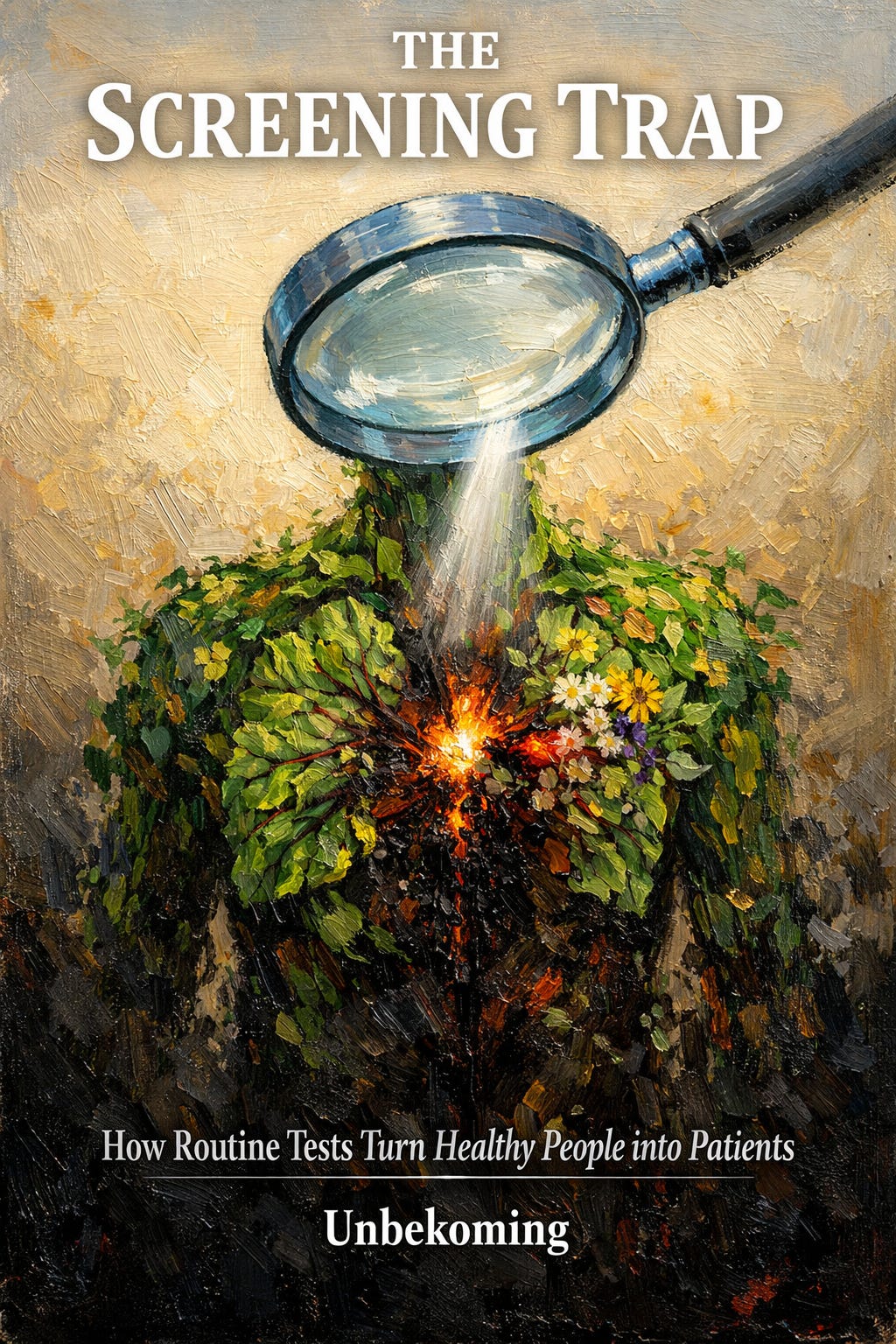
The Screening Trap: How Routine Tests Turn Healthy People into Patients collects twelve essays into a single volume, sequenced to build a cumulative case across every major screening modality in modern medicine. The book runs approximately 81,000 words across 276 pages. The essays are published as they originally appeared. What's new is a 3,200-word introduction that maps the structural pattern connecting all twelve chapters, and four appendices — roughly 7,000 words of practical tools that don't exist anywhere else — designed to be carried into a medical appointment.
Why Sequencing Matters
These essays were published weeks or months apart. Read individually, each one lands a blow against a specific screening test. Read in sequence, they reveal something larger: the same pattern repeating across every modality.
The colonoscopy chapter establishes the template — a test repurposed from diagnosis to mass screening, generating billions from a procedure whose first randomized trial showed no mortality benefit. The CT scan chapter shows the same pattern with radiation: 90 million scans a year, 103,000 projected future cancers, and only 15% of hospitals disclosing the risk. By the time you reach the PSA chapter and find that the test’s own creator calls mass screening “a public health disaster,” the pattern is no longer deniable. By the time you reach the BRCA chapter, where the foundational research contains the evidence against its own conclusions, you’re reading with different eyes.
A single screening modality failing its evidence base could be an anomaly. Twelve failing in the same way — overpromising benefit, underreporting harm, generating revenue from the cascade that follows — is a system.
What’s Inside
The book opens with colonoscopy and CT scanning, where the evidence is most accessible and the gap between promised benefit and documented harm is widest. The NordICC trial’s 455-to-1 screening ratio sits alongside the projection that a single year of CT scans will produce more future cancers than many diseases the scans are looking for.
The middle chapters press deeper. The osteoporosis essay follows a clinical observation from forty years ago — an elderly woman whose X-ray showed nearly invisible femurs with bright white calcified arteries running alongside them — to dismantle the premise that bone mineral density measures what actually makes bones break. The HPV chapter traces the full arc from a 1983 paper with less than 0.1% DNA match to a Nobel Prize, a global vaccine campaign, and a 13-year-old girl in London being pressured about a screening test she isn’t eligible for because she declined Gardasil.
The prostate biopsy chapter documents a procedure that routes a needle through the rectal wall — through billions of gut bacteria — into a sterile organ, producing infection rates of 1 in 20 in published series, while an alternative route that avoids the bacterial field entirely has existed for decades. The gadolinium chapter reveals that MRI contrast agents deposit a toxic metal permanently in the brain and bones — discovered in 2014, twenty-six years after approval — and that 82% of patients were never told.
The final three chapters, drawing on H. Gilbert Welch’s work, step back from individual tests to examine the architecture of overdiagnosis itself: the statistical illusions that make screening look effective when it isn’t, the cultural forces that make it impossible to stop, and the self-reinforcing loop in which every person overdiagnosed becomes a grateful survivor advocating for the program that harmed them.
The Appendices
These are the primary new material for readers who’ve followed the individual essays.
Appendix A: Questions to Ask Before Any Screening Test. Ten questions with brief rationale, applicable to any test — not just the ones in this book. Designed to be printed and carried into an appointment. Covers false positive rates, number needed to screen, overdiagnosis rates, direct physical risks, and financial conflicts. A doctor who cannot answer these questions is telling you something about the basis of their recommendation.
Appendix B: The Screening Scorecard. A one-page-per-modality reference covering all nine screening tests in the book. Each entry states the claim, what the evidence shows, the harm-to-benefit ratio, annual industry revenue, and the key study. Quick reference for conversations with doctors, family members, or anyone who says “but screening saves lives.”
Appendix C: How to Decline a Screening Test. The social and institutional survival guide. Addresses the four channels of pressure — authority, fear, social expectation, and systemic nudging — with specific phrases that work in a medical setting. Covers your legal rights, how to get your informed refusal documented, and what to say when your doctor reacts with hostility to questions.
Appendix D: How to Read a Medical Study. A short primer that defines absolute risk, relative risk, number needed to screen, number needed to harm, overdiagnosis, lead-time bias, length bias, sensitivity, and specificity — then provides a six-point checklist for evaluating any study. The goal is independence: the ability to assess the next screening claim yourself, without relying on this book or any other single source.
Why a Book
Individual essays change how you think about a specific test. The pattern across twelve of them changes how you think about the system. That pattern needed to be visible in one place, with practical tools attached, so it could travel from a screen into an exam room.
The Screening Trap is available now for paid subscribers, alongside the full library of my other books.
If you’re already a paid subscriber, the PDF is below. If you’re not, it will appear here once you upgrade (refresh the page.)
Keep reading with a 7-day free trial
Subscribe to Lies are Unbekoming to keep reading this post and get 7 days of free access to the full post archives.