
The PSA Trap (2026)
A New Book for Paid Subscribers

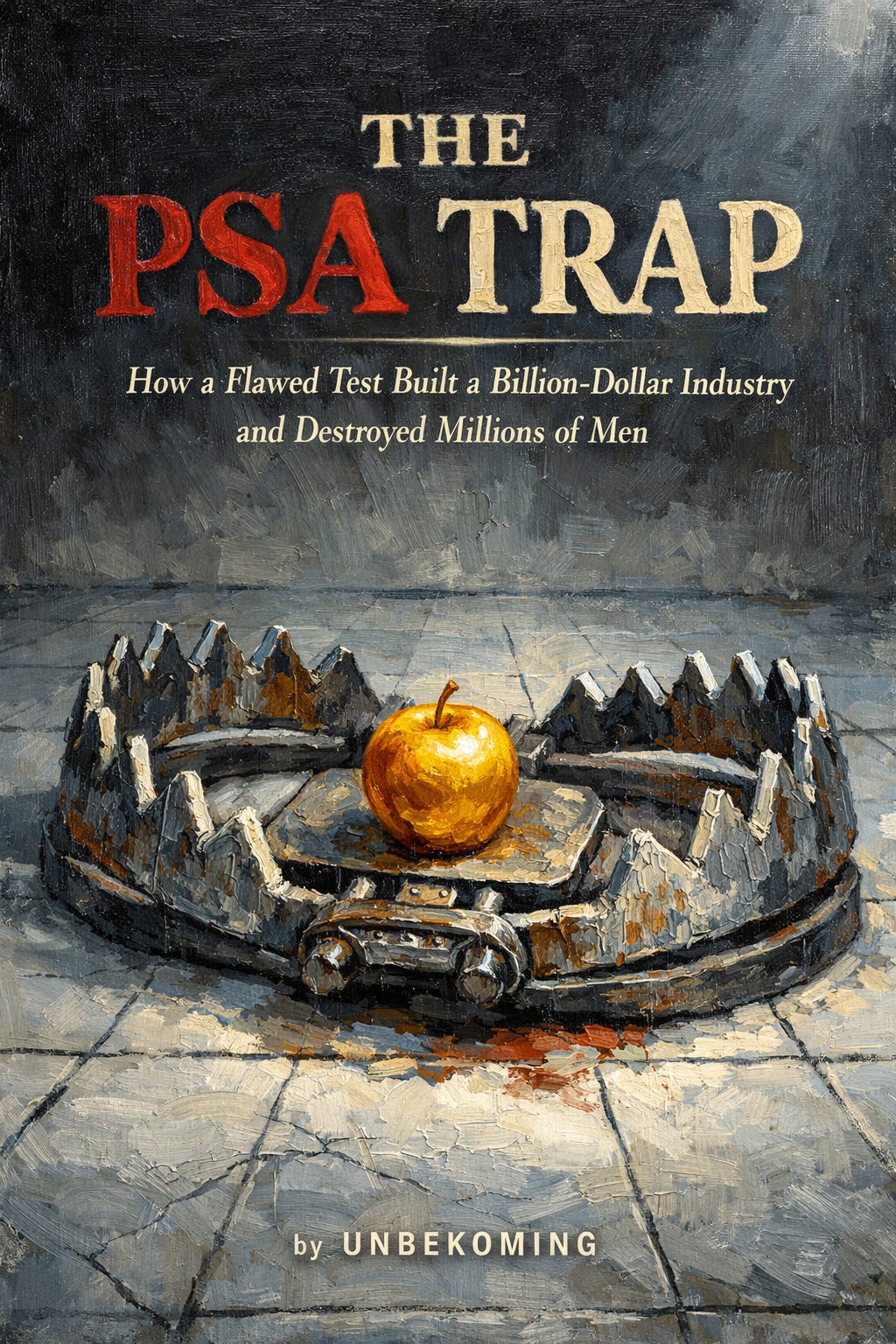
The man who discovered PSA in 1970 has spent the decades since calling mass screening “a public health disaster.” The test has a false positive rate of up to 80%. Two landmark randomised controlled trials found no survival benefit from radical surgery compared to watchful waiting. Thirty million American men are screened every year regardless. Over a million undergo biopsies. At least 750,000 of those biopsies find no cancer.
The men who do get diagnosed — most of them with cancers that would never have caused symptoms or death — enter a treatment cascade that leaves 60 to 80% with erectile dysfunction and 10 to 20% with long-term incontinence. Eight percent of incontinent patients report suicidal thoughts. The industry that produces these outcomes is worth $3 billion a year.
My two most-read stacks on this topic — the summaries of Richard Ablin’s The Great Prostate Hoax and Anthony Horan’s The Rise and Fall of the Prostate Cancer Scam — have reached more readers than almost anything else I’ve published. The response, particularly from men and their partners, made clear that this material needs to exist in a form that’s easy to share, to search, to hand to someone facing a PSA decision right now.
So I built it.
The PSA Trap: How a Flawed Test Built a Billion-Dollar Industry and Destroyed Millions of Men is available now, exclusively for paid subscribers. (Medicalized Motherhood was free for everyone. This is the first in a new series of paid-subscriber books.)
It brings together the two book summaries, the essay on the 15 most devastating truths about PSA screening, the compilation of reader testimonies (The Butchery of Men), and the extended essay on cancer screening more broadly. All in one place — from the biology and the mechanics of the test, through the financial architecture that sustains mass screening, to the personal accounts of men whose lives were altered by a diagnosis they didn’t need.
But that’s the material many of you have already read for free. What makes this a book worth paying for is what I’ve added.
What’s New
The book opens with a new introduction that frames the entire PSA story for someone encountering it for the first time — the person you want to hand this to who hasn’t yet read the stacks.
The real addition, though, is The PSA Toolkit — a practical appendix that goes further than any of the source material. It’s for the moment you’re actually sitting in a consulting room, a doctor is recommending something, and you need to know what to say, what to ask, and how to think through what comes next.
It includes three tools. Scripts with actual language for the conversations the system isn’t designed to have. A decision framework that walks through the key questions in sequence — from age and overall health through Gleason scores to treatment options — with the evidence behind each step. And a checklist of fifteen questions your doctor should answer before you consent to anything, each with enough data to know whether you’re getting a straight answer.
Here’s a sample — Scenario 2 from the doctor scripts, for a man who’s just received an elevated PSA reading:
An elevated reading — typically above 4.0 ng/mL — does not mean you have cancer. It means your PSA is above an arbitrary threshold that was never scientifically validated. Enlarged prostates, infections, recent ejaculation, cycling, and even the digital rectal exam itself can elevate PSA. Three out of four men with elevated PSA do not have cancer.
Your doctor will likely recommend a biopsy. Before consenting:
“I understand the result is elevated. Before we move to a biopsy, I’d like to understand what else could explain this number. Can we rule out infection or benign enlargement first? Can we retest in a few weeks to see if the level changes? And can you tell me what my PSA density and velocity are, since a single reading in isolation doesn’t tell us much?”
If your doctor insists on an immediate biopsy:
“I appreciate your concern, but I’m not comfortable proceeding to a biopsy based on a single elevated PSA reading without first understanding what else could be causing it. Prostate cancer is typically very slow-growing — a few weeks to investigate further and retest won’t change my prognosis. I’d like to take that time.”
That’s what the toolkit adds. Not just the case against the system, but the words and the framework for the moment you’re sitting across from a doctor who wants to run the test, order the biopsy, or schedule the surgery.
Why a Book, and Why Now
Many of you have shared these stacks with fathers, husbands, brothers, friends. The feedback I keep hearing is that people want this information in a format they can hand to someone whole — not as a series of links but as a single, coherent document that takes a man from knowing nothing to knowing enough to protect himself.
That’s what this book is. A complete case, from evidence to action, in one place.
What’s Coming
This is the first, not the last. I’m going to be producing one to two of these curated books per month — each one drawing together existing work on a single topic, adding new practical content, and packaging it in a format that’s easy to share, search, and use. Same territory this Substack has always covered. Same questions about who benefits when medicine stops serving patients.
Each book will be available exclusively to paid subscribers.
For Free Subscribers
Everything I’ve published for free stays free. That doesn’t change.
But if you’ve been reading this Substack and finding value in it, a paid subscription now gets you more than the audio library. It gets you access to The PSA Trap and every book that follows — practical, curated, shareable resources built from the evidence, with the kind of practical tools you can actually use.
Annual subscribers will get the most out of it. One to two books per month plus the full audio library adds up.
The book is available now. If you or someone you know is facing a PSA decision, this is what you need before that conversation happens.
Keep reading with a 7-day free trial
Subscribe to Lies are Unbekoming to keep reading this post and get 7 days of free access to the full post archives.