
The Generational Debt
An Essay on What Pottenger and Price Tell Us About Inheritance and Recovery

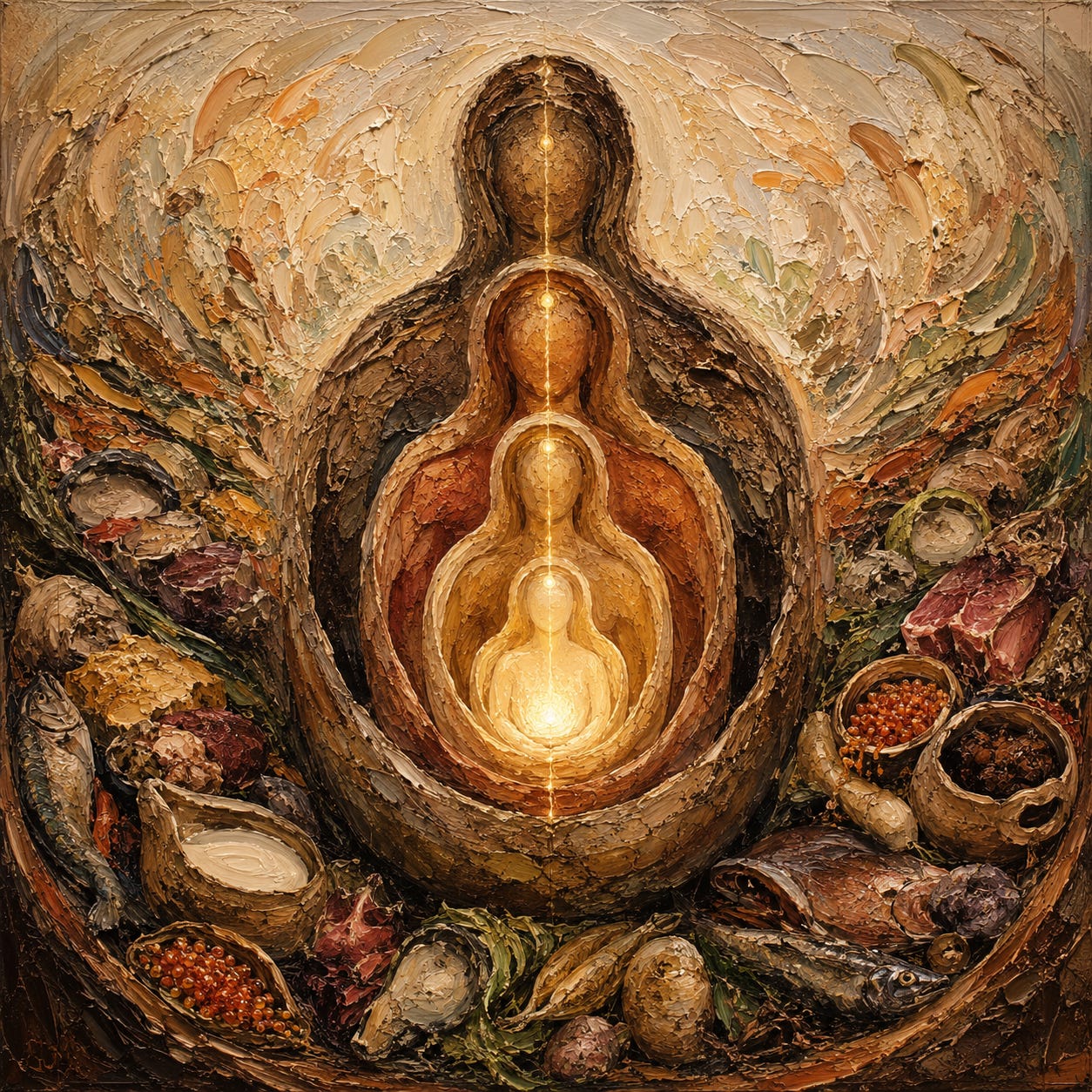
The 12-to-18 Month Threshold
Once a female cat had been kept on a deficient diet for twelve to eighteen months, she could never again give birth to fully normal kittens. Even after three or four years back on optimum food, her offspring still showed deficiency in skeletal and dental development.¹
By the time the average woman in an industrialised country considers pregnancy, she has been on a deficient diet for far longer than eighteen months. She has been on it her entire life, as had her mother before her, and her grandmother before that.
Francis Pottenger Jr. ran his cat study from 1932 through 1942 at his sanatorium in Monrovia, California.² Nine hundred cats. Ten years. Six hundred with complete recorded health histories archived at the Price-Pottenger Nutrition Foundation. Three generational classifications: normal, deficient, regenerating. The variable was simple. Some cats received raw meat, raw milk, and cod liver oil. Others received cooked meat or pasteurised milk in place of the raw foods. Otherwise the conditions were identical.
The first generation of cats placed on cooked food showed degeneration during their own lifetimes. The second generation, born to mothers already deficient, was visibly worse: smaller, more allergic, with bones described as having the trabecular fineness of cotton handkerchiefs rather than silk scarves.³ The third generation collapsed. Bones soft as rubber. Lung tissue showing hyperaemia, oedema, atelectasis. Ovarian atrophy in females. Failed spermatogenesis in males. Abortion rates of seventy percent. None of the third-generation kittens survived past six months. The strain terminated.⁴
The cats stopped being able to make cats.
Support This Work
This work remains free because paid subscribers make it possible. If you find value here, consider joining them.
Paid subscribers get access to all books — including The DMSO Book, The Kitchen Remedies Guide, Chlorine Dioxide, The PSA Trap, Breast Cancer, and more — with 1-2 new books added each month. Plus the Deep Dive Audio Library: 180+ in-depth audio book summaries and discussions.
I do this work independently, outside the institutions these books so often describe. No foundation grants, no academic approval, no editorial gatekeepers deciding what’s acceptable to publish. Your subscription makes that independence possible.
Pricing Update: The annual subscription moves from $50 AUD to $50 USD on May 7 (now extended from May 1) — the first change in five years. Current paid subscribers keep their existing rate. Free subscribers can lock in the current price by upgrading before May 7.
What Inheritance Actually Is
The mainstream explanation for why children resemble their parents — and why disease patterns appear to run in families — invokes genetics. A code, written in DNA, transmitted at conception, executed by the cells. Predispositions inscribed in the sequence. The Human Genome Project was supposed to map the establishment’s claimed code and explain inherited illness. It found about twenty thousand genes — fewer than a grain of rice carries — and decades of follow-up research have failed to identify the specific genetic variants that should account for the heritability the model predicted.⁵
Pottenger’s cats had perfectly intact feline DNA in every generation. Nothing in their hereditary material changed between generation one and generation three. What changed was the body the mother had to build the next body inside.
This is what inheritance actually is, and the indigenous cultures Weston Price documented in the 1930s understood it in operational terms long before any laboratory confirmed it.
A child is built from its mother’s tissues. Mineralised by her stores. Formed in her hormonal environment. Fed on her milk. The mother is the construction site. Her terrain — the cumulative state of her mineral reserves, her detoxification capacity, her tissue integrity, her energetic vitality — is the material from which the child is made. Whatever she does not have to give, the child does not get. Whatever toxic burden she carries, the child shares.
When that child is female, her ovaries form during her own gestation. The eggs she will one day carry to term, becoming someone’s grandchild, are laid down inside the body of her grandmother before she herself is born. Three generations exist simultaneously inside one woman’s pregnancy. This is reproductive biology, not metaphor.
So when Pottenger’s deficient mother produced a deficient daughter, that daughter’s ovaries — and the eggs within them — were already forming inside an inadequate construction site, with inadequate materials, in an inadequate hormonal environment. The damage compounded not because anything was rewritten in the DNA, but because each generation arrived with less to work with than the last. The terrain itself was the inheritance, and the terrain was being depleted faster than it could be replenished.
This is the milieu intérieur — Bernard’s internal environment — extended across generations. The body of one woman is the world in which the next body is built, and the body in which that body’s reproductive future is also being laid down. Three generations of terrain stacked inside a single pregnancy. When the terrain degrades, all three suffer.
What Price Saw
Weston Price was an Ohio dentist who, between 1931 and 1936, travelled to fourteen populations still living entirely on their indigenous foods. Swiss villagers in the Loetschental Valley. Gaelic crofters in the Outer Hebrides. Eskimos along the Bering Sea. Masai and Kikuyu in East Africa. Aboriginal Australians. Maori in New Zealand. Highland Peruvians. Coastal Polynesians.⁶
In every group living on its native diet, Price found the same constellation: broad dental arches, straight teeth, immunity to caries, fertility without complication, freedom from the chronic illnesses that filled American clinics. The incidence of tooth decay among the most isolated Polynesian groups was 0.6 percent. Among Polynesians of the same racial stock living in port towns where trader ships brought white flour and sugar, it rose to 33.4 percent.⁷
The change was not slow. It was visible in a single generation. Children born to parents who had adopted the imported foods showed narrowed dental arches, crowded teeth, and altered facial bone structure even when the children themselves were still growing. Photographs in Price’s volume document Eskimo families in which the parents have broad faces and full arches and the children — pure-blooded, same parents, same village, different food — have the recognisable narrow-jawed, crowded-teeth pattern that is now considered normal in every Western country.⁸
This is the same pattern Pottenger documented in his cats, observed in human beings, in real cultures, in real time. One generation of changed terrain produced visible degeneration in the next generation’s bodies.
What Price found that interests us most here is what these cultures did before conception. They did not, as modern obstetric protocol does, begin nutritional support after a positive pregnancy test. They began preparing parents months and years in advance.
In several African agricultural tribes, girls were fed special foods for six months before marriage.⁹ Among the Masai, young women were required to wait to marry until the season when the cows were on rapidly growing young grass, and to drink the milk from those cows for a specified number of months before they could conceive.¹⁰ In one Pacific Island group Price visited, a chief assigned young men to gather specific seafoods daily for expectant mothers. Fijian women travelled significant distances to gather a particular species of spider crab known to be necessary for the production of healthy children.¹¹ Coastal Peruvian women whose ancestors descended from the Chimu culture used dried fish eggs liberally — both during their developmental years and through their reproductive lives — to reinforce fertility and what Price called “maternal efficiency for childbearing.” Price’s laboratory analysis of these dried fish eggs showed them to be exceptionally rich in minerals and the fat-soluble vitamins.¹²
In the Indian moose country near the Arctic Circle, a disproportionate share of children were born in June. Both parents had been eating the thyroid glands of male moose during the autumn mating season, when the glands swell visibly under the throat.¹³ The Inuit timed conception to organ-meat availability.
Several patterns repeat across the cultures Price documented. Special foods for fathers as well as mothers. Pre-conception preparation measured in months, not days. Spacing between children of two and a half to four years to allow the mother to rebuild before the next pregnancy.¹⁴ Specific reliance on what Price called the “sacred foods” — fish eggs, organ meats, raw dairy from rapidly growing pasture, marine animals, insects in some cultures, blood in others — foods identified across continents and racial groups as necessary specifically for reproduction.
These cultures had no laboratories. They had thousands of years of observation. They knew that producing a healthy child was a project that began before the parents conceived, that drew on accumulated stores in both parents’ tissues, and that required specific nutrient density not present in everyday food. They built protocols around this knowledge and enforced them through custom, taboo, and chiefly authority.
The modern protocol, by contrast, is a folic acid pill once a positive test is in hand. Sometimes prenatal vitamins. Often instructions to avoid soft cheese and sushi. The construction site is whatever the mother arrived with.
The Genetic Alibi
When a child today is born with crowded teeth requiring orthodontic intervention, with allergies, with eczema, with poor immune function, with autism spectrum traits, with metabolic dysfunction — when these conditions appear, they are most often attributed to genetic factors, family history, predisposition. The clinical language is neutral on its surface. Underneath it does specific work.
A condition labelled genetic is a condition declared innate. Innate conditions are not the result of identifiable causes. They are simply how the patient was made. The investigation stops there. The treatment becomes management — symptom suppression across a lifetime, since the underlying “genetic” reality cannot be altered.
This serves three institutional functions simultaneously. It absolves the food industry of responsibility for what their products do across generations. It absolves the pharmaceutical industry of responsibility for the cumulative toxic load their products impose. It guarantees the medical industry a permanent customer who must be managed forever. None of these functions requires intent or conspiracy. The framework simply works for everyone whose interests are aligned with it. The framework also happens to be wrong in ways the evidence makes plain.
If “crowded teeth” were a genetic trait, the same racial population should produce the same proportion of crowded-teeth children regardless of environment. Price documented Polynesian, Eskimo, African, Aboriginal, and European populations in which crowded teeth were almost unknown — populations of the same genetic stock as modernised groups in which crowded teeth are standard. The genes did not change between the village and the port. The food changed. One generation later, the bones changed.
If “autoimmune predisposition” were a genetic trait, the conditions labelled autoimmune should have remained at roughly the same prevalence across the twentieth century. They have multiplied. Type 1 diabetes, multiple sclerosis, lupus, coeliac disease, Hashimoto’s, and the rest have been climbing in incidence on timeframes far too short for any genetic shift.¹⁵ The genes did not change. The environment changed. The terrain degraded.
If “infertility” were a genetic trait, indigenous populations Price observed reproducing easily for generations could not have been doing so. Pottenger’s normal cats reproduced “one homogeneous generation after another” with rare miscarriages, average litters of five, and easy nursing.¹⁶ Pottenger’s deficient cats showed seventy percent abortion rates by the second generation and complete reproductive failure by the third. Same species. Different terrain. Different outcomes.
The genetic frame functions as an alibi. It allows institutions to keep doing what they are doing while attributing the consequences to something neither they nor the patient can be held responsible for. It transforms identifiable, environmentally-driven, transgenerational damage into a story about bad luck written in the cells.
The inheritance is a debt. Each generation receives the depleted terrain its parents could provide, accumulates its own toxic burden across its life, and passes a further-depleted terrain to its children. The pattern looks like inheritance because it travels through families. It is not transmitted through DNA but through bodies — through the actual material from which the next body is built, and through the environmental insults that continue to deplete that material in each generation.
How the Insults Compound
The four categories of insult that drive disease — toxic exposure, nutritional deficiency, electromagnetic radiation, and psychological strain — each compound generationally. Toxic load accumulates and transfers to the child through placenta and breast milk; heavy metals stored in maternal bone, accumulated from amalgam fillings and environmental sources, mobilise during pregnancy and lactation.¹⁷ Mineral stores depleted across generations are slow to rebuild. Pottenger’s data showed calcium content of femurs collapsing across three generations on the same diet — bones became, in his description, soft as rubber.¹⁸ Wireless radiation, in the form chronic in modern life, affects the same biological substrates: it disrupts calcium channels, alters mitochondrial function, and crosses the placenta. The first generation conceived and gestated in pervasive wireless radiation has not yet completed its own reproductive cycle, and what the third generation will look like remains to be seen. Chronic stress depletes the same restorative processes that would otherwise replenish maternal stores between pregnancies; Pottenger noted that the second and third litters of even his alternated raw/cooked cats showed progressive deterioration.¹⁹
These four insults converge on the same terrain. A great-grandmother poisoned by industrial food and dental amalgam built a daughter with depleted stores. That daughter, raised on processed food, exposed to wartime and post-war pharmaceutical innovations, accumulated her own load and built a granddaughter with less than she herself had received. That granddaughter, raised in pesticide saturation and television-mediated stress, conceived in wireless radiation, built a great-granddaughter — the modern Western child — who arrives at the construction site already in deficit, with a mother who is also in deficit, in a world that continues to deplete rather than replenish.
This is the debt. It is not metaphorical. It is measured in the calcium content of bones, the breadth of dental arches, the timing of menarche, the rates of miscarriage, the prevalence of conditions formerly rare in childhood and now common.
What Regeneration Actually Means
Pottenger ran a regeneration arm of his study, and the findings are more hopeful than the deficiency arm suggests. The cats recovered. Not all at once. Not completely in the first generation. But they recovered — measurably, visibly, and starting immediately upon the return to good food.
The first-generation regenerating cats showed clear improvement over their deficient parents within their own lifetimes. Their offspring — the second regenerating generation — showed improvement in disease resistance and overall vitality compared to the second deficient generation. By the fourth generation, most severe deficiency signs had diminished, though Pottenger noted “seldom completely.”²⁰
The first generation acts and the first generation benefits. The first generation’s children benefit further still. This is the actual shape of the data.
What the data also shows is a permanent reproductive cost in cats kept on cooked food for twelve to eighteen months before the return to raw. Even after three or four years on optimum food, their kittens still showed skeletal and dental deficiency. The mother improved — her own health recovered substantially — but she could not produce kittens of fully restored form. Some damage to the reproductive system, once incurred, is not reversed by improved input alone.
When new bone was laid down during regeneration, Pottenger observed something that Price’s human studies also documented in adults whose diets were corrected: the new bone was not the original bone repaired. It was scar bone.²¹ This is worth understanding precisely. The body responded to corrected nutrition by laying down new tissue. That tissue was a substantial improvement on the deficient state. It was real, measurable, functional bone. What it was not was the original architecture that would have formed had the mother arrived with full stores at her own conception. The body repairs forward. It does not rebuild backward. But forward is the direction the next child will travel, and forward is enough.
The pre-conception protocols Price documented were not multi-generational. They were measured in months. Six months of special foods before marriage. A specific season’s milk before conception. The Inuit timing conception to the moose thyroid harvest. The Fijian woman gathering the spider crab for her own pregnancy. These were single-generation interventions that produced visibly healthier children. The cultures had multi-generational continuity, but the protocols themselves operated on the timescale of a season.
A first-generation woman applying these principles today — preparing her body before conception, eating the nutrient-dense foods these cultures identified, spacing her children to allow rebuilding, removing the insults she controls — is doing what those women did. She is not waiting for great-grandchildren to benefit. Her children benefit. Her own health benefits. Her reversal of her own conditions is documented in the regeneration arm of Pottenger’s study and in the adults Price photographed before and after dietary correction.
The insults the modern environment embeds — wireless radiation, ambient pesticides, water-supply contaminants — are real and they are not nothing. But they are not the dominant load for most people. The dominant load is what comes through the mouth and the medicine cabinet, and both of these are under direct control. So is what comes from the household products under the sink, the cookware in the kitchen, the cosmetics on the bathroom shelf, the sleep schedule, the time spent outdoors, and the spacing of pregnancies. The infrastructure-embedded insults are best addressed by reducing the personally-controllable load, since the body’s capacity to handle residual environmental insults depends on its terrain being otherwise sound.
What the regeneration data does not promise is full restoration in one lifetime. What it does promise is that the trajectory reverses the moment the first generation acts. The bone Pottenger’s cats laid down was scar bone, but it was new bone. The teeth that had been deteriorating in Price’s adult patients stopped deteriorating once the diet was corrected. The milk of the regenerating mother cats improved. The children came out closer to what they should have been, and those children, raised entirely on corrected food, raised their own children closer still.
Four generations to approach the original form, but the curve bends in the first.
The Construction Site
A daughter’s eggs are formed inside her grandmother’s body. Her skeleton is mineralised by her mother’s stores. The breadth of her dental arch, the volume of her cranial cavity, the integrity of her connective tissue, the resilience of her detoxification pathways, the timing of her sexual maturation, the ease or difficulty of her own future childbearing — all of this is laid down in the construction site of her mother’s body, with whatever materials her mother had at the moment of her formation.
What her mother had was determined, in turn, by what her grandmother had. And so on, back through each generation that ate the food and breathed the air and carried the burdens of its time.
The terrain is the inheritance. The construction site is the body of the mother. The materials are what she had to give. There is no separate genetic ledger. What medicine has called genetic predisposition is, in case after case, the visible accounting of what the previous generations had to spend.
The indigenous cultures Price documented understood this in operational terms. They built protocols around it: months of preparation before marriage, specific foods reserved for childbearing women, sea-foods carried long distances, organ meats for fathers, spacing of children to allow rebuilding. They treated reproduction as the most consequential act a body could perform, and they stocked the body for the demand. The protocols were not heirlooms passed down across centuries before they could work. They were applied within a single life, before a single pregnancy, and the children came out as the photographs show them.
A woman applying these principles today is doing what those women did. Her own health improves. Her children are stronger than she was. Her grandchildren, born to daughters raised on the corrected diet, are stronger still. The four-generation timeline is not a sentence she serves; it is the shape of the recovery curve, and she is its first point.
The insults she controls are most of what matters. The food she eats is fully under her control. The medications she takes — and the medications given to her children — are largely under her control. The household products, the cookware, the water filtration, the sleep, the sunlight, the time outdoors, the spacing of pregnancies, the months of preparation before conception — all of this is under her control. The infrastructure-embedded insults are real, but a body whose terrain is otherwise sound handles them better than a body already in deficit.
The bill for the past four generations has been arriving in the bodies of the children. The genes did not change; the terrain did. What is also true is that the moment one generation chooses differently, the curve begins to bend back, and this is shown in Pottenger’s regeneration data and in the photographs Price took of adults whose facial bone structure improved with corrected nutrition. The first child born to a woman who has prepared her body is closer to the form than she was, and the second child, born after she has rebuilt further, is closer still.
Pottenger’s third-generation cats could not make cats. His regenerating cats could, and their kittens kept getting better from there.
The books were not kept for four generations. One generation can begin to keep them again.
Explain It To A 6 Year Old
Imagine your mum is baking you a cake. To make a really good cake, she needs really good ingredients — flour, eggs, butter, sugar. If she has all of those, the cake comes out perfect. If she runs out of butter, the cake is a bit dry. If she also runs out of eggs, it doesn’t really hold together. If she runs out of nearly everything, the cake doesn’t work at all.
Now imagine that the cake is you. Your mum’s body had to bake you out of what she had inside her. Strong bones, good teeth, a clear head, all the parts of you that make you, you — all of it came from her. Whatever she had, she gave you. Whatever she didn’t have, she couldn’t give you, because she didn’t have it.
Where did she get her ingredients from? From her mum. Your grandma. And your grandma got hers from your great-grandma.
Once upon a time, a man called Dr Pottenger had nine hundred cats. He gave half of them really good cat food — the kind cats are meant to eat. He gave the other half not-so-good food. The cats with the good food had lots of healthy kittens. The cats with the not-so-good food had kittens that were a bit weaker. Then those kittens grew up and had kittens of their own, and those kittens were even weaker. By the time you got to the great-grandkittens, the cats couldn’t have any healthy babies at all. The kittens were too poorly to grow up.
The cats themselves didn’t change. The food changed. And once the food had been wrong for a long time, even going back to the good food didn’t fix everything straight away. It took four generations of good food before the great-great-grandkittens were okay again.
Around the same time, a dentist called Dr Price travelled all over the world to visit people who still ate the food their grandparents and great-grandparents had eaten. People who lived high in the mountains, on tiny islands, in cold places near the top of the world. He looked at their teeth. They had perfect teeth. Big, straight, strong teeth, with no holes in them. Their children had perfect teeth too.
Then he visited their cousins who had moved to the city and started eating shop food — the kind in tins and packets. Their teeth were not perfect anymore. They had crowded teeth, and lots of holes. And they were the same people. Same families. The only thing that had changed was the food.
So here is what we know. The food we eat builds the children we have. And the food those children eat builds the children they will have one day. If the food is good for a long time, the children come out strong. If the food is not good for a long time, the children come out a little weaker, and then a little weaker, until something has to change.
The good news is that bodies want to get better, and they start getting better the moment the food gets better. The cats in Dr Pottenger’s experiment showed this too. As soon as he gave the poorly cats good food again, they began to recover. Their kittens were stronger than they were. The kittens after that were stronger still. It took four generations to get all the way back, but the very first generation that ate the good food started to feel better straight away.
So if your mum is eating proper food now, you are already getting more than she got. And one day, if you eat proper food too and have your own children, they will get even more than you got. Each time someone in the family chooses better food, the next person comes out a little stronger.
That is why what your mum eats matters. And what her mum ate. And what you eat now, even though you are little — because one day you might have your own children, and your body will be the kitchen they are baked in. The good news is that the kitchen gets better as soon as you start putting better things in it.
References
¹ Pottenger, F.M., Jr. Pottenger’s Cats: A Study in Nutrition. La Mesa, CA: Price-Pottenger Nutrition Foundation, 1983 (reprinted from original 1939–1942 research). Chapter 2.
² Ibid., Introduction. Of 900 cats studied across the ten-year experiment, 600 had complete recorded health histories archived at the Price-Pottenger Nutrition Foundation.
³ Ibid., Chapter 5. “The first deficient generation shows trabeculation with the fineness of a silk scarf, that of the second generation is similar to a plain cotton handkerchief and that of the third generation is more like mosquito netting.”
⁴ Ibid., Chapter 2. “By the time the third deficient generation is born, the cats are so physiologically bankrupt that none survive beyond the sixth month of life, thereby terminating the strain.” Abortion rates: “running about 25 percent in the first deficient generation to about 70 percent in the second generation.”
⁵ Pertea, M. & Salzberg, S.L. “Between a chicken and a grape: estimating the number of human genes.” Genome Biology 11, 206 (2010). Initial Human Genome Project predictions ranged from 50,000 to over 100,000 protein-coding genes; final count is approximately 19,000–20,000, comparable to or fewer than many invertebrate species and a single rice grain.
⁶ Price, W.A. Nutrition and Physical Degeneration. Lemon Grove, CA: Price-Pottenger Nutrition Foundation, 8th edition, 2009 (originally published 1939). Chapters 2–17 detail the fourteen population groups studied.
⁷ Ibid., Chapter 8 (South Sea Islands). “The incidence of tooth decay varied from 0.6 per cent for the most isolated groups to 33.4 per cent for the modernized groups.”
⁸ Ibid., Chapter 6 (Eskimos), Figure 12. “While dental arch deformities or crowded teeth are practically unknown among many of the primitive groups of Eskimos, they occur frequently in the first generation of children born after the parents have adopted the white man’s foods.”
⁹ Ibid., Chapter 21. “In several agricultural tribes in Africa the girls were fed on special foods for six months before marriage.”
¹⁰ Ibid., Chapter 21. “Among the primitive Masai in certain districts of Africa, the girls were required to wait for marriage until the time of the year when the cows were on the rapidly growing young grass and to use the milk from these cows for a certain number of months before they could be married.”
¹¹ Ibid., Chapter 21. The Fijian crab and the chief-appointed seafood gatherers for expectant mothers are described in detail.
¹² Ibid., Chapter 14 (Peruvian Indians) and Chapter 21. “These fish eggs were an important part of the nutrition of the women during their reproductive period... A chemical analysis of the dried fish eggs that I brought to my laboratory from Alaska as well as of samples brought from other places has revealed them to be a very rich source of body-building minerals and vitamins.”
¹³ Ibid., Chapter 21. “Among the Indians in the moose country near the Arctic circle a larger percentage of the children were born in June than in any other month. This was accomplished, I was told, by both parents eating liberally of the thyroid glands of the male moose.”
¹⁴ Ibid., Chapter 21. “Another important feature of the control of excellence of child life among the primitive races has been the systematic spacing of children by control of pregnancies. The interval between children ranged from two and a half to four years.”
¹⁵ Lerner, A., Jeremias, P. & Matthias, T. “The world incidence and prevalence of autoimmune diseases is increasing.” International Journal of Celiac Disease 3, no. 4 (2015): 151–155. Documents rising incidence rates across multiple conditions labelled autoimmune on timescales incompatible with genetic shift.
¹⁶ Pottenger, Pottenger’s Cats, Chapter 2. “These cats reproduce one homogeneous generation after another with the average weight of the kittens at birth being 119 grams. Miscarriages are rare and the litters average five kittens with the mother cat nursing her young without difficulty.”
¹⁷ Drasch, G. et al. “Mercury burden of human fetal and infant tissues.” European Journal of Pediatrics 153, no. 8 (1994): 607–610. Documents transplacental transfer of mercury and its accumulation in fetal tissues proportional to maternal amalgam burden.
¹⁸ Pottenger, Pottenger’s Cats, Chapter 5. Pottenger documented progressive decline in bone mineralisation across the deficient generations, with bones described as “soft as rubber” by the third generation.
¹⁹ Ibid., Chapter 2 (alternated raw/cooked variation). “Her succeeding litters show irregularities that tend to lessen in intensity for the first two or three years of her reproductive life and then increase again.”
²⁰ Ibid., Chapter 2. “In the third generation, skeletal and soft tissue changes are still noticeable, but to a lesser degree; and by the fourth, most of the severe deficiency signs and symptoms disappear—but seldom completely.”
²¹ Ibid., Chapter 12, Figure 12.15. “The new bone laid down in regeneration is not the original bone repaired, but is a scar bone.” Price documented analogous patterns in adults whose facial bone structure improved with corrected nutrition: improvement was real, but original architecture was not fully recoverable once the developmental window had closed.
Considering years of the Great Depression, two world wars, the chemical poisonings most of humanity carries from injections, the addictions to TV, phones, and computers, the nutritional collapse of our foods, and toxicity of water sources, it's amazing that there are any humans still alive.
This essay gives a whole generational view of cause and effect, not the fragmented view we are presented with. The assaults are myriad, the original studies dealt with simple causes, not the total saturation of everything as it is now. This caused me to think of my ancestral background, and the people who came before me, myself the results of this and the effects I see in the generations after me. So interesting! Hopefully it’s not “too little, too late?”