
Prions and Deer
How Unproven Science Is Deploying Chronic Wasting Disease Against American Deer

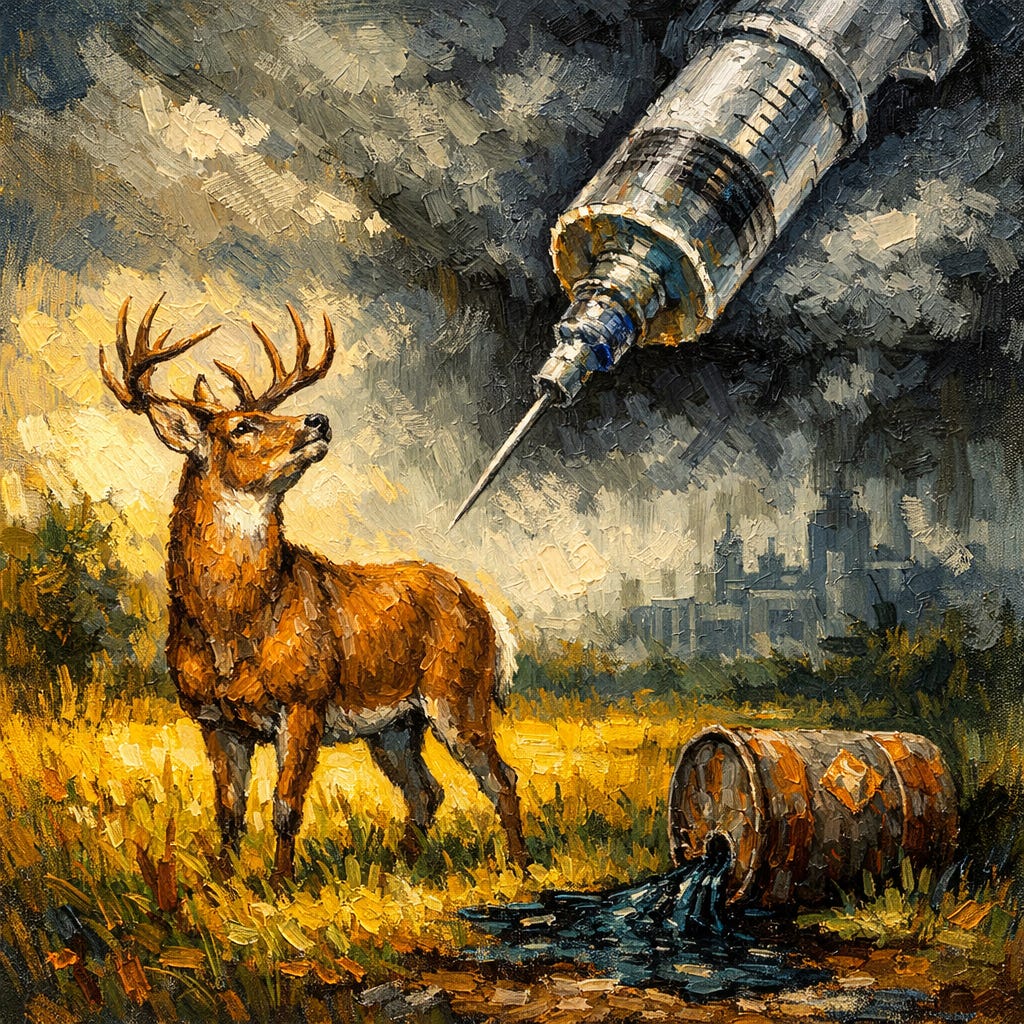
To prove that a protein causes disease, researchers inject brain tissue from a sick animal directly into the brain of a healthy animal. They wait one to two years. When neurological damage appears, they declare transmission proven.
The question no one asks: when was the last time your brain came into contact with someone else’s brain mass?
This is the experimental foundation of the prion hypothesis—the claim that a misfolded protein, containing no DNA or RNA, can somehow “infect” a host and cause fatal neurodegenerative disease. Stanley Prusiner won the 1997 Nobel Prize for this idea. The atomic structure of these allegedly infectious proteins wasn’t even known at the time. It still isn’t fully resolved.
The prion hypothesis now justifies the destruction of entire deer herds across North America, the quarantine of ranches, the collapse of a billion-dollar breeding industry, and an expanding apparatus of mandatory testing, contamination zones, and land seizures. The same template previously deployed against beef (BSE), poultry (avian influenza), and pork (African Swine Fever) is now targeting the last independent protein source available to Americans: wild venison.
The science beneath this apparatus has never been proven. The experiments that would test it have never been conducted. The questions that would challenge it are not being asked.
This investigation was prompted by correspondence from a reader in Texas, who noticed the pattern emerging in deer country and asked the questions that institutions prefer not to answer. The documents the reader provided—the original email, the research into Priogen and its personnel, Senator Hall’s amicus brief, and the reader’s questions—form the foundation of this analysis. Thank you!
Support Independent Research
This work remains free because paid subscribers make it possible. If you find value here, consider joining them.
What paid subscribers get: Access to the Deep Dive Audio Library — 180+ in-depth discussions (30-50 min each) exploring the books behind these essays. New discussions added weekly. That’s 100+ hours of content for less than the price of a single audiobook.
[Upgrade to Paid – $5/month or $50/year]
Get in touch Essay ideas, stories, or expertise to share: unbekoming@outlook.com
The Experiment That Proves Nothing
The standard method for demonstrating prion transmission involves taking brain homogenate—a slurry of brain tissue—from a diseased animal and injecting it directly into the brain of a test subject. After an incubation period of months to years, researchers examine the brain for characteristic plaques and sponge-like holes. If present, transmission is declared.
Alan Ebringer, immunologist at King’s College London, identified the fundamental problem. The researchers, he observed, inject brain tissue homogenates into experimental animals, and when neurological symptoms appear they claim to have transmitted BSE. But they have done nothing of the sort. What they are actually producing is experimental allergic encephalomyelitis.
Experimental Autoimmune Encephalomyelitis (EAE) is a well-documented phenomenon. Inject foreign protein into a brain, and the immune system attacks it. Neurons die. Holes appear. The phenomenon has been known for decades and is used as an animal model for multiple sclerosis research. Any competent immunologist recognizes that introducing foreign protein into neural tissue triggers autoimmune damage—not infection, but immune response to foreign material.
The controls that would distinguish infection from immune response have never been properly implemented. A rigorous experiment would require injecting comparable protein solutions—healthy brain matter, or prion proteins with normal folding structures—to determine whether the observed damage results specifically from the “infectious” prion or from the brain’s reaction to any foreign protein. These controls are absent from the foundational studies.
The 2004 paper in Science by Legname and colleagues, often cited as definitive proof, created artificial β-pleated prion proteins and injected them into mouse brains. Mice developed neurological disorders after 380 to 660 days. The study was hailed as a breakthrough.
The problems are methodological and fundamental. The mice were transgenic animals engineered to overexpress prion protein at levels far above normal—not ordinary animals with typical protein expression. The route of exposure was intracerebral injection—not the oral route by which the disease supposedly spreads naturally through consumption. The control group received saline solution—not a protein control that would test whether any foreign protein injection produces similar damage. Mouse neurophysiology differs fundamentally from humans and cattle—results cannot be extrapolated across species without independent validation that has never occurred.
This methodological substitution—claiming natural transmission while proving nothing of the sort—has a direct historical precedent.
Louis Pasteur built his case for rabies transmission the same way. He drilled holes in dogs’ skulls and injected brain material from rabid animals directly into the brain cavity. When the dogs developed neurological symptoms, he declared transmission proven. He never demonstrated that a bite—the actual natural route—reliably caused the disease under controlled conditions. The injection bypassed every aspect of how rabies supposedly spreads: saliva, wound, peripheral nerves, gradual progression to the central nervous system. Pasteur’s intracerebral injection produced symptoms. It did not prove that bites transmit rabies.
The prion researchers replicated his method. They inject brain homogenate into brains, wait for damage, and declare transmission. The natural route for CWD is supposedly oral—deer consuming contaminated plants, water, or soil. But oral transmission studies either fail outright or require massive doses far beyond any plausible natural exposure. So the researchers fall back on intracerebral injection and present those results as evidence for oral transmission.
The sleight of hand follows a template:
Claim the disease spreads naturally through Route A (bites for rabies, consumption for prions). Fail to reliably produce disease through Route A under controlled conditions. Use Route B (direct brain injection) to produce symptoms. Present Route B results as proof that Route A transmission occurs. Build regulatory and commercial infrastructure on this substitution.
Injecting foreign biological material directly into brain tissue causes neurological damage. This has been known for over a century. The damage does not require a novel pathogen, a misfolded protein, or a virus. It requires an immune system responding to foreign matter in a location where foreign matter should never be.
The question neither Pasteur nor Prusiner answered: if the agent spreads naturally through bites or consumption, why does the proof require drilling into skulls?
Yale neuropathologist Laura Manuelidis, who has challenged the prion hypothesis for decades, notes that John Collinge’s lab reported in 2015 what she had been saying for years: 20,000 attempts to make recombinant prion protein infectious had failed.
Twenty thousand experiments. Zero successful reproductions of the foundational claim.
The scientific community’s response to this failure was not to question the hypothesis but to continue building regulatory and commercial infrastructure upon it.
The Evidence That Should Have Ended the Debate
Even granting the infectious premise—accepting for argument’s sake that something transmissible causes these diseases—the prion hypothesis fails on its own terms.
Laura Manuelidis, head of neuropathology at Yale, has produced findings that directly contradict the protein-only hypothesis. Her laboratory work spans decades and has been published in peer-reviewed journals. The scientific establishment has not refuted her findings. It has ignored them.
Manuelidis believes a virus, not a misfolded protein, causes the disease. Her dissent stays within the infectious paradigm—she argues about what the infectious agent is, not whether infection is the right frame. Her work remains in peer-reviewed journals while Mark Purdey’s environmental research was defunded. Arguing over which infectious agent to blame still validates testing, surveillance, and culling. Challenging infection itself threatens the entire apparatus.
Her findings nonetheless demolish the prion hypothesis from within:
Her first finding: what researchers call “infectivity” persists without prion protein. Her lab demonstrated that particles stripped of detectable prion protein remain highly “infectious” by the measures used in these experiments. If the protein itself were the agent, removing it should eliminate the effect. It doesn’t. The damage persists when the allegedly causative protein is absent.
Her second finding: “infectivity” and PrPSc move in opposite directions. When the “infectious” form of prion protein (PrPSc) increases in concentration, the measured “infectivity” falls by 10,000-fold. The prion hypothesis predicts these should correlate positively—more “infectious” protein should mean more effect. They correlate inversely. A 10,000-fold inverse correlation represents a fundamental contradiction of the hypothesis.
Her third finding: virus-like particles correlate with the effect. Manuelidis identified 25nm particles in cell cultures that don’t bind prion protein antibodies—meaning they’re not composed of prion protein—but correlate with high “infectivity.” These particles have the size and density characteristics of viruses. A virus causing the damage, with the misfolded protein as downstream consequence rather than cause, would explain every anomaly the prion hypothesis cannot.
Her fourth finding: agent strains exist. Different “strains” of CJD and scrapie agents produce distinct disease patterns. The prion hypothesis struggles to explain how a misfolded protein, without genetic material, could encode strain-specific information. Proteins don’t replicate. They don’t carry genetic instructions. They don’t encode the kind of variation that produces distinct strains. Viruses encode strain differences in their genomes.
Her summary statement is unambiguous: no reproducible “infectivity” has ever been demonstrated for any pure prion protein, including recombinant prion protein. More than 100 independent experiments fail to generate any effect from recombinant PrP.
The Collinge lab’s 20,000 failed attempts, reported in Open Biology in 2015, confirm this independently. Collinge is a major figure in prion research and not hostile to the hypothesis. His laboratory’s inability to reproduce the foundational claim—after 20,000 attempts—should have prompted fundamental reconsideration. It did not.
Whether Manuelidis is correct that a virus causes the damage, or whether the “infectivity” being measured is simply an artifact of injecting foreign material into brains, the conclusion is the same: the prion protein is not the cause. The foundation of the hypothesis is wrong.
Even by the standards germ theorists set for themselves, the prion hypothesis fails. Koch’s postulates—the criteria the infectious disease establishment uses to prove causation—require three things: the organism must be present in diseased individuals, it must be isolated in pure culture, and it must cause the same disease when introduced into healthy hosts through natural routes of exposure. Prion hypothesis supporters acknowledge Koch’s postulates have never been satisfied for prions. The “pure protein” has never caused disease in normal animals through natural exposure. The intracerebral injection route that produces symptoms is not how the disease supposedly spreads.
The Nobel Prize was awarded anyway. The regulatory infrastructure was built anyway. The commercial testing apparatus was constructed anyway. The herds are being slaughtered anyway.

How the Paradigm Was Locked In
The infectious model for these diseases did not emerge from evidence. It was installed by Nobel Prizes over decades, overwriting an earlier genetic understanding.
Before the 1960s, scrapie—the sheep brain disease that supposedly gave rise to BSE—was understood as occurring endemically within certain flocks. Up to 30% of a herd might be affected. Veterinary science treated it as a genetic disease, eliminated through breeding protocols. Herbert Parry’s 1962 research in Heredity established scrapie as hereditary. The approach worked: breed out the susceptible animals, and the disease disappears.
Then the paradigm shifted.
In 1976, Carleton Gajdusek won the Nobel Prize for claiming that kuru—a dementia observed in Papua New Guinea—was a viral disease transmitted through ritualistic cannibalism. The “slow virus” Gajdusek proposed was never isolated. No one found it. But the prize locked in the infectious framework. Brain diseases that had been understood as genetic or environmental were now presumed transmissible.
Prusiner rode this wave. In 1982, he identified plaques containing prion proteins in affected brains. In 1987, when BSE emerged in British cattle, he applied his prion theory to the epidemic. A disease that might have been investigated for genetic, toxic, or nutritional causes was instead framed as infectious from the start. The investigation followed the paradigm.
The 1997 Nobel Prize cemented the framework. As one German medical journal observed, Nobel Prizes “usually follow the spirit of the times” and “can cement paradigms.”
Prusiner’s own research undermined the infectious model he promoted. By 1995, his lab had identified 18 different mutations in the prion gene found in families with frequent spongiform encephalopathies. The predisposition was genetic—specific mutations caused amino acid substitutions that accelerated the misfolding process. Families with these mutations developed the disease. Families without them did not.
This finding pointed toward heredity, not infection. It was not pursued.
The age pattern of BSE raised similar questions. Spongiform encephalopathies in humans typically manifest in old age. BSE appeared in young cattle, aged two to five years. A disease with a decades-long incubation period appearing in animals only a few years old points to developmental or genetic factors, not slow infection. Modern cattle breeding—with most animals descended from a handful of bulls whose genetics were spread through artificial insemination—explains rapid genetic propagation of susceptibility.
These questions were not investigated. The infectious paradigm, installed by sequential Nobel Prizes, determined which hypotheses were funded and which were ignored.
But one farmer noticed something the experts missed.
The Farmer Who Asked Questions
Mark Purdey was an organic farmer in Somerset, England. He raised cattle. When BSE emerged in the 1980s, the official explanation blamed meat and bone meal (MBM)—rendered animal products fed to cattle as a protein supplement. The solution: ban MBM from cattle feed.
Purdey observed something that didn’t fit the narrative. His organic cattle had consumed meat and bone meal—it was permitted under organic standards at the time. None of them developed BSE. He began investigating and discovered that across the UK, not a single case of BSE occurred in cattle born and raised on fully converted organic farms, despite those animals having access to the supposedly contaminated feed.
If MBM caused BSE, organic cattle that ate MBM should have developed the disease. They didn’t. The variable that differed was not what the cattle ate. It was what they were treated with.
Purdey’s cattle were not treated with phosmet.
Phosmet is an organophosphate insecticide mandated by UK law for warble fly control beginning in 1982. The warble fly lays eggs on cattle; larvae burrow into the animals’ backs and cause economic damage. The UK Ministry of Agriculture required farmers to treat cattle with phosmet applied along the spinal column at twice-annual doses of 20 mg/kg bodyweight—a concentration unique to the United Kingdom. Organic farms were exempt from the requirement.
Organophosphates were originally developed as nerve agents in the 1930s. The same chemical class includes sarin and other warfare agents. They function by inhibiting cholinesterase, an enzyme essential for nervous system function. At lower doses than those causing acute poisoning, organophosphates produce chronic neurological effects that have been documented for decades.
Phosmet’s application site—the spinal column—placed it in direct contact with the central nervous system. The UK’s required concentration was higher than anywhere else in the world.
Purdey documented the correlations that the official investigation ignored.
The geographic correlation: only in Great Britain, Northern Ireland, and Switzerland was phosmet used at such high concentrations—and these were the countries where almost all BSE cases occurred. Other European countries used lower doses and developed proportionately fewer cases. Countries that didn’t use systemic organophosphates on cattle had essentially no BSE. The meat and bone meal was international; the phosmet mandate was British.
The temporal correlation: the UK repealed mandatory phosmet application in the early 1990s after accumulating evidence of “a likely connection” between organophosphate exposure and various health effects in both cattle and farmers. BSE cases declined drastically from 1993 onward—a timeline that matched the phosmet withdrawal far better than it matched MBM policy changes, which had been implemented earlier without affecting the disease trajectory.
The mechanistic correlation: organophosphates cross the blood-brain barrier and chelate copper—meaning they bind to copper atoms and remove them from biological systems. Copper deficiency produces severe neurological defects in grazing animals, a condition veterinary science has long recognized as “endemic ataxia” or “swayback.” The symptoms overlap substantially with BSE: loss of coordination, tremors, progressive neurological deterioration.
Purdey proposed a coherent mechanism. Systemic organophosphate exposure disrupts metal homeostasis in the brain, depleting copper from binding sites. The prion protein normally binds copper at specific locations—this is established biochemistry. When copper is depleted, toxic metals like manganese can substitute at those binding sites. The substitution alters the protein’s structure. It misfolds.
The misfolded protein, in this model, is not the cause of disease but a downstream marker of environmental toxicity. The prion is a symptom, not an agent. The cause is chemical exposure that disrupts metal biochemistry in neural tissue.
This matters enormously. If the prion hypothesis is correct, there is no liable party—proteins misfold spontaneously or through consumption of other misfolded proteins, and the regulatory response is surveillance, testing, and culling. If the environmental hypothesis is correct, specific products, specific manufacturers, and specific regulatory agencies bear responsibility. Compensation claims worth billions would follow.
Stephen Whatley, a neuroscientist at the London Institute of Psychiatry, pursued research that supported Purdey’s framework. His privately funded laboratory work produced results confirming phosmet as a BSE trigger. He sought government funding for expanded investigation.
His application was rejected.
His observation afterward was pointed: “There is no contradictory data.” No scientific paper refuted his conclusions. No alternative explanation accounted for the patterns he documented. The research was simply not funded. The questions were not pursued. The investigation was not conducted.
Roland Scholz, Professor of Biochemistry at the University of Munich, made a similar observation. No controlled feeding experiments in the field exist—studies that anyone with common sense would require, and which everyone believes have long been carried out by inventors of the meat and bone meal hypothesis. The experiments that would prove or disprove the official narrative were never conducted.
Separate herds of cattle, fed identical diets except for the presence or absence of MBM, monitored over their lifespans for BSE development—this is the study that would settle the question. It has never been done. The assumption that MBM causes BSE has never been tested against the obvious experimental design.
Anton Mayr, Professor of Microbiology and Director of the Institute for Medical Microbiology at the University of Munich, stated publicly that BSE is not contagious and no proven transmission to humans exists. His view was shared by other German scientists who examined the evidence independently of British institutional commitments.
The alternative hypothesis was never funded. The researcher who asked the wrong questions—Purdey—was marginalized. He died in 2006, his work unfinished, the controlled experiments never conducted, the environmental causation never systematically investigated.
Science did not fail here. Science was managed.
The Epidemic That Never Was
The BSE crisis generated catastrophic predictions that shaped policy across Europe and destroyed substantial portions of national agricultural economies. Epidemiological models projected hundreds of thousands of infected cattle entering the human food chain. Warnings of a “time bomb effect” suggested variant Creutzfeldt-Jakob disease had a long incubation period—decades, perhaps—meaning millions of people who consumed British beef in the 1980s and early 1990s might be silently incubating fatal brain disease. Projections of human deaths ranged from tens of thousands to millions.
A generation of British citizens was told they might be incubating fatal brain disease from hamburgers consumed in childhood. The British public was warned that vCJD would sweep through the population in coming decades. The phrase “mad cow disease” entered common usage. Beef consumption collapsed. The British beef industry lost billions. European import bans devastated what remained.
The British Medical Journal eventually published an article titled “Creutzfeldt-Jakob disease: the epidemic that never was.”
The projected deaths did not materialize. The models were wrong by orders of magnitude. The long-incubation time bomb never detonated. A British research team publishing in 2005 projected the future course of the vCJD epidemic in the UK at numbers that were a small fraction of earlier warnings—and even those drastically reduced projections proved excessive.
The total number of vCJD cases in the UK from the beginning of the epidemic through subsequent decades: approximately 178. Not 178,000. Not millions. 178 total cases in the country where the disease originated and where exposure was concentrated.
Germany mounted one of the most extensive testing programs in Europe. They tested 5.1 million cattle over the course of the program. Among more than five million animals tested, they found 200 BSE cases. The projected human impact from those 200 bovine cases, according to Sucharit Bhakdi, Director of the Institute of Microbiology and Hygiene at the University of Mainz: three people at most, over the next 30 years.
Not a single German died from vCJD.
Zero deaths. After 5.1 million tests. At a cost exceeding €1.5 billion.
Bhakdi’s assessment of the mandatory BSE testing program was blunt: completely pointless, a pure waste of money. The tests detected cattle with BSE. The BSE in those cattle posed no documented threat to German consumers. The regulatory apparatus processed millions of samples, employed thousands of personnel, consumed €1.5 billion in resources, and prevented zero human deaths.
The infrastructure persisted anyway. The testing laboratories remained in business. The regulatory apparatus remained funded. The experts who promoted the threat retained their positions and expanded their influence. The models that failed catastrophically were not discredited—they were quietly revised downward while the policies they justified continued.
The geographic distribution of cases further undermined the official narrative. Most BSE cases occurred in southern England, reflecting the concentration of dairy farming and the areas of intensive phosmet application for warble fly control. Most human vCJD cases occurred in northern Scotland. For the infectious model to hold—for humans to contract vCJD by eating BSE-infected beef—southern English beef would need to have been consumed primarily in northern Scotland. This is geographically implausible. Scotland has its own beef industry. The pattern pointed to something other than dietary transmission.
The predictions of millions of deaths from consuming British beef proved spectacularly, catastrophically wrong. The regulatory infrastructure built to address the phantom epidemic persists. The careers advanced by promoting the threat continue. The alternative explanations remain unfunded. The testing companies established during the crisis remain in business. The template worked—for everyone except farmers, consumers, and the truth.
This same pattern is now being deployed against deer.
The Texas Apparatus
In September 2022, the Texas Parks and Wildlife Department declared that a deer found dead near a fence—a deer that had allegedly run into the fence, died, and was found on land other than where it allegedly originated—tested positive for Chronic Wasting Disease. TPWD attributed the deer to the breeding facility of Richard Young, an award-winning deer breeder who had operated in Gillespie County, in the Texas Hill Country west of Austin, for over 25 years.
Without warning or due process, TPWD immediately shut down Young’s operation and threatened to kill his entire herd—nearly 200 bucks, does, and nursing fawns. They issued a “Kill Order” and informed Young he could not appeal or challenge the decision. Agency staff told him the matter was not subject to legal review.
Young had voluntarily depopulated all deer that shared the pen with the allegedly positive animal. He tested over seventy deer during the previous two hunting seasons. None tested positive for CWD. His compliance exceeded what the law required.
It didn’t matter. TPWD’s position was total herd destruction, land quarantine, and permanent operational shutdown based on a single test of a single deer that was not even clearly his.
Young’s case ultimately reached the Texas Supreme Court. Senator Bob Hall of District 2 filed an amicus brief in January 2026 describing what had happened. TPWD, which had been operating above the law and assumed its actions needed no defense, had previously waived its right to respond to the case. The Supreme Court did not let them get away with it. Less than a day after receiving Hall’s brief, the Court ordered TPWD to respond to the petitioner’s request for review.
Hall’s brief described “the clearest example of government run amok I have seen in years.” TPWD staff had issued a Kill Order stating that armed agency personnel would soon invade Young’s land to slaughter nearly 200 animals, including does and nursing fawns. These facts, Hall wrote, “demonstrate the clearest example of government run amok I have seen in years.”
Young’s case is not isolated. It represents TPWD’s standard operating procedure applied across the state.
In December 2023, TPWD’s own research facility at Kerr Wildlife Management Area produced a single positive ante-mortem test result. The test was part of ongoing research at a facility that had conducted white-tailed deer studies for nearly 50 years. Within four days—before confirmation, before additional testing, before any due diligence—TPWD staff killed all 67 deer in the facility.
Fifty years of research. Ended in four days. Based on one unconfirmed test.
The subsequent post-mortem testing found no additional positives among the 67 slaughtered deer. TPWD then sent tissues to the National Veterinary Services Laboratory (NVSL) in Iowa—the laboratory that has final word on CWD diagnosis. Standard procedure required waiting for NVSL confirmation before taking action.
The NVSL result: not confirmed positive.
The initial test was a false positive. The deer that triggered the kill order never had the disease. Fifty years of accumulated research, genetic data, and institutional knowledge were destroyed based on a test result that the authoritative laboratory did not confirm.
TPWD’s public response was to express disappointment at having “abruptly ended nearly 50 years of white-tailed deer research that has significantly influenced deer management in Texas and across the country.” The statement contained no acknowledgment of procedural failure, no accountability for acting before confirmation, no explanation of why standard protocols were abandoned.
Senator Hall’s published account in a May 2024 Capital Hall Report detailed what he called “inexcusable government abuse of power.” The decision to euthanize an entire herd without discernible justification demonstrated “a gross lack of oversight and consideration for scientific advancements.” TPWD had sacrificed an invaluable resource for CWD study—a monitored facility that could have tested alternatives to mass slaughter.
The testing methodology TPWD relies upon is called RT-QuIC (Real-Time Quaking Induced Conversion). TPWD itself describes this test as “experimental.” The agency admitted in response to legislative inquiry that it relied on “an experimental testing method” and tonsil biopsies to justify herd destruction.
Dr. Christopher Seabury, who holds a doctorate in population and statistical genetics and has received over $26 million in research funding from the USDA, states that RT-QuIC is “not scientifically appropriate to depopulate animals based on amplification positive test considering its false positive rate.”
Seabury’s credentials are unimpeachable. His research focus is trait improvement for disease. He has published peer-reviewed work on genetic approaches to CWD management. He has demonstrated that selective breeding can reduce disease prevalence without mass slaughter.
Despite these qualifications, Seabury has been excluded from TPWD’s CWD task force and white-tailed deer advisory committee. He has told TPWD that “the only brand I ride is for the truth”—if science benefits conservation groups over breeders, that’s the finding; if it benefits breeders over conservation groups, that’s the finding. His commitment to following evidence wherever it leads disqualified him from participation.
Seabury’s research demonstrates what TPWD’s policies deny: that genetic approaches could reduce CWD prevalence through selective breeding rather than mass slaughter. He has shown that prevalence rates in captive herds will never reach 100%, that aggressive early action combined with genetic selection can clean up a CWD-positive herd, and that the Ox Ranch breeding facility successfully implemented this approach.
The Ox Ranch results provide direct evidence against TPWD’s depopulation policy. After one buck tested positive, the facility euthanized does bred by that buck and bucks that shared his pen. None of the euthanized deer tested positive. Subsequent live testing and genetic culling has maintained a disease-free herd. Had TPWD’s depopulation policy been imposed, the facility would have killed a thousand deer for nothing—Seabury’s words—because no other positive had been found.
TPWD’s testing disparities reveal the apparatus’s actual targeting. Between 2021 and 2023, the deer breeding industry spent $15 million live testing roughly 50,000 of 65,000 deer in breeding pens—a 75% test rate. In comparison, TPWD annually tests only 13,000 to 16,000 of over 5 million wild deer—approximately 0.27%.
Captive deer are tested at 280 times the rate of wild deer.
TPWD maintains that CWD prevalence in wild deer “remains low enough that visible symptoms among free ranging deer remains uncommon.” Seabury’s response: TPWD doesn’t test enough wild deer annually to really know whether CWD exists in the wild at a prevalence equal to or less than breeder deer. The surveillance is insufficient to support the claims made.
The numbers since 2002: TPWD has tested 141,000 free-ranging deer total. In 2023 alone, to match the testing rate imposed on captive facilities, TPWD would have needed to test over 3.1 million wild deer. The disparity is not a scientific choice. It is a targeting decision.
The apparatus preferentially targets captive breeding operations—identifiable landowners with fixed assets who can be compelled to submit—while leaving wild populations largely unexamined.
The Commercial Testing Pipeline
The testing infrastructure that TPWD relies upon has identifiable commercial beneficiaries.
Priogen is a University of Minnesota spinoff company specializing in “Next Generation Prion Diagnostics.” Founded in 2022, it sells CWD test kits for $63 each and processes the samples in its own laboratory. Results are returned within one to two weeks. All positive results are automatically shared with state agencies as required by law.
Peter Larsen is Priogen’s Co-Founder, CEO, and Chief Scientific Officer. He is simultaneously Co-Director of the Minnesota Center for Prion Research and Outreach at the University of Minnesota, where he serves as Associate Professor of Veterinary and Biomedical Sciences. The academic position and the commercial venture are held by the same person.
Roxanne Larsen, Peter’s wife, serves as Priogen’s Director of Lab Operations and Quality Assurance. The samples collected by hunters and ranchers using Priogen’s kits are processed by a laboratory run by the CEO’s spouse.
The company’s Board Chairman is Kevin Hadwig, Managing Director of 1945 Capital—the venture capital arm of Johnsonville Holdings, parent company of Johnsonville sausage. The investment arm of a major processed meat company chairs the board of a wildlife disease testing company.
Priogen’s published profile is explicit about the commercial opportunity. The company describes CWD as “a multi-billion USD threat to the North American economy” and notes that it “established an immediate revenue stream by offering diagnostic services for Chronic Wasting Disease.” The threat is the business model. Expanding surveillance expands revenue.
Future offerings, according to the company, include hardware and software diagnostic solutions and portable point-of-care assays. The infrastructure is being built for mandatory, widespread, continuous testing.
The academic-regulatory pipeline runs through identifiable institutions. Dr. J. Hunter Reed, a veterinarian working for TPWD who appears as a major voice promoting CWD testing across Texas, completed a joint program through Cornell University and the University of Minnesota’s Public Health Program. The University of Minnesota is where Priogen’s founders conducted their research and where Peter Larsen holds his academic appointment.
A YouTube podcast from August 2025 titled “Combatting Chronic Wasting Disease through Citizen Science” featured both Reed (representing the state regulatory agency) and Peter Larsen (representing the company that sells testing kits and analyzes results). The messaging on screen during the podcast: “Test Every Animal For CWD” and “Test Within 48 Hours of Harvest.”
The regulator and the commercial testing provider appeared together promoting mandatory testing. The tests are sold by the provider. The results are reported to the regulator. The regulator enforces policy based on results from tests sold by the provider.
Priogen has announced partnerships to expand testing access. A collaboration with Field to Freezer, a mobile-app-driven game processing platform, will provide hunters and venison consumers access to convenient CWD testing across the United States. Hunters can order kits, collect samples, ship them to Priogen’s laboratory, and receive results—which are automatically shared with government agencies.
The company’s stated goal: “strengthening national surveillance efforts.” The revenue model: sell a test for every deer harvested in America. The regulatory trend: make that testing mandatory.
This commercial pattern did not begin with Priogen. It began with Prusiner.
Stanley Prusiner, who won the 1997 Nobel Prize for the prion hypothesis, developed his own BSE quick test. He promoted it in the German science magazine Spektrum der Wissenschaft in 2005, suggesting it could be suitable for testing human blood for BSE—a potential multi-billion-dollar market. Prusiner himself acknowledged the conflict: “One may suspect that I propagate the thorough CDI test in my own interests.”
The company Prionics, which commercialized prion testing technology, captured 50% of the world market for BSE tests during the mandatory testing era. The scientist who established the hypothesis also commercialized the testing apparatus that the hypothesis required. The regulatory infrastructure created by the hypothesis generated the market for the tests. The man who won the Nobel Prize profited from the policies his prize justified.
Priogen is not an anomaly. It is the continuation of a pattern established at the founding of the field.
The Protein Pattern
CWD is not an isolated case. The same template—pathogen or misfolded protein identified as existential threat, testing apparatus constructed, mandatory surveillance implemented, productive capacity destroyed, market consolidation following—has been deployed systematically across protein categories. The pattern is visible only when the cases are examined together.
Beef faced BSE. The prion hypothesis justified the destruction of millions of cattle across Europe and the collapse of entire national beef industries. In the UK alone, over 4 million cattle were slaughtered during the crisis—most of them healthy animals killed as a precautionary measure. The British beef industry lost an estimated £3.7 billion. Export markets closed. Small farms that couldn’t absorb the losses disappeared. Large operations consolidated market share.
Regulatory regimes built during the crisis persist decades later. The testing infrastructure remains operational. The experts who built careers on the threat retained their positions. Predictions of millions of human deaths produced fewer than 230 total vCJD cases worldwide over the entire multi-decade epidemic. Mark Purdey’s environmental research suggesting organophosphate causation was defunded and marginalized. The inconvenient hypothesis was never tested.
Poultry faces avian influenza. Since 2022, over 100 million birds have been destroyed in the United States alone—the largest poultry disease event in American history. The 2022-2023 outbreak resulted in the culling of approximately 58 million birds. The 2024 wave added tens of millions more. Total economic losses to the industry exceed $3 billion.
The destruction has followed a consistent pattern: when a single bird tests positive on a farm, the entire flock is destroyed. There is no treatment protocol, no isolation procedure, no genetic selection for resistance. The response is depopulation. The USDA’s approach follows the BSE template precisely: mass culling, movement restrictions, mandatory testing, surveillance expansion.
The structural impact favors consolidation. Small and mid-sized poultry operations cannot survive repeated depopulation orders. A backyard flock of 50 chickens represents a family’s egg supply and a manageable loss. A laying operation with 100,000 birds represents a business. When both are destroyed based on a single positive test, the small producer loses everything and has neither the capital nor the psychological reserves to restart. The large operation files an insurance claim and rebuilds. Egg prices reached record levels during the outbreak—benefiting the surviving large producers while consumers paid more for fewer options from fewer sources.
Pork faced African Swine Fever. China lost approximately 40% of its pig herd to ASF between 2018 and 2020—somewhere between 100 million and 200 million pigs destroyed, depending on which estimates are accepted. This was the largest animal disease event in recorded history. The destruction reshaped global protein markets fundamentally and consolidated production in ways that persist.
China’s response followed the familiar pattern: mass culling within defined radius of any positive test, movement restrictions, mandatory surveillance, destruction of productive capacity. The country’s pig population dropped from over 400 million to under 250 million within two years. Pork prices doubled, then tripled. Imports from the United States and Europe surged—benefiting large export-oriented producers while Chinese smallholders lost their herds and livelihoods.
ASF infrastructure now exists throughout Asia and has reached Europe. Germany detected cases in 2020. Italy in 2022. The disease spreads through wild boar populations, creating permanent surveillance requirements. North American pork producers are warned of inevitable arrival and encouraged to prepare surveillance and rapid response capabilities—the same template that preceded mass culling elsewhere. The infrastructure for destruction is built before the disease arrives.
Venison now faces CWD. Wild deer represent the last independent protein source available to ordinary Americans. An estimated 6 million deer are harvested annually in the United States, producing over 300 million pounds of meat. This production occurs entirely outside the commercial food system—no processing fees required, no regulatory inspection involved, no supply chain participation necessary, no purchase required.
Hunters secure 50 to 70 pounds of meat per animal without transacting with any commercial entity. A successful hunt yields a freezer full of protein for a family at the cost of a license, ammunition, and time. A family that hunts can provide for itself without supermarkets, without meat processors, without participation in the commercial food economy. The intergenerational transmission of hunting knowledge, the land relationships it maintains, and the rural economic structures it supports operate beyond corporate reach.
No substitute protein industry captures value from wild venison. No testing company profits from it. No regulatory agency inspects it. No supply chain monetizes it. It exists outside the system.
The deer breeding industry—now facing a 50% decline from 1,395 facilities in 2014 to 732 in 2024—maintains genetic diversity, provides animals to hunting operations across Texas and beyond, and supports research into disease resistance and wildlife management. Dr. Seabury’s work on genetic approaches to CWD requires captive breeding populations. Eliminating those populations eliminates the research environment.
The apparatus now being constructed around CWD—contamination narratives, mandatory testing, depopulation authority, quarantine zones, soil and water persistence claims—has the structural capacity to replicate what happened to beef, poultry, and pork. The template is the same. The target is different: the last independent protein.
The Land Use Mechanism
The CWD contamination narrative includes claims that prions persist in soil and water for years—even decades. Infected deer shed prions in saliva, urine, and feces. The prions bind to soil particles. They contaminate water sources. They remain infectious long after the animal that deposited them is gone.
This persistence is cited as justification for long-term quarantine of affected areas. Land where CWD-positive deer lived cannot be safely used for deer habitation for extended periods. The contamination outlasts any reasonable human timeframe for remediation.
A reader from Texas, whose inquiry prompted this investigation, noted that many deer hunting leases and ranches lie west of San Antonio and Austin, extending through millions of acres of open land to the New Mexico border. The Hill Country, where Richard Young’s operation is located, connects to vast stretches of private ranch land supporting hunting operations, cattle grazing, and rural residential communities. If CWD contamination narratives justify treating this land as biohazard, the economic and population implications extend far beyond deer breeding.
The pattern has precedent. Research on the Endangered Species Act has documented how environmental designations function to collapse rural economies and property values. The ESA has established approximately 250 million acres of critical habitat across the United States—land where productive use becomes restricted or prohibited to protect designated species.
Industries targeted by ESA enforcement—timber, ranching, mining, development—show decline patterns averaging 50% in affected regions. The Pacific Northwest timber industry collapsed when the spotted owl was listed. Ranching operations across the West face restrictions based on sage grouse habitat. Mining permits are denied based on species impact assessments. The pattern repeats: environmental threat identified, regulatory authority asserted, productive use restricted, property values decline, population shifts to areas where economic activity remains permitted.
That 50% figure matches the deer breeding industry’s decline from 1,395 facilities in 2014 to 732 in 2024. The same percentage. Different regulatory mechanism. Same outcome.
The contamination narrative around CWD provides the mechanism for identical outcomes. If prions persist in soil and water for years or decades, land where CWD-positive deer lived becomes a long-term biohazard. Quarantine zones extend beyond the immediate property. Neighboring ranches face restrictions. Hunting leases become worthless. Property values collapse.
Richard Young’s 1,000-acre ranch in Gillespie County illustrates the mechanism. TPWD’s actions locked down his property based on a single test of a single deer. The deer wasn’t even clearly from his facility. Young’s land became subject to agency control, his business destroyed, his herd threatened with slaughter. The kill order remained in effect through years of legal proceedings. The economic value of his property—as a deer breeding operation, as a hunting lease, as a rural residence—collapsed.
Multiply this across hundreds of facilities and thousands of associated properties. The deer breeding industry’s $786.9 million economic impact in Texas alone depends on functioning land relationships. When those relationships are severed by quarantine orders and contamination designations, the economic structure collapses.
The mechanism operates through several reinforcing channels. Environmental threat is identified by state agencies relying on tests from commercial laboratories. Regulatory authority is asserted over affected areas. Productive use of land is restricted or prohibited. Property values decline as use restrictions expand and uncertainty increases. Population shifts toward areas where economic activity remains permitted. Rural land transitions from productive private ownership to public management, conservation easement, or abandonment.
Whether the CWD apparatus will be deployed to achieve these outcomes cannot be proven in advance. The contamination narrative is being established. The regulatory infrastructure is being built. The precedent of land quarantine following positive tests exists in current Texas policy. The commercial testing apparatus is expanding. What can be documented is that the tools exist and the pattern is consistent with previous deployments.
The stated justification—protecting public health from a disease that has never been proven transmissible to humans through normal exposure—matches the BSE narrative that produced €1.5 billion in pointless German testing costs and zero documented lives saved.
The Toxins Nobody Tests For
Some deer are sick. Neurological symptoms appear. Animals waste away. The prion hypothesis claims a misfolded protein causes this. But if the protein is a downstream marker rather than a cause—if something else damages the nervous system and the misfolding is a consequence—what are the likely candidates?
Nobody is testing. The question is never asked. But the candidates are identifiable.
Commercial Deer Feed
Bagged corn is the primary supplemental feed at hunting operations and breeding facilities across Texas and beyond. Hunters fill feeders. Ranchers pour it into troughs. The deer consume it daily during hunting season and often year-round at breeding facilities.
This corn is never tested in CWD investigations. It should be.
Glyphosate residues saturate conventional corn. Glyphosate—the active ingredient in Roundup—chelates minerals including manganese and disrupts the shikimate pathway in gut bacteria. Purdey documented how mineral disruption and manganese substitution in copper binding sites could cause prion protein misfolding. The mechanism he identified for BSE applies directly to any animal consuming glyphosate-contaminated feed.
Mycotoxins accumulate in stored grain. These fungal metabolites are documented neurotoxins. Aflatoxins, fumonisins, deoxynivalenol—their presence in corn depends on growing conditions, storage, and handling. Neurological damage from chronic mycotoxin exposure is established in livestock. No one tests deer feed for mycotoxin levels.
Atrazine contaminates corn-growing regions. This herbicide is an endocrine disruptor present in groundwater throughout the agricultural Midwest—the same region where CWD prevalence is highest. Correlation is not causation, but the correlation has never been examined.
Heavy metals absorb into grain from contaminated soils. Lead, cadmium, arsenic—their presence varies by agricultural region, soil history, and proximity to industrial activity. Their accumulation in neural tissue is documented. Their levels in commercial deer feed are unknown.
Vaccines and Pharmaceuticals
Captive deer at breeding facilities receive pharmaceutical interventions that wild deer do not. The comparison should be informative.
Vaccines are administered to breeding stock. What adjuvants do these vaccines contain? Aluminum salts are standard in veterinary vaccines. Aluminum is a documented neurotoxin that accumulates in brain tissue. No one tracks neurological outcomes in deer populations against vaccination schedules.
Deworming agents are applied regularly. Ivermectin, fenbendazole, and other anthelmintics are routine in captive deer management. Their long-term neurological effects in cervids are not studied. The assumption that approved pharmaceuticals are safe does not constitute evidence.
Antibiotics are administered for infections. Their effects on gut microbiome and downstream metabolic processes are not examined in the context of neurological disease.
The pattern is consistent: captive deer at breeding facilities—the population subjected to the most intensive pharmaceutical management—are also the population where CWD is most aggressively surveilled and detected. TPWD tests captive deer at 280 times the rate of wild deer. The correlation between pharmaceutical exposure and detection rate has never been examined because the question has never been asked.
Pesticides and Parasiticides
Purdey’s phosmet finding provides the direct template. Organophosphate applied along the spinal column, penetrating to the central nervous system, disrupting copper metabolism, enabling manganese substitution, causing protein misfolding. The mechanism was documented. The research was defunded.
What are captive deer treated with for flies, ticks, and parasites? Pour-on insecticides applied along the spine—the same application route as phosmet in British cattle. Organophosphates remain in use in veterinary applications. Pyrethroids have replaced them in some contexts but bring their own neurotoxic profiles.
The treatment records exist. The CWD test results exist. The correlation study would be straightforward. It has not been conducted.
Environmental Exposures
Wild deer in CWD-endemic areas share environmental exposures that have never been mapped against disease clusters.
Agricultural runoff concentrates in waterways. Deer drink from streams, ponds, and stock tanks that collect chemical residues from surrounding farmland. Glyphosate, atrazine, 2,4-D, chlorpyrifos—the chemical signature of American agriculture flows through the water supply.
Industrial contamination varies geographically. Mining operations, manufacturing sites, abandoned industrial facilities—their proximity to CWD detection zones has never been examined.
Lead from ammunition accumulates in gut piles. Deer scavenge. A deer consuming vegetation near a gut pile, or drinking from water contaminated by lead fragments, accumulates a neurotoxin. Lead poisoning causes neurological symptoms. The overlap with CWD symptoms has not been investigated.
Mineral deficiencies weaken resilience. Copper deficiency causes “swayback” in sheep and cattle—a neurological condition with symptoms overlapping spongiform encephalopathies. Selenium deficiency impairs antioxidant function. Soil depletion in intensively farmed regions creates mineral deficiencies in the animals that graze there. These deficiencies are not assessed in CWD investigations.
The Pattern
Every candidate shares common features: the exposure is measurable, the mechanism is plausible, the correlation study is feasible, and the investigation has not been conducted.
The prion tests continue. The toxicology tests do not begin.
If any of these candidates—glyphosate in feed, aluminum in vaccines, organophosphates in parasiticides, heavy metals in water—were identified as causal factors, liability would attach to identifiable manufacturers and regulatory agencies. Products would face withdrawal. Lawsuits would follow. Careers built on the prion hypothesis would collapse.
The absence of testing is not an oversight. The pattern of what gets investigated and what does not reveals the structure of permissible inquiry.
The Questions Not Asked
When Mark Purdey investigated BSE, he found that toxicological questions were systematically avoided. No one examined organophosphate exposure patterns in affected herds. No one tested the copper depletion hypothesis with controlled experiments. No one conducted the feeding studies that would prove or disprove MBM causation. The environmental causation research was simply not funded.
The same pattern characterizes CWD investigation.
The reader observed that no toxicology analysis is conducted on sick or dead deer that test positive for CWD. No soil samples from affected areas are analyzed for industrial contaminants, pesticide residues, or heavy metal concentrations. No water contamination studies examine what deer in affected areas are drinking. No analysis of commercial deer feed—primarily bagged corn sold to hunting operations—tests for mycotoxins, pesticide residues, or metal content.
The questions that would test environmental causation are specific and answerable:
What toxins are present in the tissues of CWD-positive deer? Heavy metals accumulate in neural tissue. Pesticide metabolites can be detected. The presence or absence of environmental contaminants in affected animals is measurable.
What is the heavy metal content of soils where CWD clusters appear? Manganese, lead, aluminum, and other metals known to cause neurological damage in mammals can be mapped geographically. Correlation with disease clusters would support or refute the environmental hypothesis.
What pesticides, herbicides, or industrial contaminants exist in water sources used by affected deer populations? Glyphosate, atrazine, organophosphates, and industrial solvents are detectable. Their presence in CWD-endemic areas would be significant.
What is the nutritional and contaminant profile of commercial deer feed? Bagged corn is the primary supplemental feed at many hunting operations and breeding facilities. Its sources, processing, and contaminant content are not examined in CWD investigations.
Do CWD clusters correlate with specific environmental exposures? Agricultural practices, industrial sites, mining operations, and other potential contamination sources vary geographically. Mapping disease clusters against environmental factors would test the infectious versus environmental hypotheses.
These questions have answers. The answers could be obtained. They are not being sought.
When the same investigative avoidance appears across decades and across diseases—BSE and CWD, cattle and deer, Britain and Texas—the pattern is not oversight. It is method. Certain questions are not asked because their answers would threaten the preferred narrative and the commercial infrastructure built upon it.
The prion hypothesis localizes causation in an abstract protein mechanism with no liable party and no preventable exposure. If misfolded proteins cause disease spontaneously or through consumption, the response is surveillance, testing, and culling—permanent regulatory infrastructure managed by experts and supplied by commercial testing providers. No one can be sued. No product can be withdrawn. No liability attaches. The solution is more testing, more surveillance, more regulatory authority.
Environmental causation implicates specific products, specific manufacturers, specific regulatory failures. If organophosphates caused BSE, the British government and pesticide manufacturers faced billions in liability. If environmental contaminants cause CWD, feed suppliers, agricultural chemical manufacturers, and regulatory agencies that approved their products face similar exposure. Someone can be held responsible. Products can be withdrawn from the market. Liability attaches to identifiable parties with resources to pay damages.
The funding dynamics follow the liability dynamics. Research that would establish liability for powerful industries does not get funded by agencies influenced by those industries. Research that supports expanded regulatory authority and commercial testing infrastructure gets funded by agencies that benefit from expanded authority and by industries that supply testing services.
The University of Minnesota houses both the Minnesota Center for Prion Research and Outreach—co-directed by Peter Larsen—and the academic programs that trained the TPWD veterinarians promoting mandatory testing. Federal grants flow to prion research. Commercial testing companies spin off from the research programs. The graduates enter regulatory agencies and promote policies that expand demand for the tests their mentors’ companies sell.
Conspiracy requires coordination. Incentive structure does not. The people involved believe in what they’re doing. The question is not their sincerity but the structure of inquiry they operate within. The questions that get funded get asked. The questions that don’t get funded don’t get asked. The pattern perpetuates itself through normal institutional processes.
The research that gets funded determines which questions get asked. The questions that get asked determine what we’re permitted to know. The knowledge we’re permitted to have determines what policies seem reasonable. And the policies that seem reasonable determine who benefits and who bears the costs.
Mark Purdey asked the wrong questions. His research was not funded. He was marginalized. He died in 2006, his work incomplete, the controlled experiments never conducted. The environmental hypothesis remains untested. The farmers whose cattle were slaughtered received no justice. The answers that might have prevented the destruction were never sought.
The questions remain unanswered. The herds are being slaughtered. The apparatus continues to expand.
How to Explain All This to a Six-Year-Old
How would you explain all of this to a six-year-old?
Some deer get sick. Scientists say a broken protein makes them sick. They say the broken protein spreads from deer to deer, like a cold.
But they never proved it spreads that way. The only way they can make healthy animals sick is by drilling holes in their skulls and injecting sick brain mush directly into their brains. That’s not how deer catch things from each other. Deer don’t drill holes in other deer’s heads.
A farmer noticed that his cows didn’t get sick, even though they ate the food the scientists said made cows sick. The difference was that his cows weren’t sprayed with bug poison. Other farmers’ cows were sprayed with bug poison. Those cows got sick. Nobody wanted to check if the bug poison was the problem, because the people who made the bug poison would get in trouble.
So instead, they blamed the broken protein. They said we need to test all the animals. The people who sell the tests make money. When animals test positive, the government kills them. The farmers lose their animals. The land gets locked up.
The tests are wrong. The protein is not the cause. The poison is the real problem. But nobody pays for tests that blame the poison-makers. Everybody pays for tests that blame the protein.
The people who sell the tests want more tests. The people in government want more power to kill animals and control land. The people who make the poison don’t want anyone asking about the poison.
So they keep testing. They keep killing animals. They keep blaming the protein.
And nobody asks about the poison.
Conclusion
The prion hypothesis fails even by the standards germ theorists set for themselves—Koch’s postulates have never been satisfied. The transmission experiments bypass natural exposure routes, lack proper controls, and demonstrate immune response rather than infection. The atomic structure of the allegedly infectious protein remains incompletely characterized decades after the Nobel Prize. Twenty thousand attempts by a leading research laboratory to make recombinant prion protein infectious have failed. Particles stripped of prion protein remain “infectious” by their own measures. The misfolded protein and “infectivity” correlate inversely. The predictions generated by prion-based disease models—millions of human deaths from BSE—proved catastrophically wrong.
On this unproven foundation, an apparatus has been constructed: testing regimes, depopulation authorities, contamination zones, mandatory surveillance, commercial laboratory networks, academic-regulatory pipelines. The apparatus destroyed the British cattle industry. It is destroying American poultry production. It devastated global pork supplies. It is now targeting wild deer and the captive breeding operations that maintain genetic diversity.
The beneficiaries are identifiable: the companies that sell tests and process results, the regulatory bodies that expand jurisdiction and budget, the industrial operations that absorb market share when small producers are eliminated through compliance costs and depopulation orders, and the replacement protein industries—lab-grown, insect-based, plant-derived—positioned to capture demand as traditional animal sources are restricted.
The alternative explanations remain unfunded. The environmental questions remain unasked. The controlled experiments that would test the official narrative have never been conducted. The researchers who pursued inconvenient hypotheses were marginalized.
A reader from Texas asked whether CWD might be another example of a disease that can’t be properly validated but requires testing that only the test sellers are qualified to analyze—with results that trigger regulatory action destroying productive capacity.
The evidence assembled here confirms that instinct. The prion hypothesis has never been proven. The environmental causation that would explain the observations has never been funded for investigation. The apparatus being constructed serves interests other than those of the hunters, breeders, ranchers, and rural communities being subjected to it.
The template is visible. BSE was the trial run. Avian influenza is concurrent deployment. African Swine Fever swept Asia and approaches North America. CWD is targeting the last independent protein—the deer that American hunters harvest without corporate participation, commercial processing, or regulatory permission.
The questions the reader asked are the questions that should be asked. They are not being asked by the agencies responsible for answering them. That silence is itself an answer.
References
Prion Science
Legname, G., et al. “Synthetic Mammalian Prions.” Science 305, no. 5684 (2004): 673-676.
Manuelidis, L. “A 25 nm virion is the likely cause of transmissible spongiform encephalopathies.” Journal of Cellular Biochemistry 100, no. 4 (2007): 897-915.
Manuelidis, L. “Nuclease resistant circular DNAs copurify with infectivity in scrapie and CJD.” Journal of NeuroVirology 17, no. 2 (2011): 131-145.
Timmes, A.G., Moore, R.A., Fischer, E.R., and Bhakti, S.A. “Recombinant Prion Protein: Failure of 20,000 Attempts to Generate Infectivity.” Open Biology 5, no. 5 (2015).
Ebringer, A. Comments on prion transmission methodology and experimental allergic encephalomyelitis. King’s College London.
BSE Crisis and Predictions
“Creutzfeldt-Jakob disease: the epidemic that never was.” British Medical Journal (2001).
Bhakdi, S. Assessment of German BSE testing program. Institute of Microbiology and Hygiene, University of Mainz.
Scholz, R. Commentary on absence of controlled feeding experiments. Institute of Biochemistry, University of Munich.
Mayr, A. Statements on BSE non-contagiousness. Institute for Medical Microbiology, University of Munich.
Mark Purdey’s Research
Purdey, M. “The UK epidemic of BSE: slow virus or chronic pesticide-initiated modification of the prion protein?” Medical Hypotheses 46, no. 5 (1996): 445-454.
Purdey, M. “Ecosystems supporting clusters of sporadic TSEs demonstrate excesses of the radical-generating divalent cation manganese and deficiencies of antioxidant co factors Cu, Se, Fe, Zn.” Medical Hypotheses 54, no. 2 (2000): 278-306.
Whatley, S. Research on phosmet as BSE trigger. London Institute of Psychiatry. (Government funding denied; no contradictory data published.)
Texas CWD Cases and Policy
Hall, Senator Bob. Brief of Amicus Curiae in Richard M. Young, Jr. v. Texas Parks and Wildlife Department, No. 25-0628, Supreme Court of Texas. Filed January 8, 2026.
Hall, Senator Bob. Letter to Deer Breeders regarding Texas Supreme Court review. January 16, 2026.
Hall, Senator Bob. Capital Hall Report on Kerr Wildlife Management Area incident. May 2024.
Texas Parks and Wildlife Department. “Chronic Wasting Disease Detected at Kerr Wildlife Management Area Captive Deer Research Facility.” Press Release, December 1, 2023.
Texas Parks and Wildlife Department. “National Laboratory Does Not Confirm Wasting Disease at Kerr Wildlife Management Area Research Facility.” Press Release, January 19, 2024.
Expert Testimony and Research
Seabury, C. Deposition testimony, April 26, 2023. State Office of Administrative Hearings, Texas Animal Health Commission proceedings.
Domel, J. “Finding, predicting, breeding out chronic wasting disease.” Texas Farm Bureau, January 8, 2024.
Collins, D. “In the War Against CWD, Deer Breeders in Texas Are Being Cast as Both the Enemy and the Answer.” Outdoor Life, February 9, 2023.
Marks, M. “A national lab didn’t detect the disease in a Texas deer, but the state had already euthanized them.” Texas Standard, January 26, 2024.
Hill, K. “Texas Issues Emergency Order as Chronic Wasting Disease Cases in Deer Breeding Facilities Soar.” Outdoor Life, July 26, 2023.
Commercial Testing Infrastructure
Priogen Corp. Company website and published profile. https://www.priogen.bio/
Minnesota Center for Prion Research and Outreach. University of Minnesota.
“Combatting Chronic Wasting Disease through Citizen Science.” YouTube podcast featuring Dr. J. Hunter Reed and Dr. Peter Larsen. August 2025.
Priogen Corp. and Field to Freezer partnership announcement. Press release.
Economic Impact
Texas A&M University Natural Resources Institute. “Economic Values of White-Tailed Deer in Texas.” November 2023.
Kirby, J.D. “Private Property Rights in Captive Breeder Deer: How Wild Are They?” Texas Tech Law Review 53 (2021): 345-380.
Ward, H. “Chronic Wasting Disease: Takings in the Deer Breeding Industry.” Drake Journal of Agricultural Law 28 (2023): 427-460.
Human Transmission Claims
CBS News. “Hunters die from prion brain disease after consuming contaminated deer meat, report suggests.” 2024.
Neurology. Case report on potential CWD-linked human deaths. doi:10.1212/WNL.0000000000204407 (2024).
Disease Context
Centers for Disease Control and Prevention. “Chronic Wasting Disease.” https://www.cdc.gov/chronic-wasting/about/index.html
USDA. Avian influenza outbreak data and depopulation statistics, 2022-2025.
Reports on African Swine Fever impact on Chinese pig herd, 2018-2020.
Legal Precedent
Loper Bright Enterprises v. Raimondo, 144 S. Ct. 2244 (2024).
Texas Parks and Wildlife Code §§ 43.357(c), 43.953(b).
Book: Medicalized Motherhood: From First Pill to Permanent Patient
Available as a free download. 123 interventions documented across six phases—from pre-conception capture through postpartum surveillance. Includes practical tools: birth plan template, provider interview questions, quick reference card, and a new chapter on interrupting the cascade. Download it, share it with someone facing their first prenatal appointment, their induction date, their cesarean recommendation. The cascade works because women don’t see it coming. This book makes it visible.
Support Independent Research
This work remains free because paid subscribers make it possible. If you find value here, consider joining them.
What paid subscribers get: Access to the Deep Dive Audio Library — 180+ in-depth discussions (30-50 min each) exploring the books behind these essays. New discussions added weekly. That’s 100+ hours of content for less than the price of a single audiobook.
[Upgrade to Paid – $5/month or $50/year]
Get in touch Essay ideas, stories, or expertise to share: unbekoming@outlook.com
Bitcoin: 3Q6BK8x8zjoPaXykQggzvoJxg5FiEbkb3U
Ethereum: 0x4CB0d39d8466a34609318FC1B003B745893788b3
New Biology Clinic
For those of you looking for practitioners who actually understand terrain medicine and the principles we explore here, I want to share something valuable. Dr. Tom Cowan—whose books and podcasts have shaped much of my own thinking about health—has created the New Biology Clinic, a virtual practice staffed by wellness specialists who operate from the same foundational understanding. This isn’t about symptom suppression or the conventional model. It’s about personalized guidance rooted in how living systems actually work. The clinic offers individual and family memberships that include not just private consults, but group sessions covering movement, nutrition, breathwork, biofield tuning, and more. Everything is virtual, making it accessible wherever you are. If you’ve been searching for practitioners who won’t look at you blankly when you mention structured water or the importance of the extracellular matrix, this is worth exploring. Use discount code “Unbekoming” to get $100 off the member activation fee. You can learn more and sign up at newbiologyclinic.com
I'm 6 years old and I approve this message. (thank you for this)
I could barely read this article, I just felt like vomiting the whole way through.
1. Every single disease has been a lie.
2. The government-backed deer cull in Texas is a preview of what our algorithmic future holds for us. No appeal, no accountability, total destruction.
3. The catalogue of domestic animals culled to eliminate transmission of so-called viral diseases is only missing one: humans.
4. We are next. The techniques have been perfected, the logic is unassailable, the authority is absolute.