
Behind Him
A Short Story

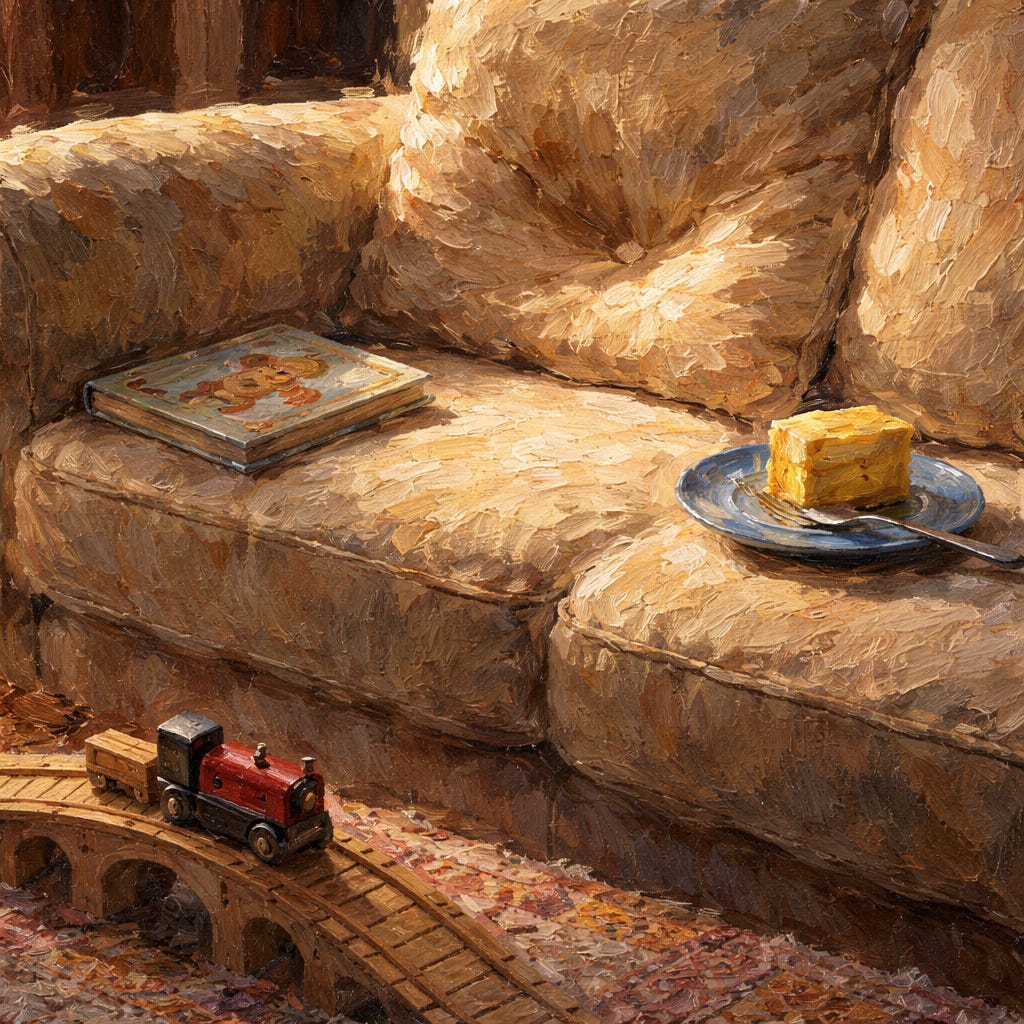
The cake is cooling on the rack by the window. I made it early, before the kitchen got warm, and now it smells the way it used to smell on Saturdays when Claire was small. Vanilla, butter, that warmth a cake gives off when it’s just out of the pan. I’ve put out the small blue plates, the ones with the rabbits around the rim, because Henry has always loved the rabbits. He used to turn the plate slowly while he ate, working his way around, naming each one. Six rabbits. He could do all six by the time he was three.
I got out the wooden train as well. It lives in the closet under the stairs now, in the basket I keep for him, and I brought the basket up to the living room and tipped it gently onto the rug. The track was a bit tangled. I sat on the floor and worked the pieces apart and laid out the long oval he likes, with the bridge in the middle and the little station at one end. The engine is the red one. He always wants the red one.
Claire texted at ten to say they were on their way. Be there by 11, sorry running a bit behind. No kiss at the end. I noticed and then I told myself off for noticing. She’s busy, that’s all, and if she hasn’t got time for a kiss at the end of a text then she hasn’t got time, and that’s the end of it. I put the phone face-down on the counter and went back to the cake.
I had to ask her three times about today. The first time she said she’d see. Then she didn’t bring it up again. The second time she said this week was hard. The third time I said, sweetheart, it’s been almost two months since I had him on my own, and there was that pause, and then she said all right, Wednesday, just for a few hours. She has been so protective of him this year. It must be the kindergarten — all the new germs going around, she’s just being careful, that’s all it is.
I’m icing the cake pale yellow, because Henry once told me that yellow is the color of Sunday. I don’t know where he got it from. He was four, in the garden, and he said it the way small children say things, out of nowhere. Yellow is the color of Sunday, Grandma. I’ve remembered it ever since. It isn’t Sunday today, it’s Wednesday, but I thought he might like it anyway.
The car pulls into the driveway at twenty past. I hear it before I see it, and I wipe my hands and go to the door and open it before they’ve even got out, the way I always do. Claire is unbuckling Henry from the back seat. The gray sweater again, the one she’s been wearing a lot lately. Her hair is up. She looks tired. She lifts him down and he stands on the gravel for a moment looking at his shoes, and then she takes his hand and they come up the path together.
“Hello sweetheart.” I bend down with my arms out, and Henry comes into them, but not the way he used to come into them. He used to run the last three steps. Today he walks the whole way and then leans against me, his head against my shoulder, his small hand coming up to the back of his own neck. I hold him for a moment longer than I might have, and then I straighten up and look at Claire.
She doesn’t come in. She used to come in. She used to sit at the kitchen table for half an hour, longer sometimes, with a coffee and a slice of whatever I’d made, and we’d talk while Henry played at her feet. She hasn’t done that since the spring. Now she stands on the doormat with her keys in her hand.
“Thanks Mom.” Just that. Thanks Mom, the way you’d thank somebody at the post office.
“I’ll be back by three. Three-thirty at the latest.”
“Don’t rush. We’re going to have a lovely time, aren’t we Henry.”
Henry doesn’t answer. He’s looking at the doormat.
“You want a coffee before you go?”
“I really can’t. I’ve got to get to the pharmacy before they close for lunch and then there’s the thing at school.” She crouches down and kisses Henry on the top of the head. “Be a good boy for Grandma. I love you.”
“Love you,” Henry says, into my leg.
She straightens up and looks at me, and for a moment I think she’s going to say something else, and then she doesn’t. A small smile that doesn’t quite reach the rest of her face. She touches Henry’s hair once, and she goes. I watch her walk down the path. I watch her get into the car. I watch the car back out and turn into the road and disappear behind the hedge.
Henry is still leaning against my leg.
“All right then, my darling. Shall we see what Grandma’s been up to in the kitchen?”
He follows me down the hall. I have to slow my walk because he’s slow today. Claire said in the text yesterday that he’d been up since five, and a small boy who’s been up since five at eleven in the morning is a tired small boy, that’s all. He sits at the table and looks at the rabbit plate, and I wait for him to start turning it. He doesn’t. He puts a finger on one of the rabbits and leaves it there.
“Do you remember their names?”
“Yes.”
“Will you tell me?”
He thinks for a moment. “This one is the brown one.”
“That’s right. And what about this one?”
“The one with the ears.”
“They’ve all got ears, honey.”
“The big ears.”
“That’s right. Floppy, isn’t he. What was his name?”
He looks at the rabbit. His hand comes up to his temple, the side of it, and he presses the heel of his hand there for a second and then puts the hand down.
“I don’t remember.”
“That’s all right. Grandma doesn’t remember either.”
Which isn’t true. The rabbit’s name was Mr Floppy. Henry named him, when he was three, sitting in this same chair on his mother’s lap. I don’t say so. I cut him a slice of cake and put it on the plate and push it toward him and I sit down opposite.
It’s when he picks up the fork that I think of the room. Just for a moment. The way he’s holding the fork — his whole fist around it, instead of the proper grip he learned last year, he used to be so proud of the proper grip — and the way his other hand is in his lap, and the fluorescent strip in the ceiling of the room was buzzing the whole time, that low electrical hum you don’t notice until you do. The nurse had a printout and she was running her finger down the printout. And we’ll do the booster today and the flu shot in the other arm at the same time, save him another visit, and you said he hasn’t had any of the COVID ones yet, so we’ll start him on those today, and then —
“This is nice cake, Grandma.”
“Is it, my darling? I’m glad.”
He’s eaten about two bites. He puts the fork down. He looks at the cake for a long time and then he looks up at me, and his hand comes up again, this time behind his ear, and he scratches there with two fingers and puts the hand down.
“Are you full already?”
“A bit.”
“Shall we save the rest for after the trains?”
“Yes please.”
I cover his plate with another plate and leave it on the table. I take his hand and we go through to the living room. He sees the train laid out on the rug and stops at the doorway and looks at it, and for a second I think his face is going to do what it used to do — the big slow grin, the catching of breath, the running over to crouch down and pick up the engine — and then it doesn’t. He walks over and sits down on the rug beside the track and picks up the red engine and holds it in his lap.
“Shall we make it go around?”
“Yes.”
I sit down on the rug too, with some difficulty, and put a few of the cars on the track behind the engine and show him how to push it. He pushes it. The engine goes around the long oval and over the bridge and back to the station and stops. He looks at it.
“Again?”
“Yes.”
He pushes it. It goes around. He watches it. His hand comes up to the back of his head, the nape, and he holds it there for a few seconds while the train goes around the bend.
“Have you got an itch, honey?”
“No.”
“All right.”
We do the train for a while. He doesn’t add the cars himself, the way he used to. He doesn’t make the engine sounds. He doesn’t tell me where the train is going — he used to tell me, to the beach Grandma, to take the people to the beach, and they have got their buckets, can you see their buckets — he just pushes the engine around the oval and watches it come back to the station and pushes it again. After a while he stops pushing it and leaves it on the bridge and lies down on the rug on his side, his cheek on the carpet, and looks at the engine from there.
His hand goes up to the back of his head again. He keeps it there. I watch him watch the train, and a thought begins in me, cold, and I don’t let it finish. I look at the bridge instead. Henry’s grandfather made that bridge from a kit when Henry was two. He sanded the edges so they’d be smooth. He was very particular about the edges.
He’s so still. He used to be a little engine himself on this rug, this exact rug, on his hands and knees pushing the train and making the sounds and telling the whole story of the journey, and now he’s lying on his side watching it not move. He’s just tired. He had a long morning. He’s started kindergarten and kindergarten is a lot for them.
I think of Claire on the phone in the spring. The conversation was about something else — about David’s mother’s birthday lunch, I think — and then I asked the way I’d been asking, every time we spoke. Have you booked his shot yet, sweetheart. And there was that pause she’d started doing, and then she said, Mom, I told you, we’re thinking about it. And I said, very calmly — I’d decided I was going to be calm about it, I’d decided I wasn’t going to lose my temper the way I had the time before — Honey, what is there to think about. They’ve approved it for his age now. The grandkids of every single one of my friends have had theirs. Linda’s two had it the week the FDA cleared it. They’re all fine. What are you waiting for. And Claire said, I’ve been reading some things. And I said — I remember exactly how I said it, because I was so pleased with the gentleness of it — I said, oh sweetheart, please don’t go down that rabbit hole. Please. I worry about you when you start reading those things. There are some very strange people on the internet right now and they prey on young mothers, they really do. The actual scientists, the actual doctors, the CDC — they’re all saying the same thing. Promise me you won’t.
And then I said it, because she had to hear it, she had to hear what she was actually doing, what she was asking of me. Sweetheart, I have to think about myself too in all this. I’m not as young as I was. They’re saying you can pass it on without even knowing you have it. That’s what asymptomatic means, honey. He could be carrying it right now and we wouldn’t know. If he brought it home from school and gave it to me, at my age, I don’t know what it would do to me. I really don’t. Look what it did to Margaret. Margaret hasn’t been right since that first winter. She still can’t get up the stairs without stopping. I don’t want to be Margaret. I want to be here. I want to be here for him. Don’t you want me to be here for him.
There was a long silence on the line. And then Claire said, very quietly, yes Mom. And I said, well then, sweetheart.
It wasn’t only that conversation. There was the Sunday dinner with David carving and me waiting until he was at the head of the table with the knife in his hand before I said, casually, looking at the gravy — David, has Claire mentioned to you that she’s having second thoughts about getting Henry his shot. And David’s face. The silence that went round the table. Claire saying Mom in that low voice and me saying, well, I think David has a right to know, sweetheart, he’s Henry’s father, and he has parents too. And David saying, Claire, what’s this about, and Claire not having an answer ready because I hadn’t given her time to have one ready.
There was the article. The little girl in Texas whose parents hadn’t, and she went to a family barbecue and her grandfather caught it from her and was dead within ten days, and the family was speaking out so other families wouldn’t have to go through what they’d been through. I sent it to Claire with no message, just the link. She didn’t reply. I knew she’d read it because the read-receipts thing was on then. I didn’t bring it up. I didn’t need to.
There was the night she called me crying because Henry had a fever and she didn’t know whether to take him in. I let her cry for a bit and then I said, honey, this is what I mean. This is what I’ve been trying to say to you. What if it’s the virus. What if he’s had it this whole time and you haven’t known, and he’s been around you, and David, and you’ve been around me. Imagine if he gave it to me and I was the one in the hospital and you were sitting there thinking I could have prevented this. I couldn’t bear that for you, sweetheart. I really couldn’t. And she sniffed, and said I know, Mom, I know, I’m sorry. And I said, don’t be sorry, my love. Just book the appointment. Will you book the appointment. And she said she would. Not that week, not the week after, but eventually she did.
I never raised my voice. Never once. I didn’t tell her she was being stupid or selfish or any of the things I could have said. I was patient. I was loving. I held her hand through it. That’s what mothers do. You don’t bully your daughter into doing the right thing. You walk alongside her until she sees it for herself.
It’s when he picks up the fork that I —
“Grandma.”
I look down at Henry. He’s rolled onto his back on the rug and he’s looking up at me. His hand is at his temple again.
“Yes my darling.”
“Can we read the bear book?”
“Of course we can. Where is the bear book?”
“In the basket.”
I get up and go to the basket and find the bear book — a book about a bear who can’t sleep, and Henry has loved it since he was two, and I’ve read it to him so many times I could recite it with my eyes shut — and I bring it back and sit on the sofa and pat the cushion beside me. He gets up slowly from the rug and comes over and climbs up and settles into the crook of my arm.
I read it slowly. He used to point at the bear on every page and say bear, even when he was old enough not to need to, because it was the joke between us. He doesn’t point today. He listens. At the end, when the bear finally falls asleep, he is very still against my arm, and I think for a moment he’s fallen asleep himself, and then he stirs and lifts his head and looks at me.
“Again?”
“Of course, my love. As many times as you like.”
I read it again. He listens. His hand comes up halfway through, to the side of his head, behind the ear, and he holds it there for the rest of the book.
When I close it the second time he doesn’t ask for it again. He just lies against me. I look down at the small hand pressed against the side of his head, and I think — for less than the time it takes a thought to form — I think what if it was the — and I’m thinking about Mary instead. What Mary said at book club last week. Mary’s grandson is the same age as Henry, and he’s been very quiet lately too, and Mary thinks it’s the kindergarten, all that sitting still, all those new children. Henry has started kindergarten too of course. That’ll be it. They all adjust at different rates. Linda was saying the same about her two. There’s been a lot of that going around with the children, a lot of quietness, a lot of tiredness — they probably caught something at school, you know how kindergartens are. Margaret hasn’t been right either, of course, but that’s different, that’s from the virus, that’s from before.
The clock on the mantelpiece says ten past two. Claire said three at the earliest. I don’t move. I don’t want to move. I keep my arm around him.
I should ask Claire how he’s getting on at school. She hasn’t told me. I had to hear from David, at the birthday lunch, that Henry had started — I didn’t even know which school in the end, they were deciding between two and Claire never told me which one they chose. David said it casually, as if I’d already know, and I had to pretend I did. I told myself she’d been busy, it had been a hectic month, she’d probably mentioned it and I’d forgotten. But she hadn’t mentioned it. She used to tell me everything about him. Every milestone, every funny thing he said. Every photograph from her phone went straight to me, sometimes two or three a day. Now she tells me he’s been up since five and that’s the size of it.
The fluorescent strip was still buzzing. The nurse had finished and was writing something on the printout and Claire was crouched in front of Henry, and Henry was on the chair with his sleeves still pushed up, and he’d stopped making the sound, but his eyes were doing something. They weren’t focusing on Claire. They were focusing past her, at the wall, and his head was tilted slightly to one side and his mouth was a little open and his hand — his small hand, his right hand, the hand he writes with — had come up and was pressed against the side of his head, against his temple, and was staying there. Claire said Henry? and he didn’t answer. Claire said Henry, sweetheart, look at Mommy. He didn’t. The nurse looked over and said, that can happen, the dizziness, just give him a minute, it’s very common with this one. And she carried on writing. Claire took his other hand and held it. After about half a minute, maybe a minute, his eyes came back. He looked at Claire. He said, I’m all right Mommy. Claire said, good boy, you were so brave. She helped him down off the chair, and his hand stayed pressed against his temple all the way out to the car.
I’d forgotten that. I’d forgotten his hand stayed there all the way out to the car. He sat in his car seat with his hand against his head and Claire buckled him in and I sat in the front. I said, brightly, who’d like an ice cream. Claire said, Mom, I think we should just get him home. I said, of course, of course, silly me. We drove home and Claire carried him from the car to the house and I waited in the kitchen while she put him to bed. When she came back down she made coffee and didn’t say anything for a long time. Then she said, I shouldn’t have done it. Very quietly, into her cup. I said, honey, you did exactly the right thing, he was so brave, he’ll be right as rain in the morning. Claire didn’t say anything else.
And he was right as rain in the morning. He was. He came down for his breakfast and he ate his toast and he watched his cartoon.
He just hasn’t been quite the same since.
Henry stirs against my arm. His hand comes down from his head and he sits up a little and looks at me, and his face is very serious, the way it gets now, and he says, “Grandma, when is Mommy coming?”
“Soon, my darling. She said three. It’s about half past two now.”
“Oh.”
“Are you missing her?”
“A bit.”
“She’ll be here very soon. Shall we have the rest of your cake while we wait?”
“No thank you.”
He puts his head back against my arm. We sit like that. I don’t know how long. I look at the train still on the bridge in the middle of the rug, and the bear book on the cushion beside me, and Henry’s hand which has come up again to the back of his neck. He’s just tired. He’s just adjusting. He’s at that age where they go quiet for a bit. Claire has been worrying too much, she’s making herself ill with worrying, and I’ll say to her when she comes — gently, not in a way that puts her back up — I’ll say, honey, look at him, he’s fine, he’s just tired, we’ve had a lovely afternoon and he’s eaten some cake and we did the train and we read the bear book twice, and you did the right thing for him, you did the loving thing, please stop torturing yourself, please.
Claire’s car turns into the driveway at five to three. Five minutes early. She’s never been five minutes early in her life.
I hear it and I don’t get up straight away. I sit with Henry against me for one more moment. Then I kiss the top of his head and say, “Mommy’s here, my brave boy,” and I help him down off the sofa and we walk to the front door together, his small hand in mine, his other hand at his temple.
Claire is on the path. She sees us and smiles, the smile that doesn’t reach the rest of her face, and Henry lets go of my hand and walks down the path to her, and she crouches down and gathers him up. She holds him for a long time. Longer than the goodbye this morning. Over his shoulder she looks at me, and I think she’s going to say something, and she doesn’t.
“How was he?”
“He was perfect. We had a lovely time.”
“Did he eat?”
“A little bit of cake. He wasn’t very hungry.”
“No. He hasn’t been.”
She straightens up, holding him against her hip. He’s too big to be carried but she carries him anyway. His head goes against her shoulder. His hand is still at his temple. She has shifted him so he’s between us now, his small body turned toward her chest, the back of his head toward me. I can no longer see his face.
“Thanks Mom.”
“Any time, sweetheart. Any time at all. You know that. Whenever you need me.”
She nods. She doesn’t say anything to that. She turns and walks down the path and puts him in the car and buckles him in. I stand on the doorstep and I wave, and Henry doesn’t wave back, but Claire lifts his small hand and waves it for him, and then she gets in the driver’s seat and they go.
I stand on the doorstep until the car is out of sight.
Then I go back inside and close the door and walk down the hall to the living room. The train is still on the bridge. The bear book is on the cushion. The basket is open on the rug. I sit down on the sofa, in the warm patch where Henry was, and put my hand on it.
He’s just tired, I tell myself. He’s just adjusting. He had a long morning. He’s just going through a quiet stretch. Claire is making herself ill with worrying and there is nothing to worry about. I did the right thing by her. I walked alongside her. I helped her see what was best for him. I helped her see what was best for all of us. That’s what mothers do for their daughters. That’s what I did for mine. He’ll be right as rain. He will.
The kitchen still smells of vanilla.
Support This Work
This work remains free because paid subscribers make it possible. If you find value here, consider joining them.
Paid subscribers get access to all books — including The DMSO Book, The Kitchen Remedies Guide, Chlorine Dioxide, The PSA Trap, Breast Cancer, and more — with 1-2 new books added each month. Plus the Deep Dive Audio Library: 180+ in-depth audio book summaries and discussions.
Pricing Update: The annual subscription moves from $50 AUD to $50 USD on May 1 — the first change in five years. Current paid subscribers keep their existing rate. Free subscribers can lock in the current price by upgrading before May 1.
I really didn't like this story at all and I will tell you why. First of all- I hate to see grandmothers portrayed as villains, because most all the ones I know fought those shots like hell from Day One.
I have NEVER trusted regular doctors and dentists because of all the harm that they caused me over many years.
In my experience it was my adult children who bought the CVD lie, hook line and sinker. THEY got my grandchildren jabbed and jabbed again and I swear I can see certain signs that worry me. We are still not even allowed to discuss CVD or medical issues at their dinner tables.
Our Satanic Overlords did a great job with their CVD bio-weapon. May they all rot in hell for what they did to ourselves, our families and our friends.
I can't imagine how many times scenes like this happen. That grandma knows exactly what happened to her grandson, but she has to try to convince herself she's wrong or she won't be able to live with herself. Her daughter knows too, and of course she resents her for talking her into getting him the shots. I worry for my own grandchildren because my daughter says he'll get whatever shots they say he needs to go to school. I'll share this with her.