
Interview with Mike Chappelle
Dr. Antonioni's Imaginary Disease—The 1988 Play That Stopped Being Satire

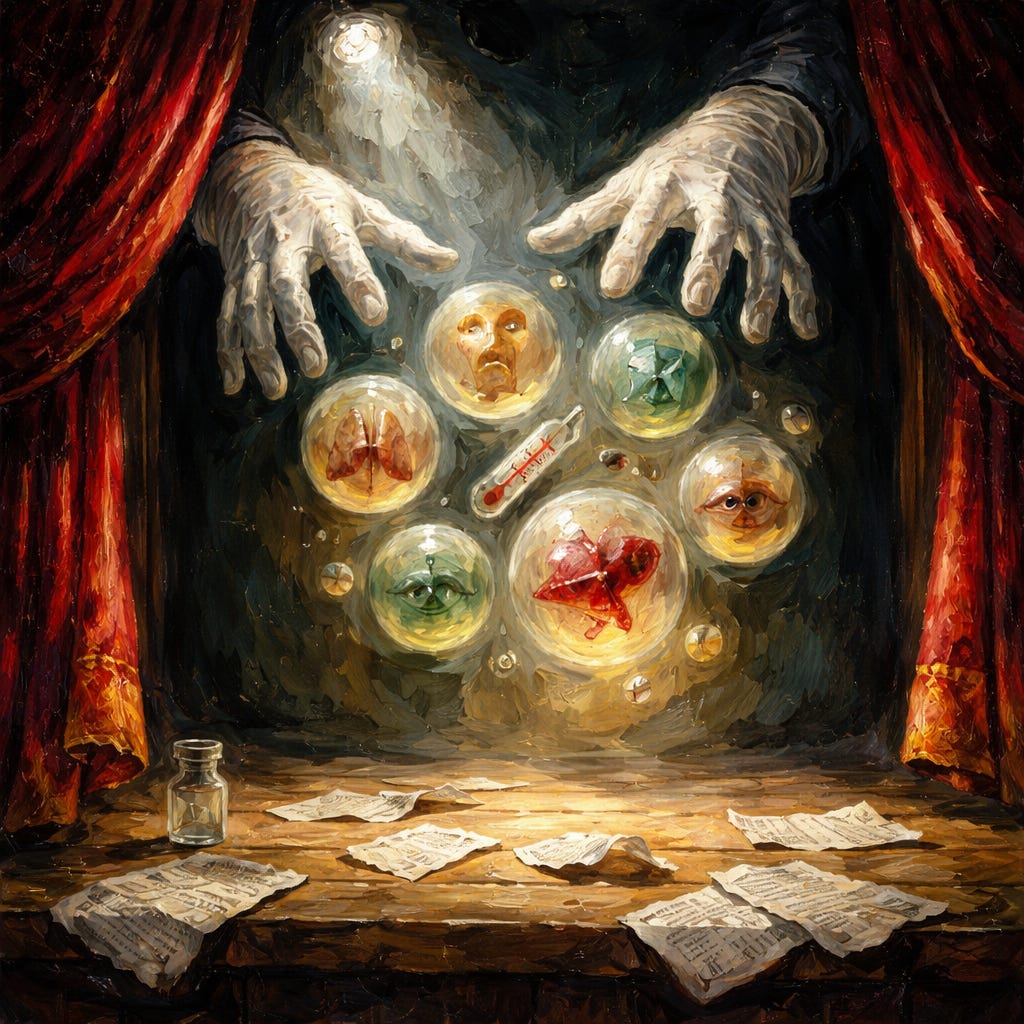
In 1988, a character named Dr. Michelangelo Antonioni walked onto a Denver stage and explained his scheme: borrow symptoms from existing diseases, combine them under a new name, wait for the epidemic to reach its predicted peak, release a vaccine, lobby the federal government to make it mandatory for every man, woman, and child, then simply redefine the borrowed symptoms back to their original conditions—officially ending the epidemic. The vaccine could be water. No one would be hurt. And he would be a shoe-in for the Nobel Prize. Audiences laughed. The mechanism was too cynical, too brazenly fraudulent to map onto reality. Then COVID arrived, and elements of that satirical scheme—mandatory vaccination campaigns, disease categories adjusted by administrative decision, epidemic status tied to classification and testing protocols—stopped being funny. As Chappelle notes, “things considered so over the top in the 1980s that they appeared ridiculous” actually happened.
Dr. Antonioni’s Imaginary Disease ran for a decade across venues that ranged from Marilyn Meganity’s Heatley’s Tea House to the University of Colorado School of Medicine, from a Nutritious Christmas Dinner in San Francisco to Kaiser Permanente’s annual banquet in Denver. It won the city’s 1989 Critics Circle Award. The play drew attendees including retrovirologist Peter Duesberg, CIA whistleblower John Stockwell (who recorded a promotional spot calling Antonioni “someone to watch”), and historian Howard Zinn, who viewed a video recording. At the American Medical Student Association conference, medical students approached Chappelle afterward asking about his sources; the head of the virology department asked the student who’d invited him, “Why did you invite the enemy here?” Some doctors, even after the performance ended, weren’t entirely sure Antonioni was fictional.
Chappelle didn’t set out to become an expert on medical history and public health. In 1988 he was a musician between bands when a friend asked him to perform something at her tea house. AIDS panic saturated the media—the fatal equation HIV = AIDS = DEATH—and his elderly neighbors were terrified they would “catch” it. He told them he’d look into it. What he found led to a one-time performance piece; positive reviews led to an extended run; the extended run led to years in medical school libraries, building the knowledge to defend what he was saying publicly, even as a fictional character. That trajectory from accidental provocation to sustained research defines both the play and the interview that follows.
With thanks to Mike Chappelle.
mikechappelle | Mike Chappelle | Substack

Support Independent Research
This work remains free because paid subscribers make it possible. If you find value here, consider joining them.
What paid subscribers get: Access to the Deep Dive Audio Library — 180+ in-depth discussions (30-50 min each) exploring the books behind these essays. New discussions added weekly. That’s 100+ hours of content for less than the price of a single audiobook.
[Upgrade to Paid – $5/month or $50/year]
Get in touch Essay ideas, stories, or expertise to share: unbekoming@outlook.com
1. Mike, please tell us what you were doing in 1988 when you first performed “Dr. Antonioni’s Imaginary Disease” at Marilyn Meganity’s Heatley’s Tea House in Denver. What led you to write a one-man play about a doctor who invents a disease?
In 1988 I was between bands when my good friend Marilyn Meganity, she of the legendary Mercury Cafe, invited me to perform at Heatley’s. AIDS, at that time, was the disease panic being featured, and it was expressed by the fatal equation HIV = AIDS = DEATH, where death would come swiftly and in a horrible way. My neighbors (an elderly and monogamous couple) were terrified that they would “catch” it. I told them I was suspicious of the media narrative and that I would look more closely into the AIDS hypothesis, do my own research as they say. In doing so I found out quite a lot, not just about AIDS, but the fields of medicine and public health in general. First of all a number of highly credentialed scientists and doctors at the top of their respective fields were challenging the HIV/AIDS theory, and these challenges had not yet been reported, or were being reported inaccurately. When I reviewed what I was learning with my neighbors, they listened intently, questioned me, and — eventually — were palpably reassured. This conversation with my neighbors struck me as profound and dramatic. These were the thoughts floating around in my head. So when Marilyn asked me to “perform something” at Heatley’s, and since I wasn’t in a band, I decided to take a shot at writing a short performance art piece as a way to bring what I had learned to the public and to challenge what the public was being told, not only about AIDS, but about the manufacturing of consent in general. I hit on the idea of creating a character who personifies the medical profession, a doctor who claims credit for a vaccine against a new and frightening disease, Antonioni’s Disease. Marilyn liked the original performance art version, said, “Make it longer and I’ll invite the press.” I did, the local press did show up, reviewed it positively, and Dr. Antonioni was on his way.
2. The play’s central scheme is intricate—Dr. Antonioni borrows symptoms from existing diseases, combines them under a new name, waits for an “epidemic,” then releases a vaccine and redefines the symptoms back to their original conditions. Where did this idea come from? Were you drawing on real historical examples or medical literature?
The idea came from AIDS and the media narrative that was spreading panic about it, it was the COVID of its day. AIDS stands for Acquired Immune Deficiency Syndrome. A syndrome is a collection of diseases. It turns out disease categories are more fluid than we think. Symptoms often overlap. Furthermore, diseases included in the syndrome (AIDS) were being added and subtracted. People could be diagnosed with AIDS in one country, travel to a second country, and get a different diagnosis. While it was sadly true that people were dying, and they are always dying, the question is, How are these deaths classified or more pointedly: Who or what is to blame for excess morbidity and mortality in a population? The asking and answering that question is where the idea for the play originated.
Regarding was I “drawing on real historical examples or medical literature?” my knowledge deepened over time. As I said, Dr. Antonioni was originally intended as a one-time performance art piece for an audience that was interested in avant-garde, experimental kinds of things. For the piece I had drawn primarily on two sources: The Covert Action Information Bulletin, (a journal published by former CIA agents as I recall) which had a special issue devoted to AIDS, and Confessions of a Medical Heretic by Dr. Robert Mendelsohn. I found these sources convincing and sufficient. However, once I began performing the play on a regular basis, I realized that if I was going to continue speaking publicly on this topic, albeit as a fictional character, I needed to stay up to date. So for the next few years I spent serious hours in the med school library, reading not only the current state of the art AIDS research, but also diving deeply into the ocean of historical data on medicine and public health.
3. Dr. Antonioni has a densely specific fictional biography—Georgetown Medical, the Kennedy Institute of Ethics, consultant for Dow and Genentech, Knight of the Sovereign Military Order of Malta. How did you construct this character’s credentials, and what were you satirizing with each layer?
I constructed Antonioni’s particular credentials out of my own experience and interests. My father had wanted me to be a doctor and I had started out to become an MD. I made Antonioni a doctor. I had friends in college who went on to Georgetown Medical School, so that’s where Antonioni went. It just happened Georgetown was a center for MK Ultra experiments. Georgetown also has an Institute of Ethics named after Joseph P. Kennedy. Since I was raised Catholic, and the Knights of Malta is a Catholic society, it was only natural for Antonioni to be catholic and a Knight. Dow Chemical was in the news at that time for poisoning people and the country of Vietnam with agent orange. AIDS researchers had come directly out of Nixon’s failed War on Cancer, so I transitioned Antonioni from bedside to bench and made up a powerful position for him at the NIH. It was a one thing led to another kind of thing.
The number of credentials were intended to be almost reasonable, but over the top, listing so many that they became a joke in themselves, signaling authority and prestige, but also satirizing them.
At each layer I was satirizing the whole thing: the politics of germ theory, medicine, public health, Big Science, and the pharmaceutical industry. I aimed to connect how the various aspects arose, evolved, had been captured, and were serving vested interests, beginning with germ theory in the late 1880s in Germany and later, in the United States and internationally, how reductionist laboratory medicine, science, and public health were institutionalized under the leadership of the Rockefeller and Carnegie foundations. Antonioni, my personification of medicine, was a seriously compromised individual, any institutions affiliated him were automatically satirized and assumed guilty by association.
4. This is a one-man show you performed for years across multiple venues. What’s the challenge of inhabiting Dr. Antonioni for a full performance? Did your relationship to the character change over time?
The first challenge was stage fright. Other than kindergarten and 7th grade I had no acting experience; now suddenly, for an hour or two every weekend, I found myself on stage alone before an audience that I was there to entertain and inform, while deconstructing a frightening ongoing mainstream media narrative. For a year or so, I kept wondering, what have I gotten myself into? Eventually self-assurance as an actor grew, and confidence in the message itself also grew based on knowledge that came from hours spent in the med school library.
The main thing regarding any change in my relationship to the character over time was his motives for telling the audience what he has done. Originally I had him “confessing” because he had become a victim of his own propaganda, believing he had caught his own imaginary disease. He hoped that by coming forward with the “truth” he could cure himself. However, over time and especially after making my movie, I’ve come to consider Antonioni as a victim of MK Ultra, perhaps a beta test for the next imaginary disease.
5. You performed this play for some unexpected audiences—Kaiser Permanente’s annual banquet, the American Medical Student Association conference. The material mentions some doctors were “annoyed” to discover Antonioni wasn’t real. What was it like performing this satire directly for medical professionals?
Those were exciting and hopeful performances. Members of the medical profession stuck their necks out to get me in front of those audiences. I did not want to let them down. The med student experience was particularly gratifying; a number of students came up afterwords and asked into the research behind the play and where and how I got my sources. I was told by the student who invited me to the conference that the head of the virology department said to him, Why did you invite the enemy here?
6. The play weaves together medicine, media, government funding, and corporate influence on public health. When you perform or discuss the work now, which of these threads do audiences tend to latch onto most?
I haven’t been doing theater for a while, so it’s the movie that people are commenting on now. Since my performing days, COVID changed everything, almost everything, that is. Live performances of Dr. Antonioni’s Imaginary Disease took place during the alleged epidemic that day, and the play had elements in it considered so over the top in the 1980s that they appeared ridiculous, and indeed you can watch audiences laughing at that them. However during COVID these things actually happened. That leaves a lot of room for thought when watching the movie. The main audience takeaway seems to be how prescient it was, which brings up all the threads you listed. As to which ones most, I guess media manipulation and pharmaceutical company influence.
7. You’ve mentioned that notable figures came to see the play—John Stockwell, Peter Duesberg, David Barsamian, and Howard Zinn saw a video of it. Were there audience responses or encounters over the years that particularly surprised you or shifted how you thought about the work?
What stuck me most over the years was the level of audience attention and spontaneous creativity. There’s quite a bit of science, medicine, public health, and their histories woven into the play, which I think is challenging stuff for a night out at the theater. On the best nights, when everything was working, it was stunning to see an audience of strangers, without any prompting, figuring out that they were in an interactive performance and then participate in it. On those best nights everyone in the room was pretending that Dr. Antonioni was real (although some folks, even doctors apparently, weren’t sure), and they would interact with the “Doctor,” asking him all sorts of “real” questions: smart, challenging, funny, and insightful ones, and in a way that allowed me to stay in character when answering them. That was the best. We, the audience and I, were examining real and significant issues together in a fictional setting. The Q & A at the end of the movie highlights this experience quite well.
Regarding the personalities you mention, each of them made significant and positive contributions as to how we see the real world and how we might help change it. Looking back, I was quite fortunate that they took the time to listen to what I had to say.
Being introduced by David Barsamian to John Stockwell certainly affected me. Having a courageous whistle blowing former field agent of the CIA take an interest in your work and engage in a serious discussion with you about the manipulation of the public isn’t something that happens every day. It brought a heightened sense of reality and urgency to what I was doing, as well as underscoring the potential reverberations of creative endeavors. Even now, so many years later, recalling John’s willingness to help with the PR for the KGNU benefit makes me feel more connected to the world.
By the way, Peter Duesberg once suggested I rename the play Dr. Antonioni Fauci’s Imaginary Disease.
8. The play includes satirical humor but also darker material—the nightmare monologue where Antonioni describes drowning, a plastic bag wrapping around his head, sifting through a childhood dump. How did you approach balancing comedy with those more unsettling moments?
I’m pretty emotional, sometimes I laugh until I cry and vice versa. So the balancing of comedy and trauma seems to be part of my makeup. The actual nightmare scene came about through trial and error. The early versions of the play had Doctor Antonioni just sitting there delivering an informal lecture, briefly he referred to having nightmares. As I became more confident as an actor, I took more risks and let more emotions out. At one point I figured what the heck, I’m gonna act the nightmare out, but try to stay in character while doing it. I wasn’t just going to describe the forces that were in play when Antonioni was born, the times he moving through, and how his character was influenced, I was going to express these things as dramatically as I could. I guess that’s what actors do. I was lucky in a lot of ways, stumbling into a play that I was writing or revising while learning how to act at the same time.
9. You’re also a singer-songwriter. How does your musical background inform your approach to writing and performing theater?
Regards music, the experience of being in a new wave/punk rock band definitely helped with the confidence. And when it comes to writing, including creating music videos, the trick is to have something to say and not settle on the way you say it. And right now the world needs some things to be said, creatively and with care.
10. The play ran from 1988 through at least the late 1990s—the Conference on World Affairs in 1998 is among the venues listed. How has the reception of “Dr. Antonioni’s Imaginary Disease” shifted over those 35-plus years?
The reception of both the play and the movie of the play, with the exception of one night-mare performance in 1990, has been both consistent and positive over the years. Audiences of diverse demographics, be they patrons of theater who simply love going to live performances, or those who rarely go to theater but are only coming because they’ve been told it’s a dark comedy having to do with a relevant medical public health issue, or those who experience it today as movie, seem to agree that it’s important and entertaining.
11. You had footage of the play from 1988 and 1990 sitting in your possession for decades. What made you decide to finally turn it into a film now, and what did that process involve?
January 2025 I wandered into the Idea Lab on the fourth floor of The Denver Public Library and discovered its state of the art film making software on powerful computers available for free to the public. I thought, hmm, I’ve got these tapes I’ve been dragging around for 30 years or so, I wonder if I can figure this tech stuff out and make a movie.
One essential the processes depended upon was librarians. The Denver staff are some of the kindest, supportive, and knowledgeable people I’ve had the pleasure to work with.
During the 8 months it took to get a handle on the software I was pretty obsessive, the process involved getting to the Lab the minute it opened every day and then rushing to get to one of the computers.
12. Your bio describes you as an oral historian. What does that work look like for you, and is it connected to what you’re focused on currently?
The oral history job was an effort to get some credentials for writing a book. Early 1990s I had an unpleasant online exchange with Noam Chomsky regarding the HIV hypothesis. He essentially said had no credentials I had no right to be saying what I was saying and that no one should take me seriously, at least he wouldn’t. That experience convinced me I should get some credentials, maybe a PhD in the history of medicine and public health, and then write a book. The quest for a PhD morphed into employment as an oral historian for the Endocrine Society. I thought that actually work experience in a medical historical field might pass for a credential somewhere on a book jacket. The job itself was merely to document the contributions of the interviewees (who were all prestigious endocrinologists) to the field of endocrinology. I wasn’t asking any critical questions. However being the Endocrine Society’s oral historian for seven years is a credential of sorts. One day soon I’ll put a link to those interviews on substack.
13. Beyond the film and oral history, what projects or questions are occupying your attention right now?
I’m making music videos, co-writing new songs, and doing a remake of Dr. Antonioni. Recently a third video of the play, one which was filmed at Wartburg College, has surfaced. I plan to rework this new footage into a second movie.
But most important of all is that I’m part of a small community here in Denver and we are working to build solidarity and an independent but aligned parallel local economy.
14. After all these years with this material, what do you hope people take away from watching “Dr. Antonioni’s Imaginary Disease”?
I hope the movie helps expose the degree to which we are being manipulated. l hope people come away validated and feeling inspired to act creatively in forms that suit their skills and personalities.
But if the play only accomplishes one thing, perhaps the most important would be to bring attention to a dissertation and a book referenced briefly on screen during the movie’s closing. These two academic works are unknown to the alternative health movement. I believe once they are discovered and their content spreads throughout the alternative health community they will have a significant positive effect on public awareness regards health and the politics of health.
1. Cultures of Bacteriology: Formation and Transformation of a Science in France and Germany 1870-1914 (Ph.D. diss., Princeton, N.J.: Princeton University, 1996) by John Andrew Mendelsohn.
This is the best history of germ theory ever written. It was never published, in fact it was withdrawn from publication. However, it is the work of a well-respected academic. It frames the emergence of today’s dominant version of germ theory as a conflict between Pasteur and Robert Koch, which Koch won. Mendelsohn’s history differs from the Terrain Theory frame which focuses on the conflict between Pasteur and Bechamp. Nonetheless, Mendelsohn’s dissertation offers critical support for Terrain Theory.
2. Death is a Social Disease: public health and political economy in early industrial France, University of Wisconsin Press, 1982 by William Coleman
Before the rise to dominance of germ theory, studies in France found that excess morbidity and mortality were the result of social factors. Solutions on a social level would thus be necessary to improve population health, including elimination of poverty and malnutrition, which in turn implied the necessity for a rise in living standards and a redistribution of wealth. Forty or so years later the germ theory provided a different conclusion: poverty and malnutrition could be downgraded or even ignored as the main cause of disease. Instead a never-ending war was launched against invisible microbes. As shown in Mendelsohn’s dissertation, it was the German government that initially backed this war on microbes approach, which led us to where we are today.
15. Where can people watch the film and follow your work?
You can find my film and work at mikechappelle.substack.com
Book: Medicalized Motherhood: From First Pill to Permanent Patient
Available as a free download. 123 interventions documented across six phases—from pre-conception capture through postpartum surveillance. Includes practical tools: birth plan template, provider interview questions, quick reference card, and a new chapter on interrupting the cascade. Download it, share it with someone facing their first prenatal appointment, their induction date, their cesarean recommendation. The cascade works because women don’t see it coming. This book makes it visible.
Support Independent Research
This work remains free because paid subscribers make it possible. If you find value here, consider joining them.
What paid subscribers get: Access to the Deep Dive Audio Library — 180+ in-depth discussions (30-50 min each) exploring the books behind these essays. New discussions added weekly. That’s 100+ hours of content for less than the price of a single audiobook.
[Upgrade to Paid – $5/month or $50/year]
Get in touch Essay ideas, stories, or expertise to share: unbekoming@outlook.com
Bitcoin: 3Q6BK8x8zjoPaXykQggzvoJxg5FiEbkb3U
Ethereum: 0x4CB0d39d8466a34609318FC1B003B745893788b3
New Biology Clinic
For those of you looking for practitioners who actually understand terrain medicine and the principles we explore here, I want to share something valuable. Dr. Tom Cowan—whose books and podcasts have shaped much of my own thinking about health—has created the New Biology Clinic, a virtual practice staffed by wellness specialists who operate from the same foundational understanding. This isn’t about symptom suppression or the conventional model. It’s about personalized guidance rooted in how living systems actually work. The clinic offers individual and family memberships that include not just private consults, but group sessions covering movement, nutrition, breathwork, biofield tuning, and more. Everything is virtual, making it accessible wherever you are. If you’ve been searching for practitioners who won’t look at you blankly when you mention structured water or the importance of the extracellular matrix, this is worth exploring. Use discount code “Unbekoming” to get $100 off the member activation fee. You can learn more and sign up at newbiologyclinic.com
Big Brother's Coming! - Revealed Secret Plan to Tag Every Man, Woman and Child
by Joe Frick
edited by matrixcutter
October 21, 2009
from ForumPrisonPlanet Website
The following article appears on page 444 of William Cooper's
'Behold a Pale Horse.'
It was originally in the August 1, 1989 edition of The Sun.
Insanely coincidental isn't it ?
This article from 1989 speak of using a Swine Flu pandemic to get people MicroChipped, and exactly 20 years later,
we have the swine flu pandemic in the age of tiny tiny microchips
CODED MICROCHIPS implanted in every person in the country would tie all of us into a master computer that could track anyone down at any moment, and plans for such a system are already under way whether you like it or not!
The secret scheme is being touted as a service for the protection of the people by high government officials, but some insiders who object to the move say it's just another way for Big Brother to control its subjects.
Transmitters
"Top-level national security agents are trying to convince sources in the Bush Administration to begin the project in which every man, woman and child will be implanted with a tiny transmitter," claims Davis Milerand, a critic of government intervention who says he has received leaked information from inside sources.
"They're trying to say this will be a good way for authorities to quickly track down missing persons and children, as well as criminals and spies."
Injections
"But with the astounding technology of today, everything about you could be contained in one tiny microchip, which would be connected to a government computer.
"Any government agency will know what any person has done and is doing at any time."
Other sources say the tiny transmitters can be injected painlessly from a tiny gun in humans without them even knowing it through a nationwide vaccination program.
"All the government would have to do is make up something like the swine flu vaccine," Milerand says.
"Imagine if they said there was a vaccine for AIDS. People would rush in droves to get shots.
"The doctors themselves may not even know what they're injecting. They could be told the microchips are genetic implants that reprogram the body into fighting disease."
He adds:
"The program would require all federal, state and local government workers to undergo the injections."
"It would only be a matter of time before everyone is implanted with a microchip, a slave to the government."
This was amazing! Had never heard of this. Just the fact you showed up Mr. Chomsky makes you a hero in my book as he suffers from a few blind spots , the Covid scam its just the latest.
Bravo!