
Conspiracy Denial
An Essay on The Ideological Function of a Thought-Terminating Cliché

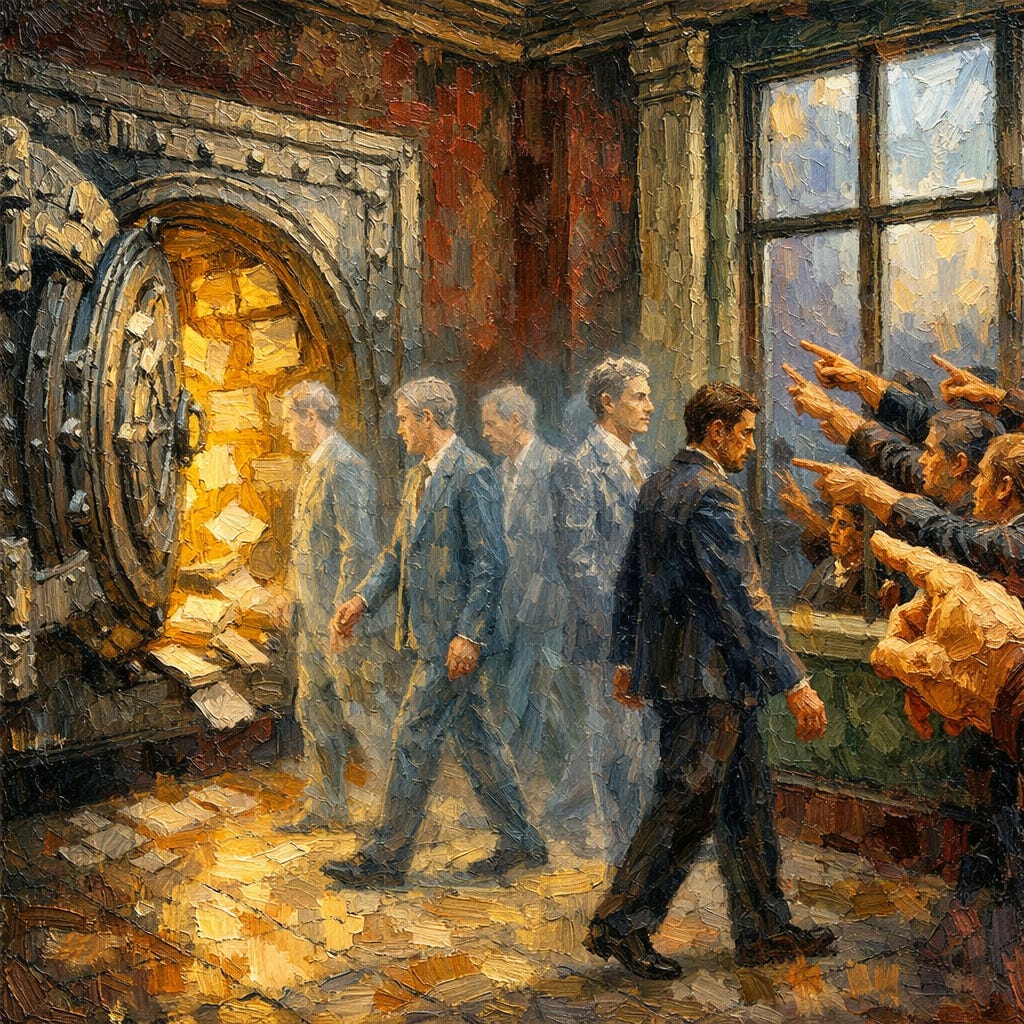
In honour of Michael Parenti (1933–2026), who passed away on 24 January 2026 at the age of 92. He spent his life naming what power prefers to leave unnamed.
In 1837, Abraham Lincoln remarked: “These capitalists generally act harmoniously, and in concert, to fleece the people.”
Today, he would be dismissed as a conspiracy theorist.
That dismissal—reflexive, automatic, requiring no engagement with evidence—is not a mark of sophistication. It is a tell. The question worth asking is not whether conspiracies exist (they are a matter of public record and a recognised concept in law) but why acknowledging their existence provokes such reliable hostility. What work does the label “conspiracy theorist” actually do?
The late political scientist Michael Parenti spent decades answering that question. His conclusion was blunt: “’Conspiracy’ refers to something more than just illegal acts. It serves as a dismissive label applied to any acknowledgment of ruling-class power, both its legal and illegal operations.” The term functions not as a descriptor but as a weapon—a thought-terminating cliché that protects the powerful from scrutiny by pathologising those who scrutinise them.
Conspiracy denial, in Parenti’s analysis, is not skepticism. It is the opposite of skepticism. It is credulity toward power dressed up as critical thinking. As he wrote in Dirty Truths: “Just because some people have fantasies of conspiracies does not mean all conspiracies are imaginary.”
Support Independent Research
This work remains free because paid subscribers make it possible. If you find value here, consider joining them.
What paid subscribers get: Access to the Deep Dive Book Summary Audio Library — 180+ in-depth discussions (30-50 min each) exploring the books behind these essays. New discussions added weekly. That’s 100+ hours of content for less than the price of a single audiobook.
[Upgrade to Paid – $5/month or $50/year]
Get in touch Essay ideas, stories, or expertise to share: unbekoming@outlook.com
The Double Standard
The asymmetry is stark once you see it.
Coal miners consciously direct their efforts toward advancing their interests. So do steelworkers, small farmers, and schoolteachers. Labour unions exist precisely because workers concert together to pursue collective goals. No one calls this a conspiracy theory. It is called organising.
But suggest that the wealthy and powerful consciously concert with intent to defend their class interests, and you have crossed an invisible line. You are now a conspiracy theorist, a crank, possibly paranoid.
Parenti put it directly: “It is allowed that farmers, steelworkers, or schoolteachers may concert to advance their interests, but it may not be suggested that moneyed elites do as much—even when they actually occupy the top decision-making posts. Instead, we are asked to believe that these estimable persons of high station walk through life indifferent to the fate of their vast holdings.”
The double standard operates silently. Workers scheme; owners sleepwalk. The public pursues its interests; elites stumble through history moved by forces beyond their comprehension or control. This is the unexamined premise that makes “conspiracy theory” an effective slur.
Consider a specific example. In 1994, the officers of the Federal Reserve announced they would pursue monetary policies designed to maintain a high level of unemployment in order to safeguard against “overheating” the economy. This was publicly announced. It appeared in the financial pages. The Fed explicitly stated it preferred a deflationary course that would keep workers competing desperately for scarce jobs.
When an acquaintance of Parenti’s mentioned this to friends, he was greeted skeptically: “Do you think the Fed bankers are deliberately trying to keep people unemployed?”
He did think it. They had said so. It was not a conjecture but a policy announcement. And yet his friends assumed he was imagining a conspiracy because he ascribed self-interested collusion to powerful people.
Those who suffer from conspiracy phobia are fond of asking: “Do you actually think there’s a group of people sitting around in a room plotting things?” For some reason that image is assumed to be so patently absurd as to invite only disclaimers.
But where else would people of power get together—on park benches or carousels? Of course they sit in rooms. They sit in boardrooms, in the Executive Office, in the conference suites of the Council on Foreign Relations, at the Bilderberg meetings, in the private gatherings at Bohemian Grove. These venues are not secret. Their existence is a matter of public record. What happens there—the coordination of policy, the recruitment of personnel, the alignment of interests—is simply not supposed to be named for what it is.
Theories of Innocence
If the powerful do not conspire, how do we explain outcomes that consistently favour their interests? In Land of Idols, Parenti identified several frameworks that substitute for analysis. He called them “theories of innocence”—alternative explanations that preserve elite respectability by denying elite intent.
Somnambulist Theory
In Parenti’s words: “Those in power just do things as if walking in their sleep, without a thought to their vast holdings.” Policy happens. Wars break out. Wealth concentrates. No one intended any of it. The rich and powerful are present at these events but somehow not responsible for them—passengers rather than pilots.
Coincidence Theory
Or as Parenti described it: “By sheer chance, things just happen repeatedly and coincidentally to maintain the existing array of privileged interests, without any conscious planning or pressure from those who benefit.” Tax policy favours the wealthy—coincidentally. Exposed in a conspiracy, the intelligence agencies coincidentally face no meaningful consequences. Environmental regulations are gutted, and corporations coincidentally profit. The pattern is not a pattern. Each outcome is isolated, unconnected to any larger design.
Incompetence Theory (or Stupidity Theory)
Then there is what Parenti called “incompetence theory, or even stupidity theory, which maintains that people at the top just don’t know what they’re doing; they are befuddled, incapable, and presumably not as perceptive as we.”
For years we heard that Ronald Reagan was a moronic, ineffectual president—his administration a “reign of errors”—even as he successfully put through most of his conservative agenda. Parenti observed: “Reagan was serving the interests of corporate America, the military, and the ideological Right with which he had long been actively associated.” The policies worked exactly as intended for the constituencies they were designed to serve. But acknowledging this would mean acknowledging intent.
During the Iran-Contra hearings, stupidity and incompetence were actually claimed as a defence. The Tower Commission—handpicked by Reagan himself—concluded that the president was guilty of a lackadaisical management style that left him insufficiently in control of his subordinates. In fact, as some of his subordinates eventually testified in court, the president not only was informed but initiated most of the Iran-Contra policy decisions that led to circumvention of the law and the Constitution.
Incompetence theory asks us to believe that those who reach the highest levels of institutional power are less capable of pursuing their interests than the average person managing a household budget.
The pattern Parenti identified with Reagan has repeated with subsequent presidents. Consider which current figures are simultaneously portrayed as existential threats and bumbling fools—and notice that the “incompetence” never works against the interests of capital. The chaos is selective. The stupidity produces coherent outcomes for specific constituencies.
Spontaneity Theory (or Idiosyncrasy Theory)
Stuff just happens. The event is nothing more than an ephemeral oddity, unconnected to any larger forces.
In 1978, the House Select Committee on Assassinations reported that there was more than one assassin—and therefore a conspiracy—involved in the 1963 murder of President John Kennedy. In response, the Washington Post editorialised: “Could it have been some other malcontent whom Mr. Oswald met casually? Could not as many as three or four societal outcasts, with no ties to any one organization, have developed in some spontaneous way a common determination to express their alienation in the killing of President Kennedy?”
The Post continued: “It is possible that two persons, acting independently, attempted to shoot the President at the same time.”
Read that again. A major newspaper, confronted with evidence of conspiracy, speculated that two independent gunmen spontaneously decided to assassinate the president at the same moment. This is what passes for sophisticated analysis when the alternative is following the evidence.
Sometimes, those who deny conspiracies create the most convoluted fantasies of all.
Aberration Theory
Secret, criminal state behaviour is dismissed as an atypical departure from normally lawful behaviour. Each exposure is treated as an isolated exception that proves nothing about the norm.
For five years beginning in 1983, the FBI carried out surveillance of the Committee in Solidarity with the People of El Salvador (CISPES) to determine whether the group had links to international terrorism. The bureau utilised all fifty-nine of its field offices yet uncovered not a shred of evidence to support its conspiracy theory about CISPES. The organisation charged that the bureau’s actions were politically motivated and part of a concerted government effort to suppress opposition to U.S. involvement in Central America.
The FBI had a long history of such harassments against a wide range of protest groups, as evidenced by its illegal COINTELPRO campaign. Yet the Senate Intelligence Committee found “no pattern of abuse” by the bureau and concluded that the FBI investigation of CISPES was an “aberration.”
Pattern recognition is apparently beyond the capacities of official oversight when the pattern implicates official behaviour.
The Historical Record
The theories of innocence require ignoring what is already known. Conspiracies are not hypothetical. They are documented, exposed, and in many cases admitted.
As Parenti catalogued in Democracy for the Few: “There was the secretive plan to escalate the Vietnam War as revealed in the Pentagon Papers; the Watergate break-in; the Federal Bureau of Investigation (FBI) COINTELPRO disruption of dissident groups; the several phoney but well-orchestrated ‘energy crises’ that sharply boosted oil prices in the 1970s; the Iran-contra conspiracy; the savings and loan conspiracies; and the well-documented conspiracies (and subsequent cover-ups) to assassinate President John Kennedy, Martin Luther King, and Malcolm X.”
The fabricated Tonkin Gulf incident served as the pretext for escalating the Vietnam War. The Johnson administration told Congress and the public that North Vietnamese boats had attacked American destroyers in international waters. This was a lie. But it worked: Congress passed the Gulf of Tonkin Resolution, and the war expanded.
Operation Phoenix saw U.S. advisors secretly set up assassination squads that murdered thousands of dissidents in Vietnam. This was not rogue behaviour but policy.
The Watergate break-in and subsequent cover-up led to the resignation of a president. The conspiracy was real enough to force Richard Nixon from office.
COINTELPRO involved government surveillance, infiltration, and sabotage of dissident groups across the political spectrum—civil rights organisations, antiwar activists, socialist parties, Black liberation movements. The FBI did not merely monitor these groups; it actively disrupted them, planted false information, fomented internal conflicts, and facilitated violence against them.
Iran-Contra saw top officials conspire to circumvent the law, selling arms to Iran in exchange for funds that were used in covert actions against Nicaragua. Weapons were shipped, money was laundered, and Congress was lied to—all in service of a foreign policy that could not survive public scrutiny.
The savings and loan scandal was described by the Justice Department as—in Parenti’s words—”a thousand conspiracies of fraud, theft, and bribery,” the greatest financial crime in history at that point. Thrift industry executives funnelled deposits into personal accounts, fraudulent deals, and schemes involving organised crime and the CIA. When the institutions collapsed, taxpayers covered the losses.
The BCCI scandal involved what investigators called the most crooked bank in the world, with tentacles reaching into intelligence agencies, drug trafficking, arms dealing, and the financing of terrorism.
These are not speculations. They are matters of public record. People went to prison. Documents were declassified. Congressional investigations produced reports. In some cases, the perpetrators wrote memoirs.
If conspiracy is by definition imaginary, what do we call these?
Is It Paranoia?
Those who feel threatened appear paranoid in the eyes of those who deny the existence of threat.
Through most of the 1980s, the United States financed and trained a counterrevolutionary army that conducted a two-front invasion against Nicaragua, killing thousands of civilians and destroying farm cooperatives, power stations, clinics, schools, and other civilian infrastructure. U.S. military planes repeatedly invaded Nicaraguan airspace. U.S. warships stood off both coasts. The superpower imposed a crippling economic embargo, mined Nicaragua’s harbours, and blew up its oil depots.
President Reagan said he wanted the Sandinistas to cry “uncle.” Secretary of State Shultz promised to “cast out” the Sandinistas from “our hemisphere.”
Yet when the besieged Managua government charged that the United States wanted to overthrow it, ABC News dismissed the complaint as “Sandinista paranoia.” The Washington Post called it “Nicaraguan paranoia.”
Then in June 1985, Reagan and Shultz announced that the United States might have to invade Nicaragua—thereby demonstrating, if any more demonstration was needed, that the Sandinistas were not imagining things.
The paranoia charge functions to delegitimise accurate perception. If you correctly identify that powerful actors are working against your interests, you are not credited with insight. You are diagnosed with a mental defect.
This framing has a long history. Critics who noted that television entertainment served capitalist values were dismissed by media scholar Todd Gitlin as “the paranoid left.” It is not paranoid to observe that a capitalist product like entertainment television contains capitalist values. These values saturate advertisements, game shows, and dramatic programming. Corporate advertisers make explicit ideological demands and withdraw their accounts when politically offended. Every network has a department whose function is to censor controversial content. As Parenti noted, the New York Times observed that although networks have relaxed their policing of sexual content, “the network censors continue to be vigilant when it comes to overseeing the political content of television films.”
Evidence of conscious effort exists. The critics are not paranoid. The diagnosis is wrong. What looks like clinical suspicion is pattern recognition.
The Left’s False Dichotomy
Those who analyse capitalism’s systemic features should be most attentive to the conscious actions of capitalists. Often the opposite is true.
Some left intellectuals dismiss conspiracy research as incompatible with structural analysis. The argument goes: either you understand that events are determined by larger configurations of power and interest, or you reduce history to the machinations of secret cabals. Structure or conspiracy. Pick one.
Parenti rejected this dichotomy. In Dirty Truths, he wrote: “It is an either-or world for those on the Left who harbor an aversion for any kind of conspiracy investigation: either you are a structuralist in your approach to politics or a ‘conspiracist’ who reduces historical developments to the machinations of secret cabals, thereby causing us to lose sight of the larger systemic forces.” This, he argued, is a false choice that disables the left.
Noam Chomsky and Alexander Cockburn both dismissed public scepticism about the Warren Commission’s findings on the Kennedy assassination. Chomsky argued that “no trace of the wide-ranging conspiracy appears in the internal record, and nothing has leaked” and that “credible direct evidence is lacking.”
Parenti’s response was pointed: Why would participants in a conspiracy of that magnitude risk everything by maintaining an internal record about the actual murder? Why would they risk their lives by going public? Many participants would know only a small part of the picture, but all would have a keen sense of the powerful forces they would face were they to become talkative. In fact, a number of those who agreed to cooperate with investigators met untimely deaths.
Chomsky was able to maintain his criticism, Parenti noted, “only by remaining determinedly unacquainted with the mountain of evidence that has been uncovered.”
The structural-versus-conspiracy framing misunderstands how power operates. Larger structural trends impose limits and exert pressures. But within those limits, different leaders pursue different courses, and the effects are not inconsequential. As Parenti argued: “It was not foreordained that the B-52 carpet bombing of Cambodia and Laos conducted by Nixon would have happened if Kennedy, or even Johnson or Humphrey, had been president. If left critics think these things make no difference in the long run, they better not tell that to the millions of Indochinese who grieve for their lost ones and for their own shattered lives.”
Structural analysis explains why elites act in certain ways. It does not exempt us from examining how they act in specific cases—including cases where their actions are secret, illegal, and deliberately hidden.
The either-or framing serves power by ruling out of bounds precisely the investigations that might expose specific crimes. If every inquiry into elite wrongdoing can be dismissed as a distraction from structural analysis, then structural analysis becomes a shield for criminals rather than a tool for understanding.
What the Label Protects
Conspiracy is a legitimate concept in law: the collusion of two or more people pursuing illegal means to effect some illegal or immoral end. People go to prison for committing conspiratorial acts. The concept is not exotic or fringe. It is a standard feature of criminal prosecution.
Ruling elites themselves acknowledge the reality of concerted secret action. They call it “national security.” As Parenti wrote in Land of Idols: “Rulers themselves recognize the need for secret and consciously planned state action. They label it ‘national security.’ ... They apply more candidly conspiratorial appellations: ‘covert action,’ ‘clandestine operations,’ and ‘special operations.’ If, for some reason, one prefers not to call these undertakings ‘conspiracies,’ then give them another name, but recognize them as consciously planned, often illegal ventures, whose existence is usually denied.”
The question is not whether conspiracies occur. The question is why naming them provokes such intense resistance.
The label “conspiracy theory” protects something important: the legitimacy of existing arrangements. If policy outcomes that favour the wealthy are the result of deliberate planning by the wealthy, then those outcomes are not natural, not inevitable, and not beyond challenge. They are choices made by identifiable people who could have chosen otherwise and who can be held accountable.
Conspiracy denial forecloses that accountability. It insists that we view history as a series of accidents, blunders, and coincidences—never as the product of will and intention by those with the power to impose their will. It asks us to extend to elites a presumption of innocence so comprehensive that it becomes a presumption of non-existence.
Parenti was clear about what this protects: “Those of us who claim that highly placed parties in the capitalist state mobilize immense resources to preserve and advance the interests of the existing class system would like the courtesy of something more than a dismissive smirk about ‘conspiracy theory.’”
To dismiss as conspiracy fantasy all assertions that elite power is consciously and intelligently exercised is to arrive at an implausible position: that there is no self-interested planning, no secrecy, no attempt to deceive the public, no suppression of information, no deliberate victimisation, no ruthless policy pursuits, no intentionally unjust or illegal gains. It is to assert that all elite interests are principled and perfectly honest, though occasionally confused.
That is a remarkably naïve view of political reality.
A Tool, Not a Conclusion
Not every conspiracy theory is true. Some are baseless. Some are fabricated. Some direct legitimate grievances toward irrelevant foes—which is itself a service to power.
The distinction is not between “conspiracy” and “no conspiracy” but between two different modes of analysis.
The right’s version of conspiracy thinking blames shadowy cabals for corrupting an otherwise pure system. Expose the conspirators, and the system returns to health. This mistakes symptom for cause. As Parenti observed in Land of Idols: “For the left, the monopolization of capital is not necessarily the result of a sneaky plot by some backroom elite; rather the system of capitalism produces monopolies and elites as natural byproducts of its own evolution.” Monopoly capitalism is not a deviation from free-market capitalism imposed by outside manipulators. It is where capitalism goes.
The left’s version asks different questions: What interests are being served? Through what mechanisms? With what documented evidence? This framework opens inquiry into specific influence operations—lobbying networks, foreign policy pressures, supranational trade bodies, revolving doors between government and industry. It examines these as features of how imperial capital organises itself, not as alien corruptions of an otherwise healthy system.
Powerful lobbies exist. Supranational bodies override democratic sovereignty. Intelligence agencies conduct covert operations. Financial interests coordinate policy across borders. These are not speculations but documented realities. Analysis either clarifies how power operates or obscures it by offering scapegoats in place of systemic understanding.
What does the evidence support? What mechanisms are operating? Who benefits, and how?
Conspiracy denial forecloses these questions by stigmatising them. Conspiracy analysis keeps them open by insisting that power be examined rather than assumed innocent.
Lincoln was not a conspiracy theorist in any pathological sense. He was a man with eyes, observing that capitalists act in concert to advance their interests. That observation remains true. What has changed is the machinery for suppressing it.
The next time someone dismisses a claim as “conspiracy theory,” ask what evidence they have engaged with. Ask which theory of innocence they are relying on. Ask whether they would apply the same credulity to the powerful that they extend to the powerless.
The answer will tell you whether you are speaking with a sceptic or a believer—and what, exactly, they believe in.
References
Works by Michael Parenti:
Against Empire (San Francisco: City Lights Publishers, 1995)
Blackshirts and Reds: Rational Fascism and the Overthrow of Communism (San Francisco: City Lights Books, 1997)
Democracy for the Few, 7th edition (Boston: Bedford/St. Martin’s, 2002)
Dirty Truths: Reflections on Politics, Media, Ideology, Conspiracy, Ethnic Life and Class Power (San Francisco: City Lights Books, 1996)
The Face of Imperialism (Boulder: Paradigm Publishers, 2011)
History as Mystery (San Francisco: City Lights Books, 1999)
Inventing Reality: The Politics of News Media (New York: St. Martin’s Press, 1993)
Land of Idols: Political Mythology in America (New York: St. Martin’s Press, 1994)
To Kill a Nation: The Attack on Yugoslavia (London: Verso, 2000)
Additional sources on conspiracy referenced by Parenti:
Lane, Mark. Plausible Denial: Was the CIA Involved in the Assassination of JFK? (New York: Thunder’s Mouth Press, 1991)
Lane, Mark. Rush to Judgment (New York: Holt, Rinehart & Winston, 1966)
Marrs, Jim. Crossfire: The Plot That Killed Kennedy (New York: Carroll & Graf, 1989)
Marshall, Jonathan, Peter Dale Scott, and Jane Hunter. The Iran-Contra Connection (Boston: South End Press, 1988)
Meagher, Sylvia. Accessories after the Fact: The Warren Commission, the Authorities, and the Report (New York: Vintage, 1992)
Morrow, Robert. First Hand Knowledge: How I Participated in the CIA-Mafia Murder of President Kennedy (New York: S.P.I. Books, 1992)
Walsh, Lawrence. Firewall: The Iran-Contra Conspiracy and Cover-Up (New York: Norton, 1997)
Michael Parenti (1933–2026): political scientist, historian, public intellectual. He wrote over twenty books examining American politics, ideology, media, and empire. PhD from Yale University. His work named the operations of class power that mainstream discourse prefers to leave invisible. He died on 24 January 2026 at ninety-two.
Book: Medicalized Motherhood: From First Pill to Permanent Patient
Available as a free download. 123 interventions documented across six phases—from pre-conception capture through postpartum surveillance. Includes practical tools: birth plan template, provider interview questions, quick reference card, and a new chapter on interrupting the cascade. Download it, share it with someone facing their first prenatal appointment, their induction date, their cesarean recommendation. The cascade works because women don’t see it coming. This book makes it visible.
Support Independent Research
This work remains free because paid subscribers make it possible. If you find value here, consider joining them.
What paid subscribers get: Access to the Deep Dive Book Summary Audio Library — 180+ in-depth discussions (30-50 min each) exploring the books behind these essays. New discussions added weekly. That’s 100+ hours of content for less than the price of a single audiobook.
[Upgrade to Paid – $5/month or $50/year]
Get in touch Essay ideas, stories, or expertise to share: unbekoming@outlook.com
Bitcoin: 3Q6BK8x8zjoPaXykQggzvoJxg5FiEbkb3U
Ethereum: 0x4CB0d39d8466a34609318FC1B003B745893788b3
New Biology Clinic
For those of you looking for practitioners who actually understand terrain medicine and the principles we explore here, I want to share something valuable. Dr. Tom Cowan—whose books and podcasts have shaped much of my own thinking about health—has created the New Biology Clinic, a virtual practice staffed by wellness specialists who operate from the same foundational understanding. This isn’t about symptom suppression or the conventional model. It’s about personalized guidance rooted in how living systems actually work. The clinic offers individual and family memberships that include not just private consults, but group sessions covering movement, nutrition, breathwork, biofield tuning, and more. Everything is virtual, making it accessible wherever you are. If you’ve been searching for practitioners who won’t look at you blankly when you mention structured water or the importance of the extracellular matrix, this is worth exploring. Use discount code “Unbekoming” to get $100 off the member activation fee. You can learn more and sign up at newbiologyclinic.com
The Engineered Scorn in the Blind, Targeted at Those With Eyes to See:
Many people I encounter are so brainwashed by media that they can't see two inches in front of their noses, and if you ever challenge them on the propaganda they find there, like Pavlov's dog they will call you a conspiracy theorist. They will then turn up their nose and walk away with a heightened sense of superiority.
The term "conspiracy theory" is remarkably adept at turning off all critical thinking like a light switch in a large portion of the people I have personally met.
Conditioning the public to react this way has to have been one of the most effective PSYOPs ever pushed onto the general population.
It is equal parts diabolic and brilliant, and it means that the elites can get away with just about anything with little to no scrutiny because everyone is too afraid to point out that the emperor has no clothes lest they be labeled a "conspiracy theorist".
The "cock up not conspiracy" crowd do my head in. It sounds reasonable, but it's essentially running cover for criminals.