
After Closure
An Essay by Luc Lelièvre

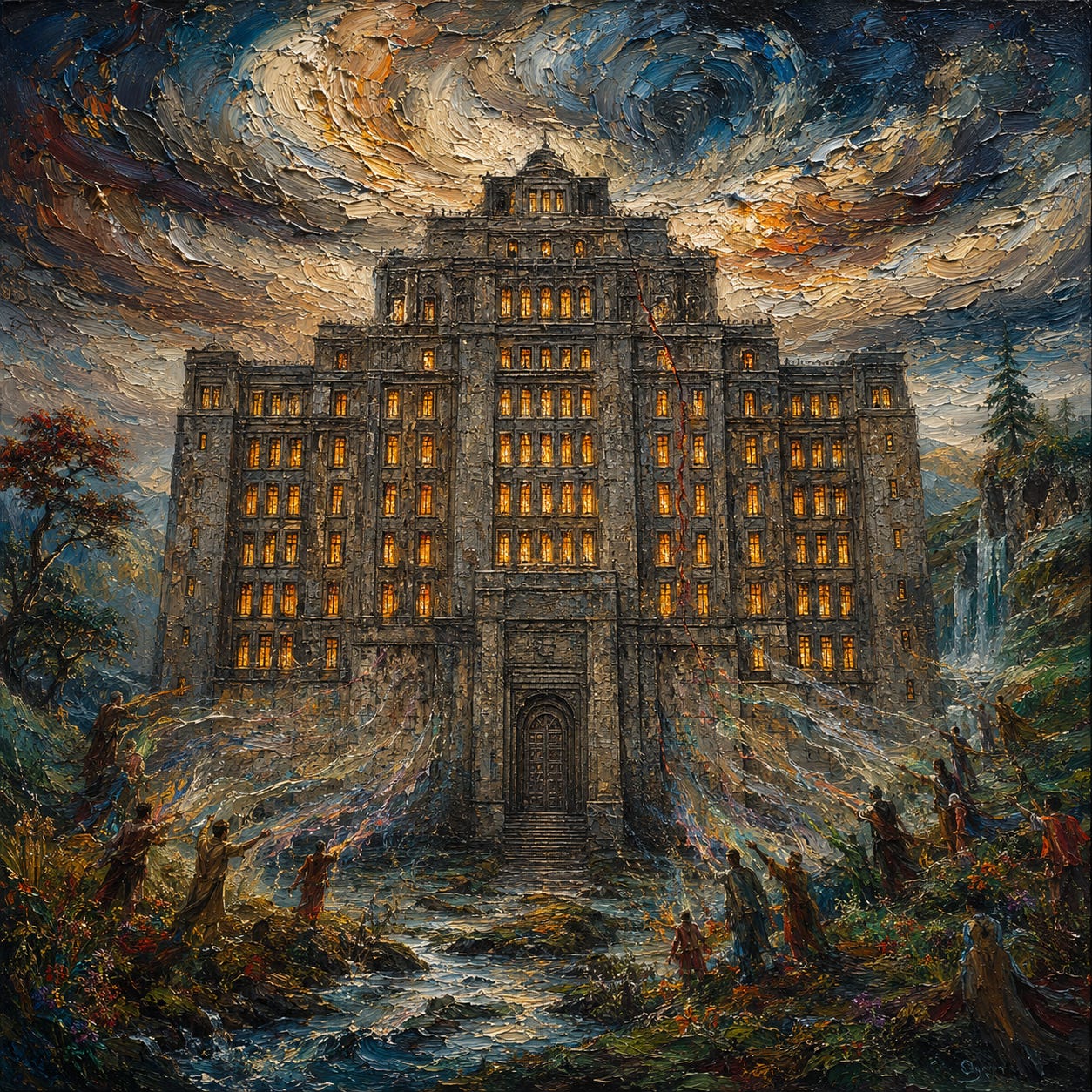
Luc Lelièvre’s Unbekoming series began with stories. Heresy told how he was pushed out of Université Laval for asking questions the university did not want asked. The essays that followed — Neutralization, Suspension, Dilution, Reversal — each examined a different technique that institutions use to silence dissent: the legal trap that exhausts the person filing a complaint, the procedural delay that buries it, the redirection that turns the complainant into the accused. Later essays widened the lens. Tyranny Without Fear, Beyond Closure, and The Silent Drift of Western Institutions argued that these techniques are not occasional abuses. They are how modern institutions protect themselves from being corrected. The Fragility of Closure introduced the concept that gives this new essay its title.
After Closure: What History Forces Us to See is the clearest statement of the series so far. Closure is what happens when an institution keeps running — issuing reports, processing forms, holding meetings — but stops being able to hear what the world outside is telling it. The lights stay on; the building still operates. But the system can no longer take in bad news, correct mistakes, or adjust when reality changes. Lelièvre shows that Closure operates on four levels at once. People inside the institution learn what they can and cannot say. The official story hardens and stops being revised. Procedures multiply but answer fewer questions. And the institution begins to treat its own survival as more important than the people it was meant to serve. The four reinforce each other, which is why fixing one without the others rarely works. The essay draws on Arendt, Orwell, Illich, Scott, Le Bon, Toffler, Hirschman, and Mumford — but it puts them in conversation, rather than treating each as a separate explanation. The central claim is plain: modern systems are not failing because they are weak. They are failing because they have drifted too far from reality to notice what is happening outside.
The second half of the essay shows the framework at work. Six examples — administrative overload, official communication that no longer matches lived experience, technocratic projects that outgrow the people running them, polarized politics that narrows the room for correction, declining trust in opaque systems, and laws so complex that ordinary citizens cannot interpret them — show how Closure appears in everyday life. Lelièvre is careful to point out that this does not require anyone to be plotting. Closure happens when systems get too large, too fast, and too rigid to keep up with the world they are meant to serve. He does not predict collapse. He argues that what is ending is a particular way of running institutions, not society itself. Recovery, he writes, depends on simpler things than most reformers propose: reducing how much we depend on large systems, speaking plainly again, rebuilding cooperation close to home, and reopening the channels through which institutions can hear what they have been blocking out. The first step is recognizing the condition for what it is.
With thanks to Luc Lelièvre.
Support This Work
This work remains free because paid subscribers make it possible. If you find value here, consider joining them.
Paid subscribers get access to all books — including The DMSO Book, The Kitchen Remedies Guide, Chlorine Dioxide, The PSA Trap, Breast Cancer, and more — with 1-2 new books added each month. Plus the Deep Dive Audio Library: 180+ in-depth audio book summaries and discussions.
Paid subscribers also get the Questions for Your Doctor series, short printable guides built around the questions doctors are not trained to answer, one decision at a time. The companion Before You Consent series goes deeper, walking through a single diagnosis or prescription from the moment it lands to the days after, with every figure sourced. And the Package Insert series reads the labels the doctor never opens and the pharmacist never mentions, what the manufacturer admits, in their own words, about what they sell.
I do this work independently, outside the institutions these books so often describe. No foundation grants, no academic approval, no editorial gatekeepers deciding what’s acceptable to publish. Your subscription makes that independence possible.
After Closure: What History Forces Us to See
An Essay by Luc Lelièvre
Executive Summary — After Closure: What History Forces Us to See
After Closure: What History Forces Us to See offers a unified framework for understanding why Western institutions struggled to adapt from 2020 to 2026. The essay argues that these systems entered a state of Closure: a structural process in which institutions remain administratively active yet gradually lose the ability to correct errors, integrate dissent, or adjust to external reality.
Closure is not collapse. It is a form of institutional drift. Systems continue to function, yet their internal logic becomes increasingly disconnected from the world they are meant to serve.
The analysis draws on a coherent set of thinkers, each illuminating a different dimension of this drift. Hannah Arendt shows how bureaucracies can become self-protective and inward-looking. Ivan Illich describes the counterproductivity threshold, where institutions begin generating the very problems they were created to solve. Alvin Toffler explains how acceleration and information overload overwhelm adaptive capacity. James C. Scott reveals how administrative simplification creates structural blind spots. Gustave Le Bon clarifies how public trust erodes and collective behavior shifts under stress. George Orwell shows how systems under pressure reinforce narratives rather than revise them. Albert O. Hirschman demonstrates how weakened feedback loops make correction increasingly unlikely. Lewis Mumford helps explain how large technocratic structures tend to harden as they expand.
Taken together, these insights reveal a three-stage sequence that defines Closure:
Erosion of corrective mechanisms — warning signals are filtered, delayed, or neutralized.
Loss of connection to external reality — internal models replace direct observation.
Collapse of adaptive learning — institutions develop “cognitive antibodies” that treat new information as a threat rather than feedback.
Closure creates an illusion of stability. Systems appear strong because they can neutralize criticism, yet they become fragile when they no longer adapt to the conditions that sustain resilience. The symptoms are visible across sectors: procedural expansion, narrative rigidity, cognitive overload, ideological polarization, social fatigue, and declining trust.
The essay does not predict a catastrophe. Instead, it argues that we are witnessing the end of a specific institutional regime, not of society. Recovery depends not on rupture or technocratic reform but on restoring the basic conditions for collective learning: reducing institutional dependence, reestablishing clear speech, rebuilding local cooperation, and reopening feedback channels.
The central claim is straightforward: modern systems are not failing because they are weak, but because they have become too far removed from reality.
Recognizing this condition is the first step toward restoring correction, adaptation, and renewal.
SECTION I — What 2020–2026 Revealed
The years from 2020 to 2026 did more than disrupt daily life. They exposed structural weaknesses that had been developing within modern institutions for decades. Systems expected to provide stability under pressure instead revealed limits in their capacity to process complexity, revise assumptions, and maintain public trust. What initially appeared to be a temporary emergency gradually became a broader revelation about the state of contemporary institutional life.
Crises act as accelerators. They bring to the surface tensions that remain hidden during periods of normalcy. Under stable conditions, institutional weaknesses can be masked by routine, economic momentum, or public habits. Under sustained pressure, these weaknesses become visible. The period from 2020 to 2026 served as exactly this kind of stress test.
One of the clearest revelations was the fragility of institutions long assumed to be adaptive and self-correcting. Many systems struggled not only to respond effectively but also to revise their assumptions once problems became evident. Administrative processes slowed precisely when flexibility was most needed, and decision-making often seemed disconnected from rapidly changing realities.
The period also revealed the growing effects of information overload. Modern societies have unprecedented access to data, yet greater access has not brought greater clarity. Instead, individuals and institutions faced a continuous flow of conflicting interpretations and rapidly shifting narratives. The result was confusion rather than understanding and uncertainty rather than trust.
A widening gap also emerged between institutional leadership and the populations these institutions claim to represent. Official communication did not disappear, but it increasingly failed to reflect lived experience. Many people felt their concerns were misunderstood, minimized, or dismissed. Public reactions grew volatile: long periods of passivity were punctuated by sudden bursts of intensity, often triggered by issues that symbolized deeper frustrations.
Finally, the period exposed the limits of modern systems’ ability to self-correct once dysfunction was embedded. Institutions often responded to emerging problems by adding new layers of procedure, increasing complexity without improving responsiveness. Solutions designed within existing frameworks tended to reinforce those frameworks’ limitations.
Taken together, these developments revealed something more significant than a temporary crisis. They exposed structural limits within contemporary institutions: fragility, overload, disconnection, procedural rigidity, narrative instability, and declining self-correction. These are not isolated problems but interconnected symptoms of systems operating near their adaptive limits.
SECTION II — Three Thinkers Who Saw the Breaking Point
The patterns observed between 2020 and 2026 are not new. They were anticipated by thinkers who studied moments when institutions fail to respond to reality. Among them, three offer particularly clear insights: Gustave Le Bon, Ivan Illich, and Alvin Toffler. Each identified a distinct mechanism through which systems lose their capacity to adapt.
Gustave Le Bon focused on the psychology of collective behavior. He showed that populations can remain passive for long periods, even when dissatisfaction is widespread. Silence does not necessarily indicate trust; it often reflects fatigue or resignation. When the connection between leaders and the public weakens, frustration builds beneath the surface and, under the right conditions, can erupt. Le Bon helps explain why systems may appear stable until the moment they are not.
Ivan Illich examined institutions themselves. He argued that systems tend to expand beyond their original purpose, becoming more complex, rigid, and self-referential. Beyond a certain threshold, they enter a counterproductive stage: instead of solving problems, they reproduce or intensify them. At this point, adding more rules or resources does not restore functionality. It deepens dysfunction. Illich explains why some institutional failures persist despite repeated reform efforts.
Alvin Toffler added the dimension of time. He showed how the accelerating pace of technological and social change can overwhelm individuals and institutions alike. When the speed of change exceeds the capacity to process it, systems fall behind. Decision-making structures designed for a slower world cannot keep pace. Information overload reduces clarity rather than increasing it. Toffler explains why modern institutions often feel disoriented and reactive rather than adaptive.
Taken together, these three thinkers illuminate a common breaking point. Systems fail not only because of external shocks but also because internal dynamics—psychological, structural, and temporal—constrain their ability to respond. When these limits are reached, stability becomes fragile and change unpredictable.
SECTION III — Closure as a Universal Structural Process
To understand the patterns described so far, we need a precise concept. Closure is the moment when institutions gradually stop responding to external reality and begin operating primarily by their own internal logic. This is not a sudden event. It is a slow, cumulative shift that is often difficult to detect from within the system.
Closure is not collapse. Institutions in a state of Closure continue to function, produce outputs, and follow procedures. They may even appear orderly and efficient. Yet their connection to the world they are meant to serve weakens over time. The key issue is not whether the system is active but whether it remains responsive.
Closure unfolds in four reinforcing layers.
The psychological layer. Individuals within institutions adapt to the system’s constraints. Over time, they learn what can be said, what is rewarded, and what is ignored. Independent judgment narrows. As Hannah Arendt observed, people can participate in dysfunctional systems simply by following established roles. Reality becomes filtered through the institution’s standards of acceptability.
The narrative layer. Every institution produces stories about itself. These narratives provide coherence and justify decisions. Under stress, the gap between official narratives and lived experience widens. Instead of revising the narrative, the system reinforces it. As George Orwell showed, language becomes a tool for preserving coherence rather than describing reality.
The administrative layer. Institutions rely on rules, categories, and procedures to function. As James C. Scott explains, this requires simplifying complex realities into manageable forms. Under normal conditions, simplification enables coordination. Under Closure, it becomes rigid. Exceptions are forced into predefined categories. The system continues to operate, but its capacity to process complexity declines.
The institutional layer. At this level, the system becomes self-referential. Decisions are guided by internal criteria rather than by external feedback. Ivan Illich’s analysis clarifies this stage: once institutions exceed a certain threshold, they prioritize their own preservation. Reform becomes difficult because the mechanisms needed to correct the system are embedded within the failing structure.
These four layers reinforce one another. Psychological adaptation supports the narrative, which justifies administrative rigidity and sustains institutional self-reference. Together, they create a closed loop.
Once this loop is established, external signals weaken. Feedback does not disappear, but it is filtered, delayed, or reinterpreted to preserve internal coherence. Closure can persist even when problems are widely recognized. The system lacks the capacity to integrate the information it already possesses.
Closure is more likely to emerge in highly complex, rapidly changing environments. As Alvin Toffler showed, acceleration drives systems toward simplification. When the cost of processing reality becomes too high, institutions retreat into their own models. Closure is an adaptive short-term response — but a source of fragility in the long term.
Viewing Closure as a process rather than an event changes how we perceive institutional failure. Closure does not depend on a single decision or actor. It emerges from many small adjustments that accumulate over time. Once fully developed, it becomes resistant to change because it operates across multiple layers.
Recognizing Closure early matters. Once the gap between internal logic and external reality becomes too wide, the system’s ability to reopen itself diminishes. Closure can persist for long periods, but it is inherently unstable because no institution can indefinitely maintain separation from the reality it is meant to serve.
ANNEX — Illustrative Cases of Closure in Contemporary Systems
This annex presents illustrative cases that reflect the systemic logic described in the main text. Each example corresponds to one or more layers of Closure—psychological, narrative, administrative, or institutional—and shows how these dynamics can manifest in concrete settings without implying intention or coordination.
This annex presents illustrative cases that show how Closure can manifest across diverse institutional settings. These examples do not imply intentional design, ideological coordination, or deliberate strategy. They are presented as expressions of the structural dynamics described in the main text: the erosion of corrective mechanisms, the narrowing of perception, and the growing distance between institutional logic and lived reality.
1. Administrative Overload and Policy Drift
Several recent policy domains illustrate how administrative systems can grow increasingly complex without improving responsiveness. In areas such as immigration processing, public health administration, and regulatory compliance, procedures have expanded faster than the capacity to assess their real-world effects. This does not reflect intentional obstruction. Rather, it reflects the tendency of large systems to accumulate rules, forms, and categories that are difficult to revise once they are embedded.
The result is a widening gap between policy design and policy experience. Individuals navigating these systems often encounter delays, inconsistencies, or unclear communication — symptoms of administrative Closure.
2. Narrative Rigidity in Public Communication
In multiple jurisdictions, public communication has shown signs of narrative rigidity: a preference for maintaining coherence over acknowledging uncertainty or revising assumptions. This pattern is not unique to any political orientation. It reflects the structural pressures institutions face when rapid change outpaces their ability to update internal models.
When narratives become difficult to adjust, institutions may increasingly rely on narrow frames to interpret events. This can create friction with populations whose lived experience does not align with official messaging, thereby eroding trust.
3. Technocratic Expansion and the Limits of Coordination
Large-scale initiatives involving digital infrastructure, identity systems, or financial regulation illustrate how technocratic projects can outstrip the adaptive capacity of the systems that implement them. These initiatives often begin with clear objectives, but as they scale, they encounter coordination challenges, privacy concerns, or public skepticism.
These tensions do not imply hidden motives. They reflect the structural challenge of aligning complex technological systems with diverse social expectations — a dynamic consistent with Closure’s administrative and institutional layers.
4. Political Volatility and the Erosion of Feedback
Recent political debates — on secularism, public safety, economic policy, or institutional reform — show that feedback loops can weaken as polarization deepens. Positions harden, incentives narrow, and the room for correction shrinks.
This, by itself, does not signal ideological extremism. It reflects the structural pressures described by Le Bon and Hirschman: when trust erodes, systems struggle to interpret public signals accurately.
Recent public debates illustrate how overload and narrative conflict can destabilize even relatively straightforward political information.
In highly fragmented media environments, even relatively straightforward political information can become unstable as competing narratives, accelerated news cycles, and cognitive overload reduce shared interpretive frameworks. Under these conditions, public debate increasingly struggles to distinguish between disagreement, confusion, and factual error.
Second, the federal bill number C-22 has been used for two unrelated laws in recent years. The earlier C-22 (2022–2023) created the Canada Disability Benefit. The current C-22 (2025–2026) is a different bill — the Digital Safety Commission Act — that is part of the federal online harms framework. Only the new C-22 is relevant to discussions of speech regulation and platform governance.
These examples do not reflect partisan dynamics. They illustrate that, under conditions of overload, even straightforward political information can become unstable.
5. Information Accessibility and Public Confidence
Public trust weakens when institutional communication is inconsistent, opaque, or difficult to verify. In highly complex administrative systems, delays, contradictions, and fragmented information flows can gradually erode confidence, even without deliberate deception. Under conditions of Closure, ambiguity itself becomes destabilizing because citizens struggle to distinguish among ordinary institutional complexity, procedural failure, and intentional concealment.
This dynamic does not necessarily imply coordinated manipulation. Rather, it reflects how overloaded systems can lose the ability to communicate clearly and coherently with the populations they govern. As transparency declines, interpretive conflict intensifies, further weakening the feedback mechanisms necessary for institutional correction.
6. Legislative Complexity and Public Interpretation
Recent legislative debates, including those surrounding federal bills such as the current C-22 (Digital Safety Commission Act), show that public understanding can diverge from legislative intent. Misinterpretations often arise not primarily from misinformation but from the growing cognitive and procedural complexity of modern legislative systems.
This is not a partisan phenomenon. It is a structural feature of systems operating near their cognitive limits.
Conclusion of the Annex
These cases illustrate how Closure manifests across domains without requiring intentional coordination or ideological design. They show how systems can drift into patterns of rigidity, overload, and self-reference, even when actors act in good faith. This annex is not intended to assign blame but to demonstrate how the structural dynamics described in the main text manifest in concrete settings.
Annotated Bibliography
This annotated bibliography includes both the authors explicitly discussed in the essay and a broader set of thinkers whose work informs its conceptual background. Not all are cited directly in the text, but each contributes to the intellectual framework in which the analysis of Closure is situated.
Hannah Arendt. Eichmann in Jerusalem: A Report on the Banality of Evil. Viking Press, 1963.
Arendt shows how ordinary people can participate in harmful systems simply by following procedures. This supports the essay’s argument that dysfunction does not require bad intentions—only systems that discourage independent judgment.
Hannah Arendt. The Origins of Totalitarianism. Harcourt, 1951.
Arendt analyzes how large institutional systems gradually become rigid, self-protective, and disconnected from reality. Her work helps explain how procedural logic can replace genuine responsiveness.
Pierre Bourdieu. La sociologie est un sport de combat. Directed by Pierre Carles, C-P Productions, 2001.
This documentary follows Bourdieu’s public interventions and intellectual work during the 1990s. It illustrates his conception of sociology as an engaged form of critical inquiry aimed at exposing hidden structures of power, symbolic domination, and institutional reproduction. The film supports the essay’s broader argument that intellectual work can function as a tool for resisting ideological Closure and restoring contact with social reality.
Antonio Gramsci. Selections from the Prison Notebooks. International Publishers, 1971.
Gramsci introduces the concept of cultural hegemony: the process through which institutions shape what society accepts as “common sense.” This framework supports the essay’s analysis of how dominant narratives maintain institutional legitimacy even during periods of visible dysfunction.
Václav Havel. The Power of the Powerless. M.E. Sharpe, 1985.
Havel explores how individuals navigate systems built on conformity and ideological ritual. His concept of “living within a lie” directly informs the essay’s examination of narrative rigidity and declining legitimacy.
Albert O. Hirschman. Exit, Voice, and Loyalty: Responses to Decline in Firms, Organizations, and States. Harvard University Press, 1970.
Hirschman explains how institutions weaken when feedback mechanisms deteriorate. His distinction between “voice” and “exit” supports the essay’s argument that systems lose adaptive capacity when dissent is neutralized or ignored. Hirschman’s notion of “trespassing” — the crossing of disciplinary boundaries — reflects a critical and humanistic approach to social analysis. Rather than isolating economics, politics, sociology, and psychology into separate domains, Hirschman argued that complex social realities can only be understood through intellectual permeability. This perspective directly aligns with the essay’s method, which deliberately integrates multiple traditions of thought to analyze institutional Closure as a systemic phenomenon.
Ivan Illich. Deschooling Society. Harper & Row, 1971.
Illich criticizes dependence on large institutional systems and advocates more decentralized, human-scale forms of cooperation. His work supports the essay’s proposed solutions, which center on autonomy and local resilience.
Ivan Illich. Tools for Conviviality. Harper & Row, 1973.
Illich argues that institutions often become counterproductive once they exceed certain limits. Instead of solving problems, they begin reproducing them. This idea strongly supports the essay’s concept of systemic Closure.
Gustave Le Bon. The Crowd: A Study of the Popular Mind. Dover Publications, 2002 (1895).
Le Bon explains how collective psychology can shift rapidly when trust in leadership erodes. His analysis supports the essay’s discussion of latent social tension, backlash, and sudden political realignment.
Luc Lelièvre. The Fragility of Closure. Unbekoming, 2026.
This earlier essay introduces the concept of “Closure” as a process through which institutions become self-contained and progressively disconnected from external reality. It provides the theoretical foundation for the present work.
Herbert Marcuse. Repressive Tolerance. Beacon Press, 1965.
Marcuse argues that formal openness and procedural neutrality can conceal deeper forms of ideological control. His critique informs the essay’s argument that institutions may appear open while suppressing meaningful correction.
C. Wright Mills. The Power Elite. Oxford University Press, 1956.
Mills examines how political, economic, and media elites converge into interconnected networks insulated from public feedback. His analysis supports the essay’s discussion of elite Closure and institutional self-reference.
Lewis Mumford. The Myth of the Machine. Harcourt Brace Jovanovich, 1970.
Mumford analyzes how large technological and bureaucratic systems evolve into “megamachines” that subordinate human autonomy to organizational control and technical efficiency. His work reinforces the essay’s critique of centralized systems that preserve structure at the expense of human responsiveness.
George Orwell. 1984. Secker & Warburg, 1949.
Orwell explores how language and narrative can shape perception and maintain institutional coherence. This reinforces the essay’s argument that Closure operates through both narrative management and administrative control.
James C. Scott. Seeing Like a State. Yale University Press, 1998.
Scott demonstrates how governments simplify complex human realities into administrative categories. His work directly supports the essay’s analysis of bureaucratic abstraction and institutional blind spots.
Alvin Toffler. Future Shock. Random House, 1970.
Toffler describes how rapid technological and social change overwhelms the adaptive capacity of individuals and institutions. His concept of overload is central to the essay’s interpretation of post-2020 instability.
Alvin Toffler. The Third Wave. Bantam Books, 1980.
Toffler argues that industrial-era institutions become obsolete during major civilizational transitions. This supports the essay’s claim that current instability reflects a broader transformation rather than a temporary crisis.
individual thought is sadly overpowered by stiffened institutions- well analized by Luc Lelievre
It is all too common for government employees to turn against the citizens they were meant to protect. They inadvertently become a self-protecting collective to maintain their budgets and prove their need to exist.